第 1 章
Inside the Mind of an Autistic Visionary
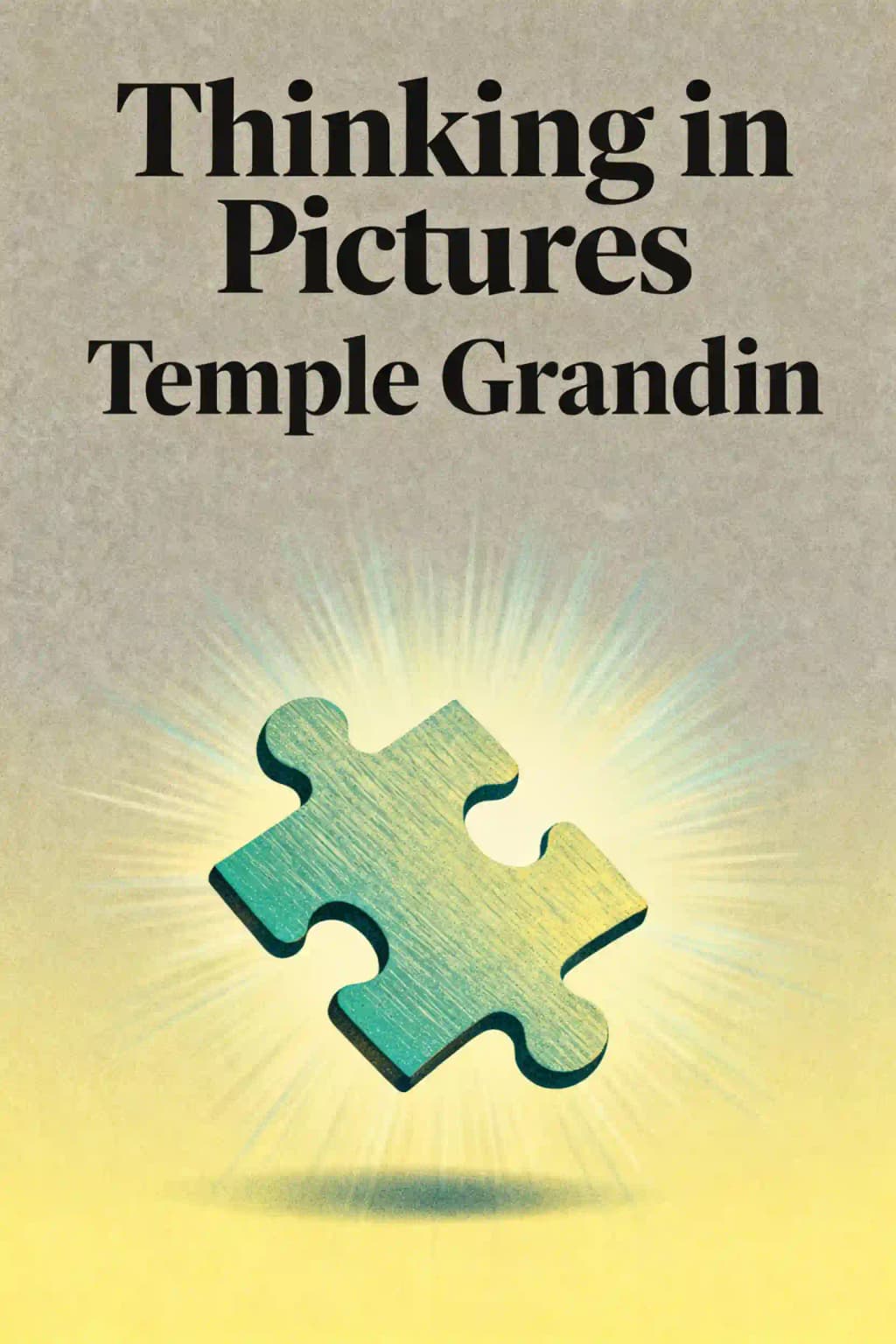
Imagine a world where your thoughts aren't words but vivid movies playing in your head. Where every noun instantly transforms into a specific image from your past. Where the humming of fluorescent lights feels like a dentist's drill hitting a nerve. This is the reality of Temple Grandin, whose groundbreaking memoir has transformed our understanding of autism and influenced fields from education to animal welfare. Since its publication, "Thinking in Pictures" has become required reading in psychology programs worldwide and has been translated into over a dozen languages. Even celebrities like Steve Jobs reportedly kept a copy on his bookshelf, fascinated by Grandin's unique cognitive processes that mirror the visual thinking that drove his own design philosophy.
第 2 章
The Visual Thinker's Mind: A Different Way of Processing Reality
I think entirely in pictures. Words are my second language, instantly translated into full-color mental movies complete with sound and sometimes even smell. When someone says "steeple," I don't conjure a generic church tower but instead see specific steeples from my memory - first the church near my childhood home, then one in Boston, followed by others I've encountered throughout my life, appearing in chronological order.
This visual thinking gives me unique advantages in designing livestock handling equipment. I can run complete three-dimensional simulations in my mind, testing designs before construction begins. When creating a new facility, I don't follow a verbal step-by-step process. Instead, I retrieve images from my vast "video library" of equipment components, cattle behavior patterns, and facility layouts, combining them like pieces in a mental jigsaw puzzle.
Unlike most people, my thoughts move from specific images to generalizations rather than the reverse. My concept of "dogs" consists of every specific dog I've ever encountered, not an abstract prototype. When someone mentions "dog," my mind displays specific dogs I've known - first our family's Irish setter, then my friend's German shepherd, and so on. There is no generic Great Dane in my mind, only particular dogs I've met or seen.
This thinking style allows me to manipulate these stored images to solve design problems. I can place a dip vat from my memory onto my mental computer screen with Star Trek-quality graphics, rotating and examining it from any angle. I can even predict how cattle will react to specific design elements based on my library of behavioral memories.
My visual abilities extend beyond design work. When reading, I translate text into color movies or store photographic images of pages to be "read" later like a teleprompter. This is likely how Raymond in "Rain Man" memorized phone books. Abstract concepts like "peace" or "honesty" required me to develop concrete visual symbols - "peace" became a dove, while "honesty" was visualized as someone placing their hand on a Bible in court.
Brain research confirms that visual and verbal thought operate through different neural systems. When someone visualizes walking through their neighborhood, blood flow increases dramatically in the visual cortex. My brain has apparently compensated for verbal deficits by expanding visual processing capabilities, allowing me to leverage mental practice as effectively as physical practice when designing equipment.
第 3 章
The Sensory World of Autism: When Ordinary Becomes Extraordinary
From my earliest memories, I hated being hugged despite craving emotional connection. Touch overwhelmed me like a tidal wave, triggering flight responses. Many autistic children share this paradox-needing pressure stimulation while being unable to tolerate unexpected touch. We need to initiate contact to process the sensation properly.
Hypersensitive skin created constant challenges. As a child, shampooing hurt my scalp like fingers wearing thimbles, and scratchy clothes felt like sandpaper on raw nerves. I still struggle with clothing transitions, taking weeks to adapt to seasonal changes rather than minutes like most people. I wear bras until they're falling apart and wash new ones at least ten times before wearing. Even now I prefer them inside out to avoid painful stitching sensations.
Auditory processing presents equally significant difficulties. Loud noises caused actual pain, like a dentist's drill hitting a nerve. Balloons popping sounded like explosions, and my college roommate's hair dryer resembled a jet plane. High-pitched electrical appliances are particularly disturbing to autistic children, though sound sensitivities vary widely between individuals-one child might love the vacuum cleaner while another fears it.
Scientific testing confirms these sensory processing difficulties. On sophisticated hearing tests, I performed poorly on tasks requiring me to distinguish between simultaneous conversations. My ears function like non-directional microphones picking up all sounds equally, making noisy gatherings overwhelming. These tests revealed significant deficiencies in my brain's ability to process complex sounds and coordinate timing between my ears, suggesting abnormalities in my brain stem and corpus callosum.
For people with severe sensory processing deficits, senses can blend together in confusing ways, especially when they're tired or upset. A graduate student with autism described how sound came through as color, while touching his face produced sound-like sensations. Donna Williams describes herself as "mono-channel"-unable to see and hear simultaneously. When listening to someone speak, visual input loses meaning; she can't perceive a cat jumping on her lap while listening to a friend talk.
The sensory chaos makes reality incomprehensible for many autistic people. Therese Joliffe explained that life becomes "a confusing interacting mass of events, people, places, sounds and sights" with no clear boundaries or meaning. Routines and rituals help create order in this chaos. Jim Sinclair describes his problem as "an interface issue, not a core processing problem."
第 4 章
The Squeeze Machine: Finding Comfort in a Chaotic World
To cope with overwhelming sensory experiences, I created my squeeze machine-a device that applies deep pressure to calm my nervous system. The idea came from watching cattle remain calm in squeeze chutes during veterinary procedures. While observing hundreds of cattle at various ranches, I noticed how the firm, consistent pressure of the chute had a notably calming effect on even the most agitated animals. I realized that controlled pressure could provide the comfort I craved but couldn't tolerate from human touch, as my heightened sensory sensitivity made casual physical contact overwhelming and unpredictable.
Jean Ayres developed sensory integration therapy, which has helped many autistic children by reducing touch sensitivity and calming the nervous system. Key components include deep pressure application and slow vestibular stimulation on swings moving 10-12 times per minute. The therapy should be playful, never forced, with therapists encouraging speech and social interaction during swinging sessions. Ayres discovered that gentle, rhythmic movement combined with controlled pressure helped children integrate their sensory experiences more effectively, leading to improved attention and reduced anxiety.
Deep pressure can be applied through various methods, each tailored to individual comfort levels. Placing children under large pillows or rolling them in heavy gym mats for fifteen minutes twice daily provides consistent, calming pressure. Padded weighted vests, available in different weights and sizes, and snug sleeping bags also provide therapeutic pressure. When I built my squeeze machine and Tom McKean created his pressure suit, we unknowingly invented therapeutic tools that have since helped many children develop better sensory integration and emotional regulation.
Research by Steve Edelson at the Autism Research Institute confirms the squeeze machine's calming effects through multiple controlled studies. Children using the machine for over five minutes daily became noticeably calmer, showed improved inhibitory control, and performed better on mechanical problem-solving tests. The improvements were particularly pronounced in children who used the machine consistently over several weeks. Helping autistic children experience the comfort of touch is like taming an animal-initially they pull away, but eventually learn that touching feels good, building trust gradually through predictable, controlled experiences.
Recent auditory processing tests revealed shocking deficits in my ability to discriminate between sounds, highlighting another crucial aspect of sensory processing in autism. When presented with two short sounds separated by a half-second gap, I heard them as one continuous sound, demonstrating fundamental differences in temporal sound processing. Research by Nathalie Boddaert shows autism involves abnormalities in brain regions processing complex sounds, particularly in the temporal lobe and superior temporal sulcus. Many nonverbal autistic children fail to develop speech because they cannot hear auditory detail-they may pass simple hearing tests but miss consonants in words, hearing only vowels. This finding has important implications for early intervention and speech therapy approaches, suggesting that traditional methods may need modification to account for these processing differences.
第 5 章
Learning Empathy: Emotional Development in Autism
To develop feelings of gentleness, one must first experience gentle bodily comfort. As my nervous system learned to tolerate the soothing pressure from my squeeze machine, I became kinder and gentler. Understanding kindness was impossible until I'd experienced soothing myself.
Many autistic children handle pets too roughly and struggle with appropriate physical boundaries. The pleasurable sensations from gentle pressure clearly connect to loving feelings for others. Without my squeeze machine, I would have remained emotionally hardened.
My emotions are simpler than most people's-I understand fear, anger, happiness and sadness, but complex emotional relationships remain beyond my comprehension. I don't understand feeling two opposite emotions simultaneously. My strongest feeling today is intense calm when handling cattle. I get satisfaction from solving design problems but don't experience rapturous joy. Like the woman with amygdala damage described by Damasio, I have difficulty judging others' intentions and recognizing subtle facial expressions.
I relate better to scientists and engineers than highly emotional people. For my mother, dealing with me is like interacting with someone from another planet. Some autistic people experience emotional jumbling similar to sensory jumbling, or have emotional patterns of younger children. I've developed a sensory empathy for cattle-when they're calm, I feel calm; when they experience pain, I feel their pain.
There are situations where "normal" people show a horrific lack of empathy that's beyond my comprehension. When company executives give themselves bonuses while asking workers to take pay cuts, they demonstrate an empathy blindness caused by power and ego circuits I don't possess. These managers seem incapable of learning from others' mistakes.
Research reveals how empathy works through brain "mirror areas" that activate when seeing another person hurt. Brain imaging studies show these circuits have less activation in people with Asperger's syndrome compared to neurotypicals.
I believe there are different types of empathy. I need to visually put myself in another's place to empathize. I can empathize with laid-off workers by visualizing their family at the dining table worrying about bills. Neurotypical people have emotional empathy but often lack visual empathy-they can't perceive how another person would see something, like when giving incomplete driving directions.
第 6 章
From Special Education to Special Talents: Developing Autistic Abilities
At age two and a half, I was enrolled in a nursery school for speech-handicapped children with one-to-one therapy. The teachers knew exactly how much to intrude into my world-enough to snap me out of daydreams without triggering tantrums. Without this intervention, I would have remained in my own little world, absorbed in Technicolor daydreams or fascinated by spinning pennies and wood-grain patterns.
When I was three, my mother hired a governess who kept my sister and me constantly engaged in structured activities-making snowmen, playing ball, jumping rope, skating, sledding, and painting. This structure was crucial for my development. Meals were always at the same time, and I was taught good manners. Safety rules were drilled into me through repetition, as autistic children need to learn everything by rote.
As I grew older, creative, unconventional people helped me most, while psychiatrists searching for "psychic injuries" were unhelpful. After being expelled from regular high school, I attended a boarding school for gifted students with emotional problems. There, my science teacher Mr. Carlock became my most important mentor, using my unusual interests as motivators rather than trying to make me "normal."
I worry about careers for people with high-functioning autism or Asperger's syndrome. Increasingly, gifted students receive the Asperger's label, potentially limiting their opportunities. Some schools even exclude these bright students from gifted programs because of their diagnosis. These students often misbehave from boredom when not properly challenged.
From my observations, successful autistic individuals share two critical factors: mentoring and talent development. Those without these supports often fail to establish good careers. I succeeded by channeling my visual thinking skills into designing cattle facilities.
Many successful undiagnosed Asperger's individuals work across various fields-plant engineers, maintenance specialists, technicians, journalists, professors, and especially computer programmers. One programmer told me he was happy because he worked "with his own people."
When I began freelance design work, people thought I was weird, but I learned to sell my work rather than my personality. My accurate articles and professional drawings of cattle facilities earned respect despite my social differences. Successful people on the spectrum often enter careers through "back doors" by showing portfolios directly to the right person, bypassing traditional interviews or admissions processes.
第 7 章
A Cow's Eye View: Understanding Animal Perception
One-third of cattle and hogs in the United States are handled in facilities I designed. My systems use animals' natural behavior patterns to encourage willing movement. When animals balk, we must understand why rather than forcing them.
I put myself in a cow's place-not as a person in a cow costume, but truly experiencing their sensory world. Cattle have wide, panoramic vision as prey animals, constantly vigilant for danger. They're hypersensitive to high-pitched sounds, novel movements, and visual contrasts. Something as minor as a plastic juice bottle on the ground can halt an entire herd. People with autism share many of these sensitivities-we both live in states of heightened awareness and fear.
Fear is a universal emotion in the animal kingdom and dominates autism as well. Before taking antidepressants, minor changes in my routine triggered intense fear reactions. Like cattle who become set in their habits and resist new pastures, autistic people can become anxious with schedule changes. Both may be expressing ancient antipredator instincts-when you've found safety, any change represents potential danger.
Many equipment designers fail to consider how restraint devices feel to animals. I excel at designing these systems because I can mentally place myself in a steer's body and feel what the equipment would be like with gentle versus rough handling. Seeing animals squeezed too hard in chutes causes me physical discomfort.
In both animal behavior and autism education, the primary mistake is misunderstanding behavioral motivation. Fear and aggression are often confused, and punishing fear-based behaviors typically worsens them. For nonverbal autistic individuals exhibiting challenging behaviors, I recommend a systematic troubleshooting approach.
First, rule out hidden medical problems like heartburn, constipation, dental issues, or infections that the person cannot communicate. Second, investigate sensory triggers-new environments, fear of sudden noises like smoke alarms or phone rings, or sensitivity to fluorescent lighting.
People with autism may panic at ordinary objects that have become associated with frightening experiences-like fearing a blue coat because a fire alarm sounded while wearing it. Animals develop similar sensory-based fear associations. I've observed horses afraid of specific colored hats or the sound of nylon jackets that were present during abuse.
第 8 章
The Connection Between Autism and Animal Thought
Approximately 9-10% of autistic people possess savant skills-extraordinary abilities like calendar calculation, perfect musical recall, memorizing entire city street maps, or instantly identifying prime numbers despite being unable to perform basic arithmetic. These individuals typically struggle with social skills and practical knowledge, like understanding money.
Animal thinking involves instinctual behavior (programmed patterns that may be modified by experience) and true thinking. Animals demonstrate both instinctual behaviors, like calves following mothers, and learned behaviors, such as cows lining up for milking. However, determining whether animals are truly thinking requires testing under novel conditions where they can't use simple rules. Studies show animals can think and use previously learned information to solve new problems.
As a visual thinker with autism, I relate to animal thinking more than to verbal thinking. While some scientists deny animals can think, these are often highly verbal thinkers with poor visualization skills. Animals likely think in pictures and memories of smell, light, and sound patterns. Cattle recognize squeeze chutes in new locations, experienced longhorn cattle turn their heads to navigate narrow passages, and birds demonstrate tool use and problem-solving. My experience confirms what many have long suspected: animals truly think, just differently than verbal humans do.
The most compelling scientific evidence for animal emotions comes from brain anatomy and neurophysiology. When comparing a human brain with a pig's brain, I discovered their limbic systems-the emotional centers-are remarkably similar. The primary difference is the human's massive cortex that engulfs the brain stem, providing superior thinking abilities. While the emotional structures are nearly identical, humans have greater capacity to process information, resulting in more complex emotional expression.
Chemical messenger systems in human and animal brains are identical. Neurotransmitters like serotonin, norepinephrine, GABA, dopamine, and endorphins function similarly across species. The most convincing evidence comes from psychopharmacology: veterinarians now treat dogs, cats, and horses with the same drugs used for human anxiety and obsessive-compulsive disorders.
第 9 章
Autism and Genius: The Connection to Einstein and Beyond
At an autism conference, I met Einstein's second cousin who had one musically talented autistic child and an intellectually gifted child. Her family history revealed depression, food allergies, and dyslexia-a pattern I've observed repeatedly. Parents and relatives of autistic children are often intellectually gifted, and research supports this connection. Two Nobel prizewinners have autistic children, and even families with low-functioning autistic children frequently show high intellectual ability in their histories.
Genius likely represents an abnormality. If we eliminated genes causing autism, manic-depression, and other disorders, we might lose creative brilliance. These genes probably benefit society in small doses. Research shows artists, poets, and writers have higher rates of mood disorders than the general population-80 percent of creative writers have experienced mood disorders during their lives, with many requiring medication.
Einstein himself displayed autistic traits as a child. He didn't speak until age three, silently repeated words until age seven, and struggled socially. Some thought him a dullard. Like many autistic children, he enjoyed jigsaw puzzles and card houses, showed singlemindedness of purpose, and had poor memory for personal matters. Einstein said his "backwardness" helped him develop relativity theory because "a normal adult never stops to think about problems of space and time."
I think with primary sensory-based areas of the brain that are subconscious in most people. Language typically covers up this sensory thinking that humans share with animals. There are different names for the same memory systems: conscious memory (verbal/explicit/declarative) versus unconscious memory (sensory-based/implicit/procedural). The unconscious system is more resistant to forgetting.
People with savant skills often outperform neurotypicals because they have direct access to primary brain areas without language interference. Baron-Cohen's research shows autistic people excel at "hidden figure" tests, using primary visual systems rather than the frontal cortex.
A.W. Snyder discovered that temporarily impairing normal people's frontal cortex with magnetic pulses produced savant-like drawing skills and improved proofreading abilities. The frontal cortex, which connects to everything in the brain, actually interferes with perceiving details.
第 10 章
Finding Meaning: Religion, Ethics, and the Autistic Mind
As a logical and scientific person, I approach religion by constantly updating my knowledge and beliefs based on new information. I cannot accept anything on faith alone as my thinking is governed by logic rather than emotion. Since childhood, I've believed all religious denominations are equally valid paths to God, a view I share with many autistic people.
My work with cattle made me confront profound questions about life's meaning. Standing on the nearly completed "Stairway to Heaven" cattle ramp, I contemplated mortality: "When your time comes, will you be proud of what you did? Did you contribute something worthwhile to society?"
My beliefs were later shaken by two events: reading about how near-death experiences could be explained by oxygen-deprived brain hallucinations, and my accidental exposure to organophosphate chemicals that temporarily eliminated my religious feelings. This disturbing experience made me wonder if spiritual sensations were merely biochemical reactions-just "a chemical Wizard of Oz behind the curtain."
Quantum physics eventually restored my spiritual belief by providing a scientific basis for concepts like souls and interconnectedness. The entanglement of subatomic particles suggests a universal consciousness-my concept of God. Working in slaughterhouses, I've witnessed strange coincidences: power outages and equipment failures occurring precisely when animals were being mistreated. While possibly random chance, these events reinforced my belief in cosmic justice through quantum entanglement.
For autistic children, abstract concepts of right and wrong are difficult to grasp. They need concrete examples to categorize behaviors properly. When I was young, my heroes like Superman and the Lone Ranger clearly modeled good behavior, unlike today's morally ambiguous characters that confuse autistic children. I learned sportsmanship through specific examples-cheating was never tolerated, and I had to return a stolen toy fire engine to its rightful owner.
In high school, I categorized society's rules into four types: Really bad things (killing, stealing, property destruction); Courtesy rules (manners for getting along); Illegal but not bad (like enrolling an underage but well-behaved teenager in community college); and Sins of the system (culture-specific prohibitions with illogically severe penalties, like drug offenses in the US). I learned I could get away with more "illegal but not bad" behaviors if I completely avoided the "sins of the system" like sex, smoking, and drugs.
The autistic mind tends to obsess on negatives, so teaching positive religious values is essential. Children on the spectrum need hands-on activities that demonstrate kindness and respect-picking up neighborhood trash, making cards for nursing home residents, or helping teach younger children to read. Abstract religious concepts won't register, but the Golden Rule can be taught through examples: treat others as you want to be treated.