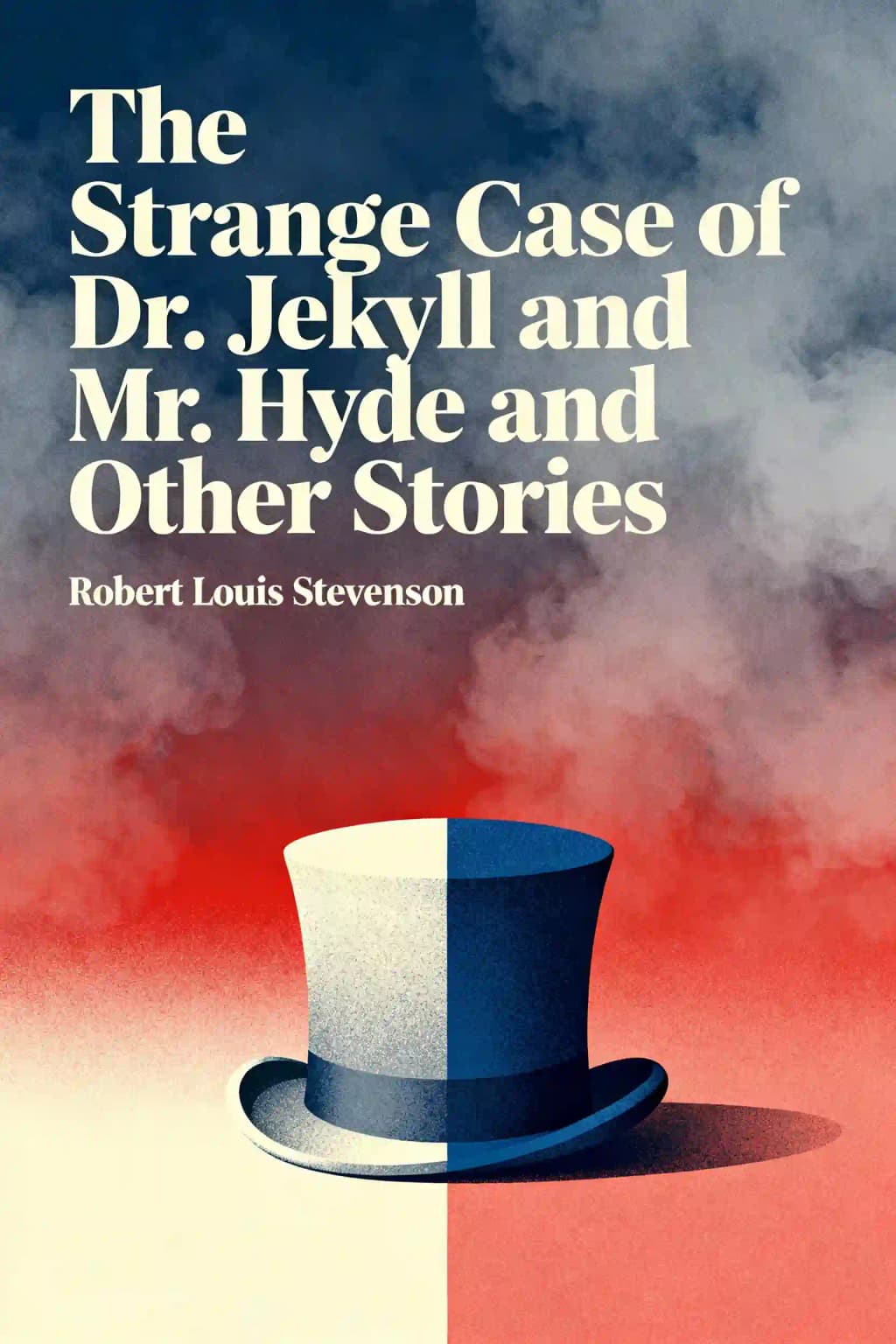
第 1 章
The Victorian Nightmare: When Good Men Face Their Demons
In the fog-shrouded streets of Victorian London, a respectable doctor creates a potion that unleashes his darkest self, forever changing how we understand human nature. Robert Louis Stevenson's "The Strange Case of Dr. Jekyll and Mr. Hyde" wasn't just a bestseller when published in 1886-it became an immediate cultural phenomenon. The story of a man who chemically separates his good and evil natures captivated Victorian society so thoroughly that Richard Mansfield's stage adaptation reportedly caused strong men to shudder and women to faint. The tale's psychological insight proved so penetrating that within six years of publication, the phrase "Jekyll and Hyde" entered everyday language to describe anyone with a dual personality.
What's remarkable is how Stevenson wrote this masterpiece-supposedly in just three days after a vivid nightmare, then burning the first draft when his wife criticized it for being merely a "shilling shocker" rather than the allegory he intended. The revised version he produced in another three days became one of literature's most enduring explorations of human duality. Even Sigmund Freud, developing his theories of the unconscious mind, recognized in Stevenson's tale a powerful metaphor for the divided self. Today, the book remains a fixture in psychology courses, literature classes, and popular culture, with over 120 film adaptations making it one of the most frequently dramatized tales in cinematic history.
第 2 章
The Divided Self: Jekyll and Hyde as Psychological Allegory
The genius of Stevenson's novella lies in its perfect marriage of gripping mystery and profound psychological insight. Through the character of Dr. Jekyll - a respected physician who creates a potion to separate his virtuous and sinful impulses - Stevenson explores the fundamental duality of human nature. Jekyll's experiment doesn't create evil; it merely gives physical form to what was already present within him, reflecting the Victorian era's deep preoccupation with respectability and hidden vice.
"Man is not truly one, but truly two," Jekyll confesses in his final statement, articulating the novella's central thesis. This Calvinistic view of human nature - that we contain both angelic and demonic impulses - reflected Stevenson's Edinburgh upbringing in Presbyterian Scotland, where the doctrine of predestination and inherent human sinfulness held particular sway. Jekyll's fatal error is believing these aspects can be cleanly separated, a delusion that mirrors the Victorian society's attempt to compartmentalize proper and improper behavior. His scientific hubris leads him to imagine he can indulge his darker nature as Hyde while preserving his virtuous self untainted - a metaphor for the broader Victorian attempt to maintain public respectability while indulging private vices.
What makes the story so psychologically astute is how Hyde gradually grows stronger while Jekyll weakens, a process that unfolds with devastating inevitability. Initially, Jekyll needs the potion to transform into Hyde, but eventually, the transformations occur spontaneously, often at the most inopportune moments. This brilliantly symbolizes how our indulged vices grow more powerful and harder to control over time, much like addiction's progressive nature. "Jekyll had more than a father's interest; Hyde had more than a son's indifference," Jekyll writes, capturing the asymmetrical relationship between our conscious and unconscious selves - a concept that would later fascinate psychoanalysts.
The physical differences between Jekyll and Hyde - the latter smaller, younger, but more energetic - suggest that our civilized selves require constant effort to maintain, while our primitive impulses remain ever vigorous. Hyde's appearance causes instinctive revulsion in others, yet they struggle to identify any specific deformity, describing him variously as deformed, hideous, or somehow wrong. This represents how evil often manifests not as an obvious monstrosity but as a subtle wrongness we sense before we can name it - what Freud would later term "the uncanny."
Stevenson's genius was presenting these psychological insights not through dry academic discourse but through a thrilling narrative that continues to resonate with readers. The story's enduring power lies in its exploration of universal questions: How well do we truly know ourselves? What parts of our nature do we keep hidden? And can we ever fully control our darker impulses? The novel suggests that attempts to completely suppress our darker nature may lead to its explosive emergence in more dangerous forms - a warning that seems particularly relevant in our era of carefully curated public personas and hidden private lives.
The story also explores the role of reputation and social pressure in shaping behavior. Jekyll's respected position in society becomes both a prison and a mask, forcing him to create Hyde as an outlet for forbidden desires. This dynamic eerily prefigures modern psychological concepts about personality compartmentalization and the formation of shadow selves. The novella thus serves not only as a gripping tale but as a prescient examination of human psychology that anticipated many later theoretical developments in understanding the human psyche.
第 3 章
Victorian Respectability and Its Discontents
The London of Stevenson's novella is a world obsessed with appearances and reputation. Though ostensibly set in London, the story's moral landscape owes much to Presbyterian Edinburgh of Stevenson's youth, where rigid social codes and the appearance of virtue often mattered more than genuine goodness.
Mr. Utterson, the story's primary narrator, embodies this Victorian respectability. He's described as "austere with himself," drinking gin alone to "mortify a taste for vintages" and avoiding theaters despite enjoying them. His famous philosophy-"I let my brother go to the devil in his own way"-reveals the Victorian tendency to tolerate vice as long as it remains discreet. Utterson represents passive virtue-he doesn't actively pursue wrongdoing but neither does he intervene until circumstances force his hand.
Jekyll's experiment emerges partly from this suffocating atmosphere of repression. As a respected doctor with social position to maintain, he cannot publicly indulge his unnamed vices. The potion offers him freedom from social constraints-as Hyde, he can pursue pleasures forbidden to Jekyll without risking his reputation. "The pleasures which I made haste to seek in my disguise," Jekyll writes, "were undignified...but in the hands of Edward Hyde, they soon began to turn towards the monstrous."
Significantly, Stevenson never specifies Hyde's "undignified pleasures." Victorian readers might have assumed sexual transgressions, but Stevenson himself insisted in a letter that "the harm was in Jekyll, because he was a hypocrite-not because he was fond of women." The true sin, Stevenson suggests, is not specific vices but the hypocrisy of maintaining a virtuous public face while secretly indulging darker impulses.
The all-male world of the story-there are virtually no female characters of significance-reflects Victorian professional society where men conducted business in clubs and drawing rooms closed to women. This homosocial environment creates its own tensions and repressions. The men in the story share a code of discretion-when Enfield witnesses Hyde trampling a child, his first instinct is to pay the family off rather than involve authorities, preserving everyone's public reputation.
Jekyll's ultimate tragedy stems from his attempt to compartmentalize his life rather than integrate his whole self. The Victorian obsession with maintaining appearances-even at the cost of psychological wholeness-leads directly to his downfall.
第 4 章
The Gothic City: London as Character and Symbol
Stevenson transforms London into a character in its own right-a city of stark contrasts that mirrors Jekyll and Hyde's dual nature. The novella opens with a description of a mysterious door in an otherwise respectable street, immediately establishing the theme of hidden passages and secret lives within the urban landscape.
The contrast between Jekyll's handsome home and the "sinister block" housing his laboratory door represents the division within Jekyll himself. The front door opens onto a "square of ancient, handsome houses" where Jekyll hosts dinner parties for distinguished guests, while the back door opens onto a dingy by-street-the perfect entrance for Hyde. This architectural division physically manifests Jekyll's psychological split.
When Utterson and the police investigate Hyde's lodgings in Soho, Stevenson describes it as "like a district of some city in a nightmare," where "the fog still slept" even at midday. This fog-shrouded London creates the perfect atmospheric conditions for Hyde's activities-a physical manifestation of moral ambiguity where clear sight is impossible. The famous London fogs of the Victorian era (actually toxic smog from coal fires) serve as both literal setting and powerful metaphor for the obscured moral vision of the characters.
The city's labyrinthine quality-its hidden courtyards, fog-bound streets, and mysterious doorways-creates a sense that beneath the orderly surface of Victorian society lies a maze of dangerous possibilities. When Hyde leads the maid witness "through the byways of London" after murdering Sir Danvers Carew, we sense how the city's complexity enables concealment and escape.
Stevenson's London anticipates the setting of later detective fiction like Arthur Conan Doyle's Sherlock Holmes stories-a city of secrets where crime lurks around every corner. The urban setting becomes essential to the story's psychological impact, suggesting that civilization itself contains within it the potential for barbarism. The city, like Jekyll, has both a respectable face and a hidden underside where darker impulses find expression.
This duality extends to time as well-Hyde emerges primarily at night, while Jekyll maintains his respectable existence during daylight hours. The nocturnal London of gas lamps and empty streets becomes Hyde's natural habitat, reinforcing the Victorian association of darkness with moral danger.
第 5 章
The Narrative Structure: Truth Through Multiple Perspectives
One of Stevenson's most brilliant choices was structuring the novella as a mystery gradually revealed through multiple perspectives. Rather than beginning with Jekyll's experiment, Stevenson introduces us first to the lawyer Utterson, who investigates the connection between his friend Jekyll and the mysterious Hyde. This delayed revelation creates suspense while allowing readers to experience the story's central mystery alongside the characters.
The narrative unfolds through a series of increasingly intimate perspectives. We begin with Utterson's external observations, move to Dr. Lanyon's firsthand witness of the transformation, and finally reach Jekyll's own confession. This progression from outside to inside mirrors our growing understanding of Jekyll's predicament and creates a sense of gradually penetrating layers of secrecy.
Utterson serves as the perfect initial narrator-a cautious, rational lawyer who approaches the mystery with skepticism. His professional detachment makes the supernatural elements more credible when they finally emerge. Through Utterson's eyes, we experience the uncanny quality of Hyde, whose appearance causes inexplicable disgust despite having no specific deformity. Witnesses can only agree on a sense of "deformity without any nameable malformation"-suggesting evil as something we recognize instinctively rather than rationally.
Dr. Lanyon's narrative provides the crucial eyewitness account of Hyde's transformation back into Jekyll. As a man of science, Lanyon's testimony carries special weight, yet the experience so profoundly disturbs him that he dies shortly afterward. His section represents the moment when rational explanation confronts supernatural reality, leaving him "shaken to its roots."
Jekyll's "Full Statement of the Case" finally reveals the complete truth, shifting from mystery to psychological confession. This first-person account transforms our understanding of the previous events, revealing Jekyll not as Hyde's victim but as his creator. The delayed revelation makes Jekyll's moral culpability all the more powerful-we've witnessed Hyde's crimes before learning Jekyll's responsibility for unleashing him.
This nested narrative structure, where each account contains and reframes the previous ones, creates a reading experience that mirrors the story's theme of hidden depths beneath respectable surfaces. Just as Jekyll contains Hyde, the final confession contains and explains all the mysterious events we've witnessed.
第 6 章
Science and the Supernatural: Victorian Anxieties
Stevenson wrote during a period of unprecedented scientific advancement that fundamentally challenged traditional religious and moral frameworks. Jekyll's experiment exists in the ambiguous territory between legitimate science and forbidden knowledge - what he calls "transcendental medicine." His potion represents Victorian anxieties about scientific overreach and the potential consequences of tampering with nature's divine order. This tension reflected broader cultural debates about the appropriate limits of scientific inquiry and humanity's right to manipulate natural laws.
Jekyll describes his scientific interests as "transcendental," suggesting they go beyond conventional boundaries into metaphysical realms. This reflects late Victorian concerns about sciences that seemed to blur material and spiritual domains - mesmerism, spiritualism, and early psychology. The period saw a proliferation of pseudo-scientific practices like phrenology and electromagnetic therapy, which claimed to bridge the physical and spiritual worlds. Jekyll's experiment isn't purely physical but affects the soul itself, separating moral qualities that religion taught were inherently intertwined. This violation of natural order echoes contemporary debates about the relationship between body and soul, and whether consciousness could be reduced to mere chemical processes.
The transformation potion works because of an "impurity" in the original salt - a detail suggesting that Jekyll's control over his experiment is illusory. When his supply runs out, he cannot replicate the formula despite multiple attempts. This represents the limits of scientific understanding - Jekyll can trigger forces he cannot fully comprehend or control. His hubris lies in believing science can neatly separate what nature and God have joined. The impurity detail also suggests that true knowledge might lie in accident rather than design, challenging Victorian notions of scientific precision and control.
Stevenson never fully explains the mechanism of Jekyll's transformation, maintaining an ambiguity that enhances the story's power. Is the change purely physical, or does it involve supernatural elements? This ambiguity allows the tale to function simultaneously as science fiction, Gothic horror, and moral allegory. The transformation scenes blend scientific language with supernatural imagery, reflecting Victorian literature's tendency to merge rational and irrational explanations for mysterious phenomena.
The Victorian era witnessed intense debates about evolution, degeneration, and atavism - theories suggesting humans might revert to primitive states. Hyde's ape-like qualities and "troglodytic" appearance reflect these anxieties about human regression. When Hyde murders Sir Danvers Carew with "ape-like fury," he embodies Victorian fears that civilization might be merely a thin veneer over our animal nature. Contemporary criminologists like Cesare Lombroso argued that criminals represented evolutionary throwbacks, their physical features revealing their moral degeneracy - ideas clearly reflected in Hyde's appearance and behavior.
Jekyll's laboratory, formerly a dissecting room, connects to another Victorian scientific controversy - the procurement of cadavers for medical research. The mention of "the old dissecting room" evokes the notorious Burke and Hare murders, where victims were killed to supply bodies for anatomical study. This historical context adds another layer to Jekyll's transgression - like those anatomists, he pursues knowledge through morally questionable means. The laboratory's location in a residential area rather than an institution further suggests the blurring of boundaries between legitimate and illegitimate scientific practice, a common concern in Victorian society where amateur scientists often conducted experiments in private homes.
The novel's treatment of science reflects broader Victorian anxieties about progress and its costs. While celebrating scientific advancement, society feared its potential to unleash forces beyond human control - anxieties that manifested in contemporary debates about vivisection, vaccination, and the use of anesthesia. Jekyll's tragic fate serves as a cautionary tale about the dangers of unfettered scientific ambition and the importance of maintaining moral boundaries in the pursuit of knowledge.
第 7 章
Beyond Jekyll and Hyde: Stevenson's Other Tales of Duality
While "Jekyll and Hyde" remains Stevenson's most famous exploration of human duality, the companion stories in this collection develop similar themes through different narrative approaches. "Markheim," "The Body-Snatcher," and "Thrawn Janet" each examine moral ambiguity and the divided self from unique angles.
"Markheim" most explicitly anticipates Jekyll and Hyde's themes. After murdering a pawnbroker on Christmas Day, Markheim is visited by a mysterious figure-possibly the devil, an angel, or a projection of his own conscience. Like Jekyll, Markheim initially blames external forces for his moral failures, claiming he's an unwilling sinner dragged down by "giants of circumstance." The visitor challenges this self-deception, revealing how Markheim has steadily deteriorated over thirty-six years of moral choices. The story culminates in a moment of moral clarity when Markheim realizes he can choose differently, telling the maid to call the police rather than committing another murder. This represents the integration Jekyll never achieves-Markheim accepts responsibility for his actions rather than projecting his evil onto a separate self.
"The Body-Snatcher" explores guilt and moral complicity through the relationship between two former medical students who once procured cadavers for dissection. When Fettes recognizes the distinguished Dr. Macfarlane years later, their shared past resurfaces with disturbing implications. The story suggests that respectability, like Jekyll's, can conceal dark secrets-Macfarlane has built a successful career despite his involvement in murder. The supernatural element arrives when a corpse mysteriously transforms during transport, suggesting the past cannot remain buried. Unlike Jekyll, who creates a separate identity for his crimes, these characters must live with their undivided guilt.
"Thrawn Janet" employs Scottish dialect and folklore to examine religious duality-specifically, the conflict between Christianity and older, darker spiritual forces. When Reverend Soulis hires Janet M'Clour as his housekeeper despite rumors she consorts with the devil, he unwittingly invites supernatural conflict into his home. After Janet's neck becomes mysteriously twisted ("thrawn"), Soulis encounters a "Black Man" (the devil) and witnesses Janet's animated corpse. The story presents evil not as an internal psychological force but as an external supernatural entity-yet the effect on Soulis parallels Jekyll's deterioration, leaving him permanently changed by his encounter with darkness.
"A Lodging for the Night" and "The Suicide Club" explore moral ambiguity without supernatural elements. In "A Lodging," poet Francois Villon debates ethics with a nobleman who offers him shelter, revealing how circumstance shapes moral choices. "The Suicide Club" presents Prince Florizel infiltrating a club where members draw cards to determine who will die, examining how boredom and existential emptiness can lead to self-destruction-themes that resonate with Jekyll's experimental risk-taking.
第 8 章
The Legacy: Jekyll and Hyde in Modern Culture
Few literary characters have permeated culture as thoroughly as Jekyll and Hyde. The phrase "Jekyll and Hyde personality" has entered everyday language, while countless adaptations have reinterpreted the story for new generations. This remarkable cultural persistence speaks to how profoundly Stevenson's tale continues to resonate with our understanding of human psychology.
The first theatrical adaptation appeared just months after publication in 1886, with Richard Mansfield's performance so convincing that during the Jack the Ripper murders, some audience members suspected Mansfield himself might be the killer. The story quickly became a staple of early cinema, with John Barrymore's 1920 silent film version establishing many visual conventions for the transformation scene. Fredric March won an Oscar for his portrayal in Rouben Mamoulian's 1931 adaptation, which emphasized Hyde's animalistic sexuality. Spencer Tracy's more psychological 1941 interpretation presented Hyde as a manifestation of repressed rage rather than lust.
Modern adaptations continue to reimagine the story for contemporary concerns. The 2007 BBC series "Jekyll" updated the tale with genetic engineering, while the musical "Jekyll & Hyde" expanded the romantic elements only hinted at in Stevenson's text. The concept has proven flexible enough to accommodate interpretations focusing on addiction, dissociative identity disorder, repressed homosexuality, or the dangers of scientific hubris.
Beyond direct adaptations, Jekyll and Hyde's influence appears in characters like Marvel's Hulk, Batman's Two-Face, and countless fictional mad scientists. The fundamental concept-that within each of us lurks a darker self struggling for expression-has proven endlessly adaptable across cultures and eras.
What makes Jekyll and Hyde so persistently relevant is how the story addresses universal psychological truths while remaining open to multiple interpretations. The tale works simultaneously as a Gothic thriller, a moral allegory, a psychological case study, and a critique of Victorian hypocrisy. Each generation finds in Jekyll and Hyde a mirror for its own anxieties about identity, morality, and the divided self.
As we continue to struggle with questions of authentic identity in an age of carefully curated social media personas, Jekyll's attempt to compartmentalize his life resonates perhaps more powerfully than ever. The story reminds us that true integration of our various aspects-rather than their separation-remains the path to psychological wholeness.
第 9 章
The Eternal Question: Are We Jekyll, Hyde, or Both?
The enduring power of Stevenson's tale lies in how it confronts us with fundamental questions about human nature. Are we essentially good people occasionally tempted by darkness, or are we fundamentally selfish creatures constrained only by social convention? Is the civilized self our true identity, with the primitive self an aberration, or is our polite exterior merely a mask concealing our authentic animal nature?
Jekyll's fatal error is believing he can cleanly separate these aspects of himself. "Man is not truly one, but truly two," he declares, but the story's events suggest a more complex truth-that we are neither purely Jekyll nor purely Hyde, but an inseparable mixture of both. The transformation potion doesn't create Hyde; it merely gives independent existence to what was already present within Jekyll. As Jekyll confesses, "All human beings... are commingled out of good and evil."
The tragedy unfolds when Jekyll tries to disown responsibility for Hyde's actions, insisting "it was Hyde, not Jekyll, who did this." This self-deception allows him to continue the experiments despite mounting evidence of their danger. Only when Hyde murders Sir Danvers Carew does Jekyll fully recognize his moral culpability: "I brought the life of that unhappy Henry Jekyll to an end."
Modern psychology would view Jekyll's experiment as a physical manifestation of dissociation-the mind's attempt to wall off aspects of experience it cannot integrate. Jekyll creates Hyde not merely to indulge forbidden pleasures but to escape the guilt such indulgence would normally cause. "Jekyll was now at peace," he writes after transforming back from Hyde after the murder; "Hyde was a problem no longer."
Yet this artificial separation proves unsustainable. As the transformations become involuntary, Jekyll confronts the truth that Hyde is not separate from him but an essential part of his nature. The final tragedy comes when Jekyll can no longer maintain his preferred identity-the transformations become permanent, and Hyde takes over completely.
Stevenson leaves us with the sobering suggestion that self-knowledge requires acknowledging all aspects of our nature-the noble and the base, the civilized and the primitive. Jekyll's attempt to live exclusively as his better self while projecting all evil onto Hyde ultimately destroys him. The story warns against both unrestrained indulgence and hypocritical repression, suggesting instead the difficult path of honest self-acceptance and moral responsibility.
Perhaps this is why Jekyll and Hyde continues to fascinate us-because we recognize in Jekyll's struggle our own attempts to reconcile the contradictory aspects of our nature. The story offers no easy answers, only the haunting question: How well do we truly know ourselves?