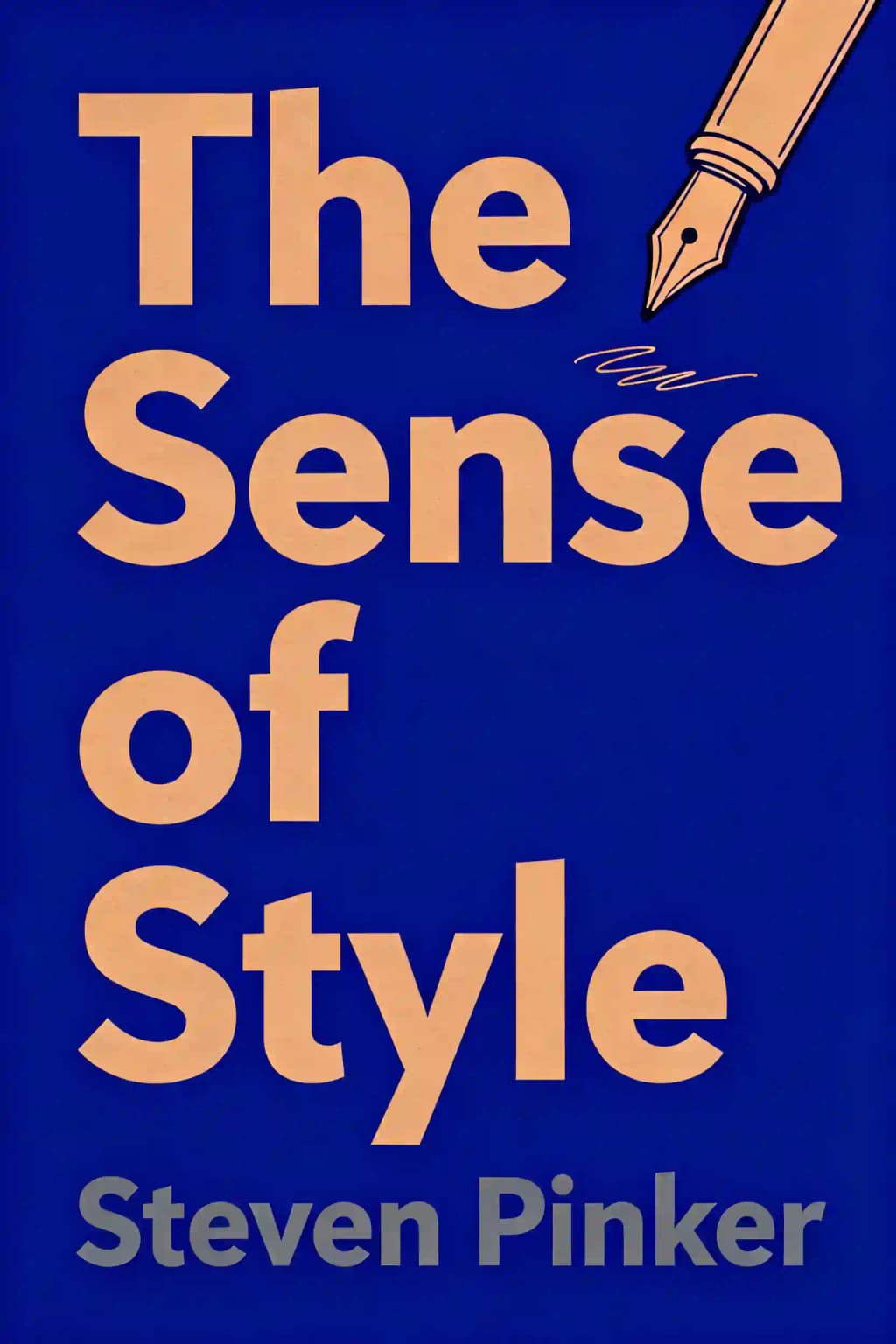
Pinker revolutionizes writing for the digital age, dismantling outdated rules while arming you against the "Curse of Knowledge." Academics praise his cognitive science approach to clarity. Ever wonder why brilliant thinkers often write terribly? This guide reveals the psychology behind truly persuasive prose.
Steven Arthur Pinker, bestselling author of The Sense of Style and a renowned cognitive psychologist, combines decades of expertise in language and mind to explore the art of clear communication in this modern writing guide. A Harvard professor and former MIT researcher, Pinker bridges his academic background in experimental psychology with practical insights into grammar, style, and the cognitive science of readability.
His acclaimed works, including The Language Instinct and The Better Angels of Our Nature, have earned Pulitzer Prize nominations and translations into over 30 languages.
Frequently featured in The New York Times, TED Talks, and Time magazine’s list of “100 Most Influential People,” Pinker chairs the Usage Panel of the American Heritage Dictionary, cementing his authority on linguistic norms. Born in Montreal and educated at McGill and Harvard, his contrarian yet evidence-driven approach reshapes traditional style guides into tools for 21st-century thinkers.
The Sense of Style distills these principles, offering writers a science-backed framework to engage audiences effectively. Pinker’s books collectively have sold millions of copies, with The Better Angels of Our Nature hailed by Bill Gates as “the most inspiring book I’ve ever read.”
The Sense of Style merges linguistics, cognitive science, and practical advice to help writers craft clear, engaging prose. Pinker critiques outdated style manuals, advocating for a modern approach that prioritizes clarity, coherence, and reader-centric communication. Key themes include overcoming the "curse of knowledge," mastering grammar to avoid ambiguity, and balancing traditional rules with evidence-based insights.
Writers, editors, students, and professionals seeking to refine their communication skills will benefit from Pinker’s insights. The book is particularly valuable for those frustrated by rigid style guides, as it offers a flexible, science-backed framework for effective writing. Educators and linguists will also appreciate its analysis of language evolution.
Yes—it’s a bestselling guide praised for blending scholarly rigor with actionable advice. Pinker’s emphasis on "classic style" (writing as a conversation) and his debunking of arbitrary grammar myths make it a standout compared to traditional manuals like The Elements of Style. Readers gain tools to simplify complex ideas and avoid common pitfalls like jargon overload.
Classic style treats writing as a window to the world, where the writer directs the reader’s gaze to shared truths. Pinker encourages simulating a dialogue, using clear syntax and concrete details over abstract nouns. This approach fosters engagement and avoids the stiffness of overly formal prose.
The "curse of knowledge" refers to writers assuming readers share their expertise, leading to unclear jargon or underexplained concepts. Pinker advises soliciting feedback from non-experts, defining technical terms, and structuring content to prioritize the reader’s perspective.
Pinker highlights syntax trees to visualize sentence structure, avoiding mismatches like dangling modifiers or noun piles (e.g., "health care policy changes"). He advocates for active voice when appropriate and stresses coherence through logical connectors (e.g., "however," "therefore").
He argues many rules (e.g., avoiding split infinitives) stem from prescriptive preferences, not linguistic reality. Pinker encourages writers to prioritize clarity and rhythm over rigid edicts, using data on language evolution to debunk myths.
Yes—its focus on reader-centered explanations, logical flow, and jargon avoidance applies to academic, legal, or scientific writing. Pinker’s "web, tree, string" framework (ideas → syntax → sentences) helps organize complex topics.
As digital communication grows, Pinker’s lessons on concision and clarity remain vital. The book’s evidence-based approach adapts to evolving language trends, offering timeless strategies for emails, social media, and AI-assisted writing.
While Strunk & White’s guide is prescriptive, Pinker’s work is descriptive, grounded in linguistics and cognitive science. He updates archaic rules (e.g., "six people" vs. "six persons") and emphasizes readability over rigid correctness.
通过作者的声音感受这本书
将知识转化为引人入胜、富含实例的见解
快速捕捉核心观点,高效学习
以有趣互动的方式享受这本书
The curse of knowledge is the single best explanation I know of why good people write bad prose.
Classic style is a wonderful alternative: a prose that is clear, simple, and direct.
The main cause of incomprehensible prose is the difficulty of imagining what it’s like not to know something.
Writing is fundamentally unnatural.
Water in the brain can kill you.
将《Sense of Style》的核心观点拆解为易于理解的要点,了解创新团队如何创造、协作和成长。
将《Sense of Style》提炼为快速记忆要点,突出坦诚、团队合作和创造力的关键原则。

通过生动的故事体验《Sense of Style》,将创新经验转化为令人难忘且可应用的精彩时刻。
随心提问,选择声音,共同创造真正与你产生共鸣的见解。

"Instead of endless scrolling, I just hit play on BeFreed. It saves me so much time."
"I never knew where to start with nonfiction—BeFreed’s book lists turned into podcasts gave me a clear path."
"Perfect balance between learning and entertainment. Finished ‘Thinking, Fast and Slow’ on my commute this week."
"Crazy how much I learned while walking the dog. BeFreed = small habits → big gains."
"Reading used to feel like a chore. Now it’s just part of my lifestyle."
"Feels effortless compared to reading. I’ve finished 6 books this month already."
"BeFreed turned my guilty doomscrolling into something that feels productive and inspiring."
"BeFreed turned my commute into learning time. 20-min podcasts are perfect for finishing books I never had time for."
"BeFreed replaced my podcast queue. Imagine Spotify for books — that’s it. 🙌"
"It is great for me to learn something from the book without reading it."
"The themed book list podcasts help me connect ideas across authors—like a guided audio journey."
"Makes me feel smarter every time before going to work"

免费获取《Sense of Style》摘要的 PDF 或 EPUB 版本。可打印或随时离线阅读。
Have you ever read a brilliant professor's paper and wondered, "Why is this so hard to follow?" The answer lies in what psychologists call "the curse of knowledge" - once we know something, we find it nearly impossible to imagine what it's like not to know it. This cognitive blind spot explains why experts often write impenetrable prose. While speaking comes naturally to humans (children learn it without formal instruction), writing is an artificial technology that emerged only 5,000 years ago. When we speak, we can see our listener's confused expression and adjust accordingly. Writers enjoy no such luxury - we must imagine an audience we cannot see. This fundamental challenge makes writing inherently difficult, even for the most intelligent among us. The physicist casually references quantum entanglement without explanation; the lawyer peppers documents with jargon; the professor assumes students already grasp foundational concepts. The result? Prose that seems perfectly clear to the writer but leaves readers bewildered. Overcoming this curse requires a deliberate mental effort to step outside your expertise and see your words through fresh eyes - the essential first step toward writing that truly connects.
