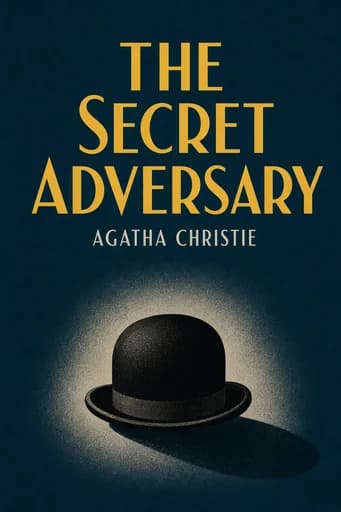
《隐秘的对手》概述
阿加莎·克里斯蒂的第二部小说在一部惊险刺激的悬疑作品中介绍了迷人的侦探组合汤米和塔彭丝·贝雷斯福德,而她的出版商最初对此持抵制态度。这部1922年的杰作开启了一对深受喜爱的侦探搭档的冒险之旅,尽管克里斯蒂当时仅获得了50英镑的连载费,但事实证明这些故事足以被多次改编为电视剧。
下载《隐秘的对手》摘要
免费获取《隐秘的对手》摘要的 PDF 或 EPUB 版本。可打印或随时离线阅读。
由哥伦比亚大学校友在旧金山创建
"Instead of endless scrolling, I just hit play on BeFreed. It saves me so much time."


"I never knew where to start with nonfiction—BeFreed’s book lists turned into podcasts gave me a clear path."


"Perfect balance between learning and entertainment. Finished ‘Thinking, Fast and Slow’ on my commute this week."
"Crazy how much I learned while walking the dog. BeFreed = small habits → big gains."
"Reading used to feel like a chore. Now it’s just part of my lifestyle."

"Feels effortless compared to reading. I’ve finished 6 books this month already."
"BeFreed turned my guilty doomscrolling into something that feels productive and inspiring."

"BeFreed turned my commute into learning time. 20-min podcasts are perfect for finishing books I never had time for."
"BeFreed replaced my podcast queue. Imagine Spotify for books — that’s it. 🙌"

"It is great for me to learn something from the book without reading it."
"The themed book list podcasts help me connect ideas across authors—like a guided audio journey."
"Makes me feel smarter every time before going to work"
由哥伦比亚大学校友在旧金山创建
"Instead of endless scrolling, I just hit play on BeFreed. It saves me so much time."
"I never knew where to start with nonfiction—BeFreed’s book lists turned into podcasts gave me a clear path."
"Perfect balance between learning and entertainment. Finished ‘Thinking, Fast and Slow’ on my commute this week."
"Crazy how much I learned while walking the dog. BeFreed = small habits → big gains."
"Reading used to feel like a chore. Now it’s just part of my lifestyle."
"Feels effortless compared to reading. I’ve finished 6 books this month already."
"BeFreed turned my guilty doomscrolling into something that feels productive and inspiring."
"BeFreed turned my commute into learning time. 20-min podcasts are perfect for finishing books I never had time for."
"BeFreed replaced my podcast queue. Imagine Spotify for books — that’s it. 🙌"
"It is great for me to learn something from the book without reading it."
"The themed book list podcasts help me connect ideas across authors—like a guided audio journey."
"Makes me feel smarter every time before going to work"
"Instead of endless scrolling, I just hit play on BeFreed. It saves me so much time."
"I never knew where to start with nonfiction—BeFreed’s book lists turned into podcasts gave me a clear path."
"Perfect balance between learning and entertainment. Finished ‘Thinking, Fast and Slow’ on my commute this week."
"Crazy how much I learned while walking the dog. BeFreed = small habits → big gains."
"Reading used to feel like a chore. Now it’s just part of my lifestyle."
"Feels effortless compared to reading. I’ve finished 6 books this month already."
"BeFreed turned my guilty doomscrolling into something that feels productive and inspiring."
"BeFreed turned my commute into learning time. 20-min podcasts are perfect for finishing books I never had time for."
"BeFreed replaced my podcast queue. Imagine Spotify for books — that’s it. 🙌"
"It is great for me to learn something from the book without reading it."
"The themed book list podcasts help me connect ideas across authors—like a guided audio journey."
"Makes me feel smarter every time before going to work"
"Instead of endless scrolling, I just hit play on BeFreed. It saves me so much time."
"I never knew where to start with nonfiction—BeFreed’s book lists turned into podcasts gave me a clear path."
"Perfect balance between learning and entertainment. Finished ‘Thinking, Fast and Slow’ on my commute this week."
"Crazy how much I learned while walking the dog. BeFreed = small habits → big gains."
"Reading used to feel like a chore. Now it’s just part of my lifestyle."
"Feels effortless compared to reading. I’ve finished 6 books this month already."
"BeFreed turned my guilty doomscrolling into something that feels productive and inspiring."
"BeFreed turned my commute into learning time. 20-min podcasts are perfect for finishing books I never had time for."
"BeFreed replaced my podcast queue. Imagine Spotify for books — that’s it. 🙌"
"It is great for me to learn something from the book without reading it."
"The themed book list podcasts help me connect ideas across authors—like a guided audio journey."
"Makes me feel smarter every time before going to work"


来自《隐秘的对手》的相同理念。选择适合你的声音、深度和节奏,随时切换。
Imagine finding yourself suddenly thrust into a world of international espionage after casually using a stranger's name in conversation. This is precisely what happens to the irrepressible Tuppence Cowley in Agatha Christie's "The Secret Adversary," the first adventure featuring her beloved detective duo Tommy and Tuppence. Published in 1922, this thrilling tale marked Christie's second novel and introduced readers to a partnership that would span her entire career-unique among her characters for aging naturally across five books from youthful adventurers to grandparents. The novel emerged from Christie's overheard conversation about someone named "Jane Fish," which she transformed into the mysterious "Jane Finn" at the heart of her plot. While Hercule Poirot may be Christie's most famous creation, Tommy and Tuppence have inspired devoted fans for their complementary partnership, romantic tension, and the sheer fun of their adventures-a quality Christie herself acknowledged when dedicating the book "to all those who lead monotonous lives in the hope that they may experience at second-hand the delights and dangers of adventure."
Tommy Beresford and Prudence "Tuppence" Cowley's story begins with a chance encounter at Dover Street Tube station in post-World War I London, amid the bustling crowds of returning soldiers and civilians trying to rebuild their lives. Both find themselves adrift in the uncertain aftermath of the Great War - Tommy having served as a second lieutenant in the military, enduring the trenches of France, and Tuppence working exhausting shifts as a Voluntary Aid Detachment (VAD) nurse tending to wounded soldiers. Over tea and scones at Lyons Corner House, a popular London tea shop where many young people gathered to escape the dreary post-war atmosphere, they commiserate about their dire financial situations. Tuppence, with characteristic dramatic flair, declares she'd be willing to do "anything, absolutely anything" for money short of breaking the law. Her savings have dwindled to precisely one and ninepence, while Tommy admits to having just a few pounds left to his name. The war has left them with valuable skills but few practical opportunities in a economy struggling to accommodate returning veterans. This casual complaint sparks an inspired idea: why not form a joint venture as "The Young Adventurers, Ltd."? The notion appeals to both their sense of romance and their practical needs. With youthful optimism and nothing to lose, they draft an advertisement for the morning papers: "Two young adventurers for hire. Willing to do anything, go anywhere. Pay must be good. No unreasonable offer refused." The partnership is sealed with a handshake and a toast to their new enterprise, though Tommy expresses characteristic caution about what they might be getting themselves into - a prescient concern given what lies ahead. Their personalities complement each other perfectly: Tommy possesses a methodical mind that approaches problems with military precision, while Tuppence relies on quick intuition and an ability to adapt to any social situation. Christie describes Tommy as "pleasantly ugly" with "slicked-back red hair" and honest blue eyes, while Tuppence, though not conventionally beautiful, radiates "character and charm" with her black bobbed hair and determined chin. Together, they form a formidable team with "pace and stamina" that will soon be tested beyond anything they could have imagined. Little do they realize their innocent business venture will catapult them into a dangerous conspiracy involving missing diplomatic papers, international revolutionaries, and a mysterious criminal mastermind known only as "Mr. Brown." Their advertisement, placed with such optimistic intentions, will draw them into a web of espionage and danger that will require all their combined wit, courage, and resourcefulness to survive. The young adventurers are about to discover that post-war London harbors secrets far more perilous than their current unemployment.
轻松跟读,《隐秘的对手》中的每个词都会随音频实时高亮。
The very next day, Tuppence's life takes an unexpected turn when she's approached by a shifty-eyed man named Whittington who overheard her conversation with Tommy. He offers her a suspiciously generous position-100 plus expenses for a three-month stay at a Paris pensionnat, posing as his American ward with strict instructions to avoid contact with friends or family. Immediately sensing something amiss, Tuppence attempts to negotiate Tommy's inclusion, which Whittington flatly refuses. As she prepares to leave, Tuppence makes a split-second decision that changes everything. On pure impulse, she introduces herself as "Jane Finn"-a name she invents on the spot. The effect is electric. Whittington's face contorts with rage and shock, revealing that this random name holds tremendous significance. Recognizing she's stumbled onto something valuable, Tuppence cleverly plays along, implying she knows more than she does. Believing she's blackmailing him, Whittington hastily gives her 50 as an advance payment and instructs her to return the following day. When Tuppence shares this strange encounter with Tommy, he recalls overhearing two men discussing someone named Jane Finn, one of whom matches Tuppence's description of Whittington. Their amateur detective work leads them to Esthonia Glassware, Whittington's supposed business, only to find it mysteriously closed overnight. Undeterred, Tuppence places an advertisement seeking information about Jane Finn, which attracts the attention of not only the mysterious Mr. Carter from British Intelligence but also an American millionaire named Julius P. Hersheimmer-Jane Finn's cousin who has been searching for her since she disappeared after surviving the Lusitania sinking in 1915. The plot thickens when Mr. Carter reveals the true significance of Jane Finn: she may possess secret diplomatic papers entrusted to her by a dying messenger aboard the doomed Lusitania-documents that, if made public, could discredit British statesmen and potentially trigger another war. With this revelation, what began as a lark transforms into a mission of national security, with Tommy and Tuppence officially enlisted to find Jane Finn before the documents fall into the wrong hands.
As Tommy and Tuppence delve deeper into their investigation, they encounter a vast conspiracy orchestrated by a shadowy figure known only as "Mr. Brown." This mysterious criminal mastermind operates through proxies and disguises, making him impossible to identify. Even his closest associates claim never to have seen his true face, creating an atmosphere of paranoia where anyone could be the elusive Mr. Brown. Mr. Carter explains that Bolshevist influence lies behind growing labor unrest in England, with Mr. Brown pulling strings from the shadows. The conspiracy aims to trigger a revolution on the 29th-just days away-using the stolen diplomatic papers to ensure labor leaders' support. The stakes couldn't be higher: the very stability of Britain hangs in the balance. The investigation leads Tommy to a suspicious house in Soho where conspirators gather. In a moment of reckless courage, he reproduces a special knock he observed and bluffs his way inside by asking for "Mr. Brown." Hidden behind a curtain, Tommy witnesses a chilling meeting of diverse conspirators-a criminal type, an Irish Sinn Feiner, a city clerk, a working-class man, and a well-dressed gentleman-each identified only by number. They discuss funding Irish terrorism, manipulating labor unions, and arranging murder, all while speculating whether Mr. Brown might actually be among them in disguise. Just as Tommy is about to learn Jane Finn's whereabouts, he's discovered and knocked unconscious. When he awakens as a prisoner, he finds himself served meals by a beautiful French girl named Annette who refuses to help him escape, claiming she fears "her people." Meanwhile, Tuppence infiltrates the household of Mrs. Vandemeyer-a beautiful but dangerous woman connected to the conspiracy-by posing as a parlormaid. There she observes visitors including the distinguished lawyer Sir James Peel Edgerton, who cryptically warns Tuppence she might benefit from a change of employment. The investigation becomes increasingly dangerous as Mrs. Vandemeyer dies under suspicious circumstances before she can reveal Mr. Brown's identity, and Tuppence herself disappears after receiving a telegram supposedly from Tommy. The race against time intensifies as the date of the planned revolution approaches, with both Tommy and Jane Finn's lives hanging in the balance.
Deception and disguise permeate "The Secret Adversary," with nearly every character concealing their true nature or intentions. Tuppence transforms herself with altered eyebrows and fair hair to become an unrecognizable parlormaid. Tommy bluffs his way into the conspirators' meeting by pretending to know more than he does. Even the villains employ elaborate disguises-Whittington poses as a butler, while the elusive Mr. Brown operates through proxies and disguises so effective that his own associates wouldn't recognize him. Most significantly, Jane Finn herself has been hiding in plain sight for years. After being captured aboard the sinking Lusitania, she overheard her captors discussing torture and made a split-second decision that would shape the next five years of her life. Terrified but quick-thinking, Jane feigned complete memory loss and pretended to speak only French. Despite painful interrogation, she maintained this elaborate deception so convincingly that she eventually almost believed it herself. The theme of hidden identity reaches its climax when "Annette"-the French girl who served Tommy during his captivity-is revealed to be Jane Finn herself. When bullets strike the car during their escape, Jane attempts to sacrifice herself, speaking perfect English and admitting she's been faking her memory loss. Her courage and resourcefulness in maintaining this deception for five years, even while helping Tommy escape, reveals extraordinary strength of character. The ultimate deception, however, comes from the most unexpected source. In the novel's shocking climax, Sir James Peel Edgerton-the distinguished K.C. who has been helping Tommy and Tuppence throughout their investigation-reveals himself as the mysterious Mr. Brown. His respectable public persona provided the perfect cover for his criminal activities, allowing him to manipulate events from both sides. This masterful twist exemplifies Christie's talent for misdirection and her understanding that the most dangerous deceptions often come from those we trust most.
The sinking of the RMS Lusitania on May 7, 1915, forms the historical backdrop for the novel's central mystery. Christie opens with a dramatic prologue set aboard the doomed ocean liner as it's struck by German torpedoes. In these chaotic final moments, a desperate man entrusts a young American girl-Jane Finn-with vitally important papers that "could make all the difference to the Allies in the war." He instructs her to watch The Times personal column for a message beginning "Shipmate" and, if nothing appears after three days, to deliver the packet to the American Embassy. This historical connection grounds the fictional narrative in real-world events that would have been fresh in readers' minds when the novel was published in 1922, just seven years after the disaster. The Lusitania's sinking was a pivotal moment in World War I-killing 1,198 passengers and crew, including 128 Americans-and helped shift American public opinion against Germany, eventually contributing to the United States entering the war. Christie cleverly uses this historical tragedy as both the inciting incident for her mystery and as a means of creating a five-year gap during which the diplomatic papers could remain hidden while still retaining their political significance. The papers' contents are never explicitly revealed, but they're described as potentially discrediting certain British statesmen and possibly triggering another war if made public-suggesting they might contain evidence of diplomatic duplicity or secret agreements. When Jane Finn is finally found, she reveals how she protected the papers despite her captivity. At the Soho house where she was initially held, she secretly hid the papers behind a picture of Marguerite, calling out the name three times during Tommy's imprisonment as a hint to their location. This connection between the historical sinking and the fictional conspiracy creates a compelling narrative that blends fact and fiction, giving weight to the adventure while allowing Christie's imagination free rein.
轻松跟读,《隐秘的对手》中的每个词都会随音频实时高亮。
As the investigation progresses, finding Jane Finn becomes increasingly urgent. Julius Hersheimmer follows Whittington to Bournemouth, where he observes him visiting a secluded house and speaking with a woman dressed as a hospital nurse. Attempting to spy through an upstairs window by climbing a tree, Julius crashes into the garden below and awakens in a private nursing home under Dr. Hall's care. Though the doctor denies having any patient named Jane Finn, Julius later realizes he actually saw Jane working as a nurse at the nursing home. Meanwhile, Tommy's captivity ends when he escapes with Annette's help, who creates a diversion with a cracked jug. Though Tommy is reluctant to leave her behind, Annette insists, repeatedly mentioning "Marguerite"-a clue whose significance Tommy doesn't yet understand. After reporting to Mr. Carter, Tommy is devastated to learn that Tuppence's belongings were found washed up on the Yorkshire coast, suggesting she has drowned. Blaming himself for her apparent death, Tommy is further shocked to discover a photograph of "Annette" in Julius's drawer. The pace accelerates when Tommy deduces that Tuppence is being held at Astley Priors, a property owned by a respected retired physician named Dr. Adams who takes "balmy" private patients. With his young ally Albert, Tommy confirms a French young lady is staying in the house and spots Tuppence's silhouette in a window. Creating a diversion by drunkenly singing a song Tuppence would recognize, Tommy receives a warning note from her about an ambush. In a parallel effort, Julius forces the Russian official Kramenin at gunpoint to reveal Jane and Tuppence's location, threatening to shoot him if he refuses. This leads to a dramatic rescue at Astley Priors, where Julius makes Kramenin demand the girls' release. As they escape by car, someone fires at them, but Julius returns fire. The race culminates when Tommy unexpectedly leaps into the car and orders the girls to catch a train to London, instructing them to go to Sir James Peel Edgerton while he stays behind to delay pursuers. The urgency of their mission is underscored by the approaching date of the planned revolution-the 29th-now just days away. Finding Jane Finn has become not just a matter of solving a mystery but of preventing national catastrophe.
Beneath the espionage and adventure runs a subtle romantic current that adds emotional depth to the story. From their first meeting at Dover Street Tube station, Tommy and Tuppence display the comfortable banter and mutual understanding of old friends with potential for something more. Their partnership as "The Young Adventurers, Ltd." becomes a metaphor for their personal relationship-initially a practical arrangement that gradually reveals deeper feelings. As dangers mount, their concern for each other grows increasingly evident. When Tuppence disappears, Tommy is devastated, finally admitting to himself that he loves her. Similarly, when Tommy goes missing, Tuppence realizes how much she's relied on his steady judgment despite often teasing him for his caution. The mission suddenly seems less like romantic adventure and more like grim reality without him by her side. A romantic triangle briefly emerges when Julius Hersheimmer impulsively proposes marriage to Tuppence. Though flattered by the American millionaire's attention and wealth, Tuppence refuses, later admitting to herself she loves Tommy. This rejection reveals Julius's proposal as insincere-his true feelings lie with his cousin Jane Finn, whom he's been searching for since learning of her existence. The romantic storylines resolve in parallel during the novel's denouement. Julius proposes to Jane during their return to the Ritz, confessing he's loved her since first seeing her photograph. Though initially hesitant, Jane admits she's loved him since their first meeting when a bullet grazed his cheek during their escape. Their detour through Regent's Park allows for a private moment to seal their engagement. Meanwhile, Tommy and Tuppence share an awkward taxi ride, also through Regent's Park. The old camaraderie between them has vanished, replaced by strained conversation as both struggle to express their feelings. Their dialogue about future living arrangements becomes a roundabout way of discussing their relationship, with Tuppence deliberately provoking Tommy into realizing they'll be sharing a home together. When Tommy embraces her, no formal proposal is necessary-their partnership has naturally evolved beyond friendship. As Tuppence declares marriage "a sport," and Tommy heartily agrees it's "a damned good sport too," Christie concludes their romance with characteristic light-heartedness that perfectly matches their adventurous spirits.
The novel builds to a shocking climax when Sir James Peel Edgerton-the distinguished K.C. who has been helping Tommy and Tuppence throughout-reveals himself as the mysterious Mr. Brown. This stunning twist comes just as they've successfully retrieved the treaty papers from behind Marguerite's picture in the Soho house. As they celebrate their success, Sir James suddenly transforms before their eyes, announcing that none of them will leave alive. His plan is to wound himself and blame the others, maintaining his respectable cover while eliminating all witnesses. This revelation forces readers to reevaluate every previous interaction with Sir James. His perceptive comments about Tuppence being a V.A.D. and suggesting she might benefit from a change of employment weren't friendly concern but calculated manipulation. His convenient "discovery" of Jane Finn in Manchester was fabricated to lure them into his trap. Even his helpful advice to Tommy about investigating the telegram sent to Tuppence was designed to maintain his trustworthy facade while advancing his own agenda. The unmasking of Sir James as Mr. Brown represents Christie's understanding of how respectability can serve as the perfect disguise for criminality. As a celebrated K.C. with expertise in criminology, Sir James was above suspicion-his very reputation making him invisible as a criminal mastermind. This theme of hidden evil beneath respectable exteriors would become a hallmark of Christie's later works. In the moment of his exposure, Sir James reveals a theatrical flair consistent with his manipulative nature. Trapped when Julius seizes him from behind, he raises his signet ring to his lips, quotes "Ave Caesar! te morituri salutant" ("Hail Caesar! Those who are about to die salute you"), and collapses as the smell of bitter almonds fills the air-having chosen suicide by cyanide rather than face justice. This dramatic end befits a villain who operated through performance and deception, maintaining his control of the narrative until his final breath.
The novel culminates in a magnificent celebration at London's prestigious Savoy Hotel, orchestrated by the ever-generous Julius Hersheimmer. The American millionaire transforms the venue into a post-war wonderland, with elaborate floral arrangements featuring roses in December, crystal champagne fountains, and a menu featuring delicacies from across the globe. The carefully curated guest list reflects the far-reaching impact of their adventure - from the American Ambassador and the enigmatic Mr. Carter of British Intelligence to Tommy's uncle, Sir William Beresford, whose unexpected appearance changes Tommy's fortunes dramatically. Sir William, impressed by his nephew's courage and ingenuity, not only offers Tommy a substantial monthly allowance but names him heir to his considerable estate. Jane Finn, the catalyst for their entire adventure, commands attention in a striking gold and red gown that symbolizes both her American glamour and her newfound confidence. The resolution of the conspiracy proves as dramatic as its unfolding. Sir James Peel Edgerton's death marks the definitive end of the inner circle's machinations. Kramenin, the Russian conspirator, flees to his homeland, leaving behind a web of broken alliances. The abandoned Astley Priors yields a treasure trove of incriminating documents - letters, coded messages, and detailed plans that reveal the full scope of their intended revolution. The government's swift action in negotiating with labor leaders - offering improved working conditions and wage considerations - successfully defuses the powder keg of social unrest that the conspirators had hoped to ignite. Both couples emerge from the adventure with their futures secured. Julius and Jane's engagement represents a fusion of American wealth and determination with the mystery that brought them together. Tommy and Tuppence's partnership, however, transcends mere romance - it's the foundation of a lifelong adventure in detection. Their decision to form the Young Adventurers, Ltd. marks the beginning of an investigative career that will span half a century across Christie's works. This inaugural adventure establishes the hallmarks that would define Tommy and Tuppence's unique place in Christie's canon. Unlike Poirot or Miss Marple, they age naturally throughout their literary journey - from the bright-eyed young survivors of World War I in this novel to experienced investigators in "N or M?" during World War II, and finally to perspicacious grandparents in "Postern of Fate." Their evolution reflects Christie's own journey through the 20th century, making them perhaps her most personally resonant characters. The novel's ending encapsulates everything that makes Tommy and Tuppence endearing to readers - their witty repartee, their balanced partnership (his methodical thinking complementing her intuitive leaps), and their unflagging enthusiasm for adventure. Tuppence's impulsiveness finds its perfect counter in Tommy's steadiness; his caution balances her daring. Together, they offer Christie's readers the perfect vehicle for vicarious adventure - two ordinary people whose courage, cleverness, and chemistry transform them into extraordinary heroes. Their story particularly resonates with Christie's dedication to those leading quiet lives, promising that adventure isn't just for the young or the naturally brave - it's for anyone willing to take that first step into the unknown with the right partner by their side.
深受 100 万+ 学习者喜爱
“坚持使用 23 天了,我每天都会打开它。它现在已经成为我的日常习惯。”
jayallen


The World of Three Pines
This plan is essential for readers and literary enthusiasts who want to look beyond the mystery and understand the profound human themes of Louise Penny’s work. It is ideal for aspiring writers, book club members, or fans of the series seeking a deeper analysis of Armand Gamache’s character and the healing power of community.

The Anatomy of a Murderous Idea
This plan is essential for students of literature and philosophy seeking to understand the psychological depths of Crime and Punishment. It is ideal for anyone interested in the intersection of morality, criminal psychology, and the arduous path toward spiritual atonement.

Detective
This learning plan bridges the gap between fictional investigative brilliance and real-world forensic application. It is ideal for aspiring investigators, true crime enthusiasts, or anyone looking to sharpen their analytical and psychological profiling skills.

Secrets of a Strange Earth
This plan is designed for curious minds who want to look beyond conventional knowledge to understand the anomalies of our universe and species. It is perfect for lifelong learners and trivia enthusiasts seeking to bridge the gap between science, history, and psychology.

The World's Most Audacious Heists
This plan offers a deep dive into the intersection of high-stakes crime, security engineering, and criminal psychology. It is ideal for true crime enthusiasts, security professionals, and art historians looking to understand the mechanics of the world's most sophisticated thefts.

The Psychic Espionage Playbook
This playbook provides a structured look into the intersection of intelligence operations and human consciousness. It is ideal for history buffs, intelligence enthusiasts, and those interested in the rigorous methodology behind scientifically-studied psychic phenomena.

Inside the Profiler's Mind
This plan provides a foundational look at the transition from traditional investigative methods to scientific behavioral analysis. It is ideal for true crime enthusiasts and aspiring criminologists seeking to understand the reality behind criminal psychology.

The Clinical Detective: From Anatomy to Diagnosis
This learning plan is essential for aspiring medical professionals or students who want to bridge the gap between basic anatomy and clinical practice. It provides a structured approach to understanding how the human body functions as a whole and how doctors solve complex diagnostic puzzles.





