第 1 章
The Retail Revolution Through Logistics: Walmart's Transformation of Space and Commerce
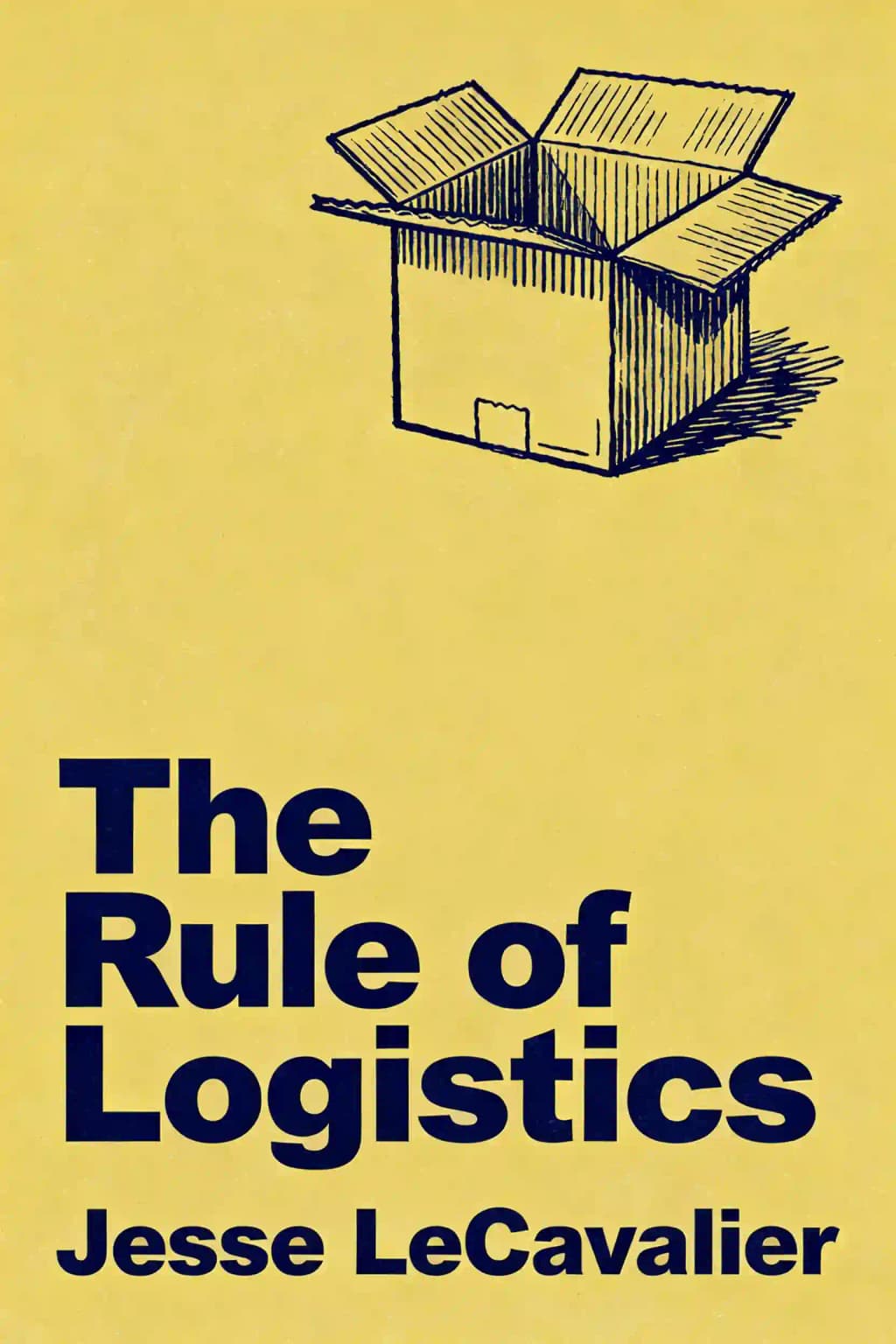
In a world increasingly defined by efficiency and optimization, few companies have shaped the American landscape as profoundly as Walmart. The Rule of Logistics by Jesse LeCavalier offers a fascinating examination of how this retail giant has revolutionized not just commerce, but the very fabric of our built environment. This book has become required reading in business schools and urban planning programs alike, with figures like Jeff Bezos reportedly citing it as influential in developing Amazon's logistics strategy. What makes this work particularly remarkable is how it reveals the hidden systems beneath everyday retail experiences-systems that have transformed not just how we shop, but how our cities develop, how workers operate, and how territory itself is conceived.
第 2 章
The Logistical Revolution: From Military Science to Retail Strategy
Logistics-once merely a military concern about moving troops and supplies-has evolved into the defining force of modern retail. The field transformed dramatically in the 1970s through what scholars call the "logistics revolution," when companies began treating the movement of goods as a comprehensive system rather than separate transportation functions. This shift paralleled the computing revolution and transport deregulation, making battles for urban space increasingly calculation-dependent. Companies like Walmart led this transformation by investing heavily in computerized inventory systems and establishing sophisticated distribution networks that would revolutionize retail operations.
At its core, logistics attempts to "get there first with the most" at the "critical point," echoing Conrad Hilton's real estate mantra about location's paramount importance. Companies gather intelligence through advanced data analytics, develop strategies using predictive modeling, and operate tactically to secure optimal positions. While military logistics focuses primarily on timing and location-such as positioning troops and supplies for maximum tactical advantage-business logistics emphasizes flows and directions-vectors and rates-defining itself as "the organization, planning, and realization of the total flow of goods, data, and control along the entire product life cycle." This includes everything from raw material sourcing to final delivery, incorporating sophisticated inventory management systems, real-time tracking, and predictive analytics.
What makes logistics particularly powerful is how it mediates between abstraction and concreteness. As philosopher Henri Lefebvre noted, space understood through logistics is "both abstract and concrete in character: abstract inasmuch as it has no existence save by virtue of the exchangeability of all its component parts, and concrete inasmuch as it is socially real and as such localized." This mediation enables a focus on action rather than form, measuring distance in time and creating seemingly counterintuitive spatial manifestations. Modern logistics companies like Amazon demonstrate this daily, treating physical spaces as dynamic nodes in a vast network of fulfillment centers, sorting facilities, and delivery routes.
Consider the example of Clearwater Paper keeping Nova Scotia lobsters alive in a facility at Louisville International Airport-reconciling abstract air transit routes and shipment manifests with the concrete biological requirements of keeping crustaceans alive for consumption. Similar complex logistics networks enable fresh sushi-grade fish from Tokyo's Tsukiji market to reach restaurants in New York within 24 hours, or allow flowers picked in Colombia to arrive fresh in Amsterdam's auction houses. This logistical imagination transforms how we understand space itself, rendering places as nodes in a network rather than distinct locations with inherent qualities. The success of companies like FedEx and DHL further illustrates how this networked thinking has revolutionized global commerce, creating what David Harvey calls "time-space compression" where physical distance becomes less relevant than logistical efficiency.
The modern logistics paradigm has reshaped urban landscapes, with massive distribution centers appearing on city peripheries and automated fulfillment centers transforming industrial zones. These developments reflect a fundamental shift in how space is conceived and utilized in the contemporary economy, where the ability to efficiently move and track goods becomes more valuable than traditional metrics of location value.
第 3 章
The Architecture of Logistics: Buildings as Processes, Not Objects
Walmart doesn't refer to its buildings as buildings but as "formats" and "prototypes." This terminology reveals how the company's architecture division develops plans without particular sites in mind but with specific performance constraints. These constraints include factors like optimal traffic flow, inventory turnover rates, and energy efficiency metrics. Unlike conventional architectural prototypes, Walmart's are contingent and relational, sharing characteristics with what organizational theorist Karl Weick calls "loosely coupled systems"-they can adapt to local conditions without modifying their core organization. This flexibility allows Walmart to maintain operational consistency while responding to diverse geographic and demographic contexts.
The supercenter, Walmart's most common building type, combines a general merchandise discount store with a large food store, typically spanning 180,000 to 250,000 square feet. These buildings serve as territorial instruments in Walmart's expansion, forming part of a vast infrastructural transmission system alongside data and distribution centers. The buildings are strategically positioned within precise drive-time radiuses of distribution centers and other stores, creating an intricate network of retail coverage. When facing community resistance, Walmart offers surface modifications through various architectural styles (Main Street, Alpine, Industrial) to suggest visual appropriateness, positioning architecture primarily as communicative surface rather than territorial instrument. These aesthetic adaptations might include brick facades in historic districts, pitched roofs in mountain communities, or modernist elements in urban areas.
What's particularly fascinating about these buildings is how they invert traditional retail architecture. Unlike mid-20th century supermarkets that functioned as both shops and warehouses with about 45% of space dedicated to storage, Walmart supercenters have minimal storage space-only about 25% of total area. This reduction in storage space is made possible by sophisticated inventory management systems and just-in-time delivery schedules. These buildings operate as infrastructural conduits and valves-simultaneously enclosures and passageways where the interior layout remains fixed while the exterior "crust" adapts to local conditions. The standardized interior layout ensures operational efficiency across locations, with carefully calculated aisle widths, checkout configurations, and department placements that optimize customer flow and employee productivity.
This architectural approach undermines traditional notions of singularity to foreground each building's role in a larger hybrid system. The buildings themselves become expressions of logistics-contingent, adaptable, and focused on performance rather than form. They're conceived as operating expenses rather than capital investments, deployed as means to ends rather than architectural statements. This perspective is reflected in their construction methods, which prioritize speed and cost-effectiveness, often utilizing pre-engineered components and standardized materials. The average lifespan of a Walmart building is calculated at approximately 20 years, after which it may be renovated, expanded, or replaced based on market conditions and operational requirements.
第 4 章
The Technological Revolution: From Bar Codes to Satellite Networks
Two transformative developments revolutionized retail architecture: self-service shopping and machine-readable product coding. The humble bar code, first used commercially in 1974 when a cashier in Troy, Ohio scanned a pack of Wrigley's Juicy Fruit gum, fundamentally changed how objects were imagined by allowing physical merchandise to be treated like information. This technological shift built upon an earlier revolution in self-service shopping, which had already transformed customer-merchandise interactions by transferring labor roles from clerks to shoppers.
When Sam Walton opened his first Bentonville store in 1950, it was only the third self-service variety store in the country. This model, patented in 1917 by Clarence Saunders for his Piggly Wiggly grocery chain, represented a radical departure from traditional retail. Instead of having clerks select items or assist customers at multiple counters, self-service allowed shoppers to move freely through the store, compare transparently priced merchandise, select items themselves, and pay at a single point before exiting.
Under the guise of increased freedom, customers actually performed work previously done by paid clerks, allowing stores to reduce overhead and lower prices. This labor transfer would be further extended through bar codes, which not only increased transaction speed but made customers into ersatz stockists and market analysts simply by retrieving items and having them scanned.
The Universal Product Code (UPC) emerged from a 1970 meeting of retailers and engineers seeking a standard inventory management system. Within two years of its 1974 introduction, over 75% of supermarket items carried the symbol. The bar code effectively creates two versions of every product: its physical form and its informational counterpart. For logisticians, items' qualitative identities become less important than their quantities and locations in time and space.
In 1966, Sam Walton traveled from Bentonville to IBM in Poughkeepsie to learn how new technologies could support his expansion plans. As Walmart grew, it required increasing abstraction to manage its expanding network, leading to investments in IBM computing systems starting in 1972. By 1984, the company committed $24 million-over a quarter of its operating budget-to develop the largest private satellite communication network in the United States, linking all stores and distribution centers with two-way voice, two-way data, and one-way video communication.
第 5 章
Territorial Strategies: How Walmart Maps and Claims Space
As Walmart expanded beyond what Sam Walton could personally survey from his small aircraft, the company needed more sophisticated site selection methods. The real estate division evolved from Walton's intuitive "fly and spy" approach to a data-driven powerhouse employing advanced geospatial analytics. While Walton relied on visual inspection and local knowledge, today's executives operate from climate-controlled offices in Bentonville, wielding powerful software tools that transform physical landscapes into digital abstractions.
The modern site selection process combines multiple layers of analysis. Demographics are broken down into precise segments like "affluent empty nesters" or "young urban professionals." Traffic patterns are studied through mobile phone movement data. Competitive analysis maps track not just other retailers' locations but their sales performance and market penetration. Advanced GIS (Geographic Information Systems) software integrates these data points with high-resolution satellite imagery, creating detailed heat maps of consumer behavior and spending potential.
These sophisticated tools allow Walmart to predict store performance with remarkable accuracy. The company's proprietary algorithms consider over 800 variables for each potential location, including household income, population density, traffic counts, and even social media activity. The software can simulate different scenarios - like the impact of a new competitor or changing demographics - helping executives optimize store placement and size. This scientific approach has largely replaced the gut instincts that guided early expansion.
The delineation of trade areas remains central to Walmart's strategy, but the process has become increasingly precise. Modern software defines these territories using isochrone mapping - areas accessible within specific drive times - rather than simple distance circles. These trade areas are further refined by natural barriers, competing stores, and shopping patterns tracked through credit card data. The company's "prospecting" applications can now identify underserved markets automatically, generating heat maps of retail opportunity across entire regions.
Vermont's experience provides a fascinating case study of Walmart's territorial sophistication. The company's response to local resistance wasn't just to build stores near the border - it was a carefully orchestrated campaign of market pressure. The seven stores positioned within five miles of Vermont's border (including two less than 2,000 feet away) were strategically sized and stocked to serve Vermont customers. The additional six stores in the outer ring created a complete commercial containment strategy. This "retail blockade" demonstrated how Walmart could leverage geography and consumer behavior to overcome political boundaries. Store placement considered not just distance but also major highways, shopping patterns, and demographic flows. When Vermont finally approved Walmart's entry in 1997, the company already had detailed data on the shopping habits of thousands of Vermont residents who had been crossing state lines to visit their stores.
This evolution from intuitive site selection to data-driven territorial strategy reflects Walmart's broader transformation into a technology-powered retail giant. The company now views geography as a digital canvas where consumer behavior, logistics, and market dynamics can be mapped, analyzed, and optimized with scientific precision.
第 6 章
The Human Element: Bodies in Logistical Environments
Distribution center workers occupy a unique position between physical objects and digital information, serving as crucial intermediaries in modern logistics networks. Unlike Taylor's factory workers who focused primarily on production output through manufacturing processes, DC workers manage "throughput"-the continuous movement of inventory through vast facilities. This fundamental shift reflects a deeper philosophical transition from subject to body, where workers become increasingly entangled in complex organizational systems and digital networks.
Distribution centers represent a departure from traditional factories in that workers don't transform raw materials into finished products but instead act as sophisticated relays between automated systems. Advanced software algorithms calculate mathematically efficient routes for workers to collect items, creating what one Amazon manager aptly termed "human automation." While robots and automated systems are increasingly deployed in these environments, human dexterity and adaptability remain more cost-effective for handling the diverse range of products flowing through these facilities. However, the intellectual demands of sorting and organizing have undergone significant "de-skilling," with complex decision-making processes broken down into simplified, repeatable tasks.
Workers in modern distribution centers must develop new forms of technological literacy to effectively navigate these hybrid environments. They interact with sophisticated technologies that serve as translators between computer systems and human operators. Voice-directed picking systems, such as the widely-used "Jennifer" platform, thoroughly embed workers in the information network, enabling them to work "hands-free" and "eyes-free" while being continuously directed by synthesized voices emanating from remote management systems. These technological interfaces transfer operational control from local floor managers to distant control centers, creating a growing disconnect between operators and the systems they serve.
The spatial organization of distribution centers has evolved to calculate space volumetrically rather than just horizontally, requiring workers to adapt to novel forms of three-dimensional mobility. In man-on-board automated storage and retrieval systems (ASRS), operators work within enclosed cabs integrated into sophisticated crane and rail systems that move seamlessly between aisles both vertically and horizontally. The automated system, rather than the worker, maintains complete control over movement patterns-efficiently shuttling operators through complex trajectories between high-density storage shelves as customer orders are processed and fulfilled.
This arrangement creates an intriguing reversal of J.C.R. Licklider's original vision of human-computer symbiosis. Instead of computers handling routine computational labor while humans engage in higher-level thinking, we see computers making sophisticated decisions while humans perform the repetitive physical tasks. The massive server farms in Bentonville fundamentally depend on their organic counterparts to execute operations, creating what could be described as a collective "servo-organism" where the machinic input, while sophisticated, triggers and coordinates extensive human physical labor. This inversed relationship raises important questions about the future of human-machine interaction in logistics environments and the changing nature of human labor in increasingly automated workplaces.
第 7 章
The Birth of Management City: Northwest Arkansas as Corporate Territory
Northwest Arkansas presents a paradox as a globally connected region with few traditional urban characteristics. With only 150 people per square mile compared to Los Angeles's 7,500, it's neither suburban nor exurban but developed around corporations rather than a central city. Unlike "technoburbs" or "exurbs" defined in relation to urban centers, the Northwest Arkansas Metropolitan Statistical Area evolved in isolation.
Sam Walton deliberately chose to "hide back there in the hills," resisting relocation despite Walmart's global reach. The region has transformed through infrastructure investments including a regional airport, interstate extensions, and cultural institutions, creating an urban configuration without reference to historic centers, material resources, or strategic location. This represents a new territorial form shaped by logistics-topological and elastic rather than traditionally urban.
Modern Bentonville functions like a Walmart theme park for visitors, featuring the Walmart Museum with its recreated soda fountain, Crystal Bridges Museum designed by Moshe Safdie, and upscale dining emphasizing local ingredients. The town's population has grown rapidly from 28,500 in 2006 to over 41,000 by 2014. This growth stems from infrastructural improvements initiated in the 1990s and continued by the Walton Family Foundation, which prioritizes creating a distinctive "sense of place" in their home region.
Clustered along Walton Boulevard are "vendorville" complexes with awkward corporate domesticity. South Walton Plaza exemplifies this with its ceremonial flagpole, obelisk, and house-like units sharing common entrances. Companies like Procter & Gamble and Clorox have opened satellite offices here, using domestic hospitality to cultivate relationships with Walmart buyers. These vendorvilles manifest logistics' discontinuity while suppliers compete to demonstrate their products' value over competitors.
Alice Walton's Crystal Bridges Museum represents both personal passion and regional development strategy. Located near downtown Bentonville and upstream from Walton's childhood home, the $800 million endowed museum offers free admission and attracts more annual visitors (533,000 in 2014) than the region's population. Crystal Bridges functions as both cultural institution and growth catalyst, attempting to produce an audience rather than merely serve an existing one-inverting the typical relationship between urbanization and cultural institutions.
第 8 章
The Logistical Proto-Type: A New Architectural Paradigm
Walmart's architectural approach produces forms both plastic and blank, neither driven by tectonic expression nor volumetric specificity. Its prototypes exist in a unique space between type and model, possessing aspects of each while forming their own distinct category. Though lacking traditionally charismatic formal qualities, this approach demonstrates remarkable potency and flexibility. While speed and cost efficiency primarily determine Walmart's building designs, their systematic procedures could evolve into a more nuanced contingent architecture of loose forms, maintaining critical relationships while allowing others to adapt and reshape according to local contexts.
The prototype functions as a sophisticated mediator between controlled corporate aspirations and contingent surroundings, notably thriving in compromised states rather than requiring architectural purity. This adaptive model suggests architecture might operate collectively rather than singularly, with prototypes deployed as comprehensive infrastructural systems carrying significant geopolitical agency. The success of this approach is evident in how Walmart's structures seamlessly integrate into diverse environments, from rural townships to urban centers, while maintaining operational consistency.
While logistics has proven exceptionally effective as a problem-solving approach in commercial architecture, it hasn't yet provided compelling alternatives to mere "efficiency" or "optimization" when addressing broader urban questions. Contemporary "smart city" technological fantasies often reinforce the instant gratification impulses evident in Walmart's operations, prioritizing immediate results over long-term urban cohesion. Although architectural research documents numerous examples of buildings deployed with explicit geopolitical intent - from government complexes to cultural institutions - examples of similar methodological means directed toward different social and cultural ends remain surprisingly rare.
Infrastructure offers a promising possibility for advancing logistics principles toward collective aims rather than just efficiency metrics. As a vital site of common use and shared stewardship, infrastructure represents substantial collective investment in the built environment, though its design features and social implications remain surprisingly undertheorized in architectural discourse. Infrastructural systems, whether transportation networks, utility grids, or commercial complexes, quickly acquire a perceived permanence in the social consciousness despite being imposed rather than inevitable. This phenomenon presents both challenges and opportunities for architects and urban planners seeking to reshape the relationship between logistics-driven architecture and community needs.
The evolution of the logistical prototype suggests potential for a new architectural paradigm that balances operational efficiency with social responsibility. By understanding how Walmart's model succeeds in its primary objectives while identifying its limitations, architects can develop more sophisticated approaches that serve both commercial and communal interests. This might include adaptive reuse strategies, flexible programming capabilities, and integrated community spaces within standardized architectural frameworks.
第 9 章
Rethinking Logistics: From Efficiency to Happiness
Walmart's slogan "Saving people money so they can live better" operates as both alibi and justification, assuming more money increases life quality-a correlation happiness scholars haven't consistently found. Studies across diverse economies show that beyond meeting basic needs, increased wealth correlates weakly with happiness. Distribution spaces increasingly offer glimpses into spatial consequences of instant gratification, exemplified by Amazon Robotics' system where robots bring inventory to workers rather than vice versa. These automated warehouses, spanning millions of square feet, represent a new paradigm where human movement is subordinated to algorithmic efficiency.
While traditional logistics might be deemed notational with fixed paths and predetermined routes, newer algorithmic logistics allows operations to unfold in unanticipated ways, constantly recalculating optimal solutions. This shift from static to dynamic systems mirrors broader changes in contemporary capitalism. Yet happiness studies question whether obtaining objects of desire quickly generates true happiness, dividing measures into three distinct categories: momentary joy (hedonic pleasure), overall contentment (life satisfaction), and eudaimonia (meaningful fulfillment). Research consistently shows that the pursuit of immediate gratification often undermines longer-term well-being. Economic growth policies enabled by logistics systems might change if these findings gained influence, potentially prioritizing delivery methods that enhance community connection over pure speed.
Contemporary logistics orchestrates hedonic landscapes of desire through vast networks of fulfillment centers, delivery routes, and digital interfaces, but could instead develop eudaemonistic landscapes of fulfillment. This would require moving beyond military-industrial practices driven by measure, control and prediction toward systems that prioritize human flourishing. Examples might include local distribution networks that strengthen community ties, or delivery systems that incorporate social interaction and meaningful exchange. The challenge lies in reconciling efficiency with human-centered design principles.
The investigation into Walmart reveals an emerging architecture of logistics that has escaped its formal zones to influence building construction, mapping, urban growth, cultural institutions, and subject formation. This extends beyond retail to reshape everything from housing developments to educational facilities. These conditions create environments increasingly illegible to their human creators, with AI-driven systems making decisions that even their designers struggle to interpret. The resulting landscape raises fundamental questions about assumptions and opportunities in this self-made wilderness, particularly regarding human agency and social connection. As we navigate this terrain, perhaps we can imagine new ways to deploy these powerful logistical systems toward more humane and fulfilling ends, such as supporting local economies, reducing environmental impact, and fostering meaningful social interactions. This might mean sacrificing some efficiency for sustainability, or speed for community resilience.