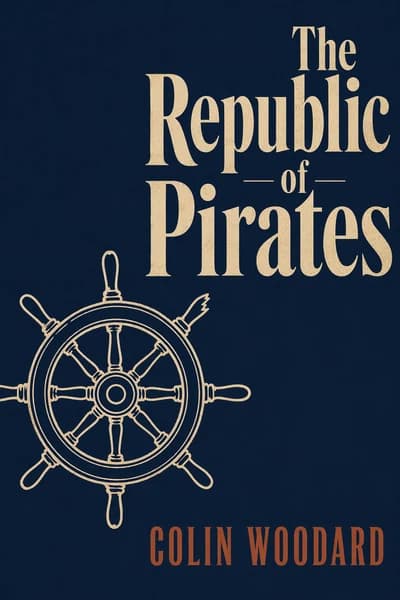
《海盗共和国》概述
探索黑胡子统治下的真实共和国,这里是 Netflix 纪录片《失落的海盗王国》与《刺客信条 IV》的灵感源泉。这部《纽约时报》畅销书揭示了加勒比海盗如何建立民主制度,在美利坚拥抱这些理想的几个世纪前,便实现了“黑人可以成为平等公民”。
下载《海盗共和国》摘要
免费获取《海盗共和国》摘要的 PDF 或 EPUB 版本。可打印或随时离线阅读。
探索黑胡子统治下的真实共和国,这里是 Netflix 纪录片《失落的海盗王国》与《刺客信条 IV》的灵感源泉。这部《纽约时报》畅销书揭示了加勒比海盗如何建立民主制度,在美利坚拥抱这些理想的几个世纪前,便实现了“黑人可以成为平等公民”。
免费获取《海盗共和国》摘要的 PDF 或 EPUB 版本。可打印或随时离线阅读。
由哥伦比亚大学校友在旧金山创建
"Instead of endless scrolling, I just hit play on BeFreed. It saves me so much time."


"I never knew where to start with nonfiction—BeFreed’s book lists turned into podcasts gave me a clear path."


"Perfect balance between learning and entertainment. Finished ‘Thinking, Fast and Slow’ on my commute this week."
"Crazy how much I learned while walking the dog. BeFreed = small habits → big gains."
"Reading used to feel like a chore. Now it’s just part of my lifestyle."

"Feels effortless compared to reading. I’ve finished 6 books this month already."
"BeFreed turned my guilty doomscrolling into something that feels productive and inspiring."

"BeFreed turned my commute into learning time. 20-min podcasts are perfect for finishing books I never had time for."
"BeFreed replaced my podcast queue. Imagine Spotify for books — that’s it. 🙌"

"It is great for me to learn something from the book without reading it."
"The themed book list podcasts help me connect ideas across authors—like a guided audio journey."
"Makes me feel smarter every time before going to work"
由哥伦比亚大学校友在旧金山创建
"Instead of endless scrolling, I just hit play on BeFreed. It saves me so much time."
"I never knew where to start with nonfiction—BeFreed’s book lists turned into podcasts gave me a clear path."
"Perfect balance between learning and entertainment. Finished ‘Thinking, Fast and Slow’ on my commute this week."
"Crazy how much I learned while walking the dog. BeFreed = small habits → big gains."
"Reading used to feel like a chore. Now it’s just part of my lifestyle."
"Feels effortless compared to reading. I’ve finished 6 books this month already."
"BeFreed turned my guilty doomscrolling into something that feels productive and inspiring."
"BeFreed turned my commute into learning time. 20-min podcasts are perfect for finishing books I never had time for."
"BeFreed replaced my podcast queue. Imagine Spotify for books — that’s it. 🙌"
"It is great for me to learn something from the book without reading it."
"The themed book list podcasts help me connect ideas across authors—like a guided audio journey."
"Makes me feel smarter every time before going to work"
"Instead of endless scrolling, I just hit play on BeFreed. It saves me so much time."
"I never knew where to start with nonfiction—BeFreed’s book lists turned into podcasts gave me a clear path."
"Perfect balance between learning and entertainment. Finished ‘Thinking, Fast and Slow’ on my commute this week."
"Crazy how much I learned while walking the dog. BeFreed = small habits → big gains."
"Reading used to feel like a chore. Now it’s just part of my lifestyle."
"Feels effortless compared to reading. I’ve finished 6 books this month already."
"BeFreed turned my guilty doomscrolling into something that feels productive and inspiring."
"BeFreed turned my commute into learning time. 20-min podcasts are perfect for finishing books I never had time for."
"BeFreed replaced my podcast queue. Imagine Spotify for books — that’s it. 🙌"
"It is great for me to learn something from the book without reading it."
"The themed book list podcasts help me connect ideas across authors—like a guided audio journey."
"Makes me feel smarter every time before going to work"
"Instead of endless scrolling, I just hit play on BeFreed. It saves me so much time."
"I never knew where to start with nonfiction—BeFreed’s book lists turned into podcasts gave me a clear path."
"Perfect balance between learning and entertainment. Finished ‘Thinking, Fast and Slow’ on my commute this week."
"Crazy how much I learned while walking the dog. BeFreed = small habits → big gains."
"Reading used to feel like a chore. Now it’s just part of my lifestyle."
"Feels effortless compared to reading. I’ve finished 6 books this month already."
"BeFreed turned my guilty doomscrolling into something that feels productive and inspiring."
"BeFreed turned my commute into learning time. 20-min podcasts are perfect for finishing books I never had time for."
"BeFreed replaced my podcast queue. Imagine Spotify for books — that’s it. 🙌"
"It is great for me to learn something from the book without reading it."
"The themed book list podcasts help me connect ideas across authors—like a guided audio journey."
"Makes me feel smarter every time before going to work"




来自《海盗共和国》的相同理念。选择适合你的声音、深度和节奏,随时切换。
Did you know that Johnny Depp studied historical accounts of Blackbeard to create his iconic Jack Sparrow character? The Republic of Pirates by Colin Woodard has become the definitive historical account of the real Caribbean pirates who inspired Hollywood's romanticized versions. This New York Times bestseller reveals the true story behind the Golden Age of Piracy (1715-1725), a brief but revolutionary period when outlaw sailors established their own democratic republic in the Bahamas, challenging the authority of empires. The book has influenced everything from the hit TV show "Black Sails" to the Assassin's Creed video game franchise, offering a glimpse into a forgotten era when common sailors rose up against brutal captains and corrupt officials to create a remarkably egalitarian society where former slaves could rise to command positions and wealth was shared equally among the crew.
The Golden Age of Piracy (1690-1730) represented far more than the romanticized tales of buried treasure and wooden legs - it marked a profound social revolution against the brutal maritime system of the early 18th century. Life aboard legitimate vessels was nightmarishly harsh, with common sailors enduring conditions that would shock modern sensibilities. Their daily existence consisted of maggot-infested hardtack biscuits, water barrels teeming with algae and rats, and sleeping quarters so cramped that men could barely turn over. Disease ran rampant, with scurvy, dysentery, and typhus claiming countless lives. Merchant shipowners routinely maximized profits through cruel cost-cutting measures. They deliberately understocked provisions, calculated food portions to bare subsistence levels, and provided minimal medical supplies. Many crews faced starvation during extended voyages, particularly when weather delayed their journey. Ship captains wielded nearly unlimited power, operating as floating dictators who could order floggings for infractions as minor as slow movement or "disrespectful" glances. The cat o' nine tails - a whip with multiple knotted cords - left permanent scars on sailors' backs. Even those who survived these ordeals often found themselves cheated of wages through manipulated account books, false charges of negligence, or simply being abandoned in foreign ports. Against this backdrop of systematic exploitation, a remarkable movement emerged as desperate sailors turned to piracy not merely as a criminal enterprise but as an organized rebellion against maritime tyranny. Unlike government-sanctioned privateers such as Francis Drake who operated within legal boundaries, these pirates declared themselves enemies of all nations. Their ranks swelled quickly, drawing disgruntled sailors who eagerly joined when their ships were captured. Even Royal Navy crews, despite facing execution for desertion, frequently defected to join pirate vessels. Particularly revolutionary was the inclusion of runaway slaves, who comprised up to 25% of some crews - a fact that terrified nearby plantation colonies and represented an unprecedented challenge to racial hierarchies of the era. The pirates' most radical innovation was their democratic organizational structure. They developed a system of shared governance that was centuries ahead of its time. Captains were elected by crew vote and could be removed from command if they proved cowardly, cruel, or incompetent. While these captains retained absolute authority during combat situations, most other decisions - from selecting targets to determining punishment for offenses - were made by general council with full crew participation. The distribution of plunder was remarkably egalitarian: pirate captains typically received only 50% more than ordinary crew members, compared to merchant or privateer captains who earned up to 1400% more than their sailors. Pirates also established the first maritime insurance system, providing standardized compensation for injuries: 600 pieces of eight for a lost arm, 500 for a leg, 100 for an eye, and proportional amounts for lesser injuries. At their height, these pirate confederations wielded enough power to severely disrupt the colonial operations of Britain, France, and Spain in the New World. They effectively severed vital trade routes, accumulated massive fortunes, and built networks of corrupt allies among merchants, plantation owners, and colonial officials. Their success represented a genuine threat to the established order, creating what historian Marcus Rediker termed "a crisis in Atlantic commerce." Some pirate crews even established autonomous settlements, attempting to create alternative societies free from traditional hierarchies and oppression.
轻松跟读,《海盗共和国》中的每个词都会随音频实时高亮。
The pirate republic's origins can be traced to Henry Avery, England's most wanted pirate in the 1690s and a figure who would reshape maritime history. After enduring the harsh conditions of naval life for 36 years - including rampant disease, meager rations, and brutal discipline - Avery orchestrated a carefully planned mutiny aboard the Charles II while anchored in La Coruna harbor. On a moonless night in May 1694, he and his conspirators overwhelmed the officers, seized the ship, and renamed it the Fancy. Significantly, Avery established one of the first democratic systems of pirate governance, with crew members voting on major decisions and receiving equal shares of plunder - a radical departure from the strict hierarchy of naval vessels. Avery's early successes included capturing several Dutch and French merchants, but his defining moment came in the Indian Ocean. Together with five other pirate ships, including American privateers Thomas Tew and William Want, Avery orchestrated an ambush of the annual Moghul treasure fleet. In a fierce battle off the coast of Surat, they captured two massive ships: the Ganj-i-Sawai and Fateh Muhammed. The treasure aboard - including gold, silver, and precious gems - was valued at over 150,000 pounds, equivalent to roughly $200 million today. While romantic stories circulated about Avery marrying a captured Moghul princess, historical records reveal a darker truth: his crew committed horrific atrocities against the passengers and crew, including torture and sexual violence. In April 1696, Avery's Fancy appeared in Nassau harbor, its hold bursting with Indian treasure. Through careful negotiation and strategic bribes to Governor Nicholas Trott - reportedly including rare gems and 1,000 pounds in gold - Avery secured safe harbor in the Bahamas. He eventually transferred ownership of the Fancy to Trott in exchange for protection and assistance in dispersing his crew. Some pirates settled in Nassau, establishing the first permanent pirate presence there. Others sailed to the American colonies, particularly Carolina, while Avery and twenty trusted men purchased a small sloop called the Sea Flower and departed for Ireland. Avery's incredible success - stealing one of history's largest pirate treasures and seemingly escaping justice - captured the imagination of sailors throughout the Atlantic world. Though most of his crew eventually met grim ends at London's Execution Dock, Avery himself vanished completely, spawning countless theories about his fate. Some claimed he died penniless in Devon, others insisted he established a wealthy new identity in Madagascar, while still others believed he founded a pirate settlement in the Caribbean. This powerful legend of the common sailor who seized a fortune and outfoxed the authorities would inspire a new generation of pirates. Men like Blackbeard, Samuel Bellamy, and Charles Vane would later cite Avery's example as they established their own pirate haven in Nassau, transforming it into the infamous "Republic of Pirates."
The War of Spanish Succession (1702-1712) created unprecedented conditions that would eventually birth the pirate republic. This massive European conflict, which pitted England, Holland, Austria and Prussia against France and Spain, drew heavily on maritime resources, transforming the Atlantic into a battleground. Naval warfare reached unprecedented scales, with nations commissioning hundreds of vessels and training tens of thousands of sailors in the arts of maritime combat and navigation. When peace finally arrived in 1713, the aftermath created a perfect storm of circumstances. Tens of thousands of skilled sailors suddenly found themselves unemployed, flooding port cities from London to Jamaica. The bankrupt Royal Navy, struggling under massive war debts, rapidly demobilized its fleet, discharging nearly three-quarters of its manpower - over 36,000 experienced seamen - within just two years. These men, trained in warfare and accustomed to danger, had few legitimate options for employment. The economic impact was devastating. Privateering commissions - government-issued licenses that had allowed private vessels to legally attack enemy shipping during wartime - became worthless pieces of paper overnight. The massive influx of unemployed sailors into merchant shipping caused wages to plummet by 50 percent, with many sailors unable to feed their families on such meager earnings. Making matters worse, Spanish coast guard vessels continued aggressive patrols, seizing English ships after the peace treaty. They would declare vessels as smugglers upon finding Spanish coins - despite these being the de facto currency throughout English Caribbean colonies, used even for official transactions. Benjamin Hornigold emerged as a pivotal figure in this chaos. A skilled navigator and former privateer captain, he gathered a crew including Edward Thatch (later infamous as Blackbeard) - both having served on Jamaican privateers during the war. Finding themselves stranded in Port Royal Harbor with dwindling prospects, Hornigold proposed a bold plan in summer 1713: they would put their wartime skills to use attacking Spanish shipping, simultaneously seeking vengeance and fortune. Their choice of the Bahamas as their base proved strategically brilliant. The archipelago sat perfectly positioned alongside the Straits of Florida - the primary shipping channel for vessels laden with silver and gold from South America, Mexico, and the Greater Antilles. The 700-island chain offered countless hidden coves, fresh water springs, tropical fruit, and protected anchorages. Most crucially, the Bahamas existed in a power vacuum since a Franco-Spanish invasion had razed Nassau in 1703, leaving no functioning government to oppose their presence. When Hornigold's crew arrived at Nassau, they found only the skeletal remains of civilization - roughly thirty families surviving in makeshift hovels amid the ruins. With remarkable efficiency, they established their base, building or "acquiring" three large wooden periaguas (specialized canoes), each capable of carrying thirty well-armed men. Their initial raids proved extraordinarily successful - within six months, they had amassed goods worth 13,175 pounds sterling, a fortune that exceeded Bermuda's entire annual imports tenfold. This spectacular success would soon draw hundreds more desperate sailors to their cause, transforming Nassau into the first true pirate republic.
On July 19, 1715, a Spanish treasure fleet was destroyed by a hurricane off Florida's coast. Ten of eleven ships were wrecked, scattering an estimated seven million pieces of eight (1,750,000 pounds) in coins, silks, porcelain, ingots, and jewels across the shallow waters. News of the disaster spread rapidly across the Americas, prompting men from every corner of British America to pile onto vessels "to fish upon ye wrecks." Henry Jennings, a respected Jamaican ship captain, led the most audacious raid. With 180 men and 20 guns aboard two vessels, he attacked the Spanish salvage camp at Palmar de Ayz on December 27, 1715. Outnumbered and outgunned, Admiral Francisco Salmon surrendered, revealing where 350,000 pieces of eight were buried in the sand. After loading the silver and several bronze guns, Jennings sailed to Nassau to divide the plunder. When Jennings arrived in Nassau with his treasure-laden fleet in January 1716, it signaled the beginning of a new era. Nassau rapidly transformed into a true outlaw state. The population swelled with men who had abandoned Spanish wrecking operations, logwood cutters from Campeche, unemployed seamen, indentured servants, criminals, and even escaped slaves from throughout the Caribbean. By spring 1716, Hornigold had established himself as the dominant force in Nassau, threatening locals like Thomas Walker (the only remaining government representative) while commanding well-armed vessels and over 100 men of the self-proclaimed "Flying Gang." Nassau's streets bustled with pirates, while prostitutes, smugglers, and arms dealers poured in. Ordinary settlers grew fearful as the pirate population expanded. The pirates reoccupied the old Fort Nassau, transferring cannon from their vessels to defend the harbor. This final provocation drove Thomas Walker to flee with his family to Charleston, abandoning Nassau entirely to the pirates. By summer 1716, the Bahamas had become the world's first functioning pirate republic.
Two men emerged as the most successful and legendary captains of the pirate republic: Edward Thatch (Blackbeard) and Samuel Bellamy. Their contrasting styles and fates would define the Golden Age of Piracy. Blackbeard was born around 1680 near Bristol, England's second-largest port. Unlike most sailors, he was educated and could read and write, suggesting a comfortable background. Tall, thin and heavily bearded, Thatch was intelligent and charismatic, quickly rising through merchant or naval ranks while mastering navigation, gunnery, and sailing tactics. After serving under Hornigold, Blackbeard developed his terrifying battle persona - pistols strapped across his chest and lit fuses tied under his hat that surrounded his face with smoke and fire. In November 1717, Blackbeard captured the French slaver La Concorde near the Windward Islands. He renamed this powerful 250-ton vessel Queen Anne's Revenge and armed it with thirty-six guns. With his new flagship carrying 150 men, Blackbeard swept through the entire 1,400-mile Lesser Antilles chain, raiding ships and harbors. Most audaciously, he attacked Guadeloupe town directly, firing red-hot cannonballs that burned half the town to ashes. By spring 1718, Blackbeard commanded a fleet of five vessels and 700 men. In May, he executed his most daring operation - blockading Charleston, South Carolina. For over a week, he paralyzed the entire colony, capturing at least five ships and 80 hostages. Rather than demanding money, he held the captives for a chest of medicines worth 400 pounds to treat his men's ailments. After receiving the medicines, he released all prisoners and vessels, departing with minimal plunder. Samuel Bellamy, known as "Black Sam," offered a stark contrast to Blackbeard's terror tactics. Born in 1689 in Hittisleigh, Devon, a poor farming hamlet, Bellamy rose from poverty to command one of the most powerful pirate fleets in just one year. His diverse crew included English, Irish, Scots, Welsh, Spaniards, Dutchmen, a Swede, and men of African descent. Bellamy was known for his eloquence and political philosophy. When capturing Captain Beer's Newport sloop, he delivered a passionate speech: "I am a free Prince, and I have as much authority to make war on the whole world as he who has a hundred ships at sea." He condemned those who "submit to be governed by laws which rich men have made for their own security," asserting that pirates "plunder the rich under the cover of our own courage" while the powerful "rob the poor under the cover of law." In February 1717, Bellamy captured the powerful slave ship Whydah, making it his flagship. With this 300-ton, 28-gun vessel, Bellamy commanded one of the most formidable pirate fleets in history. However, his career was cut short when the Whydah was caught in a violent storm off Cape Cod on April 26, 1717. The ship ran aground with shocking force, breaking apart and killing Bellamy and 160 of his men. Only two survived: John Julian, a Mosquito Indian, and Thomas Davis, a carpenter forced into service.
轻松跟读,《海盗共和国》中的每个词都会随音频实时高亮。
By summer 1718, the British government had decided to eliminate the pirate threat. King George I issued a royal proclamation offering pardons to any pirate surrendering within one year, while simultaneously preparing a military expedition to reclaim Nassau. Woodes Rogers, a former privateer who had circumnavigated the globe, was appointed governor of the Bahamas with orders to suppress piracy. The pardon offer divided the pirate community into two opposing factions. The moderate pirates - led by Henry Jennings and including Benjamin Hornigold - celebrated by raising the Union Jack over Fort Nassau, eager to regain legitimacy. The opposing faction, led by Charles Vane and including Paulsgrave Williams and "Calico Jack" Rackham, viewed themselves as rebels against the Crown. These hardliners stormed the fort and replaced the British flag with the pirates' black flag bearing a death's head. When Rogers arrived at Nassau on July 24, 1718, with a naval squadron including HMS Rose and Shark, Vane executed a daring escape. He set his ship ablaze and sent it on a collision course with the naval vessels, creating a distraction while he and his crew escaped on the sloop Katherine. Meanwhile, Rogers landed to eleven-gun salutes and was greeted by Thomas Walker and Benjamin Hornigold, whose reformed pirate crews formed an honor guard. Rogers quickly established control of Nassau, accepting surrenders from about 200 pirates who took the king's pardon. He put everyone to work repairing fortifications, but his position remained precarious as disease struck the newcomers, killing 86 colonists and sailors. Rogers himself fell seriously ill with "intestine commotions and contagious distempers." To combat remaining pirates, Rogers recruited former pirates Benjamin Hornigold and John Cockram as pirate hunters. Hornigold proved his loyalty by capturing ten pirate prisoners, whom Rogers quickly tried and hanged. This decisive action broke pirate resistance in Nassau, though threats remained from Charles Vane and Blackbeard, who was now operating from North Carolina under the protection of Governor Charles Eden.
After escaping Nassau, Blackbeard had deliberately run his flagship aground at Beaufort Inlet, North Carolina, abandoning most of his crew while keeping the treasure for himself and forty loyal men. He settled in Bath, North Carolina's capital, where Governor Charles Eden pardoned him and struck a deal: Eden would protect Blackbeard, while the pirate would quietly continue capturing vessels and share the profits with the governor. Virginia's Governor Alexander Spotswood, concerned about Blackbeard's activities, devised a plan to capture him. Lieutenant Robert Maynard was chosen to command two hired sloops with sixty men total but no cannon. The expedition departed Hampton on November 17, 1718, finding Blackbeard anchored at Ocracoke Inlet five days later. The ensuing battle was brutal. Blackbeard's cannons devastated one of Maynard's sloops, killing its commander, while twenty-one men on Maynard's vessel were killed or wounded. Thinking victory assured, Blackbeard boarded Maynard's sloop, only to be ambushed by men hidden below deck. A fierce hand-to-hand battle ensued, with Blackbeard fighting ferociously despite multiple wounds. He finally fell "with five shot in him, and 20 dismal cuts in several parts of his body." Maynard had Blackbeard's head strung up on his bowsprit and returned to Virginia, where it was displayed on a pole as a warning to other pirates. Rather than finding vast treasure, Maynard's men discovered only modest plunder aboard Blackbeard's vessel, along with incriminating papers linking Governor Eden to the pirate's activities. The remaining pirate captains met similar fates. Charles Vane was captured after being marooned on an uninhabited island following a hurricane and was hanged at Gallows Point on March 29, 1721. "Calico Jack" Rackham, who had returned to piracy with his lover Anne Bonny and the female pirate Mary Read, was captured by a privateer in October 1720 and executed on November 18. Stede Bonnet, the "Gentleman Pirate," was captured by Colonel Rhett's pirate-hunting sloops and hanged in Charleston on December 10, 1718.
With the systematic executions of major pirate captains between 1718 and 1722, the Golden Age of Piracy drew to a dramatic close. British naval records document a staggering collapse in the worldwide pirate population - from approximately 2,000 active pirates during the peak years of 1716-1718 to fewer than 200 by 1725. Nassau's transformation from a lawless pirate haven to an orderly British colony marked the end of an era, though this transition proved costly for its architect. Despite Woodes Rogers's initial success, the British Crown provided minimal financial support for his colonial administration. After successfully defending Nassau against a Spanish invasion force in 1720 - an achievement that should have secured his position - Rogers found himself recalled to England, unceremoniously replaced as governor, and imprisoned for unpaid debts, a bitter fate for the man who had brought order to the Caribbean. The pirate republic's decade of existence, though brief, left an indelible mark on maritime history and colonial society. These outlaws had carved out a remarkable zone of freedom in an age defined by rigid hierarchies and absolute monarchies. Their society operated on surprisingly democratic principles: crews voted on important decisions, established written codes of conduct, and implemented systems of checks and balances on authority. Former slaves could rise to positions of command - as demonstrated by black pirates like Black Caesar and Diego Grillo - while common sailors received equal shares of prize money, a radical departure from merchant and naval practices where wealth concentrated at the top. The pirates' challenge to established maritime order extended beyond mere theft. They effectively disrupted colonial trade networks, temporarily severing European powers from their American colonies and threatening the very foundations of mercantile empire. Their actions exposed the vulnerability of colonial systems and demonstrated how a relatively small force could challenge the mighty naval powers of the day. Public perception of pirates proved far more complex than official narratives suggested. While authorities portrayed them as bloodthirsty monsters, many colonial communities viewed them as folk heroes fighting against oppressive systems. Pirates maintained extensive support networks throughout the Americas, from New England to the Caribbean, with sympathetic merchants, officials, and settlers providing supplies, information, and safe harbor. This popular support stemmed partly from the pirates' reputation for redistributing wealth and their opposition to harsh maritime labor practices. The Republic of Pirates represented more than just a criminal enterprise - it embodied a form of social protest against the period's severe inequalities. When Samuel Bellamy declared that pirates were "free Princes" with as much right to the world's wealth as kings and merchants, he articulated a revolutionary sentiment that resonated with many common sailors and colonial subjects. The pirates' practice of offering sanctuary to escaped slaves, accepting mixed-race crew members, and allowing democratic participation in decision-making stood in stark contrast to the rigid hierarchies of colonial society. Though the pirate republic ultimately fell, its brief democratic experiment left a lasting legacy. Their system of elected leadership, equal profit-sharing, and racial inclusion - however imperfect in practice - demonstrated the possibility of alternative social arrangements in an age of absolute authority. This extraordinary chapter in maritime history continues to captivate scholars and the public imagination, representing an early challenge to established power structures and a bold experiment in democratic organization.
深受 100 万+ 学习者喜爱
“坚持使用 23 天了,我每天都会打开它。它现在已经成为我的日常习惯。”
jayallen
Empires, Battles, and Secret Shadows
This plan offers a deep dive into the intersection of military history, political intrigue, and philosophical resistance. It is ideal for history enthusiasts and strategic thinkers looking to understand how power is seized, maintained, and challenged across eras.

Power, Blood, and Statecraft
This plan provides a deep dive into the brutal evolution of political authority and the shift from divine right to state sovereignty. It is essential for students of political science, history buffs, or anyone seeking to understand the ruthless mechanics behind how power is seized and held.

The Rogue's Progress to Modern Satire
This plan is essential for literature students and writers who want to master the art of social critique through the lens of the anti-hero. It provides a historical roadmap from Spanish picaresque origins to contemporary satire, making it ideal for those interested in character-driven cultural commentary.

Commanding the 18th-Century Man-of-War
This curriculum is essential for maritime historians and enthusiasts seeking to understand the technical mastery required to lead a ship of the line. It offers a deep dive into the intersection of physics, leadership, and survival during the Age of Sail.
Columbus to early America
This learning plan provides essential context for understanding the origins of American political, social, and economic institutions. It's ideal for students, educators, or anyone seeking to grasp how colonial experiences and revolutionary ideals shaped the United States and continue to influence contemporary American society and governance.

Ancient Empires and Lost Worlds
This plan offers a deep dive into the foundations of human society by blending archaeology with cultural history. It is ideal for history enthusiasts and lifelong learners who want to understand how ancient power dynamics and daily life continue to influence the modern world.

The World's Most Audacious Heists
This plan offers a deep dive into the intersection of high-stakes crime, security engineering, and criminal psychology. It is ideal for true crime enthusiasts, security professionals, and art historians looking to understand the mechanics of the world's most sophisticated thefts.

Ancient Blueprints for Modern Heroes
This plan bridges the gap between classical literature and modern entertainment, revealing how ancient stories still shape our culture. It is ideal for students of literature, film enthusiasts, and creative writers looking to ground their work in timeless archetypal structures.