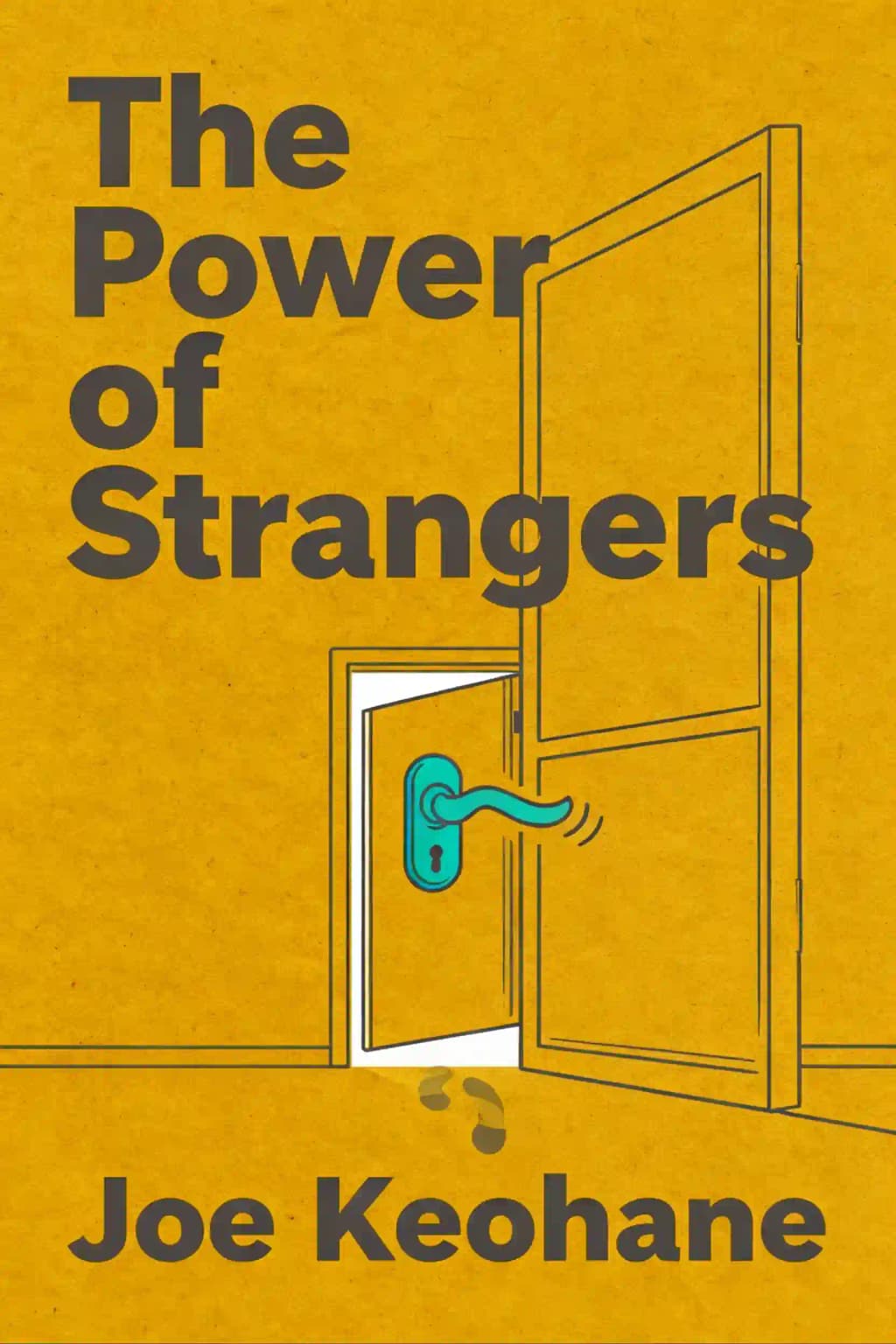
Based on the facts provided, I cannot create an introduction for "The Power of Strangers" by Joe Keohane as this appears to be a research article by James R. Bettman, not a book by Joe Keohane. Would you like me to create an introduction for a different book or clarify the title?
Joe Keohane, author of The Power of Strangers: The Benefits of Connecting in a Suspicious World, is an award-winning journalist and authority on social behavior, exploring how human connection shapes societies.
His book—a blend of psychology, sociology, and narrative nonfiction—examines trust-building across cultures, drawing on his decade-long career editing at Esquire, Entrepreneur, and Medium.
Keohane’s writing on politics, technology, and social science has appeared in The New Yorker, Wired, and New York magazine, cementing his reputation for translating complex research into accessible insights. A 2017 Screenwriter’s Colony fellow, he combines rigorous analysis with storytelling flair.
The Power of Strangers has garnered widespread acclaim, earning over 8,400 ratings on Goodreads for its timely critique of modern isolation and pragmatic solutions for fostering community.
The Power of Strangers explores the transformative benefits of connecting with people we don’t know, blending evolutionary biology, psychology, and anthropology. Joe Keohane argues that engaging strangers combats loneliness, fosters empathy, and strengthens communities, supported by global anecdotes and research on human cooperation.
This book suits socially curious readers, advocates for community-building, and individuals seeking to overcome social anxiety. It’s particularly valuable for those interested in societal cohesion, mental health improvements through connection, or understanding human behavior in polarized times.
Yes—readers praise its mix of rigorous research and relatable storytelling, calling it “meticulously researched and buoyantly written” (Esquire). Many report lasting impacts on their approach to social interactions, though some critique its occasional anecdotal digressions.
Keohane links today’s “loneliness epidemic” to declining stranger interactions, offering strategies like active listening and vulnerability to rebuild communal ties. He highlights initiatives fostering public dialogue as models for reconnection.
Some readers find the blend of research and personal anecdotes uneven, with passages feeling lengthy. However, many acknowledge the narrative’s effectiveness in illustrating practical applications of its theories.
His career at Esquire and Entrepreneur sharpens the book’s investigative depth, blending data-driven analysis with vivid storytelling. This approach makes complex social science accessible to general audiences.
While written pre-pandemic, Keohane notes lockdowns intensified societal isolation, underscoring his thesis. Post-pandemic readers gain urgency from his case for rebuilding public trust through small, intentional interactions.
Yes—Keohane suggests starting with low-stakes environments (e.g., coffee shops), using open-ended questions, and prioritizing active listening. He emphasizes consistency over perfection to build comfort.
Unlike Robert Putnam’s institutional focus (Bowling Alone), Keohane emphasizes interpersonal solutions. Compared to Malcolm Gladwell’s Talking to Strangers, this book prioritizes actionable strategies over diagnostic analysis.
These lines encapsulate its thesis on innate sociability and belonging.
As AI and remote work reduce spontaneous interactions, Keohane’s advocacy for intentional connection offers a counterbalance to digital isolation, making it a timely resource for rebuilding frayed social fabrics.
通过作者的声音感受这本书
将知识转化为引人入胜、富含实例的见解
快速捕捉核心观点,高效学习
以有趣互动的方式享受这本书
Everyone has 'a bit of gold' to share.
Technology has eliminated the 'friction' that once necessitated talking to strangers.
Everyone wrongly assuming no one else wants to talk.
Cooperation remained our dominant tendency.
Strangers hold the key to expanding our worlds in ways we can barely imagine.
将《Power of Strangers》的核心观点拆解为易于理解的要点,了解创新团队如何创造、协作和成长。
将《Power of Strangers》提炼为快速记忆要点,突出坦诚、团队合作和创造力的关键原则。

通过生动的故事体验《Power of Strangers》,将创新经验转化为令人难忘且可应用的精彩时刻。
随心提问,选择声音,共同创造真正与你产生共鸣的见解。

"Instead of endless scrolling, I just hit play on BeFreed. It saves me so much time."
"I never knew where to start with nonfiction—BeFreed’s book lists turned into podcasts gave me a clear path."
"Perfect balance between learning and entertainment. Finished ‘Thinking, Fast and Slow’ on my commute this week."
"Crazy how much I learned while walking the dog. BeFreed = small habits → big gains."
"Reading used to feel like a chore. Now it’s just part of my lifestyle."
"Feels effortless compared to reading. I’ve finished 6 books this month already."
"BeFreed turned my guilty doomscrolling into something that feels productive and inspiring."
"BeFreed turned my commute into learning time. 20-min podcasts are perfect for finishing books I never had time for."
"BeFreed replaced my podcast queue. Imagine Spotify for books — that’s it. 🙌"
"It is great for me to learn something from the book without reading it."
"The themed book list podcasts help me connect ideas across authors—like a guided audio journey."
"Makes me feel smarter every time before going to work"

免费获取《Power of Strangers》摘要的 PDF 或 EPUB 版本。可打印或随时离线阅读。
A cab driver on Nantucket once shared a haunting story: her wealthy Manhattan parents had bound her calves as a child following a bizarre socialite fad, permanently crippling her. When asked how they responded to the damage they'd caused, she replied, "They made me take dancing lessons... because they wanted to teach me to fall down more gracefully." This moment captures something profound about the human condition-and about what we're missing when we stop talking to strangers. We're living through a loneliness epidemic. Political polarization has transformed neighbors into aliens. Technology has eliminated the "friction" that once forced us to interact. Yet paradoxically, whenever we do connect with strangers, we experience relief and expansion. Research confirms this intuition: studies tracking daily interactions found that conversations with "weak ties"-passing acquaintances or friendly strangers-significantly boost happiness and belonging. Even brief exchanges with strangers during commutes create more positive experiences than silence, regardless of personality type. Yet when asked beforehand, people consistently predict these interactions will be unpleasant. We suffer from "pluralistic ignorance"-everyone wrongly assumes no one else wants to talk.