第 1 章
The Wisdom Beneath Our Skin: How Our Bodies Shape Intelligence
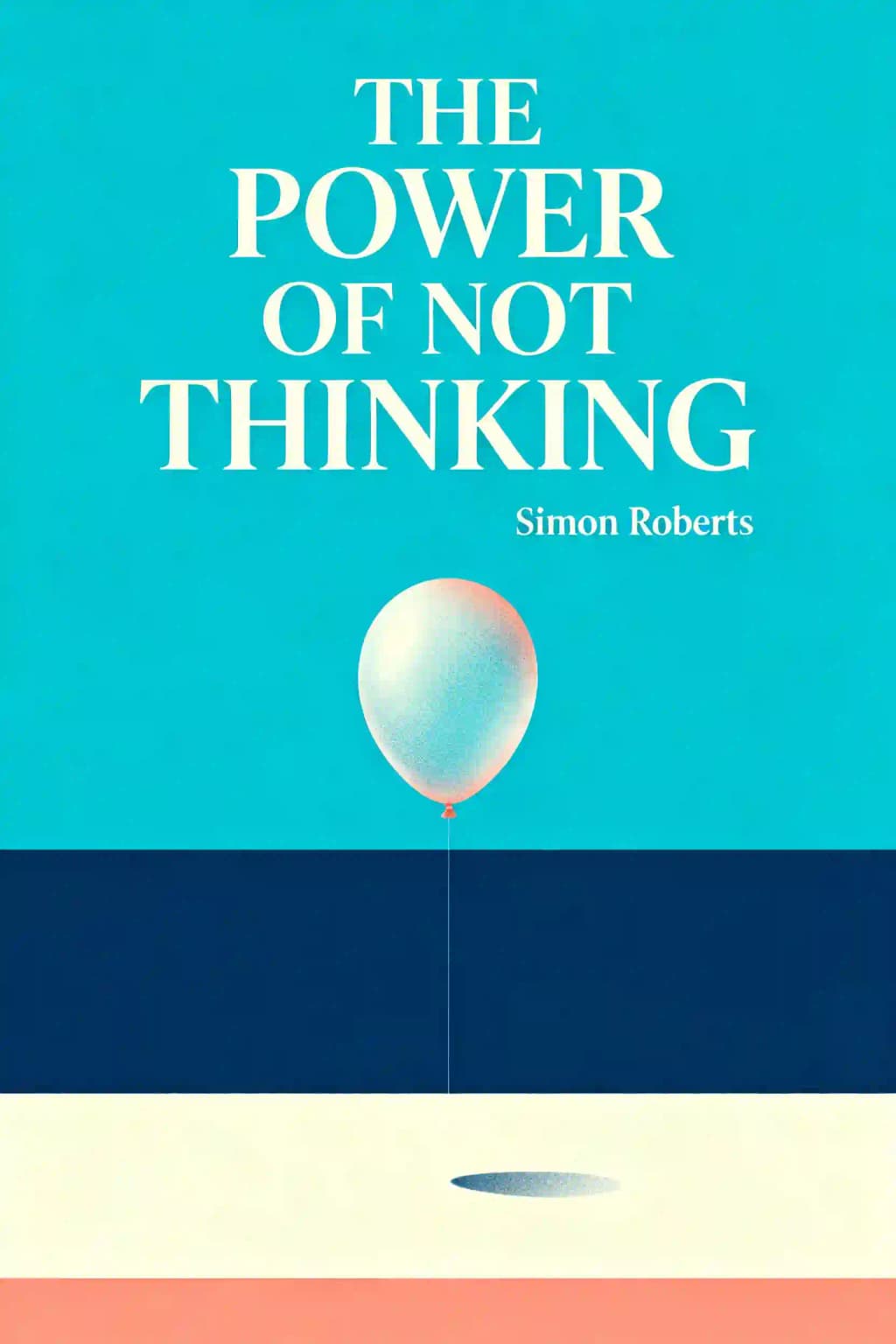
Imagine standing in front of a bicycle. You understand its mechanics perfectly-the chain, pedals, handlebars-yet when you try to explain how to ride it, words fail you. "Just balance," you say, knowing this inadequately describes the complex coordination of muscles, balance, and spatial awareness involved. This paradox lies at the heart of Simon Roberts' exploration of embodied knowledge-the profound intelligence that resides not just in our minds but throughout our physical being. In a world increasingly enamored with artificial intelligence and digital solutions, Roberts' work has garnered attention from business leaders at companies like Google and Facebook, who recognize that the most sophisticated algorithms still can't replicate the intuitive understanding that comes from physical experience. The book has become particularly relevant as organizations struggle to understand markets and behaviors that defy purely data-driven analysis, offering a compelling counternarrative to Silicon Valley's computational view of intelligence. As neuroscientist Antonio Damasio noted, "The Power of Not Thinking" provides "a timely reminder that we are creatures of flesh and blood, not just neural circuitry."
第 2 章
The Cartesian Legacy: Mind Over Matter
Rene Descartes cast a long shadow over Western thought when he separated the immaterial, thinking mind from the mechanical, passive body. This Cartesian dualism positioned the mind as the animator of an otherwise lifeless machine, much like a clockwork toy that operates only when wound up. Descartes dismissed the body as an unreliable knowledge source, arguing that our bodily senses deceive us. Using the example of a distant tower that appears round but might be square upon closer inspection, he claimed that only mathematics and geometry-products of mind, not body-reveal true understanding.
This distinction between mind and body has persisted through centuries, reflected in phrases like "ghost in the machine" and characters like Pinocchio who yearns to become a "real boy." It established a hierarchy where minds are trusted for accuracy while bodies are merely transportation devices or sources of sensory deception.
Descartes wasn't alone in developing new ideas about human intelligence. His contemporary Blaise Pascal created calculating machines as a teenager, perfecting the "Pascaline" that could perform basic arithmetic operations. Later, Charles Babbage developed his "difference engine" in 1822, which could use previous calculation results in subsequent ones-a breakthrough that led to his Analytical Engine, the blueprint for early computers.
Augusta "Ada" Lovelace, Lord Byron's daughter and Babbage's collaborator, made two revolutionary insights: first, that machines could manipulate symbols beyond just numbers if properly expressed; and second, that computers might perform creative acts beyond their explicit programming, like composing music. This transition from calculation to computation established the foundation for general-purpose computing.
Lovelace stands at the beginning of a lineage of thinkers whose work led to automating thought itself-from mechanical calculating devices to artificial intelligence. This progression follows the Cartesian logic that intelligence emerges from the mind's information processing, with the body playing little role. However, as we'll explore, our bodies aren't merely vessels directed by the mind but equal partners in our intelligence and knowledge acquisition.
第 3 章
Mapping Reality: When Abstractions Replace Experience
D.H. Lawrence once observed, "The map appears to us more real than the land," capturing how abstracted representations can supersede direct experience. This phenomenon has accelerated in our modern world, where GPS navigation has revolutionized travel but eliminated much of our need to pay attention to our surroundings.
London cab drivers dismiss GPS and services like Uber, claiming these systems can't match their intimate understanding of the city's streets and traffic patterns. Unlike GPS users dependent on abstract representations and instructions, cab drivers sense traffic flow, anticipate problems, and adjust routes dynamically based on embodied knowledge acquired through years of experience navigating London's complex streets.
GPS exemplifies "disembodied technology"-accurate but lacking intimate sense of place. Similarly, Google can provide restaurant information like address and busyness, but can't convey atmosphere or clientele type. This represents "knowledge by description" versus "knowledge by acquaintance"-the latter requiring personal experience. We've become so dazzled by descriptive technologies that we often trust them over our own experiences, replacing embodied engagement with disembodied efficiency.
This trend extends beyond navigation to how we understand society itself. The term "big data" emerged around 2003 when the volume of digital information reached unprecedented levels. By 2003, five exabytes of information existed-equivalent to 37,000 Library of Congress collections. By 2025, we'll create 463 exabytes daily.
Big data's intellectual lineage traces back to 17th century thinkers who, inspired by Galileo's mathematical monism, believed society could be explained through numbers just like nature. Early "data scientists" like astronomer Edmond Halley applied mathematical analysis to mortality data for insurance, while John Graunt analyzed disease patterns in London, establishing epidemiology's foundations.
This "social physics" approach continues today in crime prediction systems like New York's HunchLab and court sentencing algorithms. The underlying philosophy-that social life follows statistical laws-connects to George Zipf's mid-20th century belief that the same mathematical patterns govern everything from planets to human emotions. This thinking now shapes our daily experiences, from how streaming services like Spotify recommend music to how businesses view data as "the new oil."
Big data's limitations stem from its Cartesian dualism-the belief that an objective, numerical representation of society can exist separate from subjective human experience. While useful in many contexts, big data often fails to capture social relations, emotions, and inner worlds, encouraging us to mistake the map for the territory.
第 4 章
The Octopus Mind: Intelligence Beyond the Brain
The octopus defies our conventional understanding of intelligence and body-brain relationships. Despite their initially terrifying appearance, these gentle, inquisitive creatures display distinct personalities, recognizing different humans and even "greeting" divers with extended arms. With half a billion neurons-comparable to dogs-octopuses have invested heavily in brains, but what's truly remarkable is how their intelligence is distributed: over two-thirds of their neurons reside in their eight arms, with each sucker containing over ten thousand neurons.
Unlike humans, octopuses don't separate brain and body functions neatly. Their arms can act independently and intelligently without central coordination-even a severed arm can reach and grasp objects. More astonishingly, research suggests their skin can not only taste and smell but also "see," either by functioning as an eye or perceiving independently of the brain. These capabilities challenge our Cartesian assumptions about consciousness, suggesting bodies themselves can be intelligent. The octopus serves as nature's embodiment of the "embodied mind" concept-the idea that the mind is not merely connected to the body but fundamentally influenced by it.
While Descartes saw the mind as our essence and the body as a mechanical vessel, philosopher Maurice Merleau-Ponty reversed this relationship. He argued that "all forms of human experience and understanding are grounded in and shaped by our bodily orientation in the world." For Merleau-Ponty, perception begins with the body rather than the mind.
The phenomenologists challenged the distant, third-person perspective of objective science by describing human experience from a first-person viewpoint. Merleau-Ponty rejected the Cartesian notion that we are detached observers, instead seeing the body as our "anchorage" in the world. Where Descartes proclaimed "I think, therefore I am," Merleau-Ponty might have said, "I have a body, therefore I can know." He argued that our thinking depends on and is guided by our bodily experience rather than a higher form of logical intelligence.
Our bodies perform countless actions requiring embodied knowledge in daily life. At a concert, we dance, use phones, respond to our environment, and engage in nonverbal communication-all without conscious thought. This challenges traditional views of knowledge as something explicitly articulated and mentally processed.
Unlike explicit knowledge (like following a recipe from a cookbook), embodied knowledge is lived rather than documented. After cooking a dish several times, we rely less on written instructions as the knowledge becomes embodied. This knowledge is context-specific-a festival-goer would feel out of place in a classical concert hall because their body lacks the relevant embodied knowledge for that environment.
第 5 章
Stealing Knowledge With Your Eyes: How Observation Builds Intelligence
In 1990s Yemen, anthropologist Trevor Marchand gained access to traditional minaret builders by first observing them, then joining their ranks as an apprentice. What fascinated him was how complex building skills were transmitted with almost no formal instruction. Apprentices began with menial tasks while watching skilled craftsmen, gradually advancing to more complex work. Despite the absence of architectural plans and minimal verbal guidance, they mastered intricate three-dimensional construction through observation and mimicry.
Marchand discovered this inverted his Western architectural training, where theory preceded practice. The apprentices "stole knowledge with their eyes," learning by watching senior craftsmen's movements and techniques. Knowledge transferred from body to body without words, as apprentices observed, mimicked, and eventually mastered what they witnessed. This pattern of skill acquisition without explicit instruction appears across diverse traditions-from basket weaving to Capoeira-where embodied knowledge passes through observation rather than verbal teaching.
When someone finishes your sentence with exactly the word you intended to use, they're engaging in what linguists call "shared utterance"-demonstrating that speech is a collective act creating shared understanding. These verbal exchanges mirror our physical interactions, where we anticipate and complete each other's actions, like helping a struggling partner strain vegetables.
Motor simulation theory explains the science behind learning through observation. When we watch someone perform an action-whether hitting a tennis forehand or chopping herbs-our brains activate the same neural pathways as if we were performing the action ourselves. Our bodies experience minute nerve activity in relevant muscles, subtly preparing us to perform what we're observing. This explains how apprentices learn complex skills without instruction-their bodies are "understanding" through observation.
Even seemingly simple physical skills like somersaults are better demonstrated than described, as watching primes our bodies to perform. Observation is just the first step; embodied knowledge ultimately requires practice and repetition, but motor simulation theory reveals how our bodies begin learning before we physically attempt a task.
The power of observation extends beyond crafts to financial markets. Steve Eisman and his FrontPoint team discovered a massive financial opportunity before the 2008 crisis by immersing themselves in the real world of sub-prime lending. After arriving in Las Vegas with a $300 million short position against the market, they left with enough conviction to increase their bet to $550 million.
While FrontPoint had analyzed market data extensively, their firsthand observations provided the conviction to act decisively. The theoretical spreadsheets couldn't capture what direct experience revealed-that housing prices wouldn't rise forever, that low-wage workers with multiple properties spelled trouble, and that market oversupply would crash prices. As Marcel Mauss noted, "the body is man's first and most natural instrument" for learning about the world. Eisman's embodied observations created a perspective that abstract data alone couldn't provide.
第 6 章
Practice Makes Perfect: How Bodies Learn
Riding a bicycle seems simple once learned, yet explaining how we do it proves nearly impossible. Scientists struggled for decades to understand the physics behind cycling, with Jim Papadopoulos finally developing the definitive equations in the 1980s, though they weren't published until 2007. These equations revealed that we maintain balance primarily by steering into our falls-a counterintuitive action we perform unconsciously. This illustrates Michael Polanyi's concept that "we can know more than we can tell." Our embodied knowledge of cycling develops through practice rather than theoretical understanding, as our bodies learn to integrate movement, balance, and the bicycle's mechanics until the bike becomes an extension of ourselves.
Sociologist Erin O'Connor discovered that skill acquisition happens through immersion in practice environments when she apprenticed as a glassblower. Upon entering New York Glass, she was enveloped by the multisensory experience-the scent of charcoal and hot metal, the constant chatter of collaboration, and the heat. Initially just observing, she soon participated, learning that glassblowing knowledge comes through sensory experience rather than instruction alone. When struggling with techniques like "riding the bubble," her instructor's slight adjustment to her wrist position suddenly made abstract instructions meaningful. Over time, her body began to perform actions automatically, like continuously rotating the blow pipe while walking-evidence that she was becoming a glassblower through embodied practice.
The Dreyfus model of skill acquisition progresses from novice to expert through distinct stages. Novices learn basic rules without context, like sailors identifying wind direction. Advanced beginners apply maxims based on experience. Competent learners recognize which features to focus on in complex situations and develop care about performance. Proficient individuals replace reasoned responses with intuitive reactions, seeing problems holistically rather than as discrete components. Finally, experts know both what needs to be done and how to perform correctly through immediate, intuitive responses-they're not sailing a boat, they're sailing. As we develop mastery, we rely less on explicit rules and more on embodied knowledge, where our bodies "just know what to do."
Overthinking can devastate expert performance. Research shows that when skilled performers consciously focus on individual components of well-learned actions, their performance deteriorates-a phenomenon called "choking." In experiments with experienced golfers, they performed better when distracted by a secondary task than when focusing on their swing mechanics. Similarly, skilled footballers could dribble effectively while dividing attention, while novices needed conscious focus. The body performs best when allowed to execute learned skills without excessive mental interference.
第 7 章
Improvisation: The Body's Response to Uncertainty
Life unfolds in the present tense, filled with unanticipated events requiring spontaneous responses. The word "improvisation" itself derives from the Latin "improvisus," meaning unforeseen. Our ability to handle the unexpected is central to navigating daily existence.
Chess serves as a powerful metaphor for life's complexity and our improvisational abilities. While simple in appearance, chess quickly spirals into mind-boggling complexity-after just three moves, 121 million possible board positions exist. Chess games have scripted openings and calculated endgames, but the middle game requires true improvisation when players encounter novel positions. Unlike computers that analyze millions of positions per second, human masters rely on pattern recognition, identifying familiar configurations among their repertoire of 50,000-100,000 patterns.
Gary Klein's groundbreaking research on firefighter decision-making reveals how humans navigate complex situations without analytical comparison of options. Fire commanders facing life-or-death choices don't construct decision trees-they rely on "recognition-primed" decision making, instantly recognizing patterns from years of experience to anticipate how flames will spread or when buildings might collapse.
Klein discovered this approach extends beyond firefighting to critical care nursing, military operations, and chess. Experience proves crucial-veterans instantly pattern-match situations to their mental repertoire, while novices fall back on analytical approaches. This recognition-based strategy works best under time pressure and fluid conditions, though analytical methods remain valuable when decisions require justification or involve abstract data.
The body's perceptual powers stand central to this intuitive decision-making process. Through accumulated experience, humans develop the remarkable ability to read situations, assess options, and generate effective responses without conscious deliberation-a capability that remains extraordinarily difficult to replicate in machines.
The challenge of creating fully autonomous vehicles illustrates the remarkable complexity of human improvisation. Despite massive investments and top talent, companies like Waymo have admitted that Level 5 autonomy (vehicles that can drive anywhere, anytime, in any conditions) remains elusive and perhaps impossible. The hurdles are numerous: weather disrupts sensors, roads constantly change with shifting vegetation and infrastructure, and mapping the world in sufficient detail is prohibitively expensive.
Most critically, roads contain unpredictable humans-drivers, pedestrians, cyclists-creating infinitely complex environments. Even simple driver interactions at intersections involve subtle communication through eye contact, body language, and vehicle positioning that humans process effortlessly but machines struggle to interpret. This "game theorizing" happens in seconds yet represents an everyday marvel of human intelligence.
第 8 章
The Mirror Within: How Bodies Create Empathy
Our capacity for empathy-understanding others' perspectives and experiences-emerges not from abstract thought but through bodily experience. This fundamental human capability has declined in Western societies even as communication technology has proliferated.
A middle-aged mountain biker's sudden fear on a forest trail reveals how bodily experience unlocks genuine empathy. Despite years researching aging populations, only when experiencing his own physical decline did he truly understand the emotional reality of growing older.
Architect David Dillard's innovative "Sleepover Project" demonstrates this principle professionally. During the 2008 recession, he assigned his young architects simulated health conditions-arthritis, dementia, mobility impairments-before sending them to spend 24 hours in senior living facilities. The experience transformed their understanding as they discovered how thresholds between materials became obstacles, how residents "furniture surfed" for support, and how terrifying being hoisted over a bath could feel. The architects realized that no amount of research could substitute for embodied experience of the challenges faced by those they designed for.
William James argued that emotions originate from our bodies, not our minds-we feel afraid because we run, not run because we're afraid. Without physical manifestations like quickened heartbeats or trembling limbs, emotions would be merely intellectual concepts. This embodied view of emotions suggests we can't conjure emotional responses without bodily involvement.
The body shapes the mind in profound ways. Studies show that "whistling to keep up courage" or using Botox to prevent frowning can actually improve mood-people with depression who received Botox injections showed 47% improvement compared to placebo groups. Darwin similarly noted that expressing emotions intensifies them, while suppressing physical signs diminishes emotional experiences.
In the 1990s, researchers in Parma, Italy discovered "mirror neurons" in monkeys' brains that fired both when performing an action and when watching others perform similar actions. These neurons appeared to map observed actions onto the monkey's own motor system, suggesting a direct neural mechanism for understanding others' actions.
Further experiments revealed these neurons respond to meaning rather than just visual features-monkeys' brains showed similar activity when hearing paper being ripped as when seeing it, and when imagining someone picking up food behind a screen. In humans, this mirroring system extends to emotions-when we see someone expressing disgust, our brains activate the same neural patterns as if we were experiencing disgust ourselves. This provides a biological basis for empathy, what neuroscientist Ramachandran called "Gandhi cells" that break down barriers between people by allowing us to literally feel what others feel.
第 9 章
Bodies That Remember: How Knowledge Becomes Muscle Memory
If the body is central to experience and feelings, it's also fundamental to how we retain and recall knowledge. The "Proustian moment"-when sensory cues trigger vivid memories-demonstrates that memory resides as much in the body as in the brain. Contrary to viewing the brain as a filing cabinet of memories, our bodies themselves store and access knowledge in ways that challenge conventional understanding.
Our bodies remember not just how to perform actions but also spaces, sensations, and feelings associated with places. When visiting familiar environments like our supermarket, we navigate effortlessly through a multidimensional sensory map engaging all senses-temperature changes near refrigerated aisles, enticing smells from the bakery-along with proprioception, our sense of body position. This embodied memory extends to our relationships with others-sleeping on the same side of the bed or adopting familiar walking positions with partners creates comfort through bodily alignment. Sensory memories like tastes or odors can trigger the essence of people, places, or moments without conscious effort, demonstrating how deeply our memories are grounded in our physical experiences.
Professional identities aren't just about uniforms or knowledge but require truly embodying a role. Police officers must physically assert authority beyond knowing laws, while priests learn bodily positions that convey humility and care. As Marcel Mauss observed, even walking styles reflect cultural dimensions rather than just personal habits. Our bodies become repositories of cultural knowledge-military training physically transforms recruits into soldiers by breaking down and remaking their bodies as weapons. Cultural practices worldwide involve bodily alterations and decorations that communicate social messages and mark transitions. The body isn't merely flesh and bone but a vessel that both contains and expresses cultural meaning.
Actors' seemingly effortless memorization of scripts relies on linking dialogue with physical action. Research shows lines delivered while moving are more memorable than those spoken while stationary. When actors physically engage with props and movements that reflect their character's meaning, the memory becomes grounded in bodily action. This connection between meaning, lines, and movement creates stronger recall than simply memorizing dialogue.
Andy Clark and David Chalmers revolutionized cognitive science by arguing that our minds extend beyond our brains into our bodies, objects, and environments. Their "extended mind" theory suggests thought is "scaffolded" by external elements-just as we use paper for complex calculations or smartphones to store phone numbers. They illustrated this with Otto, who uses a notebook to compensate for memory impairment, functioning cognitively like someone with normal memory. This perspective unites brain, body, and environment in understanding cognition, recognizing that our "muscular consciousness" makes memory more than just a cognitive phenomenon.
第 10 章
Embodied Business: When Experience Trumps Data
In 2018, Comcast CEO Brian Roberts took an unconventional approach during his Sky television takeover bid. While his advisers analyzed numbers, Roberts spent time talking with Sky salesmen and even absorbed insights from a knowledgeable taxi driver about Sky's product differences. This first-hand experience gave him a feel for what made Sky special, influencing his 22bn acquisition decision. This approach contrasts sharply with typical business operations that treat markets as abstractions rather than collections of diverse humans with emotions and contradictions.
The Duracell executive team from New York experienced firsthand what camping entails, from learning about tog ratings and lumens at an outdoor equipment store to pitching tents at Lake Morena County Park. Their inexperience showed in tent placement and campsite etiquette, while they learned valuable lessons about different lighting needs in the wilderness. The cold night made theoretical product specifications suddenly practical concerns. By morning, the executives gained embodied knowledge about why outdoor enthusiasts care deeply about reliable equipment-especially battery-powered devices that ensure comfort and safety. This experiential approach to market research, though risky in a corporate context, proved invaluable. The insights gained led to one of Duracell's most successful advertising campaigns featuring climber Kevin Jorgeson, which resonated authentically with the outdoor community because the team had physically experienced what mattered to their target audience.
When Facebook needed to understand users in emerging markets like India, they took an embodied approach to knowledge. Engineering VP Tom Alison sent a team to experience firsthand how users accessed Facebook on slow networks and low-end devices. They discovered users who would leave Facebook open overnight just to download enough content for morning viewing-a stark contrast to Silicon Valley's high-speed experience. This led to "2G Tuesdays," where Facebook employees could opt to experience their own product on simulated slow networks for an hour weekly. This visceral experience of frustration using their own product on 2G networks spread throughout the company, complementing market data with embodied understanding. The initiative contributed to Facebook's successful adaptation to emerging markets, including the launch of Facebook Lite, which gained 200 million users in just two years-their fastest-growing app ever.
Peter Drucker warned in 1989 about businesses becoming too dependent on disembodied data and information, stunting their ability to assess reality. As organizations increasingly adopted analytical logic and statistics to convert experiences into quantifiable information, they began not just using computers but thinking like them. This mechanistic worldview, rooted in Cartesian philosophy, pushed perceptual approaches aside in favor of analytical ones. Yet markets aren't governed by immutable physical laws-they're animated by "animal spirits" and human emotion, filled with contradictions. While executives are often criticized for using "gut feel" (33% admit to using experience and intuition for strategic decisions), in a world of imperfect information and uncertainty, judgment based on relevant experience remains essential.
第 11 章
The Body's Advantage: Human Intelligence in the Age of AI
From Descartes's mythical mechanical daughter to HAL 9000 and replicants in Blade Runner, the fascination with reproducing human intelligence persists. Roboticist Rodney Brooks defines intelligence simply as "the sort of stuff that humans do, pretty much all the time," focusing on everyday activities rather than grand ambitions like DeepMind's mission to "solve intelligence."
AI was born at an eight-week summer workshop in Dartmouth in 1956, establishing research centers and planting the seed for artificial general intelligence (AGI)-an intelligence capable of learning any intellectual task humans can perform. The attendees, primarily mathematicians and computer scientists, approached intelligence as symbol manipulation following rules, mirroring computer operations rather than human embodied cognition.
Early AI research focused on reproducing a mind that could translate real-world information into processable symbols within a logical system. This approach, later dubbed "GOFAI" (good old-fashioned artificial intelligence), viewed intelligence as disembodied computation, assuming "the mind was a kind of software program, and the body and the brain just hardware." Systems for tasks like object recognition were developed in controlled laboratory conditions, isolated from real-world complexity.
Our misconception that intelligence is defined by cognitive skills like chess or mathematics led early AI researchers to believe they could quickly achieve their goals. While AI has made remarkable progress in these "hard" cognitive domains, it struggles with what Hans Moravec observed are seemingly "easy" human tasks. Computers can win at chess but cannot match a one-year-old's perception and mobility skills. Humans effortlessly recognize faces in crowds, manipulate objects with perfect pressure, and read emotional states-all incredibly difficult engineering problems that we handle unconsciously through our embodiment. These sensory and motor skills, developed over a billion years of evolution, far outdate our reasoning abilities, which are merely a hundred thousand years old.
Our education system has perpetuated the narrow view that intelligence is primarily cognitive ability, leading AI development to focus on replicating logical analysis and reasoning. But intelligence requires a body that inhabits the world-it's our embodiment that enables distinctively human abilities like sense-making, pattern recognition, and sensorimotor capabilities. As Melanie Mitchell explains, human understanding depends on "common-sense knowledge" about how the world works, including goals and motivations of other creatures, and our ability to form abstract concepts and make analogies.
While we must learn to live with AI and robots, accommodating their growing capabilities in our society, we should focus on how they can complement our weaknesses rather than replace us entirely. Technologies like driving safety systems and medical diagnostic tools can extend human capabilities, but our embodiment gives us unparalleled abilities that machines cannot easily replicate. Two important paradoxes highlight this: Polanyi's assertion that "we know more than we can tell"-human knowledge is ineffable, dynamic and contextual; and Moravec's paradox, which reminds us that our perceptual and manipulative skills far exceed those of machines. While computers excel at chess and data processing, they struggle with the "low-level" skills of perception and manipulation that humans perform effortlessly.
We've been conditioned to trust hard data over experience, instinct, and intuition, believing that "computable" knowledge is more reliable than what we derive from our own experiences. This mindset has been reinforced by the rise of computing technology. Yet embodied knowledge-the intelligence that emerges from our physical interaction with the world-is what separates us from artificial intelligence and gives us our competitive advantage. By developing embodied knowledge, we'll be better equipped to handle uncertainty and make decisions based on empathetic understanding. We should celebrate this uniquely human capacity to know, think, and feel through the interaction of our minds, bodies, environments, and experiences.