第 1 章
The Conservative Vision: A Journey Through Intellectual History
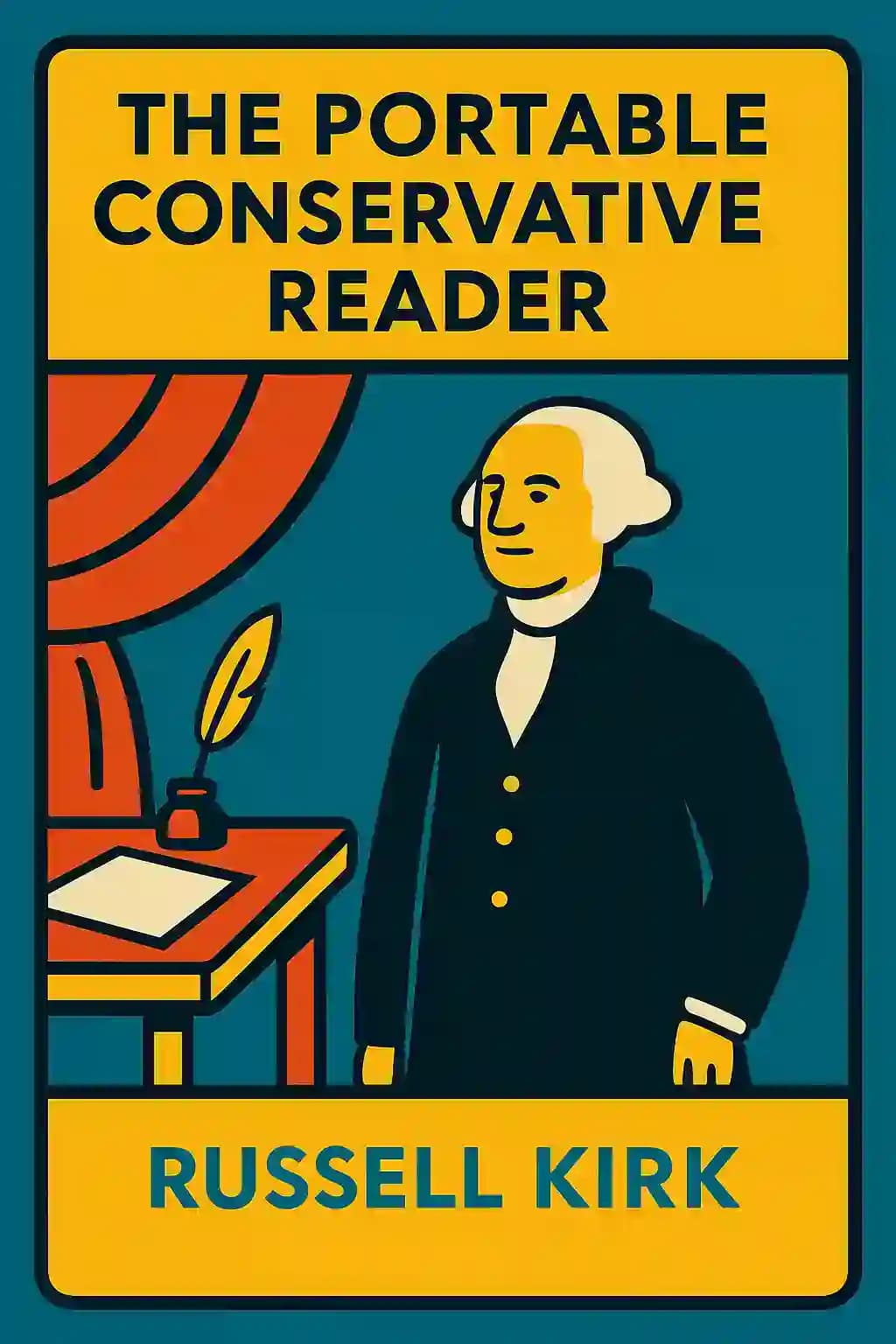
In the tumultuous landscape of political thought, conservatism stands as one of the most misunderstood yet enduring philosophical traditions. Russell Kirk's "The Portable Conservative Reader" offers a profound journey through this intellectual heritage, tracing its development from Edmund Burke's response to the French Revolution through the challenges of the modern era. What makes this collection remarkable isn't just its historical scope but its demonstration that conservatism represents not a rigid ideology but a way of viewing human nature and society with both skepticism and reverence. Interestingly, this book has found unexpected champions in figures like Christopher Hitchens, who despite his left-leaning politics, praised Kirk's anthology for its intellectual honesty and depth. The work's cultural impact extends beyond political circles, influencing filmmakers like Whit Stillman and writers like Marilynne Robinson, who have drawn from conservative intellectual traditions in their creative works. In an age of increasing political polarization, Kirk's collection reminds us that conservatism at its best offers not just resistance to change but a thoughtful approach to preserving what is valuable in human experience.
第 2 章
The Delicate Balance: Order and Freedom in Conservative Thought
At the heart of conservative philosophy lies a fundamental tension between the need for social order and the desire for individual liberty. Edmund Burke, widely regarded as the father of modern conservatism, masterfully articulated this balance in his writings on the French Revolution. Unlike radical revolutionaries who sought to remake society according to abstract principles, Burke understood that freedom exists not in a vacuum but within the context of established traditions and institutions.
"A state without the means of some change," Burke observed, "is without the means of its conservation." This profound insight reveals that true conservatism isn't about rigid opposition to all change but about ensuring that necessary reforms preserve what is essential while addressing what is deficient. The conservative approach treats liberties not as abstract rights to be invented but as "an entailed inheritance" passed down through generations, creating what Burke called "a just correspondence and symmetry with the order of the world."
This inheritance includes what Burke termed the "decent drapery of life" - those customs, manners, and moral habits that elevate human existence above mere animal survival. When revolutionaries strip away these civilizing elements in the name of reason or equality, they don't liberate humanity but expose it to the raw forces of power and violence. The "pleasing illusions" provided by the moral imagination aren't deceptions but the very fabric that makes civilized society possible.
Burke's distinction between abstract rights and practical political rights remains especially relevant today. While theorists might speak of absolute freedoms, Burke understood that rights in society must consider circumstances and convenience. Government requires "delicate and complicated skill" based on deep knowledge of human nature. True rights exist in a middle ground, representing advantages gained through compromises and balances that acknowledge "the nature of man is intricate; the objects of society are of the greatest possible complexity."
Perhaps most importantly, Burke recognized that liberty requires self-restraint. His famous observation that "men are qualified for civil liberty in exact proportion to their disposition to put moral chains upon their own appetites" reminds us that freedom without virtue inevitably descends into chaos. The conservative vision sees liberty not as license but as the space where responsible individuals can flourish within a moral framework that both constrains and elevates human nature.
第 3 章
America's Conservative Foundations: Federalist Wisdom
While many associate American political thought primarily with revolutionary ideals, the conservative principles articulated by the Federalists played an equally crucial role in shaping the nation. John Adams, Alexander Hamilton, and Fisher Ames developed a distinctively American conservatism that, while influenced by Burke, responded to the unique challenges of building a new republic.
Adams recognized that free government offered immense advantages over monarchy through broader communication with citizens and checks against ministerial abuses. Yet he insisted that democracy required careful constraints to prevent its descent into tyranny. "No free government can exist without a democratic branch," Adams observed, but he warned that the wealthy and able must be separated into a senate to prevent their overwhelming influence in a single representative assembly.
This balanced approach reflected Adams' clear-eyed view of human nature. While affirming that "all men are born to equal rights," he denounced as fraudulent the notion that all possess equal powers or advantages. Natural differences inevitably create different levels of influence in society, making perfect equality an impossible and dangerous goal.
Hamilton, writing as The Continentalist, similarly warned against weakening the federal government in the name of local liberty. Drawing lessons from the Greek commonwealths whose jealousy of centralized authority led to constant civil strife, Hamilton argued that in federal systems, the greater risk was that member states would overpower the central government rather than the reverse. His prescient analysis identified how citizens would naturally feel stronger allegiance to their state than to the union, potentially undermining national cohesion.
Perhaps the most sobering assessment came from Fisher Ames, who foresaw America's potential decline even as others celebrated its founding. Unlike optimistic contemporaries, Ames perceived a republic already "visibly drawn within the revolutionary suction of Niagara." He warned that "simple governments are despotisms; and of all despotisms a democracy, though the least durable, is the most violent." America's experiment with unprecedented democratic elements was undertaken with "blind presumption," and Ames feared that faction would inevitably triumph as democracy bred groups seeking to "engross power to themselves."
These Federalist concerns weren't rejections of liberty but attempts to secure it through prudent constitutional arrangements. Their insights remind us that America's founding wasn't simply a revolutionary break with tradition but a careful effort to establish ordered liberty based on realistic assessments of human nature and historical experience.
第 4 章
The Poetic Response: Conservative Literary Imagination
While political theorists articulated conservative principles in prose, poets often expressed these insights with even greater emotional resonance and imaginative power. The Romantic poets, in particular, offered a unique perspective on the revolutionary era, as their artistic sensibilities allowed them to capture both the initial allure and subsequent disillusionment with radical change. Initially sympathetic to revolutionary ideals, poets like Samuel Taylor Coleridge, William Wordsworth, and Robert Southey eventually turned against radicalism as they witnessed its destructive consequences unfold across Europe.
Coleridge's evolution from revolutionary enthusiast to conservative thinker is particularly well documented in his 1798 "France: an Ode." The poem begins with powerful invocations to nature - clouds, waves, woods, and mountains - as authentic emblems of true liberty, contrasting sharply with the false freedom promised by revolutionary France. Coleridge confesses his initial excitement when France "upreared" and "said she would be free," even opposing Britain's alliance against France. But his tone shifts dramatically as he witnesses France's descent into violence and tyranny, lamenting "blasphemy's loud scream" and the "fierce and drunken passions" that corrupted the revolution's noble aims. The poem culminates in a recognition that genuine liberty requires moral restraint and cannot exist in conditions of anarchic violence.
Wordsworth's political transformation paralleled Coleridge's. His early enthusiasm for the French Revolution, captured in "The Prelude," gave way to horror at the Reign of Terror. In his later works, particularly "The Excursion," Wordsworth celebrated instead the quiet dignity of rural life and traditional communities, viewing them as repositories of wisdom that modern progress threatened to destroy. His poetry increasingly emphasized the importance of gradual, organic change over revolutionary rupture.
Beyond poetry, Coleridge offered profound insights into constitutional theory that continue to influence conservative thought. He argued that a constitution isn't merely a document or collection of laws but "a principle existing in the only way in which a principle can exist - in the minds and consciences of the persons whose duties it prescribes, and whose rights it determines." Though abstract, it has "real existence" in the same way that mathematics or life itself have reality. This understanding of constitutions as living traditions rather than mere legal documents became central to conservative political philosophy.
Robert Southey, meanwhile, turned his literary talents to critiquing industrial exploitation, demonstrating how conservative thought could embrace social criticism. In his portrayal of Manchester, he condemns the manufacturing system that creates "white slaves" doing "all its dirty work." He describes workers toiling in "unwholesome employments" before "furnaces which are never suffered to cool," leading inevitably to disease and death. His accounts of child labor were particularly moving, describing young lives stunted by endless hours of mechanical labor. While acknowledging England may struggle to remedy these evils, he suggests other countries can avoid them by ensuring high wages, which benefit society by allowing workers to educate their children and maintain dignified lives.
These poetic responses reveal how conservatism isn't merely about defending existing power structures but often involves critiquing aspects of modernity that undermine human dignity and traditional communities. The conservative literary imagination recognizes that material progress doesn't necessarily represent moral improvement, and that technological advancement can sometimes come at the cost of deeper human values. Their work demonstrates how conservative thought, at its best, combines respect for tradition with a humane critique of social and economic developments that threaten human flourishing. This literary tradition helped establish conservatism not just as a political philosophy but as a comprehensive way of seeing the world that values imagination, emotion, and cultural memory alongside rational analysis.
第 5 章
Southern Conservative Thought: A Distinctive Tradition
The American South developed its own distinctive conservative tradition, characterized by passionate attachment to rural society and traditional ways. John Randolph of Roanoke emerged as perhaps its most eloquent champion, defending the old Virginia constitution against proposed innovations in the state's 1829-30 constitutional convention.
Speaking with regret that representatives from his region had been reluctant to debate, Randolph argued that while he wasn't opposed to constitutional change when necessary, any alterations must address vital, proven grievances with reasonable remedies. He rejected abstract principles as guides to governance, quoting Burke that "no rational man ever did govern himself by abstractions."
Randolph's most penetrating insight came in his declaration that separating property from power is impossible - "the two sexes do not more certainly gravitate to each other, than power and property." He warned that if "King Numbers" prevailed, he would consider leaving Virginia entirely, declaring "I would not live under King Numbers. I would not be his steward, nor make him my taskmaster."
John C. Calhoun provided a more systematic defense of this Southern conservative vision, particularly in his 1842 Senate speech opposing Henry Clay's proposed constitutional amendment to limit presidential veto power. Calhoun challenged Clay's premise that the American people constituted a nation governed by simple numerical majority, demonstrating through careful calculation how the Electoral College gives disproportionate influence to smaller states.
Calhoun argued that our system is not a union of individuals in a social compact (which would make it a nation), nor merely of governments (which would be a confederacy), but "an union of States" maintaining their separate existence while united in sovereignty. This complex system wisely prevents either the tyranny of the majority or minority by requiring the concurrence of different parts of government representing different interests.
Southern conservatism, while ultimately defeated in the Civil War, offered important insights about the dangers of unchecked majority rule and the value of maintaining distinct regional cultures and traditions within a larger national framework. Its emphasis on local autonomy and skepticism toward centralized power continues to influence American conservative thought today.
第 6 章
The Conservative Critique of Democracy and Equality
Conservative thinkers have consistently questioned the assumptions underlying democratic governance and egalitarian ideals, offering nuanced critiques that remain relevant to contemporary political discourse. James Fenimore Cooper, in his detailed analysis, made a crucial distinction between equality of condition and equality of rights - a differentiation that forms the cornerstone of conservative political philosophy. He argued that equality of condition is "incompatible with civilization" and exists only in societies "slightly removed from the savage state," ultimately resulting in what he termed "common misery" in practice. This perspective emerged from his observation of various attempts at enforced economic equality throughout history, from ancient agrarian societies to early American experiments with communal living.
Cooper's examination of the Declaration of Independence's famous proposition that "all men are created equal" was particularly sophisticated. He emphasized that this statement demands careful interpretation rather than literal acceptance. Men are not born physically or morally equal - "one possessing genius, while his brother is an idiot" - and these natural inequalities manifest in countless ways, from intellectual capacity to physical abilities. Instead, Cooper argued, the Declaration's meaning is specifically political: "God has not instituted political inequalities," and humans possess the natural authority to form social institutions suited to their needs and circumstances. This interpretation preserves both natural hierarchy and democratic legitimacy.
Perhaps most presciently, Cooper warned against what he saw as democracy's greatest threat: the tyranny of public opinion. His observation that "in America, it is indispensable that every well wisher of true liberty should understand that acts of tyranny can only proceed from the publick" anticipated modern concerns about cancel culture and social media mob mentality. He insisted that the public must be watched in America as "kings and aristocrats are watched" elsewhere - a warning that seems particularly relevant in our age of mass communication and social pressure.
Alexis de Tocqueville expanded this analysis through his comprehensive study of American democracy, particularly examining how democratic equality transformed traditional moral understanding. While acknowledging that modern morality expanded certain Christian principles - especially regarding equality and charity - Tocqueville argued these were developments rather than fundamental changes. He observed how charity had evolved from a personal virtue practiced by individuals to "a social duty, a political obligation," with governments increasingly expected to address inequalities and provide support to the disadvantaged. This shift, he noted, fundamentally altered the relationship between citizen and state, creating new expectations and dependencies that would have been foreign to earlier generations.
This conservative critique doesn't reject democracy wholesale but rather seeks to temper its excesses through constitutional constraints and moral education. It recognizes that majority rule without limitations can be as tyrannical as any monarchy - potentially more so, as it claims the legitimacy of popular will. The solution, these thinkers argued, lies not in abandoning democratic principles but in strengthening the institutions that protect individual rights, promoting civic virtue, and maintaining the delicate balance between popular sovereignty and constitutional limits. This includes fostering a robust civil society, maintaining checks and balances, and cultivating an educated citizenry capable of responsible self-governance.
第 7 章
Against Utopian Thinking: The Conservative Realism
A central theme in conservative thought is skepticism toward utopian schemes that promise perfect societies through radical transformation. Nathaniel Hawthorne's allegorical tale "Earth's Holocaust" brilliantly captures this concern, depicting reformers who burn everything from marriage certificates to religious emblems in a great bonfire of purification.
The tale reaches its climax when a dark stranger appears, laughing at the entire spectacle, and reveals what the reformers have forgotten to burn: "the human heart itself." Without purifying that "foul cavern," he declares, all shapes of wrong and misery will simply reappear. Hawthorne's profound insight is that external reforms mean nothing without internal transformation - a distinctly conservative recognition of the limits of political solutions to moral problems.
This realism about human nature appears throughout conservative writing. Orestes Brownson, though supporting the Union in the Civil War, preferred Southern society's natural hierarchy to Northern materialism and radical notions of human progress. He condemned those who would revolutionize Southern society, arguing that its aristocratic structure provided stability through natural leadership, unlike the North's artificial, business-oriented hierarchy.
Sir Henry Maine similarly examined how political theories persist through their vocabulary long after being discredited. He dissected Rousseau's Social Compact theory, which posits that mankind emerged from a State of Nature by unanimously agreeing to surrender all individual rights to the sovereign community. Maine dismissed this foundation as "the most baseless" political speculation, built on imaginary premises about primitive society.
This conservative realism extends to economic matters as well. E.L. Godkin challenged socialist promises by examining their economic foundations. He noted that while previous social evolutions increased productivity and wealth, the proposed socialist transformation would be primarily about spending rather than creating wealth. The fundamental problem, Godkin argued, is not some untapped "reservoir of wealth" but the reality that subsistence must be earned.
Conservative realism doesn't mean resignation to injustice but rather a recognition that social improvement comes through gradual reform guided by experience rather than abstract theories. It values the accumulated wisdom of tradition over the speculative schemes of intellectuals who would remake society according to their own designs.
第 8 章
The Modern Challenge: Conservatism in an Age of Ideology
As the twentieth century progressed, conservatives faced unprecedented challenges from totalitarian ideologies and the expanding reach of state power. Christopher Dawson conducted an extensive analysis of different forms of totalitarian states and their complex relationship to religion, examining cases from Nazi Germany to Soviet Russia. While Communism directly opposed Christianity by offering a rival "way of salvation" through historical materialism and class struggle, Dawson argued that the greatest threat to religious life wasn't violent persecution but something more insidious - "the crushing out of religion from modern life by the sheer weight of a state-inspired public opinion and by the mass organization of society on a purely secular basis." This subtle erosion occurred through education, media control, and the reorganization of daily life around secular institutions.
T.S. Eliot's critique of Marxist literary criticism demonstrated both wit and philosophical depth. He observed how communism seduced young intellectuals by offering a comprehensive worldview that explained everything from economics to aesthetics. Through detailed analysis of specific works and critics, Eliot rejected the deterministic notion that communist art would be superior, arguing that truly great art - from Shakespeare to Dante - transcends its historical conditions rather than being merely explained by them. The Christian critic, Eliot suggested, could appreciate excellence in writing regardless of its political origins, while the Marxian critic was forced to engage in tortuous analysis to determine what art "ought to be" according to dialectical materialism.
C.S. Lewis addressed what he termed "the poison of subjectivism" with characteristic logical precision. He demonstrated that if morality is merely subjective - just expressions of emotion or cultural conditioning - then we face insurmountable philosophical problems. We cannot meaningfully condemn Nazi ideology as worse than our own, nor can we coherently speak of moral progress without some unchanging standard against which to measure change. Through careful analysis of specific examples, Lewis exposed how moral reformers repeatedly contradicted themselves by rejecting traditional values while simultaneously smuggling them back through vague concepts like "the good of the community" or "social justice."
These conservative thinkers recognized that modern ideologies threatened not just political arrangements but the very foundations of Western civilization - its religious heritage, moral traditions, and cultural achievements. Their response wasn't mere reactionary opposition but a thoughtful defense of enduring values against ideological simplifications. They demonstrated how totalitarian systems, whether through direct opposition or subtle erosion, undermined the complex web of traditions, beliefs, and cultural practices that sustained civilized life. Their writings offered sophisticated philosophical arguments showing how ideologies that reduced human experience to economic or political formulas failed to capture the full depth of human nature and society's needs.
Through careful historical analysis and philosophical argument, these thinkers showed how conservatism could engage with modern challenges while preserving essential truths about human nature, morality, and culture. Their work remains relevant for understanding contemporary challenges to traditional values and institutions.
第 9 章
Preserving Civilization: The Conservative Vision for the Future
Despite the challenges facing traditional societies, conservative thinkers have consistently offered hope for cultural renewal through the preservation of essential institutions and values. Michael Oakeshott described the conservative disposition as one that values the concrete world of things as they are - a world of fact rather than poetic image, where other people exist independently of our emotions.
Robert Nisbet argued for the importance of intermediate associations - groups lying between individual and state with meaningful autonomy. He emphasized that individual initiative rarely exists outside some moral and intellectual community, and that humans are naturally bound by ties of work, friendship, recreation, learning, faith and mutual aid. Nisbet saw signs of hope in the recrudescence of kinship, neighborhood and local community, believing that intermediate association and social invention were not utopian fantasies but historical realities likely to reemerge.
Russell Kirk, reflecting on the fragments of Christian civilization, found hope in those working to preserve what remains valuable. Using the metaphor of "cultural debris," Kirk identified three pillars holding modern civilization together: Christian faith, humane letters, and ordered liberty. He warned that our civilization faces collapse unless those who "know what makes life worth living" make common cause against modern barbarism.
This conservative vision for the future doesn't promise utopia but offers a realistic path toward maintaining what G.K. Chesterton called "the democracy of the dead" - the accumulated wisdom of tradition that connects us to previous generations and provides guidance for addressing contemporary challenges. It recognizes that true progress comes not from revolutionary breaks with the past but from building thoughtfully upon foundations laid by those who came before us.
In an age of rapid technological change and social transformation, the conservative vision reminds us that human nature remains constant, that communities and traditions provide essential contexts for individual flourishing, and that civilization itself depends on preserving certain fundamental truths about the human condition. This isn't mere nostalgia but a recognition that some things are worth conserving precisely because they speak to permanent aspects of human experience that transcend the fashions and ideologies of any particular era.