第 1 章
The Whisper That Speaks Volumes
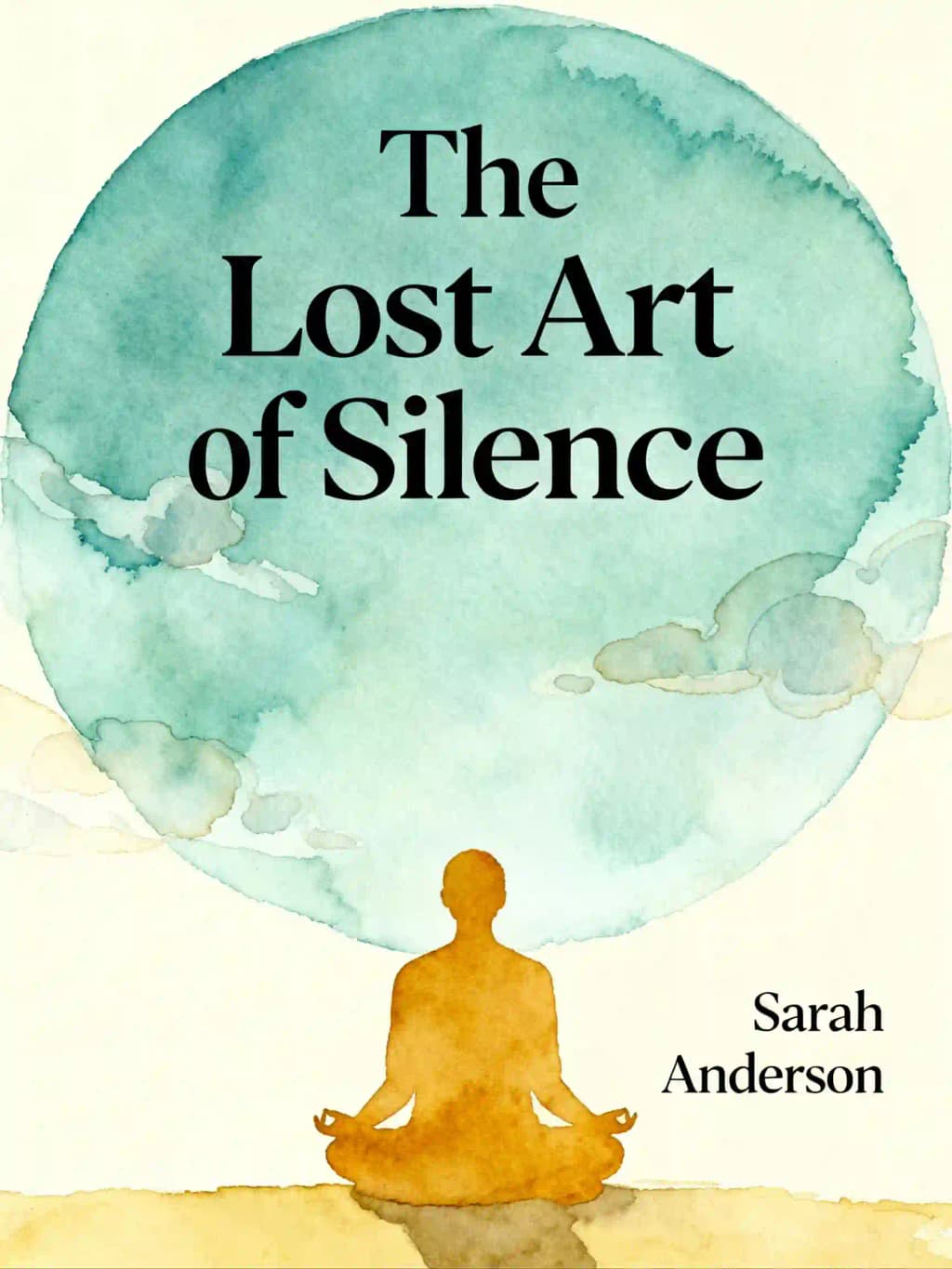
In a world that never stops talking, silence has become a luxury few can afford. Sarah Anderson's "The Lost Art of Silence" arrives at a critical moment when the average person checks their smartphone every twelve minutes and noise pollution affects over 210 million Europeans daily. This thoughtful exploration has garnered praise from mindfulness experts and spiritual leaders alike, with the Dalai Lama calling it "essential reading for our distracted age." Anderson's journey through silence spans continents-from Antarctic ice fields to Carthusian monasteries-and resonates deeply with readers seeking respite from our cacophonous world. As noise-canceling headphone sales surge past $10 billion annually, this book offers something more valuable: a path to reclaiming our relationship with silence itself.
第 2 章
The Paradoxical Nature of Silence
Silence isn't merely the absence of sound-it's a presence with its own texture and substance. As Anderson explores, we crave silence because it enhances attention and provides rest from external stimuli, allowing our minds to process information more deeply and creatively. Gandhi noted that "a seeker after truth has to be silent," recognizing how constant distraction prevents depth of thought and feeling. This insight is echoed in various spiritual traditions, from Buddhist meditation to Christian contemplative practices. Wittgenstein's famous conclusion, "Whereof one cannot speak, thereof one should be silent," acknowledges silence's role when language reaches its limits, suggesting that our deepest truths often lie beyond words.
The book distinguishes between external silence (the quieting of ambient noise) and internal silence (calming the mind's constant chatter). Finding true silence means battling both exterior sounds and our interior dialogue - that persistent inner voice that comments, judges, and narrates our experience. During the 2020 pandemic lockdowns, with fewer planes, cars, and urban activity, silence became more accessible even in typically cacophonous cities like London, revealing its presence rather than absence. This unprecedented quiet allowed many to experience what acoustic ecologists call "natural soundscapes" - the subtle layers of sound usually masked by human activity. Anderson found this timing perfect for her exploration, though while many struggled with isolation's psychological weight, she embraced the quieter environment for writing, reading, and painting.
Our relationship with silence is deeply personal and often contradictory. Some naturally gravitate toward it, finding solace and renewal in quiet moments, while others actively resist it, filling every moment with noise to avoid confronting uncomfortable thoughts or emotions. Anderson recounts her own childhood silent protests and how silence became protective regarding her missing arm-lost to cancer at age ten. By not speaking about her disability, she could pretend others hadn't noticed it, creating what psychologists term a "protective silence." This illustrates how silence can be both healing and harmful depending on context - a shield against pain but also potentially a barrier to connection and healing.
The most profound silence Anderson experienced came in Antarctica in 2005, highlighting how true silence often requires extreme circumstances to experience. After leaving a Russian icebreaker for inflatable dinghies among icebergs, all engines were turned off as snow began falling. This moment of complete stillness created what psychologists call a "peak experience"-a transcendent moment of connection and wholeness that continues to bring deep peace when remembered. Such perfect silence is rarely repeatable in our modern world - we typically only notice silence when our normally noisy surroundings suddenly quiet, as during the 2010 Icelandic volcano eruption when planes were grounded, creating an unusual acoustic environment that made people acutely aware of the constant background noise we normally tune out.
第 3 章
The Historical Quest for Quietude
Throughout history, people have desperately sought refuge from noise. Computer pioneer Charles Babbage waged a famous war against London street musicians, whom he called "instruments of torture." His campaign backfired spectacularly-neighbors hired musicians to play outside his house, one blew a tin whistle daily for months, and mobs of children followed him through the streets. Despite support from Charles Dickens, who was "driven nearly mad by street musicians," Babbage's anti-noise crusade made him deeply unpopular.
Thomas Carlyle attempted a more radical solution by building a soundproof room atop his Chelsea house in 1853. He instructed builders to create a slate-roofed chamber with double windows and a skylight that would be "inaccessible to sound." The project was a spectacular failure-taking nine months instead of six weeks, costing over 200 (a substantial sum at the time), and completely failing to block noise. Carlyle lamented that "all my labour and suffering... has been quite thrown away." To compound his misery, his maid Fanny ran off with one of the workmen during construction.
Philosopher Arthur Schopenhauer considered noise the greatest spoiler of concentration, particularly detesting whip-cracking. He believed those insensitive to noise couldn't appreciate the humanities, declaring "Eminent minds have always abhorred every kind of disturbance." Joseph Pulitzer, the newspaper magnate, had silent rooms built in all his properties to escape noise.
Modern hermits continue this tradition of seeking silence. Brother John Mercer lived in a converted farm building in West Sussex until 2020, while Rodney Thompson, subject of the documentary "The Cloud of Unknowing," lived thirty years without electricity or running water in Connemara, Ireland. Henry David Thoreau, perhaps the most famous American hermit, wrote eloquently about silence, describing it as "worthy to be heard" and having "various depth and fertility, like soil."
Some create structured silence within otherwise conventional lives. Writer Anne D. LeClaire practiced "silent Mondays" despite resistance from her husband and others who found her practice inexplicable. She discovered these silences were "restful and restorative," improving her listening and reflection. Actor Larry Hagman maintained silent Sundays for years without explanation beyond "you've got to try it to appreciate how nice it is."
第 4 章
Nature's Silent Symphony
Since ancient times, humans have sought silence in nature. Pythagoras recognized how contemplating natural landscapes in silence creates a sense of unity, encouraging us to "Let your quiet mind listen and absorb the silence." Nature contains both tremendous noise (earthquakes, storms, roaring seas) and profound silence, requiring us to learn what silence truly is to appreciate it.
Forests often evoke cathedral-like silence, with naturalist John Muir describing sequoias as "solitary, silent, and serene." In Olympic National Park, acoustic ecologist Gordon Hempton established "One Square Inch of Silence," marking America's quietest place with the motto "Silence is not the absence of something but the presence of everything." Though natural sounds remain, human noise is absent. Sadly, such quiet places are rapidly disappearing-Washington State's twenty-one "quiet places" in 1984 dwindled to just three by the early 1990s.
Organizations like Quiet Parks International now work to certify and protect quiet places worldwide, identifying 262 potential sites including Britain's Brecon Beacons and Snowdonia. Some countries even market silence as a tourist attraction-Finland promotes itself with "Silence Please" campaigns, where both the landscape and the people embrace quiet, avoiding unnecessary small talk.
Nature offers remarkable examples of silence in action. Owls fly almost soundlessly thanks to their unique wing formation-jagged leading edges, fringed trailing edges, and velvety plumage-allowing them to glide noiselessly when hunting. Children's literature captures this wisdom too-Beatrix Potter's Old Brown owl remains silent despite Nutkin's taunts, embodying the nursery rhyme wisdom that the silent owl hears more.
Mountains offer a unique soundscape that ranges from the roaring of rivers to profound silence. John Muir described the delicate silence of snowflakes on Mount Shasta as "little silent messages from heaven." Similarly, Nan Shepherd, in her book The Living Mountain, trained herself to "listen to silence" in the Cairngorms, realizing how rare true silence is. When she found it-in mist, snow, summer nights, or September dawns-she experienced something beyond mere absence of sound: "In September dawns I hardly breathe-I am an image in a ball of glass. The world is suspended there, and I in it."
Japanese has a word for snow falling: shinshin, meaning the absence of sound where sound existed before-a deep silence. Snow creates a muffled quietness because snowflakes accumulate with air between them, giving sound waves less surface to bounce off. Physicists say humans cannot hear snow falling-the sound is too high-pitched-though wolves and bats can, while for fish, snowflakes meeting water create unbearably loud noise.
第 5 章
Desert Whispers and Sacred Spaces
Deserts hold an everlasting allure with their vast emptiness. As Aldo Leopold wrote, blank spaces on maps that seem useless to some are "the most valuable part" to others. These blank "sleeping beauties" inspire possibility and excitement, offering a quality of silence not found elsewhere.
Desert silence has captivated many writers. John Charles Van Dyke described "weird solitude" and "great silence" in desert landscapes. Aldous Huxley, who wrote "The Perennial Philosophy" in the Mojave Desert, called silence "the cloudless heaven perceived by another sense" and "a natural symbol of the divine." T.E. Lawrence wrote of being "shamed into pettiness by the innumerable silences of stars," while Paul Bowles captured the Sahara's "incredible, absolute silence" that seemed to dissolve noise. For Bowles, experiencing "le bapteme de la solitude" (the baptism of solitude) in the desert created an addiction to "the absolute" that had "no price."
The desert's silence has deep religious connections. In the third century CE, Christian ascetics fled to the Egyptian desert to escape institutionalization, becoming known as Desert Fathers. These early hermits valued contemplative prayer and silence-some to extreme measures, like Abba Agathon who kept a stone in his mouth for three years to prevent speaking. Charles de Foucauld, after a misspent youth, found happiness "in the silence of the desert" in Algeria, writing that it was "deeply sweet" and difficult to leave.
Personal desert experiences vary dramatically. Anderson's night in Oman's Wahiba Sands was neither tranquil nor silent-filled with panic, howling wind, and flying sand. In contrast, at Botswana's Makgadikgadi salt pan, walking alone at sunset produced "total tranquility and silence" that was "massive and all-enveloping."
Silent spaces can also be found in man-made structures. Historic cathedrals and churches can be bastions of silence, their "very solidity and substance generating a feeling of calm." These sacred spaces seem to "carry silence from previous ages," creating an invitation to enter and experience their profound quiet. Philosopher Max Picard viewed cathedrals as "growing around the silence that is locked inside," though he lamented that modern cathedrals have become "silent museums" rather than living spaces of worship.
第 6 章
Silence Across Spiritual Traditions
Silence has been fundamental to spiritual traditions throughout human history. Most religions and spiritual traditions see silence as essential and have it at their core, connecting us to the essence of spirituality across time. From Jesus retreating to hills for prayer to Hindu yogis meditating in remote caves, silence has been a universal spiritual practice.
Eastern spiritual traditions have particularly emphasized silence as a path to enlightenment. The Buddha achieved liberation through silent meditation under the bodhi tree and often responded to questions with "noble silence." In China, the Naga (Serpent God) transformed into a dragon symbolizing "the pursuit of silent illumination" in Zen practice. Taoist philosophy, as expressed by Lao Tzu, valued inaction (wu wei) and solitude as essential for creativity. Taoist sages retreated to mountain hermitages where they would "invite the words of a poem to enter the stillness, holding their breath so as not to disturb its emergence."
Silence weaves paradoxically through Christianity-God's Word born in silence requires listeners to be silent to hear him, yet his silence can feel like absence. The Bible presents contrasting views: the comforting silent presence of Job's friends during his grief versus silence as control, like St. Paul commanding women's silence in church. Though early Christians were noisy in worship, they later adopted monastic silence after encountering Hindu and Buddhist traditions.
St. Bruno founded the Carthusians in 1084, rejecting ecclesiastical pomp for isolation and poverty. The order maintains strict silence, emphasizing both exterior quiet and interior silence as "positive receptivity." Their lifestyle has remained largely unchanged since the 16th century. Philip Groning's nearly wordless film "Into the Great Silence" documents their life, revealing younger generations' yearning for silence while older viewers often grew restless during screenings.
The Eastern Orthodox Church preserved silence traditions more effectively than Western Christianity. Gregory Palamas promoted hesychasm-contemplative prayer through icon contemplation-a tradition that continues today. Hesychasm, meaning "stillness, rest, quiet, silence," follows Jesus's teaching to pray in secret. For hesychasts, silence connects to the heart (nous), reached through God's grace and inner stillness.
In Judaism, silence possesses energy-a soft whisper, a listening silence where faith becomes "the ability to hear the music beneath the noise." The Hebrew letter aleph, written in miniscule in Torah scrolls, is silent yet contains the entire Torah compressed within it, representing God's oneness in Jewish mysticism.
第 7 章
The Meditative Path
Meditation bridges Eastern and Western traditions, though its Western roots were rediscovered only recently through figures like John Main, Thomas Merton, and Bede Griffiths. During the 1960s, many Westerners sought Eastern meditation traditions, unaware that a rich meditative heritage already existed in Christianity.
Both Eastern and Western traditions emphasize entering silence without expectations-challenging for goal-oriented Westerners. As Benedictine monk Aelred Graham noted, "The fine point of meditation is not to think about something, but rather that we should think about nothing." This silence isn't merely absence of sound but a "cloak of silence" around divine mystery.
While Western psychology focuses on self, Eastern traditions aim for self-transcendence. Many turn to meditation seeking deeper meaning beyond consumer culture. As John Main explained, meditation isn't about experiencing an experience but entering into it-"a coming to consciousness and going beyond self-reflective consciousness."
Though meditation traditions emphasize not seeking specific results, modern psychology has shown interest in its ability to improve mental health and reduce stress. Meditation activates the vagus nerve, boosting immunity, and studies suggest silence may help conditions like depression and Alzheimer's by generating new cells in the hippocampus. It also clarifies thinking by training awareness. Though free and requiring no equipment, meditation ultimately transcends psychological benefits to become a spiritual practice-a way of encountering Ultimate Reality through inner stillness.
Many struggle with meditation's silence requirements. During a retreat in Spain, Anderson battled anxiety and distraction while others seemed deeply immersed. Meditation isn't universally beneficial; some experience "dark nights" with feelings of disconnection and terror. For psychologically healthy people, working through meditation's difficulties can be transformative, but those with mental health issues may find suppressed emotions returning distressingly.
Patrick Leigh Fermor, a sociable writer who visited monasteries, initially found monastic silence depressing and taxing: "The desire for talk, movement and nervous expression...found, in this silent place, no response." Yet within a short time, the abbey transformed from tomb-like to "a silent university" where "the troubled waters of the mind grow still and clear." He observed that silence takes time to appreciate, with cumulative benefits.
第 8 章
Artistic Expressions of Silence
Literature has long explored silence as both presence and absence. Poetry especially captures silence's many dimensions, from the frightening silence of monsters in Beowulf to the divine silence sought by mystics. Wordsworth captured London's morning silence in "Upon Westminster Bridge," depicting a city temporarily still, while Keats explored the paradoxical power of unheard melodies in "Ode on a Grecian Urn." T.S. Eliot sought silence as essential for religious belief, while Rilke connected silence with the Divine.
Playwrights have masterfully employed silence as a dramatic tool. Shakespeare used silence meaningfully in works like "King Lear," where Cordelia's refusal to verbalize her love proves her sincerity but is misinterpreted by her father. Modern playwrights like Harold Pinter, Samuel Beckett, and Eugene Ionesco elevated silence to an art form. Beckett, who believed "every word is like an unnecessary stain on silence," created works ranging from the wordless "Act Without Words" to the rapid-fire monologue "Not I." Pinter used pauses and silences to reveal relationships and isolation, noting that "speech is a constant stratagem to cover nakedness."
The visual arts offer a unique form of silence-paintings both depict silence and instill silent reactions. Piero della Francesca's works radiate silence through figures who avoid eye contact and appear sealed in their own worlds. Japanese writer Yoko Ogawa described his painting "Madonna and Child with Saints, Angels and Federico da Montefeltro" as "a picture of silence" where each character seems to be listening to something viewers cannot hear.
Johannes Vermeer's interiors embody silence, with philosopher Emil Cioran calling him "the master of intimacy and confidential silences." Francisco de Zurbaran's deceptively simple "A Cup of Water and a Rose" contains immense depths and stillness that can absorb the viewer completely, allowing one to escape surrounding noise through silent contemplation.
Music and silence exist in profound relationship. As Aldous Huxley wrote, "After silence, that which comes closest to expressing the inexpressible is music." Pianist Alfred Brendel noted that "Silence is the basis of music," while Artur Schnabel claimed artistic mastery resided in "the pauses between the notes." John Cage's famous "4'33"" is often misunderstood as merely silence, but Cage explained that listeners miss the point: what they perceive as silence is actually "full of accidental sounds"-wind, rain, audience movements.
第 9 章
The Darker Side of Stillness
Silence has been weaponized throughout history. During the First World War, constant noise formed a "wall of roaring sound" that never stopped-a stark contrast to how we experience it now through silent films. Yet the silence that occasionally fell could be even more terrifying-"tense, more awful than ever" as B. Neyland wrote, especially when lying beside fallen comrades.
War sites command a profound silence that seems to swallow words and rob them of meaning. When Archbishop Rowan Williams and Rabbi Jonathan Sacks visited Auschwitz, they spoke only in whispers, humbled by the weight of history. Sacks described hearing "ghosts...a whole murdered generation in a quite small space of time."
Silence has long been weaponized as punishment in prisons. In the eighteenth century, reformer John Howard advocated silence and solitude as beneficial for prisoner reflection. Philadelphia's Eastern State Penitentiary, opened in 1822, imposed total isolation on inmates, a practice Charles Dickens condemned as "cruel and wrong," noting the "terrible endurance" etched on prisoners' faces.
Enforced silence through solitary confinement often drives prisoners to insanity. Those who survive best are typically educated political prisoners with a sense of purpose who maintain some small measure of control-choosing when to eat their rations or walking a specific number of steps daily. Eugenia Ginzburg, imprisoned during Stalin's Great Purge, found silence "tangible and stifling," attacking "not only the mind but the whole body."
Beyond imprisonment, silence has historically been weaponized in various forms of social punishment. The barbaric "scold's bridle"-an iron head cage with a spike to pierce the tongue-was used to silence "nagging" wives in Scotland from 1567. Social ostracization through silence, known in England as being "sent to Coventry," creates profound emotional pain. Neurologically, the anterior cingulate cortex processes this emotional pain identically to physical pain, making silent treatment a form of genuine abuse.
第 10 章
Finding Silence in a Noisy World
After exploring silence through personal experiences, natural places, structures, spiritual traditions, arts, and its darker applications, we must consider how to approach silence moving forward. The key is mindfulness of both noise and silence, approaching from curiosity rather than fear. Different cultures have vastly different relationships with silence-indigenous wisdom values it deeply, while British culture tends to fill "awkward silences" with chatter.
The health implications of constant noise exposure are increasingly alarming. A Danish study published in the British Medical Journal linked long-term residential exposure to traffic noise with increased dementia risk. The World Health Organization identifies 55 decibels as the threshold for "serious annoyance" from environmental noise, with 210 million Europeans regularly exposed to this level or higher from road and rail traffic.
Finding silence doesn't require extreme measures but rather a conscious choice and spiritual practice. Sean Swallow describes silence as "the attitude of relinquishing mental anxiety," suggesting that sitting with uncomfortable thoughts in silence can lead to a deeper sense of being: "Be still and know that I am God. Stillness-silence's sister."
Collective silence holds tremendous power. Silent vigils and gatherings after tragedies create a profound shared experience that words cannot match. Pope Francis demonstrated this when visiting typhoon victims in the Philippines, saying simply, "I don't know what to tell you-I can only be silent. I accompany you silently in my heart."
Silence serves as a powerful link connecting us to the past and to each other. Through paintings, literature, and nature, we can silently commune with creative minds across time. Though not truly "lost," silence has disappeared from many lives and faces further erosion in our 24-hour world.
Despite the dark sides of silence, its benefits-peace, creativity, and human connection-make it worth embracing. Our modern insistence on constant connectivity through devices has prompted initiatives like London City Airport's "dumb phone" program, encouraging travelers to disconnect from smartphones that the average person checks every twelve minutes.
Silence can be incorporated into daily life without retreats or formal meditation-finding a quiet corner at home, in a garden, park, cemetery, or church can suffice. The author reflects that despite learning extensively about silence while writing, her own relationship with silence hasn't dramatically changed. Her most profound silent experience remains her time in Antarctica-not because it required traveling to such an extreme location, but because she approached it with openness rather than actively seeking silence.
Finding silence is about remaining "open and curious" to discover it in unexpected places close to home, knowing that transformative silent experiences are always possible: "However long it takes, it would be worth the wait."