第 1 章
A Colonial War in a Postcolonial Age
In 1899, a remarkable exchange took place between two men with vastly different visions for Palestine's future. Yusuf Diya al-Khalidi, the worldly Ottoman mayor of Jerusalem, wrote to Theodor Herzl, founder of political Zionism, with a prescient warning. While expressing respect for Judaism, al-Khalidi cautioned that Palestine was "inhabited by others" who would never accept being supplanted. Herzl's reply established what would become a pattern spanning the next century: dismissing indigenous concerns while claiming Jewish immigration would benefit locals. Most tellingly, Herzl addressed a concern al-Khalidi hadn't raised, writing "who would think of sending them away?" - while privately recording plans to "spirit" the native population across borders.
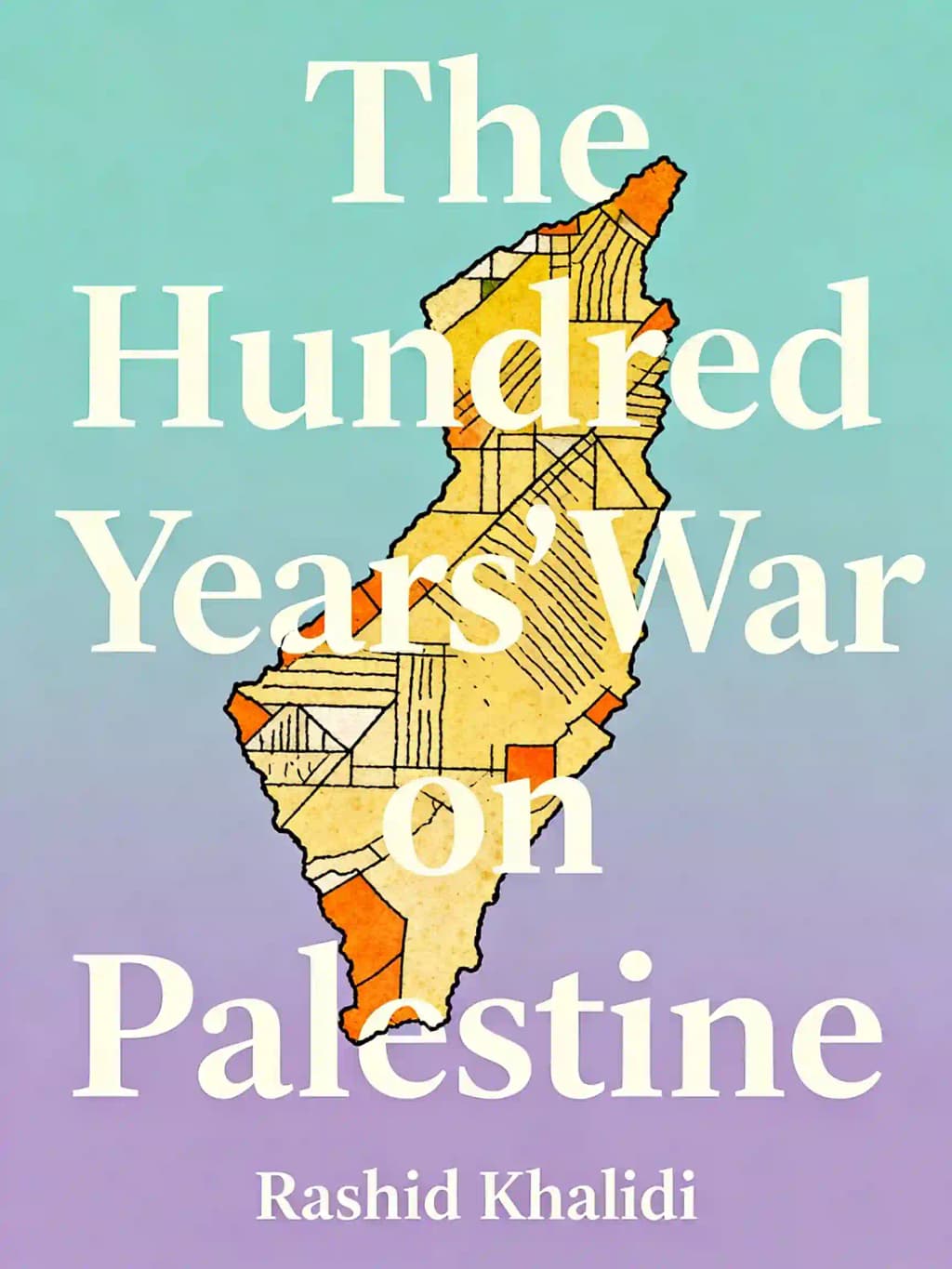
This exchange reveals the colonial nature of what would become a hundred-year war on Palestine - a conflict where powerful external forces repeatedly allied with Zionist ambitions against the indigenous population. Rashid Khalidi's masterful analysis, enriched by his family's deep roots in Palestinian society, illuminates this struggle through six critical episodes spanning from the British Mandate to the present day. The book has garnered acclaim across the political spectrum, with The New York Times calling it "a piercing work of history with contemporary resonance" and The Economist praising its "illuminating insights into the Palestinian experience."
第 2 章
The First Declaration of War: British Mandate and Balfour
Palestine at the turn of the twentieth century was undergoing significant transformation. The economy was integrating into global capitalism with increased export crops and wage labor. Infrastructure modernized with telegraphs, railways, and electricity. Education expanded through missionary and Ottoman state schools. Society remained predominantly rural and patriarchal, though coastal cities like Jaffa and Haifa saw the emergence of a commercial bourgeoisie and working class.
This development was violently disrupted by World War I, which brought devastating hardships to Palestine. The Ottoman Empire suffered catastrophic losses, with over three million dead (15% of the population). Palestine's population, previously growing at 1% annually, declined by 6% during the war. Even privileged families weren't spared - four of Khalidi's father's brothers were conscripted. Southern Palestine endured grinding battles with trench warfare and bombardments throughout 1917, with Gaza particularly devastated.
The Balfour Declaration of November 2, 1917 - a single sentence pledging British support for "the establishment in Palestine of a national home for the Jewish people" - fundamentally transformed Palestine's future. Though using diplomatic language, it effectively committed Britain to supporting Jewish statehood and control of immigration. The declaration notably referred to the Arab majority (94% of the population) only as "existing non-Jewish communities," promising them merely "civil and religious rights" rather than political or national rights.
For Palestinians, this declaration amounted to a gun pointed at their heads - a declaration of war by the British Empire launching a century-long assault on their existence. Palestinians' reaction was initially delayed, as wartime censorship prevented news from spreading until nearly two years after the declaration. When Palestinians finally learned of it, they were already prostrate from war's devastation.
World War I accelerated Palestinian national identity from localized loyalties to modern nationalism. Entering the post-war world, Palestinians faced a radically new reality: British rule and their country promised as a "national home" for others. The Palestinian press provides crucial insight into their evolving self-perception. Newspapers like 'Isa al-'Isa's 'Filastin' promoted Palestinian identity while criticizing the Zionist-British alliance. In 1929, al-'Isa warned of Palestinians becoming "Strangers in Our Own Land" as Jewish settlers seized every opportunity while Palestinians remained poorly organized.
After World War I, Palestinians organized politically against both British rule and the privileged position granted to the Zionist movement. Their efforts included petitions to British authorities, the Paris Peace Conference, and the League of Nations, alongside seven Palestine Arab congresses held between 1919-1928. These congresses consistently demanded independence for Arab Palestine, rejection of the Balfour Declaration, majority rule, and limits on Jewish immigration and land purchases.
This elite-led legal approach proved fruitless, as British officials refused to recognize the congresses' authority. Meanwhile, popular discontent erupted into increasingly intense demonstrations in 1920, 1921, and 1929. By the early 1930s, younger, middle-class Palestinians launched more radical initiatives, including Shaykh 'Iz al-Din al-Qassam's clandestine armed network and the Istiqlal ("independence") Party.
The Mandate essentially created a Zionist para-state parallel to British governance, exercising many sovereign functions for the Jewish population including representation, education, health, and international diplomacy. Article 4 gave the Jewish Agency quasi-governmental status as a "public body" with extensive economic and social powers. Article 6 facilitated Jewish immigration and land settlement, enabling strategic territorial control along Palestine's coast and fertile valleys.
Lord Balfour, in a confidential 1919 memo, candidly admitted the contradiction between League of Nations principles and Allied policy in Palestine: "We do not propose even to go through the form of consulting the wishes of the present inhabitants." He acknowledged that the Powers had "made no statement of fact which is not admittedly wrong, and no declaration of policy which, at least in the letter, they have not always intended to violate."
The British treated Palestinians with the same contemptuous condescension they showed other colonial subjects. They monopolized top government positions, excluded qualified Arabs, censored newspapers, and banned political activities when inconvenient. Unlike typical colonial situations, Palestine experienced an influx of foreign settlers explicitly aiming to take over the country, establishing colonies in strategic locations to ensure territorial control.
Hitler's rise to power in 1933 dramatically changed Palestine's trajectory. With discriminatory immigration laws blocking entry to the US and UK, many persecuted German Jews fled to Palestine. In 1935 alone, over 60,000 Jewish immigrants arrived - more than the entire Jewish population of Palestine in 1917. By 1939, the Jewish population exceeded 30% of Palestine's total, and the Jewish economy overtook the Arab sector. Palestinians increasingly felt they were becoming "strangers in their own land," as journalist 'Isa al-'Isa had warned.
The Palestinians failed to develop an overarching framework for their national movement, undermined by their hierarchical society and sophisticated British divide-and-rule tactics. The British co-opted elite factions, set family members against each other, and invented "traditional institutions" like the position of grand mufti of all Palestine.
The 1936 six-month general strike erupted spontaneously from below, forcing the divided Palestinian elite to form the Arab Higher Committee. However, they brokered an end to the strike at the request of Arab rulers acting for the British, who promised redress of grievances. Instead, the 1937 Peel Commission proposed partitioning Palestine, creating a small Jewish state requiring the expulsion of over 200,000 Arabs.
This denial of Palestinian self-determination triggered a more militant uprising in October 1937. Britain's brutal suppression employed 100,000 troops, summary executions, hostage-taking, home demolitions, detention without trial, and mass exile of leaders. Despite temporary successes, the revolt had devastating consequences. British repression killed, wounded, jailed or exiled 14-17% of adult Palestinian males.
第 3 章
The Second Declaration of War: Partition and Nakba
In 1947, Ismail al-Khalidi returned to Palestine for the first time in eight years. Having left in 1939 for graduate studies in America, he remained there during World War II working as an Arabic-language broadcaster. A Middle Eastern tour brought him to Jerusalem, where his much older brother, Dr. Husayn Fakhri al-Khalidi, the former mayor of Jerusalem, summoned him during this time of crisis for Palestinians. Dr. Husayn tasked Ismail with delivering an unwelcome message to King 'Abdullah of Transjordan: while Palestinians appreciated his offer of "protection," they declined it, preferring to control their own fate. When Ismail reluctantly delivered this message on November 29, 1947, the king reacted angrily. At that exact moment, news arrived of the UN General Assembly's vote for partition of Palestine. Before stalking out, King 'Abdullah coldly told Ismail, "You Palestinians have refused my offer. You deserve what happens to you."
By summer 1949, Palestinian society had been devastated. Approximately 80 percent of the Arab population in what became Israel had been forced from their homes, with at least 720,000 of 1.3 million Palestinians made refugees. Israel now controlled 78 percent of Mandatory Palestine, ruling over just 160,000 remaining Palestinian Arabs - barely one-fifth of the prewar Arab population. This catastrophe (Nakba) resulted from the defeat of the Great Revolt, Zionist determination, foreign interference, and fierce inter-Arab rivalries, compounded by Palestinian internal divisions and the absence of modern state institutions.
The end of World War II brought two new major powers to the Middle East: the United States and USSR. America, suddenly the preeminent global power, established a permanent regional presence beginning in 1942. Meanwhile, the Zionist movement, led by David Ben-Gurion, presciently foresaw the global power shift. The 1942 Biltmore Program in New York marked the first open Zionist call for turning all of Palestine into a Jewish state, strategically proclaimed in America where the movement effectively mobilized political support.
Two crucial post-war events revealed the Palestinians' growing isolation. First, when six Arab states formed the British-backed Arab League in March 1945, they removed references to Palestine from the inaugural communique and retained control over Palestine's representation. Second, the 1946 Anglo-American Committee of Inquiry, established to address Jewish Holocaust survivors in European displaced-persons camps, ignored both the British government's preference and Albert Hourani's prescient warnings about the catastrophic consequences of creating a Jewish state.
The Palestinians fatally lacked the apparatus of a modern state. The Arab National Fund, though impressive in raising 176,000 Palestine pounds in just over a year, was dwarfed by Zionist resources - demonstrated when a single Jewish widow from South Africa donated one million Palestine pounds to the JNF. The Arab Higher Committee was equally dysfunctional, with no bureaucratic structure whatsoever. As Sayigh described it: "When Jamal Husseini left the office in the afternoon, he locked the door and put the key in his pocket. There was no secretariat... Not even a secretary who would take notes or type."
The Arab Office, primarily financed by Iraq's British-backed government, eventually alienated Egypt and Saudi Arabia, who suspected it was a vehicle for Iraqi regional ambitions. Meanwhile, King Abdullah of Transjordan harbored his own designs to dominate Palestine, conducting extensive clandestine meetings with Zionist leaders Moshe Sharett and Golda Meir, hoping to incorporate the Arab portion of Palestine under his rule.
Since 1917, Palestinians had faced the hostile tandem of Britain and the Zionist project. But the yishuv grew increasingly hostile to its British patron after the 1939 White Paper, culminating in assassinations and the 1946 King David Hotel bombing that killed ninety-one. Unable to control the armed opposition of the yishuv, whose military they had themselves reinforced, and reeling from postwar economic problems, Britain finally capitulated and handed Palestine to the new United Nations in 1947.
The UN Special Commission on Palestine (UNSCOP) recommended partitioning the country heavily in favor of the Jewish minority, giving them over 56 percent of Palestine. The November 29, 1947 passage of Resolution 181 reflected the new global power balance, with both the US and USSR voting for partition. This resolution was another declaration of war, providing the international birth certificate for a Jewish state in an Arab-majority land, violating the principle of self-determination in the UN Charter.
The Palestinian catastrophe unfolded in stages. From November 1947 to May 1948, Zionist paramilitary groups defeated poorly armed Palestinians and Arab volunteers. Plan Dalet in spring 1948 involved conquering and depopulating major Arab centers including Jaffa, Haifa, and West Jerusalem. Ethnic cleansing began well before Israel's proclamation on May 15, with about 300,000 Palestinians expelled. After May 15, when Arab armies belatedly intervened under public pressure, another 400,000 Palestinians fled following further defeats and massacres. None were allowed to return, and most homes and villages were destroyed to prevent their return.
Among those displaced were the author's grandparents. His 85-year-old grandfather initially refused to leave his home at Tal al-Rish, staying alone for weeks until a family friend retrieved him during a lull in fighting. He left unwillingly, lamenting that he couldn't take his books. Neither he nor his children ever saw their home again, though its ruins still stand abandoned on the outskirts of Tel Aviv.
第 4 章
The Third Declaration of War: 1967 and Resolution 242
The Six-Day War of 1967 began with Israel's devastating first strike that destroyed most Egyptian, Syrian, and Jordanian warplanes on the ground, giving Israel complete air superiority. This allowed Israeli forces to swiftly conquer the Sinai Peninsula, Gaza Strip, West Bank including East Jerusalem, and the Golan Heights in just six days.
Despite widespread belief that Israel faced existential danger, President Johnson and US intelligence knew Israel's military was far superior to all Arab states combined. When Israeli Foreign Minister Abba Eban claimed Egypt was about to attack, Johnson assured him that intelligence showed no imminent threat and that Israel would "whip hell out of them" if attacked. Five Israeli generals later confirmed Israel was never in danger of losing, contradicting the persistent myth of vulnerability that has justified extreme policies.
Egypt's seemingly illogical provocation of Israel in May 1967 - moving troops into Sinai and requesting removal of UN peacekeeping forces - came in response to an upsurge of Palestinian guerrilla raids on Israel from bases in Syria, which had prompted Israeli attacks and threats. Despite having 60,000 troops tied down in Yemen, Egyptian leadership felt compelled to respond to maintain prestige in the Arab world. These moves provided Israel with the casus belli for its long-planned first strike that devastated three Arab armies and transformed the Middle East.
During the war, Khalidi witnessed the Security Council's frantic efforts to halt the fighting, attending sessions with his father who worked in Political and Security Council Affairs. By June 9, the fifth day, Israeli forces had defeated Egypt and Jordan and occupied Gaza, Sinai, the West Bank, and East Jerusalem. As Israel advanced toward Damascus after storming the Golan Heights, the Soviet Union urgently proposed a third cease-fire resolution demanding immediate cessation of hostilities.
When US Ambassador Arthur Goldberg requested a two-hour adjournment during this critical moment, Khalidi's father explained bitterly: "The Americans are giving the Israelis a little more time." Thanks to this diplomatic maneuver, Israel's advance continued until the following afternoon, demonstrating the new Israeli-American axis in action - Israeli military might with American diplomatic cover.
The 1967 war marked a decisive shift in US-Israeli relations. While previous administrations had maintained some distance, Johnson's administration represented a fundamental change. This shift stemmed from global Cold War dynamics, Johnson's personal sympathies for Israel, and his circle of advisors. Unlike Kennedy, who had visited Palestine as a young man and maintained a skeptical view of both sides' arguments, Johnson surrounded himself with devoted Israel supporters.
Before launching its first strike in 1967, Israel secured American approval through a crucial meeting between Mossad chief Meir Amit and Defense Secretary McNamara. The US facilitated Israel's attack while misleading Arab ambassadors with promises of restraint and mediation. Most significantly, Johnson's administration abandoned Eisenhower's policy of forcing Israeli withdrawal from conquered territories, a transformation with disastrous consequences for Palestinians.
The third declaration of war against Palestinians came through Security Council Resolution 242, crafted primarily by Britain but reflecting US and Israeli views. Though it stressed the "inadmissibility of acquisition of territory by war," it linked Israeli withdrawal to peace treaties with Arab states and secure frontiers, making withdrawals conditional and delayed. The resolution's ambiguous language - specifying withdrawal "from territories occupied" rather than "from the territories occupied" - created a loophole Israel has exploited for over fifty years to colonize Palestinian and Syrian lands. By treating the conflict as solely between states, Resolution 242 erased Palestinians entirely, referring to them only as "refugees" requiring "a just solution." This consecrated Israel's narrative that there were no Palestinians - a position Golda Meir would explicitly state in 1969.
Resolution 242 enabled Israel to split the conflict into separate bilateral state-to-state issues, dealing with each Arab country individually while sidelining Palestinians. The United States actively supported this strategy, with Henry Kissinger explicitly working to prevent Arab unity. This approach succeeded when Egypt in the 1970s and Jordan in the 1990s negotiated separate peace treaties with Israel, removing themselves from the conflict and leaving Israel in a stronger position against its remaining adversaries.
Paradoxically, Israel's 1967 victory "resurrected the Palestinians" as a national movement. While Palestine remained almost unmentionable in American discourse, Palestinian writers and poets played a crucial role in reshaping Palestinian identity. This cultural renaissance accompanied the rise of new political movements like the Movement of Arab Nationalists (MAN) and Fatah. These groups were founded by young middle-class radicals who saw themselves as heirs to Shaykh 'Iz al-Din al-Qassam, whose death fighting the British had helped spark the 1936 revolt.
Two main Palestinian resistance trends emerged in the 1960s. The Movement of Arab Nationalists (MAN), founded by George Habash, initially aligned with Nasser's Egypt and advocated Arab unity as the path to reclaiming Palestine. After 1967's defeat, MAN transformed into the Marxist PFLP, which gained notoriety through airplane hijackings but also respect through Habash's intellectual leadership. Meanwhile, Fatah, established in Kuwait in 1959 by professionals led by Yasser 'Arafat, took a deliberately nonideological stance focused solely on direct action against Israel. To counter these independent movements, the Arab League created the PLO in 1964, but after the 1967 war, the militant groups took over the organization with 'Arafat becoming chairman - a position he held until his death in 2004.
第 5 章
The Fourth Declaration of War: Lebanon 1982
By 1982, after years of war had weakened but not defeated the PLO in Lebanon, Israel launched another invasion with American Secretary of State Alexander Haig's approval of Ariel Sharon's plans to eliminate the Palestinian organization and nationalism entirely. The assault began on June 4 with massive aerial bombardment of Beirut, particularly targeting the Fakhani district where most PLO political offices were located. For Palestinians living in Beirut like Khalidi, the invasion meant immediate danger as Israeli forces considered all Palestinians, including children, as potential "terrorists."
The June 1982 invasion of Lebanon marked a watershed moment in the Israeli-Palestinian conflict. The assault began with intense bombardment of Beirut, followed by a massive ground offensive involving eight divisions (over 120,000 troops) that culminated in a brutal seven-week siege ending August 12. Nearly fifty thousand people were killed or wounded, with entire apartment buildings obliterated and neighborhoods devastated. Unlike previous limited operations, this invasion had a strategic objective beyond Lebanon itself - Ariel Sharon's primary goal was to destroy Palestinian nationalism in the occupied territories by eliminating the PLO's power base.
Throughout the ten-week bombardment, Khalidi's family sheltered together in their Zarif neighborhood apartment after his mother's home in Haret Hreik was hit by artillery. Despite the acute shortages of water, electricity, and fresh food, staying together helped maintain their morale. During this existential crisis for the Palestinian cause, he served as an off-the-record source for Western journalists while his pregnant wife Mona continued editing WAFA's English-language news bulletin remotely.
Begin often drew parallels between Arafat and Hitler to justify civilian casualties, suggesting that killing Arafat was permissible regardless of collateral damage. During the siege, Israeli intelligence operated openly in Beirut - one notorious spy known as Abu Rish frequently positioned himself near the author's mother-in-law's apartment building, even becoming recognizable to his daughters. Despite Israel's intelligence capabilities, the PLO maintained supply lines through bribing members of the Lebanese Front with fuel, food, and munitions flowing across enemy lines.
The PLO was ultimately forced to evacuate Beirut under relentless pressure from Israel, the United States, and their Lebanese allies, with no meaningful support from any Arab government. The negotiations primarily involved Ambassador Habib as intermediary, with peripheral involvement from France, Saudi Arabia and Syria. Throughout the process, the United States remained committed to Israel's core war aim: completely defeating the PLO and expelling it from Beirut. Begin and Sharon had successfully convinced President Reagan that the PLO was a Soviet-aligned terrorist group whose elimination would serve both American and Israeli interests, ensuring unwavering US diplomatic and military support.
The invasion of Lebanon was made possible by explicit American assent. Ten days before the offensive began, Sharon met with Secretary of State Alexander Haig in Washington and detailed his ambitious war plan. Haig's only response was that there "must be a recognizable provocation" that would be "understood internationally." The attempted assassination of Israel's ambassador in London soon provided this pretext, though it was carried out by the anti-PLO Abu Nidal group.
The PLO had severely damaged its standing among Lebanese through years of heavy-handed behavior. In one typical incident near the Institute for Palestine Studies, guards for a senior PLO leader shot and killed a young Lebanese couple who failed to stop at a hastily erected checkpoint. Such inexcusable acts went unpunished. Though the Cairo Agreement of 1969 had formally granted the PLO control of refugee camps and freedom of action in south Lebanon, the organization had become an increasingly domineering force throughout the country.
After President-elect Bashir Gemayel's assassination on September 14, Israeli forces immediately occupied West Beirut despite promises to the United States not to do so. Palestinians, fearing massacres like those at Tal al-Za'tar in 1976, sought safety wherever possible. On September 16, Israeli flares illuminated the Sabra and Shatila refugee camps throughout the night as Lebanese Forces militias slaughtered defenseless civilians. Between September 16 and 18, the militiamen murdered more than thirteen hundred Palestinian and Lebanese men, women, and children. The Kahan Commission established the responsibility of Begin, Sharon, and senior Israeli commanders for these massacres.
After the Sabra and Shatila massacres, Khalidi and his family were evacuated from Beirut with help from Ryan Crocker, the senior American diplomat remaining at the embassy. Crocker escorted them in an armored vehicle to Shtaura, from where they took a taxi to Damascus. In Syria, they faced hours of detention and interrogation by Syrian intelligence before continuing to Tunis, where they reunited with Palestinian friends evacuated there.
The 1982 war brought enormous regional changes that persist today, including the rise of Hezbollah and the intensification of Lebanon's civil war. It marked America's first direct military intervention in the Middle East since 1958 and Israel's only attempt at forcible regime change in the Arab world, generating fiercer antipathy toward both nations. The war provoked widespread revulsion in Israeli society, growing the Peace Now movement, while producing the first significant negative American and European perceptions of Israel since 1948. Paradoxically, the PLO's evacuation from Beirut gradually shifted the Palestinian movement's center of gravity from neighboring Arab countries back to Palestine itself, where the First Intifada would erupt five years later.
第 6 章
The Fifth Declaration of War: Oslo's False Promise
The 1987 Palestinian intifada demonstrated the law of unintended consequences. While Israel's 1982 Lebanon invasion weakened the PLO externally, it strengthened Palestinian resistance within the occupied territories. The uprising began after Israeli forces killed four Palestinians in Gaza's Jabalya camp, quickly spreading throughout the territories.
Defense Minister Rabin's "iron fist" response, ordering soldiers to break protesters' bones, damaged Israel's international image. The prolonged conflict produced powerful imagery of Palestinian youths confronting Israeli tanks, transforming Israel's image from victim to oppressor.
After two decades of occupation and 200 settlements, Palestinian alienation had intensified. The intifada employed predominantly nonviolent tactics - demonstrations, strikes, boycotts, and tax resistance. Women assumed crucial leadership roles as men faced imprisonment. Unlike the 1936-39 revolt, this uprising maintained strategic unity and represented the first clear Palestinian victory in the colonial conflict since 1917.
The uprising created tension between local activists and the exiled PLO leadership in Tunis, who poorly understood conditions under occupation. The PLO's remote management often ignored ground-level perspectives, especially after Israel's 1988 assassination of Abu Jihad. Their grasp of American politics was equally limited, failing to engage effectively with U.S. audiences and power structures.
Though the intifada provided the PLO valuable political capital, their diplomatic inexperience led them into a process designed to extend rather than end the occupation. By accepting UN Resolution 242, they embraced parameters that ignored core Palestinian rights. 'Arafat's "neutral" stance during Iraq's Kuwait invasion further isolated the PLO from crucial Gulf state support.
The 1992 Palestinian Interim Self-Governing Authority proposal failed because its broad jurisdiction contradicted Zionist doctrine of exclusive Jewish rights to Palestine. The Oslo process that followed produced deeply flawed agreements, partly due to the PLO's inexperienced negotiators facing Israel's legal experts.
When 'Arafat returned to Gaza in 1994, he seemed unaware of his limited authority. The Oslo framework preserved Israel's advantages while making the PLO a subcontractor for the occupation. As Israeli General Gazit noted, 'Arafat could only choose to be either a proxy administrator or a more effective one - but never a truly independent leader.
第 7 章
The Sixth Declaration of War: Gaza Under Siege
Palestinians' initial optimism about the Oslo Accords quickly faded as colonization continued and conditions deteriorated. A complex system of permits, checkpoints, and barriers emerged, separating Gaza from the West Bank and Jerusalem. Between 1993-2004, GDP per capita declined despite promises of prosperity, with only PLO/PA elites enjoying freedom of movement.
Gaza faced particularly severe restrictions, enclosed by Israeli forces on land and sea. Jerusalem's Palestinian neighborhoods were cut off from the West Bank, requiring nearly impossible-to-obtain permits. East Jerusalem's contribution to Palestinian GDP dropped from 15% to 7% by 2018, losing its status as an economic hub.
These deteriorating conditions led to massive demonstrations in September 2000. Hamas, emerging from the Palestinian Muslim Brotherhood in 1987, gained support as Oslo's failures seemed to validate their critique of PLO's diplomatic approach. The promised five-year interim period extended indefinitely, and final status negotiations never materialized. The hastily arranged 2000 Camp David summit between 'Arafat and Barak failed due to poor preparation and lack of prior agreements.
The Second Intifada erupted in September 2000, triggered by Ariel Sharon's provocative visit to the Haram al-Sharif. Israeli forces responded with overwhelming force, causing numerous casualties. After Yasser 'Arafat's death in 2004, Mahmoud 'Abbas assumed leadership, presiding over national movement deterioration and increased inter-Palestinian conflict.
Hamas's unexpected victory in the 2006 parliamentary elections, running on a reform platform, led to escalating conflict with Fatah. Despite attempts at unity through the Prisoners' Document, Israel and the US rejected Hamas's participation in government. Following a failed Fatah coup attempt in 2007, Hamas seized control of Gaza, leading to Israel's full blockade.
By 2018, Gaza's humanitarian crisis deepened with 53% poverty and 52% unemployment. Israel launched three devastating assaults (2008, 2012, 2014), implementing the "Dahiya doctrine" of disproportionate force. The 2014 attack destroyed vast infrastructure, displacing 450,000 Gazans.
These events marked a shift in American perceptions. While Republican support for Israel remained strong, backed by Evangelical Christians and conservative Jewish groups, criticism grew among younger, progressive Democrats. By 2019, a stark partisan divide emerged: 61% of Republicans viewed Israel favorably compared to 26% of Democrats. However, US policy remained largely unchanged, with the Democratic Party leadership maintaining pro-Israel positions despite growing pressure from its base.
第 8 章
A Century of War: Looking Forward
In 1917, Balfour declared Britain wouldn't consult "the wishes of the present inhabitants" of Palestine. A century later, Trump echoed this sentiment by recognizing Jerusalem as Israel's capital, saying "We took Jerusalem off the table." Throughout this century, great powers have repeatedly acted without Palestinian consultation, ignoring them or pretending they didn't exist. Yet despite overwhelming odds, Palestinians have shown remarkable resistance to political elimination and dispersal. More than 120 years after the first Zionist congress and over 70 years after Israel's creation, the Palestinian people remain a formidable presence, making Israel at least as contested globally as ever before.
The United States has wavered between acknowledging Palestinians' existence and trying to erase them from the Middle East map. America and Britain have attempted the impossible: imposing a colonial reality in a postcolonial age. As Eqbal Ahmad noted, Palestine's colonization occurred paradoxically at "the dawn of decolonization." Zionism succeeded in creating a thriving new nation but failed to fully supplant the indigenous population. Historically, settler-colonial confrontations end in only three ways: elimination of natives, expulsion of colonizers, or abandonment of colonial supremacy through compromise and reconciliation.
While Israel could theoretically attempt new expulsions like those of 1948 and 1967, several factors make this less likely: Palestinians would fiercely resist removal, international attention remains focused on the conflict, and the Palestinian narrative has gained currency globally. Even if undertaken during a regional war, such ethnic cleansing would risk fatal damage to Western support Israel depends on. Nevertheless, with religious nationalists and settlers dominating Israeli governments, explicit annexation plans for the West Bank, and parliamentarians calling for Palestinian removal, fears of expulsion have grown.
The colonial nature of the Palestine conflict remains invisible to many Americans and Europeans who see Israel as a normal nation-state facing irrational Muslim hostility. This image represents one of Zionism's greatest achievements. As Edward Said noted, Zionism "won the political battle for Palestine in the international world in which ideas, representation, rhetoric and images were at issue." Dismantling this fallacy is necessary for Palestinians and Israelis to transition to a postcolonial future where one people doesn't use external support to oppress another.
Three approaches have proven effective in expanding understanding of Palestine's reality: comparing it to other colonial-settler experiences like those of Native Americans or South Africans; highlighting the power imbalance between Israel and Palestinians; and foregrounding inequality. The colonial comparison faces particular challenges in America, where "settler" and "pioneer" carry positive connotations from the heroic narrative of westward expansion.
Inequality represents the most promising avenue for expanding understanding of Palestine's reality. Systemic inequality was central to creating a Jewish state in an Arab-majority land and remains vital to maintaining its dominance. Within Israel, certain rights are reserved exclusively for Jewish citizens and denied to the 20% who are Palestinian, while five million Palestinians under military occupation have no rights at all compared to Israeli settlers.
Any sustainable resolution to the conflict must be based on absolute equality of human, civil, political, and national rights. Both peoples have developed national identities through arbitrary, constructed processes common to all national movements. Palestinians assume their nationalism is pure while denying the same of Israeli Jews, though there's a crucial difference: most Palestinians are indigenous, while most Israeli Jews are relatively recent arrivals through a colonial process. Nevertheless, two peoples now exist in Palestine, and their mutual acceptance can only be based on complete equality of rights, including national rights.
The Trump administration pursued what it called "the deal of the century," dispensing with decades of US policies and outsourcing strategy to Israel. Trump's team rejected the term "occupation," endorsed annexation, and pushed an economic development initiative that would maintain Israeli control. Their plan involved a non-sovereign Palestinian entity without settlement removal, under full Israeli security control, excluding Jerusalem.
Neither Fatah's diplomatic approach nor Hamas's nominal armed resistance has advanced Palestinian national aims. Arab regimes have normalized relations with Israel while public opinion remains supportive of Palestinians, with 75% of respondents in twelve Arab countries considering Palestine a concern for all Arabs. Palestinians must appeal over the heads of unresponsive regimes to sympathetic Arab public opinion.
Despite regional disarray and a directionless Palestinian movement, Israel and the US cannot simply bury the Palestine question. Arab public opinion consistently emerges with Palestinian flags whenever democratic currents rise against autocracy, as seen in Cairo (2011) and Algiers (2019). Israel's regional dominance depends on undemocratic Arab regimes suppressing such sentiment, making real Arab democracy a grave threat to Israeli hegemony.
Palestinians will continue mounting resistance regardless of what deals their discredited leaders may accept. Meanwhile, global power configurations are shifting - China and India will have greater influence in the Middle East due to energy needs, while Europe and Russia, being closer to the region, will play larger roles as American influence potentially wanes. These changes may allow Palestinians, together with Israelis and others worldwide who desire peace with justice, to craft a different trajectory based on equality that can conclude the hundred years' war on Palestine with lasting peace and liberation.