第 1 章
Banking's Barony: The Rise and Transformation of a Financial Dynasty
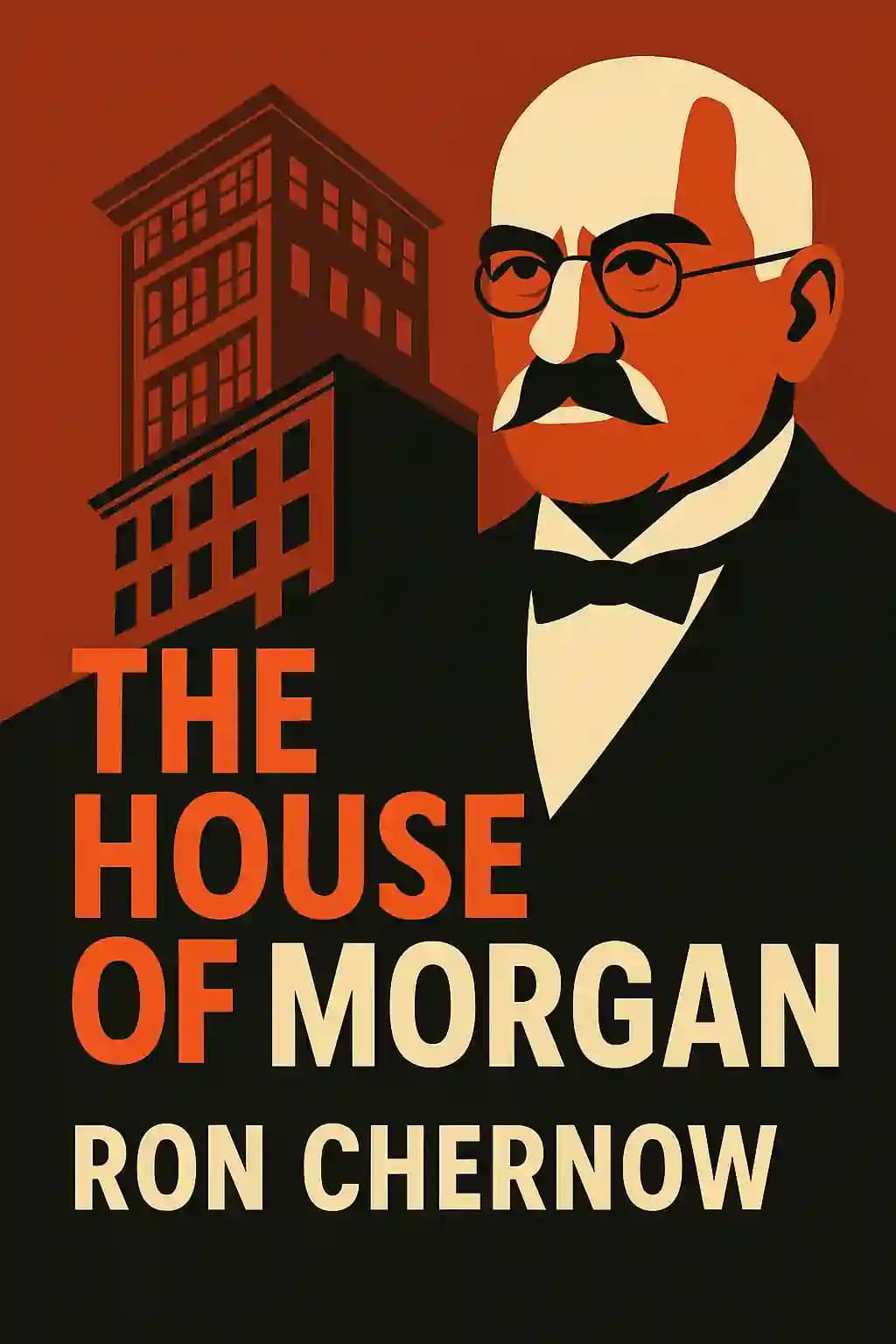
The House of Morgan stands as perhaps the most formidable financial institution in modern history. For over 150 years, this banking dynasty wielded extraordinary influence over Western economies, operating at the intersection of high finance, international diplomacy, and political power. Warren Buffett reportedly considers this book essential reading for anyone seeking to understand the evolution of modern finance, while Bill Gates praised it as "a masterful account of how banking and power became intertwined in America." The book's brilliance lies in revealing how a secretive partnership grew into a global financial empire that shaped the destiny of nations-an institution that "wielded far more power than most Americans ever imagined, even in their most fevered nightmares."
第 2 章
The Origins: From Miserly Founder to Financial Titan
The Morgan dynasty began with George Peabody, a paradoxical figure who embodied the extremes of nineteenth-century capitalism. Despite amassing a fortune exceeding 1 million, Peabody lived with remarkable frugality-traveling by penny bus, demanding halfpenny change from office boys, and spending a mere 600 of his annual 60,000 income. This miserliness extended to his business practices; when he eventually passed his London banking house to Junius Spencer Morgan in 1864, he refused to allow Morgan to keep the prestigious Peabody name and forced him to purchase the office lease on onerous terms.
Yet Peabody underwent a remarkable transformation in his later years. After facing a near-death experience during the Panic of 1857 (when the Bank of England rescued his firm with an 800,000 credit line), he embraced philanthropy on an unprecedented scale. He established the Peabody Institute in Baltimore, created housing projects for London's poor, and received the Freedom of the City of London-becoming the first American to receive this honor. When he died in 1869, his body was transported to America aboard a British warship, with young J.P. Morgan arranging a funeral of martial splendor.
Junius Morgan proved a worthy successor, transforming the modest banking house into a transatlantic powerhouse. His signature achievement came in 1870 with a daring French loan that revealed the riverboat gambler behind his steely exterior. When Paris fell in 1871, followed by the Paris Commune uprising, bond prices plummeted to 55 (45 points below par). In a breathtaking gamble, Junius nearly bankrupted himself buying these bonds to prop up prices. When France prepaid the bonds in 1873, bringing them to par value, he netted 1.5 million-vastly increasing his capital and propelling him into the upper ranks of government financing.
Junius carefully groomed his son J.P. "Pierpont" Morgan for leadership, though their relationship remained complex. For thirty-three years, Pierpont wrote detailed intelligence reports to his father twice weekly, which Junius cherished but Pierpont later burned. Despite geographic separation, they maintained an intense relationship, with Junius micromanaging every aspect of his son's life. This paternal oversight proved necessary, as young Pierpont displayed both brilliance and recklessness-once making an unauthorized but profitable speculation on Brazilian coffee and later financing the controversial Hall carbine affair during the Civil War, where obsolete government rifles were bought, modified, and resold to the Union at six times their original price.
第 3 章
The Baronial Age: When Bankers Ruled
The father-son team of Junius and Pierpont Morgan emerged during what Chernow calls the "Baronial Age" of banking-a time when private bankers wielded extraordinary power. This era coincided with the rise of railroads and heavy industry that required capital beyond the means of even wealthy individuals. Despite these enormous capital needs, financial markets remained provincial and limited.
Bankers became essential intermediaries, allocating scarce credit and providing their imprimatur to reassure investors about unknown companies. With no government regulatory agencies, bankers often ended up running defaulting companies, gradually blurring the line between finance and commerce until much of industry fell under banker control.
The leading bankers operated according to the Gentleman Banker's Code-they didn't seek clients but waited for proper introductions, avoided branch offices, refused to take clients from other bankers without permission, and abstained from advertising or price competition. This arrangement favored established banks and kept clients dependent, though beneath the elegant surface lay vicious competition.
By the late nineteenth century, Pierpont Morgan had emerged as America's most powerful banker. His influence extended far beyond traditional banking into corporate reorganization and consolidation. During the devastating Panic of 1893, Morgan orchestrated the rescue of the U.S. government's gold reserves, working with President Grover Cleveland to arrange a massive gold purchase that stabilized the Treasury. In 1895, Morgan wired London that the situation was "critical" with politicians in control. While Cleveland waited for congressional action on the Springer Bill that would allow Treasury bond sales, Morgan and August Belmont stood ready. When the bill was defeated, Morgan rushed to Washington through a blizzard.
The Morgan-Rothschild operation calmed financial markets. Their bonds sold out in just twenty-two minutes in New York, but the syndicate became a victim of its own success. Taking up bonds at 10412, they quickly soared to 119, creating the impression that bankers had cheated the government and reaped $6-7 million in profits. Morgan later claimed these figures were exaggerated.
The Populist reaction was furious and laced with anti-Semitism due to Rothschild participation. Mary Lease called Cleveland a tool of "Jewish bankers and British gold," while William Jennings Bryan had Congress read Shylock's bond from The Merchant of Venice during his denunciation. Despite this controversy, Cleveland never regretted his decision, praising Morgan's "lightning-like rapidity" and "far-seeing patriotism."
第 4 章
The Trust Builder: Creating Industrial Giants
The dawn of the new century brought America's first great merger wave, with combinations jumping from sixty-nine in 1897 to over twelve hundred by 1899. Driven by improved communications, transportation, and America's global ambitions after the Spanish-American War, national markets replaced local ones.
As markets expanded beyond local boundaries, industries required large-scale financing, shifting Wall Street's focus from railroads to industrial trusts. In these arrangements, stockholders traded shares in constituent companies for "trust certificates" of holding companies, typically incorporated in New Jersey after laws permitted one company to own another. By 1901, these corporate leviathans dominated industries from sugar and lead to whiskey, plate glass, and coal.
Morgan, who saw competition as destructive and inefficient, favored large-scale combinations. With Republican William McKinley's presidency creating a permissive regulatory environment, the business community felt emboldened after the 1900 GOP landslide that defeated William Jennings Bryan's anti-trust platform.
The genesis of United States Steel in 1901 emerged from a looming collision between Andrew Carnegie's steel company and Morgan's Federal Steel and National Tube. After Charles Schwab, Carnegie's lieutenant, presented a vision of an integrated steel trust at a dinner attended by Morgan, the banker quickly saw "a new light." Within weeks, Morgan assembled a proposal to control more than half the steel business, combining Carnegie Steel, Morgan's Federal Steel, and numerous other companies.
The resulting $1.4 billion corporation-the first billion-dollar corporation in history-stoked a bonfire of speculation on Wall Street. Despite predictions that so much stock would saturate the market, the issue succeeded spectacularly, with the syndicate taking in $57.5 million in stock for its services.
Behind Morgan's imposing public persona lay profound vulnerability. Edward Steichen's famous 1903 photograph captured this duality-the piercing eyes and fierce demeanor alongside a hidden sadness. Morgan's most notable physical feature, his grotesque nose afflicted with acne rosacea, grew increasingly monstrous with age and was routinely touched up in official photographs. Though he tried numerous remedies, including one recommended by England's Queen Alexandra, the condition persisted. In philosophical moments, Morgan converted this affliction into a mark of pride, declaring it "part of the American business structure."
第 5 章
The Panic of 1907: Morgan as Central Bank
The 1907 panic, despite being widely anticipated, struck Wall Street with devastating force. When selling roiled the Stock Exchange in March, financial powers gathered at Morgan's Corner for a secret meeting to create a stabilizing pool. Jack Morgan (Pierpont's son) favored cooperation, but Pierpont, then in Europe, rejected the plan as "entirely at variance with all the policies we have ever adopted."
By October, the 70-year-old Morgan was attending the Episcopal Convention in Richmond when emergency telegrams flooded in from Wall Street. Despite his semi-retirement, he rushed back by private railroad car, telling Bishop Lawrence, "They are in trouble in New York. They do not know what to do, and I don't know what to do, but I am going back."
Within two weeks, Morgan functioned as America's central bank, saving trust companies, a major brokerage house, New York City, and the Stock Exchange. His victory proved Pyrrhic, as Americans decided no individual should wield such power again. The panic stemmed from reckless trust companies that had exploited legal loopholes to engage in speculation, paying high interest rates while maintaining inadequate reserves. Ironically, Morgan rescued institutions the Wall Street establishment despised.
In an elaborate finale on November 2, Morgan devised a rescue for the still-shaky Trust Company of America, Lincoln Trust, and Moore and Schley, a brokerage house $25 million in debt holding a majority stake in Tennessee Coal and Iron Company. Like an impresario, Morgan gathered bankers at his library, placing commercial bankers in the East Room beneath zodiac signs and trust-company presidents in the West Room under the gaze of Madonnas, while he played solitaire in between. After all-night negotiations, with the bronze doors locked, Morgan forced trust presidents to contribute to a $25-million rescue pool, while engineering U.S. Steel's purchase of Tennessee Coal and Iron to save Moore and Schley.
From these events arose the Federal Reserve System, as Senator Nelson Aldrich noted: "We may not always have Pierpont Morgan with us to meet a banking crisis." By confirming Morgan's storied powers, the crisis inadvertently fostered talk of an omnipotent Wall Street money trust.
第 6 章
The Diplomatic Age: War and International Finance
The House of Morgan reached its zenith of international influence during World War I. Harry Davison had conceived an inspired plan to eliminate profiteering middlemen by concentrating Allied purchases in a single agency that could negotiate from strength. The Anglo-American House of Morgan was the logical choice.
On January 15, 1915, the House of Morgan signed the Commercial Agreement with the Army Council and Admiralty, beginning with a $12 million purchase for horses. Similar arrangements followed with the French through Herman Harjes in Paris.
No one foresaw the operation's magnitude. Lord Kitchener estimated purchases might reach 10 million, but they eventually totaled an astronomical $3 billion-almost half of all American supplies sold to the Allies during the war. With a 1-percent commission, Morgan earned $30 million in fees, making it probably the most important deal in the firm's history, both financially and for the political and corporate connections it generated.
To head the Export Department, Tom Lamont recruited Edward R. Stettinius, Sr., former president of Diamond Match Company. Meticulous and demanding, Stettinius drove his staff of 175 ("Slaves of Stettinius") mercilessly, often until midnight. He became the single most important consumer on earth, purchasing $10 million in goods daily-from corned beef to locomotives to artificial limbs. The German general staff never imagined America could switch so quickly to war production. Stettinius promoted building new factories, with Morgan and Britain making loans to arms manufacturers. By war's end, U.S. arms-making capacity eclipsed England and France combined, earning Stettinius the title "father of the military industrial complex."
Morgan also performed intelligence work, preventing German investors from buying Bethlehem Steel by helping create a voting trust. The British even exempted Morgan from mail censorship, allowing them to use their in-house code.
The Export Department wasn't an unqualified success. The French never used it as extensively as the British, and the Admiralty remained cooler than the War Office. Persistent suspicions arose that Morgan favored friends, as many contract winners-General Electric, Bethlehem Steel, Du Pont, and U.S. Steel-were firmly in the Morgan orbit. The Guggenheims particularly profited through Kennecott Copper and American Smelting and Refining. The distribution of billions in contracts enabled Morgan to win loyalty from dozens of powerful companies.
第 7 章
The Crash and Depression: Morgan's Diminishing Power
As the twentieth century dawned, Pierpont Morgan became the personified symbol of industrial gigantism threatening pastoral America. His exploits took on mythic proportions, with Life magazine creating a catechism that claimed Morgan, Hill, and Rockefeller had "reorganized" the world in 1901. Writers competed to craft Morgan titles-king of trusts, morganizer of the world, financial titan, Napoleon of finance, or simply Zeus or Jupiter.
For a country lacking aristocratic tradition, Morgan and other robber barons became ersatz nobility whose feats were avidly chronicled by the press. The public reacted with fear and resentment but also admiration for his implacable will and superhuman strength.
Jack Morgan, who succeeded his father after Pierpont's death in 1913, faced a dramatically different political landscape. The New Deal era would bring unprecedented challenges to the House of Morgan's dominance. The 1933 Glass-Steagall Act, which separated commercial and investment banking, shattered the Morgan empire into separate entities including J.P. Morgan & Co., Morgan Stanley, and Morgan Grenfell.
During the 1929 crash, Morgan partners tried to stabilize the market as they had in 1907, but their efforts proved futile in the face of overwhelming selling pressure. On Black Thursday, October 24, Thomas Lamont chaired a meeting of major bankers who pledged $240 million to buy stocks and stabilize the market. Richard Whitney, acting president of the Stock Exchange and brother of Morgan partner George Whitney, became their agent, taking a jaunty stroll across the Exchange floor and bidding 205 for twenty thousand shares of U.S. Steel.
After trading closed, Lamont told reporters, "There has been a little distress selling on the Stock Exchange"-an understatement that would become legendary. He blamed the decline on a "technical condition" and said the market was "susceptible to betterment."
The crash unfolded in two stages. After a weekend pause, selling resumed Monday with American Telephone and Telegraph dropping 34 points and General Electric 47 points. On Tragic Tuesday, October 29, more than sixteen million shares changed hands-a record that would stand for forty years. By day's end, the two-day damage had dragged share prices down by nearly 25 percent.
第 8 章
The Casino Age: Modern Banking Emerges
By the 1980s, the three Morgan houses had evolved into very different institutions. J.P. Morgan & Company had become a commercial bank focused on wholesale lending to corporations and governments. Morgan Stanley had transformed from a genteel underwriting house to Wall Street's most aggressive player, pioneering hostile takeovers and dominating mergers and acquisitions. Morgan Grenfell in London similarly shed its "House of Lords" reputation to become the City's most aggressive takeover specialist.
The transformation of Morgan Stanley under Robert H.B. Baldwin exemplified the changing nature of Wall Street. Baldwin saw Morgan Stanley as fighting for its life against rising firms like Salomon Brothers and Goldman Sachs, which were using trading skills to challenge the traditional "big four" investment banks. In 1971, Baldwin finally convinced the firm to develop sales and trading operations, transforming Morgan Stanley from a stately underwriting house into a full-service firm. This decision led to massive growth, cultural transformation, and the end of the firm's homogeneity as it hired traders, salespeople, and ethnic minorities based on performance rather than pedigree.
Morgan Stanley's transformation into a trading powerhouse meant embracing a rougher culture. The traditional Morgan men had traveled in a sedate world dealing only with chief executives, while traders inhabited a high-pressure environment with "raucous, tough-minded, four-letter-word" language. Many older partners looked down on traders as having "dirt under their fingernails."
The firm struggled to recruit traders initially, as nobody believed the august Morgan was serious about trading. The work ethic changed dramatically-traders arrived by 8:00 a.m. while corporate finance people ambled in at 9:30. Some employees worked through the night in the superhuman effort to recreate the firm, with secretaries surreptitiously changing clothes to hide overnight stays.
Meanwhile, J.P. Morgan was evolving from a purely commercial bank into a hybrid with investment banking activities. The bank invested heavily in employee education, running "almost a small university" to transform commercial bankers into deal makers and market operators. By the late 1980s, J.P. Morgan was earning more from fee business than standard loan spreads.
第 9 章
The End of an Era: Banking's Transformation
By 1989, the Morgan bank had outgrown its historic shrine at 23 Wall Street, a building that had symbolized American financial power for nearly a century. The limestone edifice, with its battle-scarred facade from the 1920 anarchist bombing, could no longer accommodate the technological demands of modern banking. To address these needs, the bank purchased a gleaming forty-seven-story tower at 60 Wall Street designed by acclaimed architect Kevin Roche. The new building represented both progress and the changing face of banking, with its modern trading floors and advanced telecommunications systems.
Initially budgeted at $530 million, the project encountered significant challenges. Cost overruns, driven by sophisticated security systems and cutting-edge trading technology, pushed the final price to $830 million. The financing structure itself reflected the globalization of banking, with $400 million coming from Japan's Dai-Ichi Mutual Life Insurance Company - a transaction that would have been unthinkable in the Morgan bank's earlier years. This international funding arrangement symbolized how American banking had become increasingly dependent on global capital flows.
As the bank prepared for its move, internal changes reflected broader shifts in banking culture. Reports of ten percent workforce reductions signaled the death knell of the bank's legendary paternalistic approach. Gone were the days when Morgan employees could count on lifelong employment and the careful mentoring that had characterized the institution for generations. The bank's decision to retain 23 Wall Street as a monument, despite chairman Lewis Preston's admission that it had "no value to anybody except us," highlighted the tension between banking's past and future.
The transformation mirrored fundamental changes in global finance. The Morgan partners' traditional approach - characterized by careful relationship cultivation and long-term strategic vision - had emerged from an era of small partnerships when few institutions wielded significant financial power. The bank's distinctive character had been forged when it served as America's window to global finance, during a time when most American institutions remained provincially focused. By the 1990s, financial power had become widely dispersed among numerous American, European, and Japanese firms, with no single institution capable of achieving the dominant position once held by the House of Morgan.
The democratization of capital markets fundamentally altered the banking landscape. Modern corporations seeking capital could now access a vast array of options: commercial paper, bond markets, equity offerings, foreign exchanges, and numerous other financial instruments across global markets. This proliferation of choices diminished the mystique and power of traditional banking relationships. The Morgan story thus encapsulates the evolution of modern finance - what was once the exclusive domain of a select group making decisions in elegant mahogany-paneled rooms had transformed into a complex web of transactions conducted across digital networks in trading rooms worldwide. While future decades would certainly see larger deals and greater fortunes made, the consensus was clear: "there will never be another barony like the House of Morgan," as the age of the singular, dominant financial institution had passed into history.
第 10 章
The Legacy: From Partnership to Global Institution
The House of Morgan's evolution from private partnership to global financial conglomerate mirrors the transformation of modern capitalism itself. What began as George Peabody's modest London banking house in 1838 grew into a financial empire that would fundamentally reshape the global economic landscape. The firm's journey from a small merchant bank to a global powerhouse parallels the development of modern financial markets, international banking, and corporate finance.
The three Morgan houses that emerged from the Glass-Steagall separation in 1933 each forged distinctive paths that reflect different aspects of modern finance. J.P. Morgan & Co., focusing on commercial banking, eventually merged with Chase Manhattan in 2000 to form JPMorgan Chase, creating a financial behemoth with over $3 trillion in assets. Morgan Stanley established itself as a leading investment bank, pioneering new financial products and expanding into wealth management and institutional securities. Morgan Grenfell maintained its prestigious position in London until its acquisition by Deutsche Bank in 1989, marking the end of an era in British merchant banking.
The Morgan legacy extends far beyond these institutional transformations. The firm's response to the Panic of 1907, when J.P. Morgan personally coordinated the rescue of the American financial system, led directly to the creation of the Federal Reserve System in 1913. This established a model for central bank intervention that would be repeatedly invoked in future crises, including the 2008 financial meltdown. The Morgan approach to corporate finance revolutionized how businesses raise capital and grow through acquisition. Their innovation of syndicated underwriting spread risk among multiple banks, while their emphasis on due diligence and corporate governance set standards that persist today.
The physical and cultural footprint of the Morgan empire remains visible. The Morgan Library & Museum, originally J.P. Morgan's private library, houses priceless manuscripts and art collections. The firm's historic headquarters at 23 Wall Street, known as "The Corner," still stands as a symbol of financial power, despite now serving different purposes. The Morgan name continues to carry tremendous weight in global finance, representing stability, innovation, and institutional excellence.
The Morgan story illuminates the intricate relationship between financial power and political influence. From financing the Allied Powers in World War I to advising governments on economic policy, the firm demonstrated how private banking interests become intertwined with national and international governance. This integration of finance and policy continues today, as evidenced by the crucial role banks play in implementing monetary policy, managing government debt, and facilitating international trade.
As the financial industry faces unprecedented challenges from financial technology, cryptocurrency, changing regulations, and evolving global power dynamics, the Morgan legacy offers valuable lessons. It demonstrates how successful institutions adapt to changing circumstances while maintaining core principles of sound banking, risk management, and public responsibility. The fundamental challenge of balancing profitable innovation with systemic stability - a challenge the Morgans repeatedly faced - remains at the heart of modern finance.