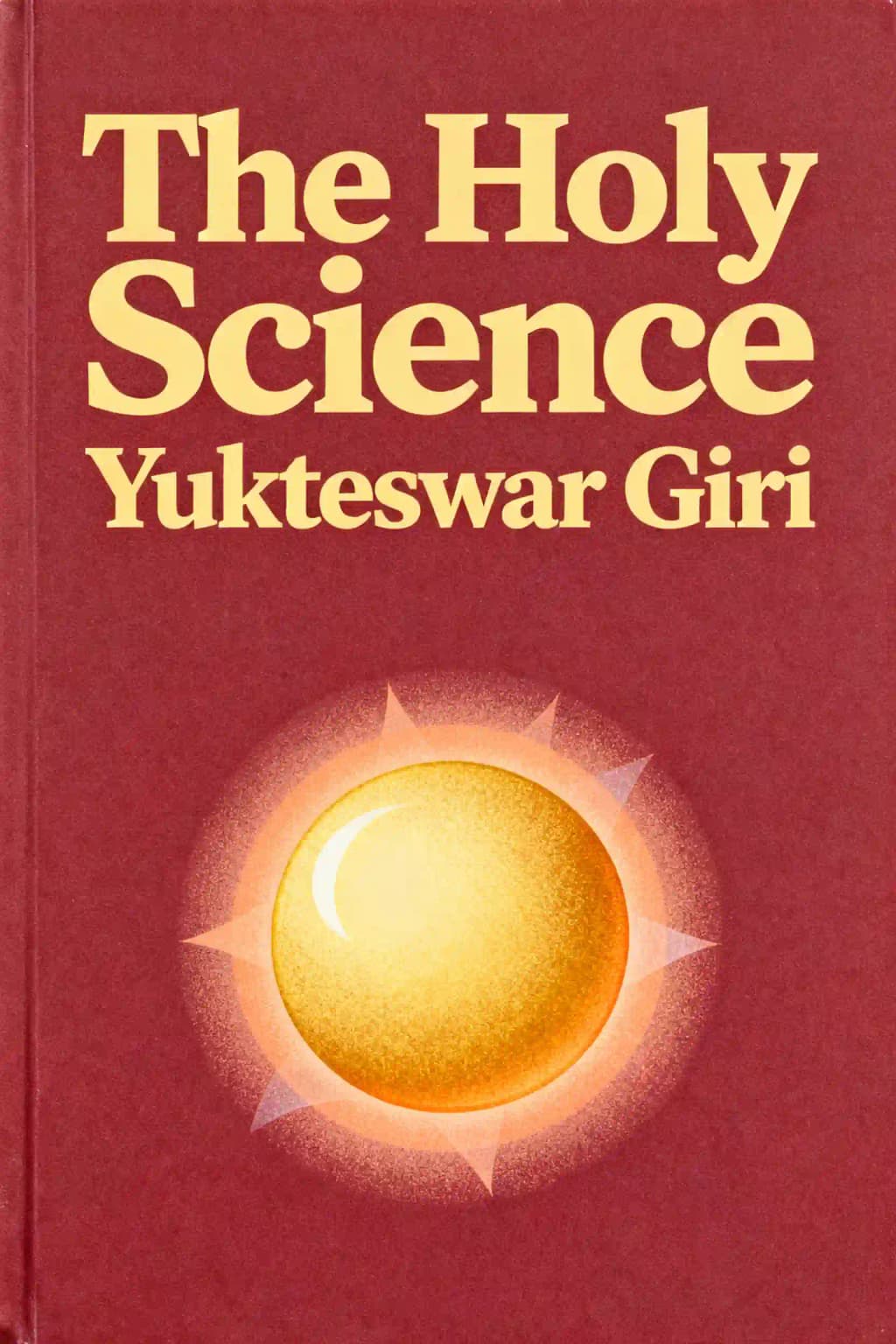
Holy Science
《Holy Science》概述
The Holy Science bridges Hindu and Christian wisdom, commissioned by the mystical Mahavatar Babaji himself. Did you know its revolutionary astronomical theories inspired a James Earl Jones-narrated documentary? Steve Jobs' spiritual mentor, Yogananda, introduced countless seekers to this consciousness-expanding masterpiece.

《Holy Science》核心主题
- cosmic yuga cycles
- spiritual evolution timeline
- vedic astronomical calculations
- universal consciousness science
- eastern western metaphysics
《Holy Science》经典语录
I send forth this treatise, unembellished with scriptural display, to summon the sons of Bharat Mata to her ancient glory.
The purpose of this book is to show as clearly as possible that there is an essential unity in all religions; that there is no difference between the truths inculcated by the various faiths; that there is but one method by which the world, whether Hindu or Christian, can be benefited.
God is the only real substance in the universe - eternal, indivisible, and the source of all that exists.
Maya is merely God's play of ideas.
关于作者
《Holy Science》作者介绍
Sri Yukteswar Giri, born Priya Nath Karar (1855–1936), was the author of The Holy Science and a distinguished Kriya yogi, Vedic astrologer, and scholar from Serampore, Bengal. His groundbreaking book on comparative spirituality reveals the scientific unity between Hindu scriptures and the Christian Bible.
Written in 1894 at Mahavatar Babaji's request during the Kumbh Mela in Allahabad, the work introduced revolutionary concepts including a reanalysis of the Vedic yugas and the precession of the equinoxes.
A disciple of Lahiri Mahasaya, Sri Yukteswar established ashrams in Serampore and Puri where he trained students through rigorous spiritual discipline. His expertise spanned astronomy, astrology, the Bhagavad Gita, and the Upanishads.
His most celebrated disciple, Paramahansa Yogananda, carried his teachings to the West and immortalized him in the spiritual classic Autobiography of a Yogi. The Holy Science remains a foundational text for those exploring the intersection of science and spirituality across religious traditions.
下载《Holy Science》摘要
免费获取《Holy Science》摘要的 PDF 或 EPUB 版本。可打印或随时离线阅读。
关于本书的常见问题
The Holy Science by Swami Sri Yukteswar Giri is a spiritual treatise written in 1894 that demonstrates the essential unity of all religions by comparing parallel passages from the Bible and Hindu scriptures, particularly the Upanishads. The book presents a scientific approach to spiritual evolution, outlining four stages of knowledge: the nature of creation, the ultimate goal of life, the practical methods to achieve it, and the revelations that come from spiritual practice.
Swami Sri Yukteswar Giri was a renowned Indian sage, astronomer, and spiritual teacher who wrote The Holy Science (originally titled Kaivalya Darsanam) at the request of Mahavatar Babaji in 1894. He is best known as the guru of Paramahansa Yogananda, author of Autobiography of a Yogi, and founded the lineage that brought Kriya Yoga to the West. His approach combined mathematical precision with mystical insight to present spirituality as an exact science.
The Holy Science is ideal for seekers interested in comparative religion, Kriya Yoga practitioners, and anyone exploring the scientific foundations of spirituality. This book particularly appeals to readers who want to understand the parallels between Eastern and Western spiritual traditions, students of Vedanta and Sankhya philosophy, and those seeking experiential wisdom rather than blind faith. It's essential reading for followers of Paramahansa Yogananda's teachings.
The Holy Science is worth reading for anyone seeking a unified understanding of world religions and practical spiritual methods. Despite its compact size, the book offers densely packed wisdom that bridges Christianity and Hinduism, presents spirituality as verifiable science, and provides actionable guidance through meditation and self-discipline. However, readers should approach it slowly, as its depth requires contemplation and possibly guidance from a spiritual teacher.
The core teaching of The Holy Science is that all religions share the same essential truths and lead to one ultimate goal: union with God, known as Kaivalya. Swami Sri Yukteswar emphasizes that there is one method by which the universe evolved and one path to liberation, accessible through scientific spiritual practice rather than blind belief. The book teaches that consciousness evolves through distinct stages, requiring divine love, a true guru, and disciplined inner work.
The Holy Science is structured into four sections representing stages of spiritual knowledge:
- The Gospel explains creation and the evolution of consciousness using Sankhya philosophy
- The Goal describes humanity's search for Existence, Consciousness, and Bliss (Sat-Chit-Ananda)
- The Procedure outlines practical methods including meditation on Aum, moral conduct, and guru guidance
- The Revelation discusses transformative states experienced by advanced practitioners approaching divine realization
The Holy Science demonstrates religious unity by drawing direct parallels between Jesus Christ's teachings and Vedic wisdom, especially comparing the Bible's Book of Revelation with Sankhya philosophy. Swami Sri Yukteswar shows that concepts like the Word (Aum/Amen), Holy Ghost, baptism, and salvation have equivalent meanings in both traditions. He supports these connections with specific scriptural citations, revealing that both paths describe the same journey from ignorance to divine realization through repentance and inner transformation.
Kaivalya means complete oneness with God or Self-realization, and it represents the ultimate goal of human existence according to The Holy Science. Swami Sri Yukteswar teaches that achieving Kaivalya liberates the soul from Maya (the illusion of separateness), ends the cycle of birth and death, and allows one to experience eternal freedom. This state is not theoretical but an experiential reality attained through sustained spiritual practice, moral purity, and the grace of a true guru.
The Holy Science emphasizes:
- Yama and Niyama (moral self-control including non-injury, truthfulness, and purity)
- Meditation on Aum (the divine sound)
- Following a natural lifestyle with a plant-based diet
Swami Sri Yukteswar stresses that finding a true spiritual teacher (Sat-Guru) is indispensable for advancement, as genuine knowledge requires awakening by a living master who embodies truth. He presents these methods as scientific procedures for verifiable inner transformation rather than mere rituals.
In The Holy Science, Aum (Om) is explained as the primal sound and vibratory essence of all creation, equivalent to "the Word" mentioned in the Bible's Gospel of John. Swami Sri Yukteswar describes Aum as Moola Prakriti in Sankhya philosophy, the cosmic vibration from which the manifested universe emerges. Meditation on Aum is presented as the most direct path to God-realization, allowing practitioners to experience the divine presence through sound and inner perception.
The first chapter of The Holy Science is rooted in Sankhya philosophy, explaining the cosmos through 24 basic principles of creation. Swami Sri Yukteswar describes how:
- Purusha (Cosmic Spirit)
- Prakriti (Creative Nature)
...interact to manifest the universe, detailing elements like Mahat (cosmic intelligence), chitta (consciousness), manas (sensory mind), ahankara (ego), and the sense organs. This framework provides a scientific understanding of how consciousness evolves from pure spirit into material form and back again.
The Holy Science remains profoundly relevant in 2025 because it addresses humanity's timeless need for unity, meaning, and inner peace in an increasingly divided world. Its message that all religions share the same essential truths offers healing in an era of religious conflict, while its scientific approach to spirituality appeals to modern seekers who value evidence and direct experience over blind faith. The book's emphasis on consciousness evolution and self-realization speaks directly to contemporary interest in mindfulness, meditation, and personal transformation.