第 1 章
The Quest That Transforms: Finding Purpose Through Extraordinary Challenges
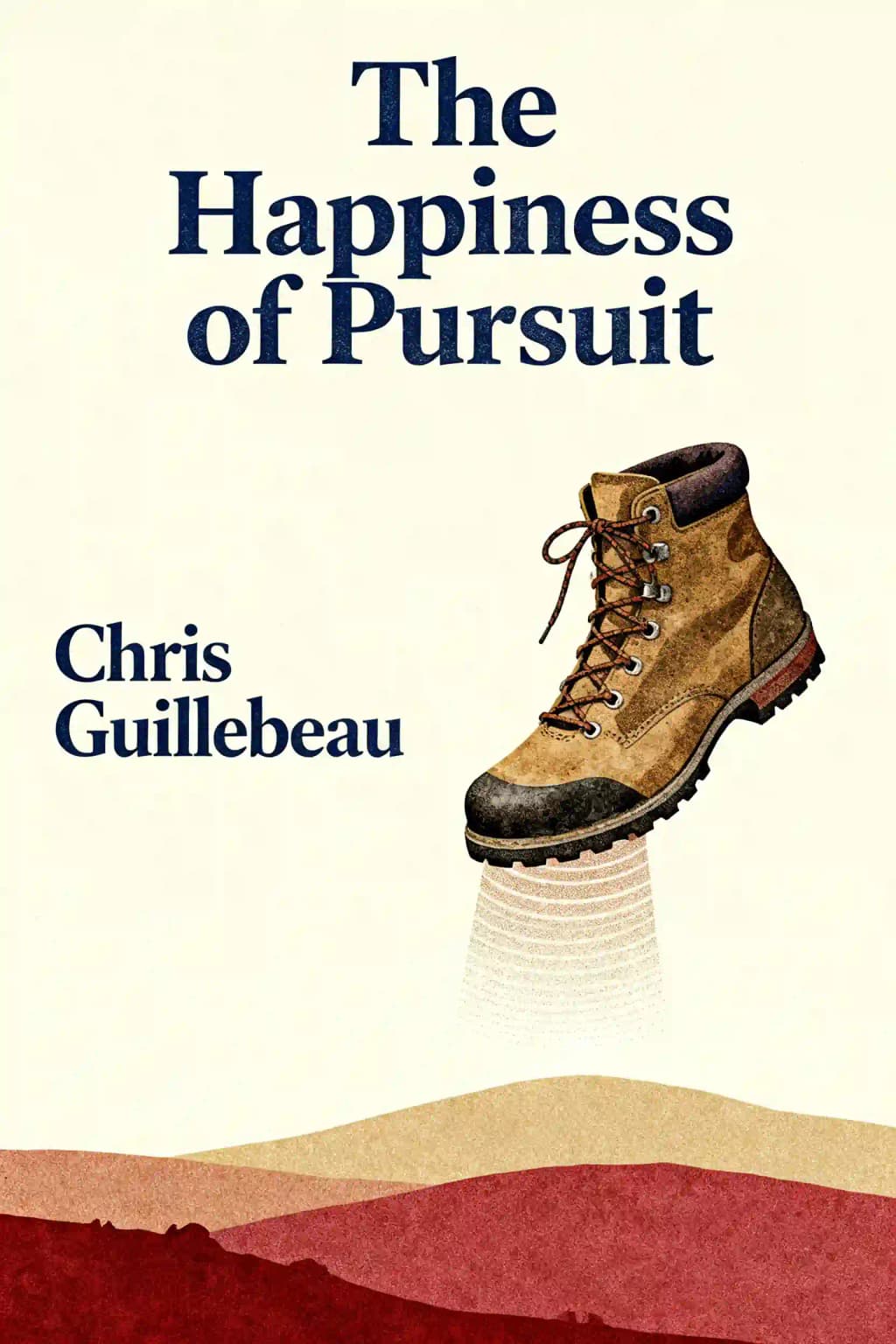
What if the path to happiness isn't found in comfort, but in the pursuit of something greater than ourselves? Chris Guillebeau discovered this truth during a sleepless night in Dakar's international airport, waiting for a dawn flight to Guinea-Bissau-his final African country in a decade-long quest to visit every nation on Earth. Despite mosquitoes, persistent porters, and uncomfortable plastic chairs, he felt alive with purpose. This bestselling memoir has inspired thousands to embark on their own quests, from celebrities like Tim Ferriss who credits it for his own adventures to everyday people who've redesigned their lives around meaningful pursuits. Beyond just travel inspiration, the book has sparked a movement of intentional living that challenges our culture's emphasis on passive consumption, showing how structured adventure can bring profound meaning to ordinary lives.
第 2 章
The Awakening: How Quests Begin
Quests have captivated humanity since our earliest stories-from ancient epics to modern blockbusters, we're drawn to tales of grand adventures and meaningful journeys. But quests aren't just fictional constructs; they're powerful frameworks for living that can transform ordinary lives into extraordinary ones.
A true quest has specific characteristics that distinguish it from general self-improvement or casual hobbies. It requires a clear goal with a definite endpoint, presents genuine challenges that stretch your capabilities, demands meaningful sacrifice, often connects to a sense of calling or mission, and progresses through incremental steps toward completion. Unlike vague aspirations to "get in shape" or "travel more," a quest has structure and specificity-it's the difference between wanting to see some countries and committing to visit every country in the world.
The seeds of quests often sprout from unexpected places. For Guillebeau, it began while volunteering on a hospital ship in West Africa, where he discovered a fascination with travel that eventually evolved into visiting every country. What started as exploration of regional destinations gradually expanded into a global mission, with each country becoming like a stage in a video game he was determined to complete.
Others find their quests through different awakenings. Some respond to external events, like Sandi Wheaton who turned a devastating layoff from General Motors into an opportunity to photograph Route 66. Others follow internal stirrings, like Tom Allen who rejected a promising job offer because he felt others were steering his life, choosing instead to cycle around the world with minimal planning and experience.
The common thread among all quest-seekers is a moment of clarity when they realize they must pursue something meaningful, regardless of practicality or others' opinions. As Sandi described it, she suddenly experienced "the sense of being at the reins of my life" after twelve years of corporate routine. This awakening often involves asking fundamental questions: What truly matters to me? Who am I beneath societal expectations? What would I attempt if I weren't afraid?
Quests begin when discontent meets inspiration and transforms into action. The formula becomes: Dissatisfaction + Big Idea + Willingness to Act = New Adventure. Without all three elements, transformation remains just a dream.
第 3 章
The Calling: When Purpose Finds You
A calling transcends mere dissatisfaction-it's a profound sense of purpose that combines destiny with determined free will. When we feel drawn to something greater than ourselves, we experience a mission that demands to be fulfilled, regardless of practical considerations.
John Francis found his calling after witnessing an oil spill in San Francisco Bay. What began as walking twenty miles to a party instead of driving evolved into a seventeen-year quest combining walking everywhere and complete silence. Though his choices cost him his job and complicated relationships, John felt compelled to continue. When explaining his decision became exhausting, he took a vow of silence that lasted seventeen years, discovering that "not speaking precludes argument, and the silence instructs me to listen."
Your calling doesn't need to be as extreme as walking the earth in silence or as ambitious as Dr. Mani Sivasubramanian combining pediatric heart surgery with social entrepreneurship. But a true mission will challenge and thrill you, involving trade-offs and sacrifice that feel worthwhile. The key is identifying what genuinely excites you-that thing that makes you lose track of time and fills you with authentic enthusiasm.
As Bob Dylan observed, "everybody has a calling" but "few are chosen" because distractions prevent people from finding their true selves. A calling isn't about being different-it's about being "the best at whatever you are called at," with confidence rather than arrogance. Like Jiro Ono, the sushi master who feels "victorious" over a good tuna, or Mark McDonough, the train enthusiast who shouts with joy at spotting a Heritage Unit, your quest should make your heart race with excitement.
When you feel drawn to something, even if others don't understand, the journey produces its own rewards. As Amelia Earhart said: "When a great adventure is offered, you don't refuse it." The question becomes not whether you have a calling, but whether you'll have the courage to answer it when it finds you.
第 4 章
Defining Moments: When Life Changes Direction
Any moment can transform your life-whether through conversation, opportunity, or a shift in perspective. The most inspiring changes often come not from necessity but from choice, when someone alters their comfortable life simply because they feel compelled to pursue something meaningful.
For many quest-seekers, an emotional awareness of mortality drives them to action. While we all intellectually know we'll die someday, developing a visceral understanding that "I will someday die" helps clarify what truly matters. Kathleen Taylor, a hospice worker, notes that at life's end, "people are incapable of bullshit" as normal distractions fall away. This awareness, whether triggered by external events like illness or an internal stirring, compels purposeful living.
Phoebe Snetsinger's birding obsession illustrates this transformation. What began as a hobby evolved into an all-consuming quest after her terminal melanoma diagnosis. Rather than pursuing treatment, she chose to travel actively-and unexpectedly survived. This near-death experience intensified her quest, leading her to trek through difficult terrain worldwide to identify nearly 5,000 bird species, determined to be the first woman to reach this milestone while "living on borrowed time."
Similarly, Thomas Hawk pursues an audacious quest to shoot and publish one million processed photos while balancing a day job and family life. His commitment requires discipline and sacrifice-less sleep, family tension, and constant prioritization. For Thomas, this isn't merely documentation but ensuring "art will play a significant and prominent role" in his life until death. His manifesto acknowledges life's brevity while emphasizing persistence: "When I'm tired, I keep shooting."
The distinction between hobby and quest lies in obsession. While hobbies can be casually abandoned, quests become total fascinations. Playing golf on weekends is a hobby; playing every Scottish course within a timeframe is a quest. Both Phoebe Snetsinger and Thomas Hawk transcended hobbyist status through their all-consuming commitments. The defining characteristic of a quest is when you wake at night consumed by your idea-when it refuses to let you go until you take action.
第 5 章
Self-Reliance: Standing Alone in Your Convictions
Quest-seekers must ultimately rely on themselves, even when facing opposition from others. Not everyone needs to believe in your dream, but you do-this lesson becomes essential for anyone pursuing an unconventional path.
Bryon Powell abandoned his legal career to build a virtual community for ultrarunners, immediately listing his house to downsize while changing careers. For over a year, he worked 10-14 hours daily, seven days a week, putting everything into his vision. "Easy projects aren't quests, they're holidays from real life," he explains. "Any real trial will challenge you to the core." Despite his determination, the constant pressure nearly broke him-when he forgot a tripod during race coverage, he almost quit on the spot. The experience taught him to pace himself better while maintaining his commitment.
Similarly, Julie Johnson, born with glaucoma that led to legal blindness at age twenty, decided to train her own guide dog despite widespread discouragement. She rejected established programs that used corrective training methods and retained ownership of the dogs, preferring her own approach. "There were a lot of people telling me that it couldn't be done," she explained. "The more people tried to push me away, the more I became intrigued." Her motivation crystallized in a sentiment echoed by many questers: "If I didn't do it, I would always wonder about what could have been."
For a quest to succeed, you must believe in its possibility even when no one else does. Laura Dekker never doubted her ability to complete her sailing journey despite fighting loneliness and Dutch authorities. Being told something is impossible often proves supremely motivating. As one marathon runner who completed fifty races in a year noted, "According to conventional wisdom, you're just not supposed to run a marathon every week. But that's why it's so satisfying!"
Self-reliance also means embracing calculated risks that align with your values. Society judges risk-taking based on outcomes rather than intentions-successful adventurers are labeled "brave" while failed ones are deemed "stupid." Yet life itself is inherently risky, and we must each choose our own acceptable level of risk rather than allowing fear to make our decisions for us.
第 6 章
Everyday Adventure: Finding Quests in Ordinary Life
Quests and adventures can be incorporated into everyday life without requiring extreme commitments like walking for seventeen years or sailing across oceans. The focus is on making adventure a priority over routine, regardless of where you live or your age.
Sasha Martin, a 33-year-old living in Tulsa, Oklahoma, created a "Stovetop Travel" project to reconnect with her international upbringing. She embarked on a quest to cook complete meals from all 195 countries in alphabetical order. Despite initial resistance from her "picky eater" husband Keith, the family embraced the project, with Keith documenting their daughter's reactions to each country's cuisine. The quest unexpectedly connected Sasha with immigrants living in Tulsa and evolved into a cultural peace initiative, with Sasha giving educational talks and inspiring other families to undertake similar projects.
What transformed Sasha's cooking project from occasional foreign cooking into a true quest was its structure: a clear goal (preparing meals from all 195 countries), measurable progress (coloring countries on a map each week), a sense of calling (connecting with global cultures), and concentrated effort (following the A-Z order without excuses). This structure created a meaningful, challenging adventure with defined parameters and purpose.
Other everyday quests include location-based projects like Marc Ankenbauer's "Glacial Explorer" mission to jump into all 168 lakes in Glacier and Waterton Lakes National Parks, Allie Terrell's visits to every basilica in the United States, and Josh Jackson's lifelong project with his dad to visit every Major League Baseball stadium.
For those seeking smaller adventures, life experiments offer accessible entry points. Allan Bacon found happiness by making small changes to his routine when feeling discontent. These experiments can be simple: talking to strangers, taking cold showers, changing your commute route, or offering your home on Airbnb. These small disruptions shake up routines and create everyday adventures.
Everyone claims to be busy, yet we all have the same amount of time. If adventure matters to you, something else must give. There are two approaches to change: make small but regular adjustments, or transform everything at once. Either can work, but waiting for change to find you isn't an option. Even without running 250 marathons, you can pursue a meaningful quest by creating structure around a project with a timeline and connecting your interests with an extended challenge.
第 7 章
Time and Money: Making the Impossible Possible
Before beginning a quest, count the cost. Breaking down overwhelming projects into manageable tasks makes them achievable. When Guillebeau first calculated visiting 100 countries would cost roughly $30,000 over 5-7 years, his reaction was "Wow, that's all?" Though he didn't have extra money lying around, living frugally made it possible. As he approached that goal, he realized visiting every country was within reach by solving one problem at a time.
Applying specific planning to any quest makes it more achievable. Start by defining what success looks like and estimate the requirements: Goal, Time, Money, Other Costs, and Unknowns. Matt Krause, who walked across Turkey, created detailed spreadsheets mapping his 60-mile weekly walks for 22 weeks, including elevation and climate data. Scott Young spent two months preparing to learn MIT's four-year computer science curriculum in one year, including a one-week pilot study that built confidence and revealed optimal study times.
Having a clear destination doesn't eliminate spontaneity-it enables it. When sailing toward your "Ithaca," the goal drives you forward while allowing for detours and discoveries. Planning actually creates space for spontaneity; the more prepared you are for your quest, the more freedom you have to embrace unexpected opportunities along the way.
Metrics provide focus for any quest. Marathon runners track their mileage during training and during the race itself. Mountain climbers need to know how many peaks they're targeting. While it might seem that tracking reduces experiences to mere checkboxes, the opposite is true-measurable goals provide clarity and motivation. The numbers become companions that guide your journey and help you stay focused on your ultimate destination.
For those prone to overthinking, sometimes the best approach is simply to begin. Tom Allen, who cycled away from England into foreign lands, frequently hears from people asking technical questions about gear and packing. His advice has simplified over time: "Pick a departure date. Start saving. Get a bike, tent, and sleeping bag. And go." Similarly, Gabriel Wyner mastered multiple languages through total immersion, starting with just "Hallo" at a German language camp where speaking only the new language was required. Both stories reinforce the same lesson: stop making excuses and jump in with both feet.
第 8 章
Life Listing: Structuring Your Quest
The concept of creating lists of things to do before dying has evolved from "The Bucket List" film into websites dedicated to life-listing and the "quantified self" movement. Even simple tracking can motivate us-like pushing yourself harder during a run because you're monitoring your performance. Beyond basic life lists, what if you organized your entire life around a single quest? When someone asks "What do you do?", having a quest gives you another answer that reflects your true identity: "I'm trying to visit every country in the world" or "I'm on a quest to publish one million processed photos."
Nicholas Felton has created extensive personal annual reports since 2004, documenting his life through countless data points-everything from meals and drinks to precise locations and sleep hours. Rather than making his life more regimented, this detailed self-tracking has made him more aware of his routines and more appreciative when he breaks from them. The reports inspired him to "say yes" to activities he might normally decline, showing how tracking can actually encourage variety rather than monotony.
In 1994, sixteen-year-old Kristen Goldberg created her first and only life list, years before "The Bucket List" popularized the concept. Twenty years later, she's still following the same list without modifications, even though some items reflect teenage priorities. The list has significantly shaped her life-her husband even chose his proposal location to help her cross off an item. As a teacher, Kristen now shares her experience with students, encouraging them to create their own life lists.
Steve Kamb transformed from self-described boring economics graduate to adventurer by structuring his life as a video game quest. He earns "experience points" for completing items on his list, "levels up" after every five items, and tackles increasingly difficult "master quests." The game structure tapped into his competitive nature, making self-improvement addictive.
Creating a life list helps ensure we reach the end of our lives feeling fulfilled rather than regretful. The process involves dedicating time to consider what experiences would make life meaningful, then listing them without self-editing. Effective life lists avoid fuzzy goals in favor of specific, measurable objectives like "Meet the Dalai Lama." They should include diverse categories of goals rather than focusing solely on adventure. Most importantly, they should encourage thinking big rather than limiting possibilities based on current circumstances or fears.
第 9 章
Forward Motion: Maintaining Momentum
Quests often involve long periods of monotonous effort punctuated by moments of achievement. Like Odysseus's decade-long journey home, modern quests involve much tedium that's rarely highlighted but is essential to success.
Experience breeds confidence, which produces success. Guillebeau's journey to visit every country became technically more difficult as he approached the final destinations-requiring complex visas and flight itineraries-but mentally easier as variables decreased and options narrowed. With fewer countries remaining, the path became clearer. His travel-hacking skills improved to where he could reroute trips from remote locations and confidently handle visa rejections by finding solutions on the ground.
Many questers experience accelerated progress as they build momentum. Phoebe Snetsinger, initially planning to see a few hundred bird species annually, soon found herself identifying nearly 1,000 new species in a single year. Robyn Devine started with knitting 100 hats but quickly realized she needed a more ambitious goal-10,000 hats-to feel truly challenged. Measuring progress is crucial; maintaining a checklist gives surges of accomplishment as you advance toward your goal.
John "Maddog" Wallace exemplifies obsessive quest commitment. After his first marathon left him swearing "never again," he surprisingly ran another just two days later, then a third three weeks after that. At 54, he officially began his quest and has now completed over 300 marathons in more than 100 countries, plus marathons in all fifty U.S. states-twice. Similarly, Martin Parnell cycled from Cairo to Cape Town, then designed multiple extreme athletic quests to raise $1 million for charity, including running 250 marathons in a single year.
Scott Young, a recent college graduate drawn to independent learning, created a quest to master MIT's computer science curriculum in one year without attending the university. Working 12 hours a day, five days a week, Scott completed every lecture and exam available online, posting his results publicly despite criticism. The accountability helped him persist through the challenge. After a year of intense study, he passed every course-some with flying colors-proving that forward motion and accountability are essential for quest completion.
Like Odysseus who kept moving forward through both challenges and monotony during his twenty-year saga, questers must maintain momentum. When faced with choices, active decisions that create forward progress are always preferable. Through this process, you'll develop resilience when plans go awry and learn to make peace with routine and monotony-choosing which form it takes rather than trying to avoid it entirely.
第 10 章
Transformation: How Quests Change Us
As quests progress, the initial naive enthusiasm evolves into deeper understanding. The journey changes you, often revealing that expectations were the source of frustration. Whether motivated by achievement or process, questers find themselves transformed by their experiences.
Quest motivations generally fall into two categories: achievement-focused (accomplishing something specific) or process-focused (doing something step by step). Achievement-motivated people, like Guillebeau who briefly considered visiting every Nando's restaurant location worldwide for a lifetime pass, focus on completing goals. Process-motivated individuals, like Isabelle Leibler who trained an "untrainable" horse or Sasha Martin who cooked meals from every country, find satisfaction in the daily progress and measurable steps toward their goal.
Long quests inevitably transform their pursuers. Several key changes emerge from these transformative journeys:
First, independence and confidence develop through overcoming challenges. Isabelle Leibler discovered that "the only true strength you will ever need comes from you, and you alone." Nate Damm underwent a complete personality transformation, evolving from shy and quiet to confident in handling tough social situations.
Second, maturation occurs as perspectives broaden. Rita J. King found that her quest gave her deeper insight: "I listen much more. I feel comfortable letting things unfold even while I maintain a breakneck pace with my own work." John Francis evolved from rebellious silence to wisdom-initially refusing to speak or use motorized transport as protest, but eventually realizing his decisions had become "a prison." After 22 years of walking, he began speaking again and using vehicles, explaining: "The lesson was to always revisit my decisions in light of new knowledge. Don't be afraid to change."
Third, vision expands beyond initial goals. Guillebeau's solo travels evolved into community connections, hosting meetups on every continent. Sasha Martin's cooking project grew from improving family meals to "sharing a message of peace through understanding." Tom Allen's cycling journey transformed from self-discovery to reconnecting with people-he married in Armenia and launched storytelling projects while continuing his adventures.
Finally, success breeds empowerment. Guillebeau describes earning just $1.26 from an online experiment in Belgium as transformative-not for the amount but for proving his concept worked. Similarly, approaching his final thirty countries, he felt unstoppable: "I can take on the world." As quests progress, "I can do this!" becomes "What else can I do?"-dreams expand with pursuit.
第 11 章
The Journey's End: Finding New Beginnings
The end of a quest brings mixed emotions. After walking across America, Nate Damm felt both amazed and annoyed that his daily purpose was complete. Gary Thorpe was effusively thrilled when his decades-long dream of staging the Gothic Symphony finally happened. Guillebeau's own completion of visiting every country culminated in Norway, where he celebrated with family, friends, and readers from twenty countries who traveled to join his "End of the World" party. The adventure that began as a solo journey ended surrounded by community.
Post-quest depression is real-from Brooks Hatlen's suicide after prison release in The Shawshank Redemption to John Stuart Mill's existential crisis upon achieving his goals. Howard Weaver experienced this after winning his decades-long newspaper war in Alaska. When the competing Anchorage Times finally closed in 1992, Howard felt "tired and disoriented" despite achieving his long-sought victory. "A large part of how I'd defined myself simply was no longer there."
The greatest challenge of returning "home" is recognizing you've changed fundamentally. You've "leveled up," as Steve Kamb described it using video game terminology. Many questers encounter dismissive phrases like "back to real life now" or "that wouldn't work in the real world" from friends and family who can't relate to their experiences. Tom Allen believes this logic is backward-"Life on the road WAS the real world. Back in England, it was modern society that seemed to be a place of isolation and abstractions." You can't truly go back because you've been transformed.
Recovering from post-quest funk starts with accepting that you've changed and can't return to your former self. Next, you need a new quest and mission. Focus on telling a few meaningful stories, and remember that the "real world" is what you make of it.
Each of us is writing our own story, and a quest can bring purpose and meaning to our lives. As Alicia Ostarello said after completing her dating mission: "This is my story. No one can take it from me. And that is what has made everything entirely worth it." Perhaps the most powerful lesson comes from Phoebe Snetsinger, who after receiving a "fatal" cancer diagnosis, spent seventeen years pursuing her bird-watching quest before dying in a van accident in Madagascar. As she wrote before her death: "If I had spent my life avoiding any and all potential risks, I would have missed doing most of the things that have comprised the best years of my life."