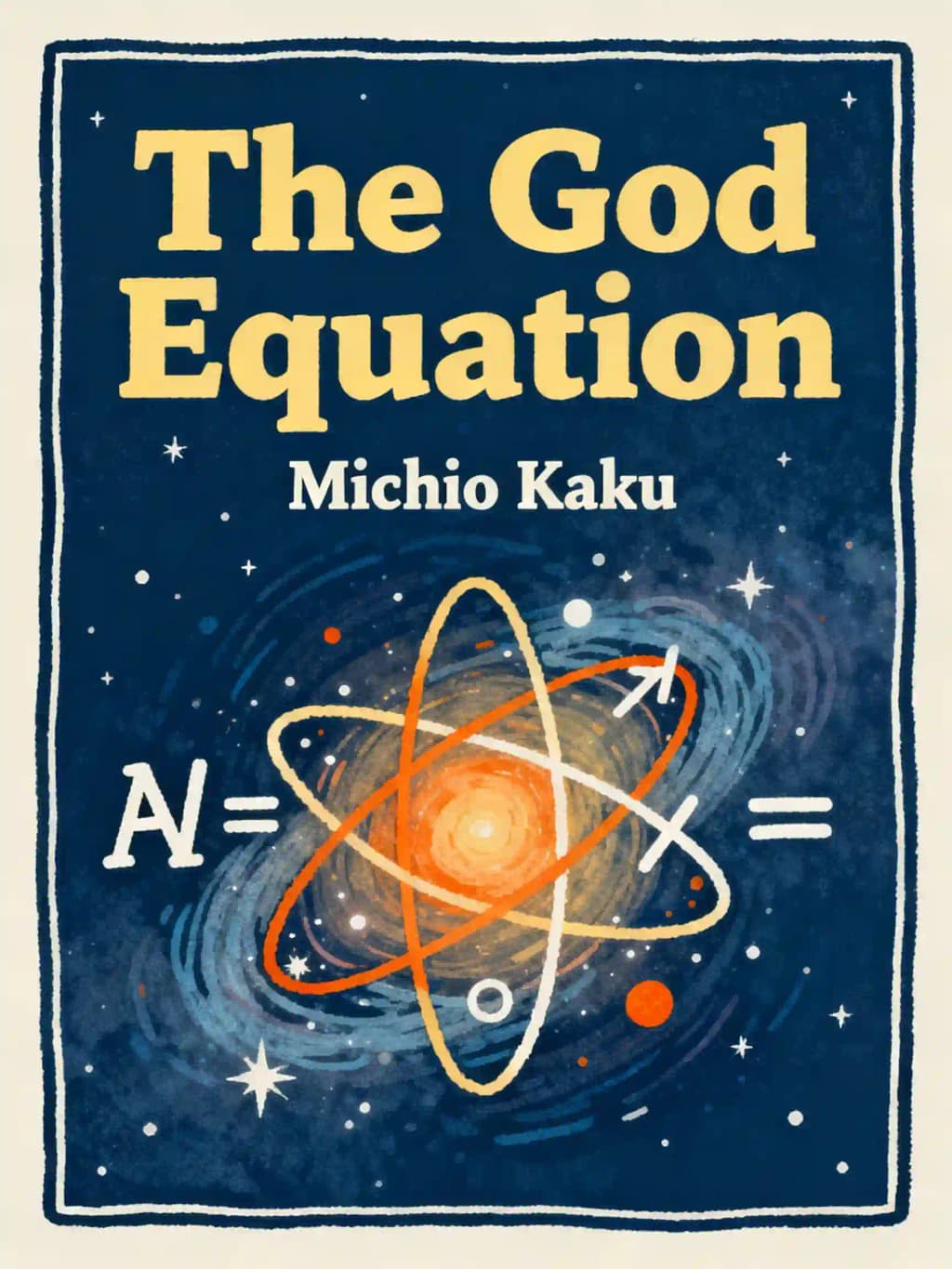
Michio Kaku's quest to unite physics' fundamental forces into one elegant equation captivates both scientists and spiritual seekers. Even without a physics background, readers find themselves pondering: Could the mathematical perfection of our universe actually hint at a cosmic designer?
Michio Kaku, theoretical physicist and New York Times bestselling author of The God Equation: The Quest for a Theory of Everything, is a leading authority on cosmology and futurescape science.
The book explores humanity’s pursuit of a unified "theory of everything" through frameworks like string theory and quantum mechanics. This reflects Kaku’s decades of academic work at the City College of New York and his public advocacy for advancing Einstein’s unfinished unified field theory.
A frequent guest on The Daily Show, 60 Minutes, and BBC science documentaries, Kaku has hosted acclaimed TV series such as Sci Fi Science (Discovery Channel) and Futurescape (Science Channel), distilling complex physics for global audiences. His other bestselling works, including Physics of the Impossible and The Future of Humanity, solidify his reputation for bridging speculative science and mainstream accessibility.
The God Equation debuted at #1 on the New York Times bestseller list and has been translated into over 20 languages, underscoring Kaku’s role as one of the most influential science communicators of the 21st century.
The God Equation explores the century-long quest to unify physics through a "Theory of Everything," merging Einstein’s relativity with quantum mechanics. Michio Kaku traces breakthroughs from Newton to string theory, framing the search as humanity’s effort to decode cosmic order. The book balances scientific rigor with philosophical reflections on existence, God, and the universe’s elegance.
Science enthusiasts, physics students, and readers curious about cosmology’s big questions will find this book accessible. Kaku’s storytelling caters to non-experts, making complex concepts like string theory and multiverse dimensions engaging. It’s ideal for those intrigued by how science intersects with philosophy and spirituality.
Yes—Kaku demystifies advanced physics with clarity, weaving history, theory, and futurism into a cohesive narrative. While critics note simplified explanations, the book succeeds as a primer on unifying physics. Its exploration of Spinoza’s God and cosmic design adds unique depth, appealing to both skeptics and spiritual thinkers.
String theory posits that microscopic vibrating strings underlie all matter and forces. Kaku presents it as the leading candidate for a Theory of Everything, bridging relativity and quantum mechanics. He argues its 11-dimensional framework could finally unify physics, though empirical proof remains elusive.
Kaku distinguishes between a personal deity and Spinoza’s "God of order," favoring the latter as a metaphor for universal laws. He identifies as agnostic, citing the universe’s mathematical beauty as evidence of a deeper design. This philosophical thread ties scientific inquiry to existential wonder.
Some readers find Kaku’s theological analogies oversimplified, particularly his categorization of God into distinct types. Others note string theory’s speculative nature and the lack of experimental validation. However, these critiques don’t overshadow the book’s educational value.
Unlike dense theoretical texts, Kaku prioritizes narrative flow and relatable metaphors. It’s less technical than Stephen Hawking’s works but more philosophically expansive, making it a bridge between academic research and mainstream curiosity.
Key moments include Newton’s gravity, Einstein’s relativity, quantum mechanics, and Higgs boson discovery. Kaku frames these as steps toward the ultimate goal: a single equation governing all cosmic forces.
Spinoza’s God represents the universe’s inherent order and elegance, devoid of human-like intervention. Kaku aligns this with Einstein’s belief in a cosmic architect, arguing that physics’ mathematical harmony reflects a deeper, impersonal intelligence.
He portrays math as the universe’s "language," revealing hidden patterns. Equations like Einstein’s E=mc² and quantum formulas underscore his thesis: abstract math often precedes real-world discoveries.
The universe’s simplicity—governed by a few core laws—suggests a deeper coherence. Kaku argues this elegance isn’t accidental, hinting at an underlying logic that a Theory of Everything might finally expose.
Kaku envisions breakthroughs in space exploration and particle colliders validating string theory. He remains optimistic that a Theory of Everything will emerge this century, reshaping humanity’s cosmic understanding.
He likens string theory’s extra dimensions to a spiderweb’s vibrations and describes black holes as "gateways" to alternate universes. These analogies make abstract ideas tangible for general readers.
通过作者的声音感受这本书
将知识转化为引人入胜、富含实例的见解
快速捕捉核心观点,高效学习
以有趣互动的方式享受这本书
"read the mind of God."
Superstition replaced scientific inquiry.
Light itself was an electromagnetic wave.
"Can you outrace a light beam?"
Time slows and objects compress.
将《God Equation》的核心观点拆解为易于理解的要点,了解创新团队如何创造、协作和成长。
将《God Equation》提炼为快速记忆要点,突出坦诚、团队合作和创造力的关键原则。

通过生动的故事体验《God Equation》,将创新经验转化为令人难忘且可应用的精彩时刻。
随心提问,选择声音,共同创造真正与你产生共鸣的见解。

"Instead of endless scrolling, I just hit play on BeFreed. It saves me so much time."
"I never knew where to start with nonfiction—BeFreed’s book lists turned into podcasts gave me a clear path."
"Perfect balance between learning and entertainment. Finished ‘Thinking, Fast and Slow’ on my commute this week."
"Crazy how much I learned while walking the dog. BeFreed = small habits → big gains."
"Reading used to feel like a chore. Now it’s just part of my lifestyle."
"Feels effortless compared to reading. I’ve finished 6 books this month already."
"BeFreed turned my guilty doomscrolling into something that feels productive and inspiring."
"BeFreed turned my commute into learning time. 20-min podcasts are perfect for finishing books I never had time for."
"BeFreed replaced my podcast queue. Imagine Spotify for books — that’s it. 🙌"
"It is great for me to learn something from the book without reading it."
"The themed book list podcasts help me connect ideas across authors—like a guided audio journey."
"Makes me feel smarter every time before going to work"

免费获取《God Equation》摘要的 PDF 或 EPUB 版本。可打印或随时离线阅读。
Imagine standing at Einstein's desk, staring at his unfinished notebook containing the most ambitious intellectual pursuit in history-a single equation, just one inch long, that could unite all cosmic forces and potentially allow us to "read the mind of God." This quest for a unified theory captivated eight-year-old Michio Kaku when he saw a newspaper photo of Einstein's desk, igniting a lifelong passion. Each time scientists have unraveled a fundamental force, civilization has transformed dramatically-Newton's laws enabled the Industrial Revolution, while quantum theory gave us the high-tech revolution. A unified theory might finally answer our deepest questions about black holes, time travel, higher dimensions, and the very fabric of reality itself. The implications are staggering. String theory, the leading contender for this unified theory, suggests that everything in the universe-from electrons to stars-consists of tiny vibrating strings. Like different notes on a violin create different sounds, different vibration patterns create different particles. This elegant concept has the potential to explain the entire cosmos through a single principle, just as Einstein dreamed. But the journey to this understanding has been long and winding, filled with brilliant insights, false starts, and unexpected revelations about the nature of reality.