第 1 章
Ancient Wisdom for Modern Life: The Gita's Secret Recipe
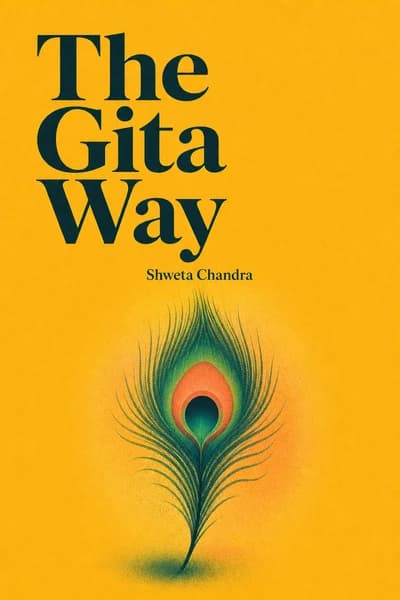
When was the last time you felt truly aligned with your purpose? Not just going through the motions of daily life, but feeling deeply connected to your unique reason for being? In a world where 85% of people report feeling disengaged at work and countless others struggle with existential questions about their life's direction, "The Gita Way" by Shweta Chandra offers a revolutionary approach to discovering our true selves. This contemporary interpretation of the 2,300-year-old Bhagavad Gita has garnered praise from business leaders and spiritual seekers alike, with figures from Elon Musk to Oprah acknowledging the Gita's timeless wisdom. Unlike traditional religious interpretations, Chandra's approach strips away mythology to reveal practical insights for modern life. As Warren Buffett once noted about ancient wisdom: "The principles haven't changed-only the applications have." Through this lens, the battlefield where Arjuna faced his crisis becomes our own internal struggle to discover who we truly are and what we're meant to contribute to the world.
第 2 章
Finding Your Unique Purpose in a World of Distractions
Life's most significant discovery isn't your birth-it's finding your purpose. As Mark Twain observed, discovering why you exist ranks second only to the miracle of existence itself. The Bhagavad Gita teaches that each person possesses a unique dharma (righteous duty) perfectly aligned with their swa-bhava (inherent nature). This isn't something you can borrow or imitate from others.
Imagine being lost at sea-true motivation emerges only when you have clear direction, trust in your guidance system, meaningful goals, and the ability to navigate both challenges and opportunities. Without purpose, we become victims of circumstance rather than creators of our own destiny. When we pursue goals influenced by external factors rather than our inherent nature, we experience stress and diminished motivation.
The Gita emphasizes that your personal dharma (swa-dharma), though imperfect, is superior to perfectly following another's path. Your purpose cannot be compared or benchmarked against others. The ultimate goal is moksha-liberation through self-realization-achieved when you fulfill your unique purpose and internalize life's universal purpose.
Our behavior is governed by natural forces, yet we each possess unique attributes in both tangible and intangible forms. Discovering these inherent strengths requires looking inward rather than mimicking others' success. True strengths energize us intrinsically and produce quantum results when developed.
Consider a cricket player naturally gifted as a bowler who tries becoming an all-rounder because that's more celebrated. By focusing on weaknesses to emulate others, they risk mediocrity in all areas, while developing natural talents would lead to excellence and fulfillment. The question isn't "How can I be like them?" but "How can I become the fullest expression of myself?"
第 3 章
The Joy of Self-Discovery: Where Purpose Meets Passion
The Gita describes "joy of the self" as the intrinsic motivation we experience when pursuing activities that energize rather than drain us-where even failure doesn't diminish enthusiasm. Unlike profession-related stress, these pursuits aren't driven by external cravings but by self-motivation that creates tireless, stress-free enjoyment.
Think about your hobbies-activities you'd happily do without payment or recognition. That feeling of flow and timelessness signals alignment with your natural strengths. When hobby becomes profession, as with Warren Buffett's interest in company financials, one achieves greater fulfillment. However, The Gita Way suggests that even if your profession doesn't currently align with your natural strengths, you can develop those strengths to extraordinary levels and apply them to your current work.
For example, someone naturally gifted at communication might transform their approach to engineering work by becoming exceptional at explaining technical concepts, rather than immediately changing careers. This transformation of approach often proves more effective than dramatic career changes.
Goal-setting can begin either from developing discovered natural strengths or identifying a larger purpose first. For those who've already invested time developing certain strengths, starting there makes sense. For beginners, identifying what you want to achieve works better, provided it isn't merely inspired by someone else's success.
The Gita contrasts Arjuna and Mahatma Gandhi, who developed strengths first and discovered their purpose later, with Mother Teresa and paleontologist Mary Anning, who identified their goals early and devoted their lives to them. The key is introspection through self-examination, meditation, self-questioning, and unlearning. When you discover your natural strength and commit to developing it fully, your life's purpose will eventually become clear.
第 4 章
Overcoming Doubt: The Greatest Enemy of Self-Realization
The Gita emphasizes that doubt arises from having too many choices. When faced with multiple strengths, either they're correlated (choose the most appealing and develop others alongside) or your introspection remains incomplete. Indecisiveness kills thought processes and leads to procrastination.
Consider the story of Barbarika from the Mahabharata-a warrior with exceptional skill who could destroy armies with a single arrow. Before the great war, Krishna asked warriors to assess the battle's outcome. Barbarika claimed he could end it in minutes. After demonstrating his skill by piercing all leaves on a banyan tree with one arrow (even finding the leaf Krishna had hidden under his foot), Barbarika revealed his pledge to always fight for the losing side.
Krishna realized this indecisiveness would make Barbarika switch sides repeatedly, potentially killing everyone in both armies. When Krishna asked who his guru was, Barbarika named Krishna himself. When asked for gurudakshina (teacher's fee), Krishna requested his head. Barbarika complied immediately, and in return was granted the ability to witness the entire battle from a nearby mountain.
This story illustrates how indecisiveness, even with great skill, makes us self-defeating. To resolve conflicts, we must use our intellect with a steady, undistracted mind focused on our supreme goal. The Gita teaches that yogis aren't ascetics but those with steady minds who control their senses and act from right duty, which requires right knowledge through karma yoga and gyan yoga.
第 5 章
The Journey to Self-Knowledge: Discovering Your True Identity
We often mistake our perceived self for our real self. Many aspects of our lives-parents, upbringing, schooling, language-are predetermined by Prarabdha (destiny). Even after developing awareness, we're driven by others' aspirations, internalizing external identities and borrowed belief systems.
Yet beneath these layers lies our true individuality, which can be discovered through Purusartha (self-effort). When our senses awaken, Purusartha allows us to dig beneath our perceived self. Desire often obscures knowledge-"As fire is covered by smoke, mirror by dust, and embryo by amnion, so is knowledge covered by desire." Pursuing others' goals or sensory pleasures misaligns us from our natural strengths, creating doubt and frustration.
The Gita Way teaches that our spiritual identity exists beyond external parameters like physical form, family, qualifications, or profession. Though the world knows us through these external markers, most of us only know ourselves through them as well. To truly know ourselves, we must understand six elements that form the self:
First, consciousness of self-identity-our existence is undeniable, as Descartes said, "I think, therefore I am." While happiness comes in moments of achievement, permanent happiness emerges only when we realize our inherent purpose. Self-consciousness produces two similar but distinct qualities: ego (inflated pride) and self-respect (feeling worthy while treating others equally). The Gita recommends cultivating self-respect without ego as essential to self-knowledge.
Second, intellect-our essential decision-making tool, strengthened by accumulated knowledge and experience. The Gita views intellect as the core faculty that distinguishes between knowledge and ignorance. While undecided minds wander in countless directions, the determined intellect focuses singularly toward our supreme purpose.
Third, primordial matter-the Gita contemplates that our vital spirit forms part of the universal spirit. Everything in the universe is energy, making the universe itself an ocean of immeasurable power with us as forms within it holding specific potential.
Fourth, sources of perception and action-our mind and five senses. The barrier to self-realization is our tendency to identify self through physical form rather than essence. We must know our senses and mind as tools before detaching from their entanglement.
Fifth, physical body and fitness-though physical fitness is prerequisite to performing any duty, the Gita cautions against confusing our bodies with our inner core. Our true identity transcends physical form.
Sixth, false goals such as desire, aversion, and pleasure-desire becomes a false goal when driven by others' achievements rather than our natural strengths. Aversion stems from lost faith after failure, compounding over time and leading to inaction.
第 6 章
The Path of Action: Karma Yoga for Modern Life
Every activity ensures an outcome, yet the Gita teaches that results lie outside our control. We must perform our prescribed duties without contemplating outcomes, focusing only on the quality and sincerity of our actions. Like a farmer who controls seed quality, manure, and irrigation but cannot guarantee the perfect crop, we must do our best and leave outcomes to universal energy.
Inaction brings its own problems-like an untended field growing weeds. Contemplating outcomes disturbs action quality, much like risk management compromises optimal outcomes. A karma-yogi accepts failure with equanimity, knowing there's no alternative to performing duty with excellence, especially when aligned with one's unique life purpose.
Prescribed duties directly or indirectly support our supreme purpose, while prohibited acts are driven by desire. Short-term goals motivated by wealth accumulation or sensory pleasures divert us from life's true purpose. Knowledge and intellect help distinguish between these acts. People with confused goals oscillate between activities, losing focus. Once we know our purpose, prescribed duties should never be abandoned-not from fear of strain or pain.
Working on prescribed duties generates joy as they align with our natural strengths (swa-bhava). A karma-yogi develops firmness to stay on path despite hardships, unpleasant results, or lack of support, driven by knowledge of purpose rather than attachment to outcomes.
Yoga, the essential ingredient of karma-yoga, is the state of an equipoised mind that handles both pain and pleasure, failure and success with stability. Both ecstasy in success and frustration in failure can divert us from our ultimate purpose. Success may breed overconfidence while failure may convince us to abandon our path prematurely.
Worldly pleasures are like quicksand-the more we seek enjoyment in them, the deeper we sink. The Gita provides a solution through seeking joy beyond worldly pleasures, focusing instead on activities aligned with our life purpose. A karma-yogi remains equanimous in both success and failure, treating milestones as mere steps toward the supreme purpose rather than ultimate achievements.
Consider Abraham Lincoln who faced numerous political defeats before becoming President, or Thomas Edison who had 10,000 failed experiments alongside his 1,000 patents. Those who maintain equipoise discover new skills and approaches through both success and failure. This stability comes from clarity of purpose and selfless devotion.
第 7 章
Breaking the Cycle of Desire and Discontent
The purpose of yoga is conditioning the mind to seek the right purpose. Without this clarity, confusion manifests through time-consuming activities driven by desire. This creates an irreversible cycle: desire leads to attachment, which enhances desire further. When these desires remain unfulfilled, frustration and anger arise, creating delusion that clouds intellect.
This "desire-entrap" cycle is the root cause of unhappiness. Only a stable mind with clarity of purpose, selfless devotion, and control over the senses can break this cycle. The karma-yogi conquers mind and senses through intellect, placing the conscious self above all. In this hierarchy of control, the conscious self performs activities without claiming "I am the doer" and remains aware of life's supreme purpose without identifying with intellect, mind, or body-the ultimate state of yoga.
True success in karma-yoga isn't measured by outcomes but by fulfillment in pursuing one's life purpose. Prarabdha (destiny) is one of five factors determining outcomes alongside body, performer, senses, and endeavor. While four factors remain within our control, prarabdha represents collective forces of nature beyond individual influence.
Like a skilled driver who crashes despite careful driving because of another's recklessness, prarabdha follows natural patterns of cause and effect rather than random luck. The timing of outcomes often extends beyond our expectations-sometimes affecting future generations-making karma-yoga's focus on devoted action rather than results even more relevant.
The Butterfly Effect explains prarabdha as tiny initial changes creating significant outcome differences. Edward Lorenz discovered this when minimal rounding differences in weather model data produced dramatically different results. Like dice throws that never replicate exactly despite similar technique, the collective karma of subtle differences creates varying outcomes.
The Gita teaches that we must lift ourselves through self-control, as the mind is both our friend and enemy. Though restless, the mind can be controlled through repeated meditation and dispassion practice. We don't need to become ascetics-all goals remain within reach by following yoga principles with devotion.
第 8 章
The Integration of Knowledge and Action: Finding Wisdom
The Gita teaches that every individual has a unique purpose discoverable through their natural strengths. Both knowledge-yoga and karma-yoga are complementary methods for achieving this purpose-knowledge develops specialized skills while karma discovers a unique path. In reality, these practices cannot exist separately: knowledge-yoga enables self-realization while karma-yoga achieves self-worth through fulfilling life's purpose.
The combined approach requires wisdom and sacrifice. Unlike intellect which merely provides reasoning power, wisdom clarifies reasons and helps choose the right path. While intellect presents alternatives and reasons for doubt, wisdom provides solutions and enables decision-making.
Wisdom, shining like the sun, is the true knowledge that destroys ignorance and reveals the supreme goal. While the yoga of knowledge aims to understand everything in self-realization, wisdom is what applies this knowledge. Ultimate dispassion, traditionally achieved through asceticism, can be reached even while performing duties to family and society.
Wisdom helps us permanently deal with negative emotions like anger and frustration, rather than seeking temporary solutions. It's the application of knowledge and experience, illuminating our inner self just as the sun illuminates the world. Self-control emerges from wisdom and helps overcome the major hurdles in performing our duties: pleasure of the senses, desire to pursue those pleasures, and lust for others' success.
Doubt is the greatest enemy of both knowledge and karma yoga, as the path requires conviction. Indecisiveness stems from ignorance, lack of knowledge, and fear of risk-taking-affecting even well-qualified people. Every moment demands decision-making, and indecisiveness leads to inaction that slowly destroys our life purpose. Wisdom is the weapon that slashes through doubt, enabling us to move forward with clarity and purpose.
False wisdom occurs when illusion affects our judgment, making us perceive wrong as right. This happens when we refuse to accept mistakes or failures, driven by the illusion of "I am right" or "I am the doer." In this state, we reject suggestions to correct our course. When combined with lust for achievement, our actions become prohibited acts.
Sacrifice in the Gita Way isn't religious killing but giving away elements of pleasure and desire. At an advanced stage of karma-yoga, it means surrendering the idea of "I am the doer" even when results are favorable. This is the only path to dispassion. When we give away achievements unconditionally, we achieve selfless action; when we cling to accomplishments, we invite attachment and desire.
第 9 章
Unlocking Your Inner Power: The Energy Within
Centring involves applying yoga principles to attain wholeness by using all knowledge together. This wholeness can solve many personal and social problems, but requires understanding the power within one's real self. The energy inside us is no different from universal energy-like a drop in the ocean of omnipresent energy.
The supreme energy contains all knowledge and power, omnipresent and omnipotent. While we perceive ourselves through consciousness, body, primordial matter, intellect, mind, and senses, these are merely illusions. The Gita teaches that our true identity is the spirit-the non-illusive self-waiting to be realized within us.
The spirit inside us is identical to universal energy-omnipresent, omnipotent, and containing all knowledge. Our individual energy is bounded by perceived elements of self but connects to supreme energy. Our true identity lies beyond the physical form, consciousness, primordial matter, intellect, mind and senses-these are merely objects of perception, like coal whose true value is its heat energy rather than its physical form.
While coal cannot choose how it's utilized, we can decide how to use our inner energy through knowledge and karma yoga. All spirits are interconnected, explaining prarabdha (destiny)-our actions create waves affecting others, contributing to natural order and harmony. This power remains underutilized until we realize it and release it through yoga practices.
Centring is a method to unlock the power of the real-self by gathering all our knowledge, wisdom, and experience to a single point. Like solving a puzzle, centring involves taking our mind away from the problem, connecting with supreme energy, then bringing focused attention back to the issue. This approach helps us access our complete knowledge and perspective-we already possess adequate resources to solve any problem, but struggle to use all our knowledge simultaneously.
Through meditation, centring helps achieve this wholeness. The ultimate stage of centring is "Brahma Gyan" (absolute knowledge), where knowing everything and knowing nothing become identical-a point of ultimate dispassion. Centring represents the best combination of knowledge and karma yoga, using available knowledge to discover the unknown.
第 10 章
The Power of Devotion: Transforming Knowledge into Action
Devotion transforms action and knowledge from cold, dry practices into the path to attaining the supreme spirit. Unlike mere worship, devotion represents unconditional commitment to life's purpose with indifference to results. It arises from conviction in one's path and goal, which comes through self-realization and clarity of purpose.
The Gita describes devotion as the key to achieving supreme yoga-the catalyst transforming personal purpose into universal purpose. It simplifies the hardships of yoga and makes selfless karma possible. While some abandon efforts at the first sign of failure, the devoted persist through challenges with ardent love, commitment, and persistent zeal that fuels both knowledge and karma yoga.
The ultimate goal of devotion, like knowledge and karma yoga, is freedom from the cycle of birth and death. The Gita states that those who surrender all actions to the supreme spirit with focused meditation will be delivered from this cycle. Liberation means freedom from cause and effect (prarabdha), beginning and end, and time itself-creating ultimate dispassion.
When knowledge and karma yoga work together with devotion, intellect and wisdom form a cycle of liberation: knowledge creates intellect to determine appropriate duties; karma provides experience which combines with intellect to produce wisdom; all working together to clarify self-realization with each cycle. This cycle generates increasing energy with each revolution, potentially reaching the point of complete liberation and union with supreme spirit.
Devotion emerges from conviction in our unique strengths and goals-these are its basic ingredients that simply need ignition. This conviction in purpose, combined with the pursuit of a dedicated path, enables self-realization. While knowledge and karma yoga are helpful supplements, devotion's foundation is single-minded conviction in a purpose.
To ignite devotion, we must discover our real self beneath the perceived elements of self. Neither conviction alone nor any substitute can match devotion's resolve, which brings both focus for knowledge and perseverance for karma-essential mental states for accomplishment.
第 11 章
Aligning with Universal Purpose: The Supreme Goal
Even after detailed discourse on purpose, knowledge, karma and devotion, Krishna needed to reveal his universal form to Arjuna. This demonstration serves as an allegory for seeing beyond individual purpose to the supreme purpose. While self-realization reveals individual purpose, aligning with universal purpose requires greater vision.
Arjuna's immediate purpose (winning the war) extended to a broader warrior's purpose (fighting for righteousness), which further expanded to the supreme purpose (establishing dharma for generations). The Gita teaches that the supreme spirit resides in everything as "the seed of all living beings," meaning nothing exists without purpose. Though individuals contain this power within, various yogic practices are needed to realize and align personal purpose with universal purpose.
The universal form represents the supreme, omnipotent, omnipresent nature of purpose - without beginning, middle or end, like the vacuum holding countless galaxies. When our purpose becomes universal, it attracts like-minded people and resources, radiating power that benefits all. Mother Teresa's compassionate service and Gandhi's nonviolent resistance exemplify supreme purposes that transcend individual lifetimes.
A supreme purpose must protect righteousness and truth, remaining indestructible and imperishable throughout one's journey. Unlike limited personal goals (like driving safely home), universal goals (ensuring everyone's safety) align with natural processes and draw universal support. The divine eye sees beyond individual perception to recognize self, purpose, and one's role in the universal purpose.
Most people live self-centrically, pursuing comfortable routines and chasing false goals to meet others' expectations. We drain energy pursuing objectives misaligned with our real selves, developing stress and health problems while missing genuine fulfillment. Ironically, this sacrifice already resembles karma-yoga - selfless investment of life. To practice pure karma-yoga requires knowing our real self, discovering our purpose, and working toward universal good beyond family or organization.
第 12 章
The Path to Liberation: Continuous Improvement of Self
The Gita Way inspires us to discover our unique strengths and purpose, recognizing that improvement is always possible. Working on our natural strengths brings us closer to our unique goals, while discipline of knowledge and karma with developed wisdom makes achieving these goals possible. Continuous improvement requires discipline and devotion, which are states of mind that must be understood and cultivated regardless of whether we're focused or distracted.
No act can be inherently classified as sattva, rajas, or tamas, as these classifications depend on context and purpose. Once we understand how to classify our thoughts and actions within these modes, we can improve them from rajas and tamas toward sattva. Everything emerges from these three modes of nature, though the supreme spirit stands beyond them.
Sattva emerges from pursuing genuine happiness and knowledge. Sattvika thoughts and actions are flawless, addressing universal truths like eternal love and unwavering integrity. A sattvika person derives joy from working on their unique strengths and purpose, finding everlasting happiness that doesn't change with circumstances. They experience inner unconditional happiness, extracting joy from even small things. Small situations test our sattvika character - like being stuck in traffic without becoming frustrated.
Rajas is born of desire and attachment, binding a person to action and results through attachment to the perceived self. All sattvika elements become rajasika with a change in purpose. Karma directed toward life's purpose is sattvika, while karma pursuing desires or sensory pleasures becomes rajasika. Love for the real self is sattvika and eternal, while love for the perceived self is rajasika, often manifesting as love for money, wealth and fame. Happiness from rajasika goals is short-lived and relative, as there's no end to desire.
Tamas means darkness - pure ignorance, the darkness of knowledge and karma. It manifests as inaction and attachment to prohibited acts, seeking worldly pleasures without effort, resulting in ill deeds and corruption. Tamas belongs to the lost and ignored self. Rajasika elements become tamasika when pursuing negative, selfish goals that harm others. Tamasika thoughts involve inaction with desire for selfish gain, often transforming into negative actions.
According to the Gita, the supreme purpose of all creatures is moksha - salvation through self-realization. This represents liberation from rebirth when the individual spirit transforms by merging into the supreme one. Liberation means transforming our individual purpose into the supreme purpose. The path begins with self-realization, as the divine resides in the heart of all beings. The real self within us possesses divine propensities (daivi sampad) that make everything achievable.
Sattva represents the most effective approach to purpose by applying our best resources toward its fruition. Though not the ultimate goal itself, a sattvika self brings us closest to our real self and is the best means to achieve any end. The sattvika self aligns with the natural order, following the rules of prarabdha and attaining intellect and wisdom that yield better results.
The Gita Way makes liberation achievable in daily life without abandoning our human form or emotions. We need only deep understanding of self and devoted first steps toward our goal. Even after understanding the Gita's principles, we remain human with emotions-but prarabdha (forces of nature) will support our sattvika or righteous purpose. That's the Gita Way-a path to discovering your true self and fulfilling your unique purpose in harmony with universal order.