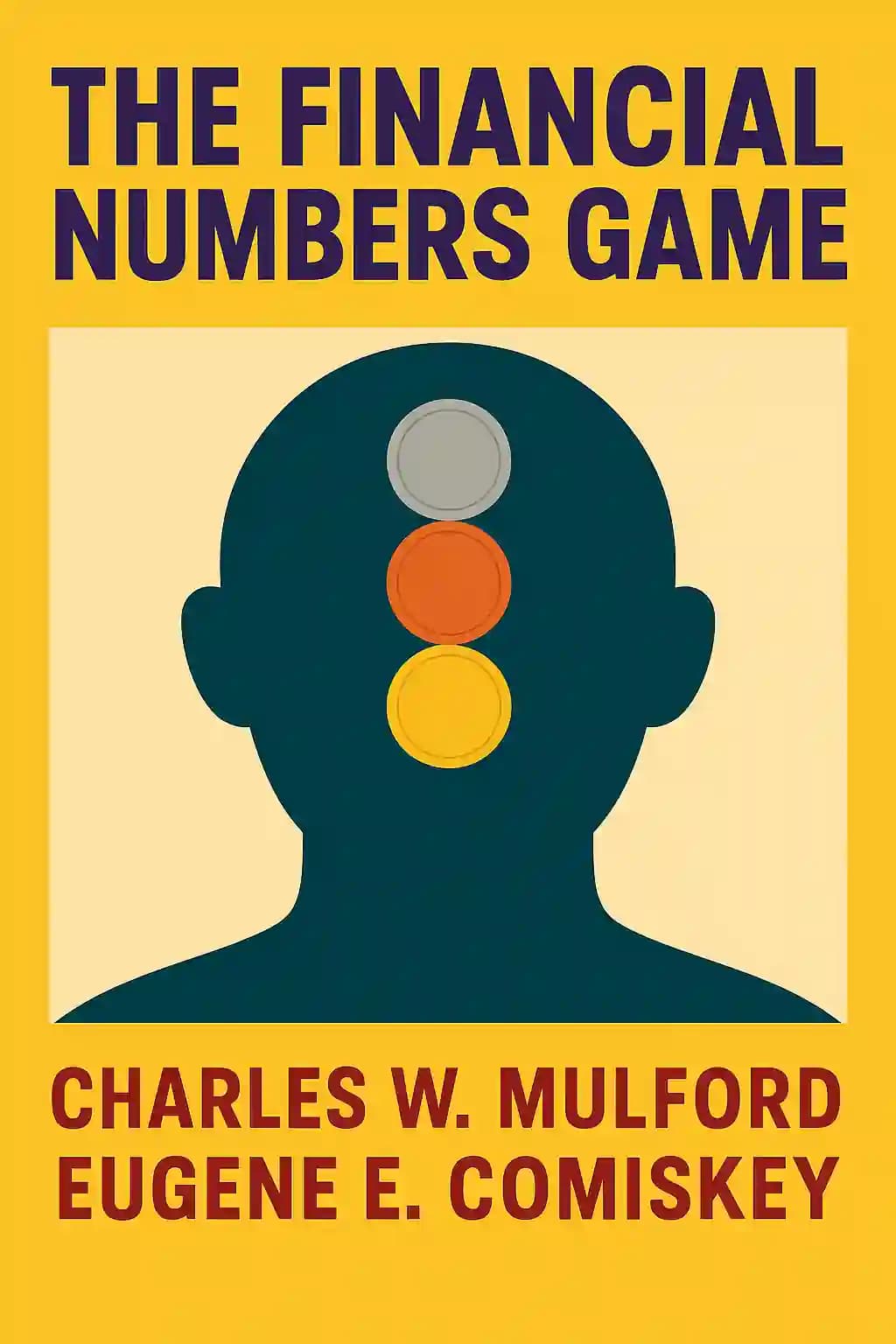
Uncover how companies manipulate financial statements in "The Financial Numbers Game." Learn to detect accounting tricks that fooled investors and regulators before major scandals erupted. Essential reading for anyone who wants to protect their investments from corporate sleight-of-hand.
Charles W. Mulford and Eugene E. Comiskey, authors of The Financial Numbers Game: Detecting Creative Accounting Practices, are renowned accounting experts and professors at Georgia Institute of Technology’s DuPree College of Management.
Both hold prestigious chairs (Invesco and Callaway, respectively) and are Certified Public Accountants with decades of experience in financial analysis. Their work focuses on exposing manipulative accounting practices, blending academic rigor with practical insights from consulting for major banks and investment firms worldwide.
They coauthored the influential Creative Cash Flow Reporting: Uncovering Sustainable Financial Performance, a companion text exploring cash flow manipulation tactics. Mulford frequently contributes to financial media, appearing on CNBC, ABC News, and Bloomberg TV to discuss corporate financial reporting.
Their research has shaped modern auditing standards and is cited in MBA curricula globally. The Financial Numbers Game remains a cornerstone resource for investors and analysts, praised for its actionable frameworks to detect earnings management.
The Financial Numbers Game exposes creative accounting tactics used by companies to manipulate financial statements, focusing on premature revenue recognition, aggressive capitalization, and misreported assets. It analyzes how these practices contributed to the 2008 financial crisis, critiques government policies, and offers solutions for detecting financial misrepresentation. The book combines academic research with real-world examples to empower investors and analysts.
This book is essential for investors, financial analysts, auditors, and business students seeking to identify red flags in financial reports. It’s particularly valuable for professionals analyzing corporate earnings quality or studying post-crisis regulatory impacts. Accounting educators will also find its frameworks useful for teaching forensic accounting principles.
Yes, it’s a critical resource for understanding financial manipulation. Reviewers praise its actionable insights for detecting earnings management, with Strategic Finance calling it “a book for its time.” The authors’ blend of academic rigor and practical guidance makes it relevant for post-2008 crisis analysis and modern accounting challenges.
The book categorizes five key tactics:
Mulford argues that government policies—not just Wall Street greed—fueled the crisis. Key factors include lax mortgage lending standards, exclusion of non-bank institutions from regulation, and the Federal Reserve’s monetary missteps. The book critiques the interplay between public policy and corporate accounting behaviors.
It advocates for stricter regulatory oversight of non-bank financial entities, improved transparency in mortgage-backed securities, and investor education on detecting red flags. The authors emphasize free-market accountability and detailed cash flow analysis as safeguards.
The book teaches readers to:
Some reviewers note its dense technical sections may challenge casual readers. However, professionals appreciate its depth, with SmartPros highlighting its timeliness post-Enron. Critics argue it could expand on international accounting standards.
Mulford, an Invesco Chair and Georgia Tech accounting professor, draws on 40+ years of academic research and industry experience. His CPA background and advisory roles with institutions like Bank of America lend credibility to the book’s analytical frameworks.
With rising ESG reporting and complex financial instruments, the book’s lessons on detecting manipulation remain vital. Its analysis of policy-driven crises applies to modern debates about cryptocurrency regulation and AI-driven financial disclosures.
Unlike generic guides, it combines crisis case studies (e.g., 2008 recession) with a systematic classification of manipulation tactics. The focus on both corporate and governmental culprits distinguishes it from narrower procedural manuals.
通过作者的声音感受这本书
将知识转化为引人入胜、富含实例的见解
快速捕捉核心观点,高效学习
以有趣互动的方式享受这本书
Understanding these techniques is the difference between being fooled and being informed.
Missing earnings forecasts by even a penny can trigger severe stock price declines.
This pressure drives creative accounting behaviors.
Fraud became so pervasive that employees joked about delayed shipments.
将《The financial numbers game》的核心观点拆解为易于理解的要点,了解创新团队如何创造、协作和成长。
将《The financial numbers game》提炼为快速记忆要点,突出坦诚、团队合作和创造力的关键原则。

通过生动的故事体验《The financial numbers game》,将创新经验转化为令人难忘且可应用的精彩时刻。
随心提问,选择声音,共同创造真正与你产生共鸣的见解。

"Instead of endless scrolling, I just hit play on BeFreed. It saves me so much time."
"I never knew where to start with nonfiction—BeFreed’s book lists turned into podcasts gave me a clear path."
"Perfect balance between learning and entertainment. Finished ‘Thinking, Fast and Slow’ on my commute this week."
"Crazy how much I learned while walking the dog. BeFreed = small habits → big gains."
"Reading used to feel like a chore. Now it’s just part of my lifestyle."
"Feels effortless compared to reading. I’ve finished 6 books this month already."
"BeFreed turned my guilty doomscrolling into something that feels productive and inspiring."
"BeFreed turned my commute into learning time. 20-min podcasts are perfect for finishing books I never had time for."
"BeFreed replaced my podcast queue. Imagine Spotify for books — that’s it. 🙌"
"It is great for me to learn something from the book without reading it."
"The themed book list podcasts help me connect ideas across authors—like a guided audio journey."
"Makes me feel smarter every time before going to work"

免费获取《The financial numbers game》摘要的 PDF 或 EPUB 版本。可打印或随时离线阅读。
In 2002, WorldCom shocked markets with a $3.8 billion accounting fraud that eventually ballooned to $11 billion. Their stock plummeted 94% within months. A year earlier, Enron's collapse had already wiped out $74 billion in shareholder value. These weren't isolated incidents but dramatic examples of what former SEC Chairman Arthur Levitt called "the numbers game" - the widespread practice of manipulating financial reporting to create altered impressions of business performance. This dangerous game has devastating consequences. When Centennial Technologies' fraudulent asset overstatements were discovered, its stock collapsed from $55.50 to $3 in just three weeks. Similarly, Twinlab's share price plunged from $20 to under $3 when its aggressive revenue recognition practices came to light. Why does this happen? Imagine driving on a highway where everyone speeds. If you maintain the legal limit, you'll be passed by competitors and possibly punished by impatient investors. This pressure creates a race to the accounting bottom, where companies feel compelled to stretch the rules just to keep pace. As Warren Buffett remarked, "Only when the tide goes out do you discover who's been swimming naked." The financial numbers game works until it doesn't - and when it fails, the consequences are swift and severe.