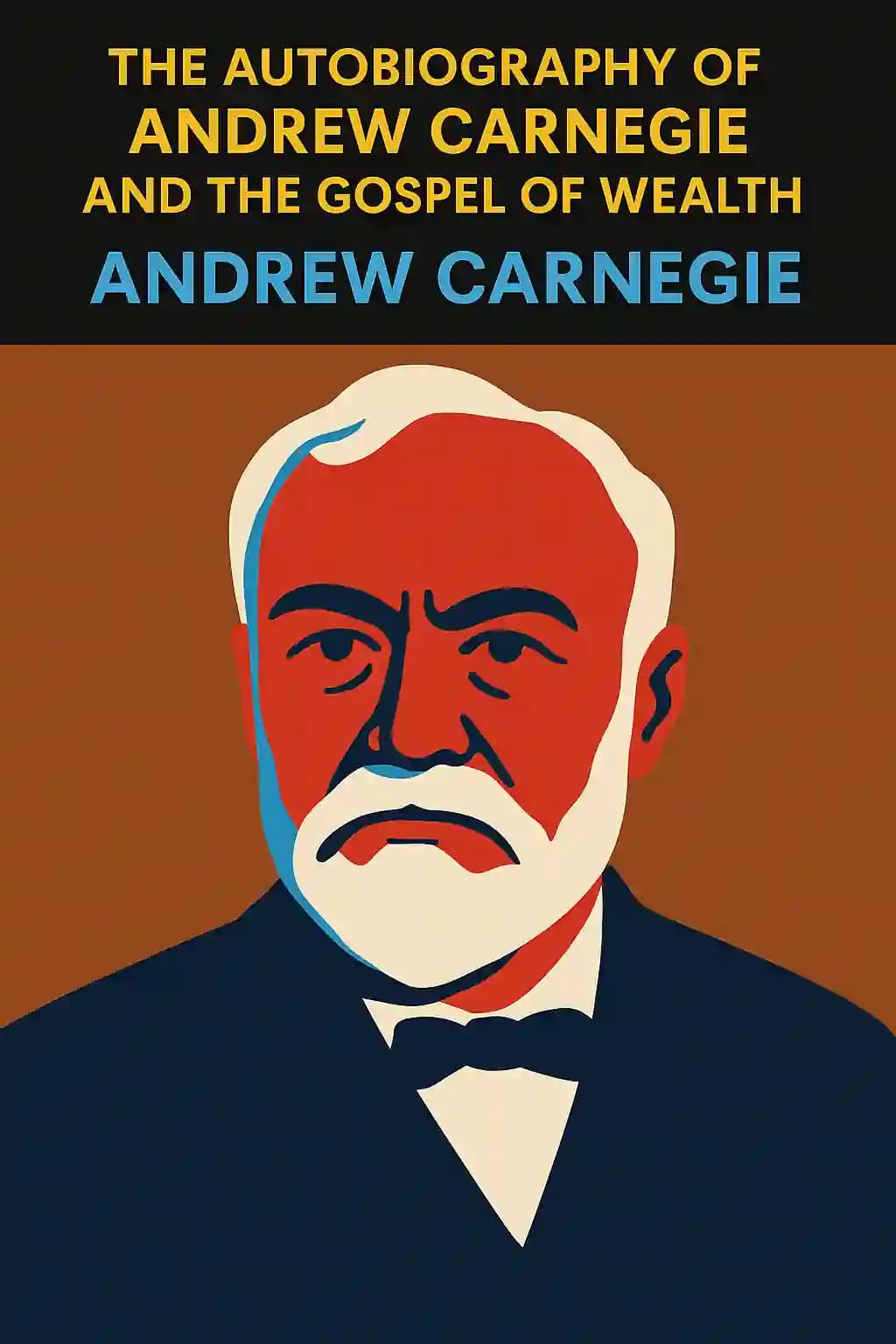
From rags to riches to revolutionary philanthropy, Carnegie's autobiography reveals how he built a steel empire then gave away $4 billion in today's money. Even Mark Twain called him "St. Andrew" - but what drove this industrialist to believe the wealthy must die poor?
Andrew Carnegie (1835–1919) was a Scottish-American industrialist and philanthropist, renowned for his memoir The Autobiography of Andrew Carnegie and essay The Gospel of Wealth, which established him as a pioneering advocate for ethical wealth distribution.
Born in Dunfermline, Scotland, Carnegie immigrated to the U.S. at age 12, rising from a cotton mill worker to helm Carnegie Steel Company—later sold to form U.S. Steel, making him the world’s richest man. His writings blend business philosophy with social responsibility, arguing that the wealthy must use their fortunes to uplift society, a principle he embodied by funding over 2,500 public libraries, Carnegie Hall, and institutions like Carnegie Mellon University.
Carnegie’s other works, including Triumphant Democracy and The Empire of Business, explore industrial progress and democratic values. A transformative figure of the Gilded Age, he dedicated his later life to philanthropy, donating over $350 million (equivalent to $10.9 billion today) to education, peace initiatives, and scientific research. The Gospel of Wealth remains a cornerstone of philanthropic theory, cited in ethics and economics curricula worldwide.
The Autobiography of Andrew Carnegie and The Gospel of Wealth combines Carnegie’s life story with his influential essay on wealth redistribution. The autobiography details his journey from impoverished Scottish immigrant to steel tycoon, while The Gospel of Wealth argues that the rich must use their fortunes for societal good through strategic philanthropy, not inheritance or charity.
This book suits history enthusiasts, business leaders, and philanthropists seeking insights into Gilded Age capitalism. It’s also valuable for readers interested in ethical wealth management, Social Darwinism, or the origins of modern charitable foundations.
Yes—Carnegie’s arguments about corporate social responsibility and critiques of generational wealth inequality resonate in modern debates about billionaires’ obligations. His emphasis on funding education (e.g., libraries, universities) directly influenced today’s philanthropic models like the Gates Foundation.
Carnegie asserts that:
Carnegie credits his success to luck, mentorship (e.g., Pennsylvania Railroad’s Thomas Scott), and shrewd investments in railroads, oil, and steel. He pioneered vertical integration in steel production and adopted innovations like the Bessemer process to dominate the industry.
Key lines include:
Both advocate evidence-based giving, but Carnegie focused on infrastructure (libraries, universities) over direct poverty alleviation. Unlike effective altruists, he rejected wealth accumulation for heirs and supported estate taxes to enforce redistribution.
Critics argue Carnegie:
Growing up poor in Scotland, Carnegie saw education as liberation. His essay reflects this through its focus on free libraries and disdain for charity that creates dependency—prioritizing tools for self-improvement over temporary aid.
Carnegie funded over 1,600 libraries, Carnegie Mellon University, Carnegie Hall, and the Carnegie Corporation of New York. These embodied his belief in “helping those who help themselves” through education and cultural access.
While influenced by Herbert Spencer’s “survival of the fittest,” Carnegie rejected pure individualism. He argued wealth created societal obligations—a “noblesse oblige” for industrialists to uplift others, blending Darwinist competition with collectivist responsibility.
The combo contextualizes his philosophy: the autobiography shows how he earned wealth, while the essay explains why he gave 90% away. Together, they model his two-stage life philosophy—accumulation followed by redistribution.
通过作者的声音感受这本书
将知识转化为引人入胜、富含实例的见解
快速捕捉核心观点,高效学习
以有趣互动的方式享受这本书
My heart is in the work.
This, then, is held to be the duty of the man of Wealth: First, to set an example of modest, unostentatious living, shunning display or extravagance.
Thus is the problem of Rich and Poor to be solved. The laws of accumulation will be left free; the laws of distribution free. Individualism will continue, but the millionaire will be but a trustee for the poor; intrusted for a season with a great part of the increased wealth of the community, but administering it for the community far better than it could or would have done for itself.
I became the main breadwinner of the family at the age of fourteen.
将《The Autobiography of Andrew Carnegie and The Gospel of Wealth》的核心观点拆解为易于理解的要点,了解创新团队如何创造、协作和成长。
将《The Autobiography of Andrew Carnegie and The Gospel of Wealth》提炼为快速记忆要点,突出坦诚、团队合作和创造力的关键原则。

通过生动的故事体验《The Autobiography of Andrew Carnegie and The Gospel of Wealth》,将创新经验转化为令人难忘且可应用的精彩时刻。
随心提问,选择声音,共同创造真正与你产生共鸣的见解。

"Instead of endless scrolling, I just hit play on BeFreed. It saves me so much time."
"I never knew where to start with nonfiction—BeFreed’s book lists turned into podcasts gave me a clear path."
"Perfect balance between learning and entertainment. Finished ‘Thinking, Fast and Slow’ on my commute this week."
"Crazy how much I learned while walking the dog. BeFreed = small habits → big gains."
"Reading used to feel like a chore. Now it’s just part of my lifestyle."
"Feels effortless compared to reading. I’ve finished 6 books this month already."
"BeFreed turned my guilty doomscrolling into something that feels productive and inspiring."
"BeFreed turned my commute into learning time. 20-min podcasts are perfect for finishing books I never had time for."
"BeFreed replaced my podcast queue. Imagine Spotify for books — that’s it. 🙌"
"It is great for me to learn something from the book without reading it."
"The themed book list podcasts help me connect ideas across authors—like a guided audio journey."
"Makes me feel smarter every time before going to work"

免费获取《The Autobiography of Andrew Carnegie and The Gospel of Wealth》摘要的 PDF 或 EPUB 版本。可打印或随时离线阅读。
Picture this: a poor Scottish immigrant boy who became the world's richest man, then gave it all away. Andrew Carnegie's life reads like fiction, yet his impact on business and philanthropy remains profoundly real today. His autobiography, published posthumously in 1920, and his famous essay "The Gospel of Wealth" reveal a man who believed wealth carried moral responsibility. Carnegie's philosophy that "the man who dies rich, dies disgraced" continues to inspire modern billionaires like Warren Buffett, Bill Gates, and MacKenzie Scott. What makes his story so compelling isn't just his accumulation of wealth - it's his thoughtful reflection on its purpose. In an age of growing inequality, Carnegie's journey from poverty to purpose offers timeless insights about success, responsibility, and legacy.