第 1 章
The Meditation Revolution: Transforming Your Life in Minutes a Day
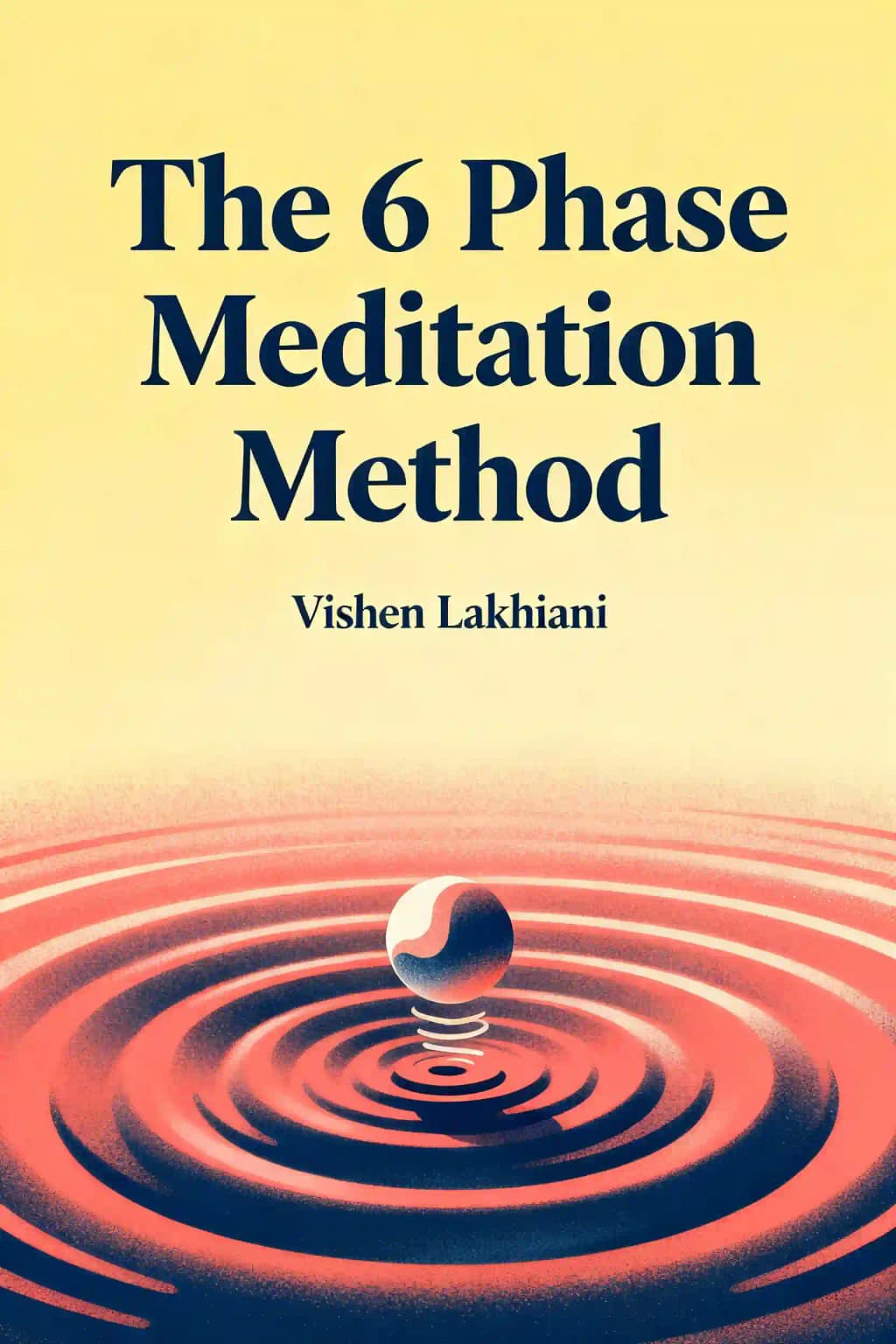
What if you could transform your entire life with just fifteen minutes of daily practice? This is the promise of Vishen Lakhiani's 6 Phase Meditation Method, which has gained remarkable popularity among high-performers across industries. When tennis star Bianca Andreescu credited this meditation for helping her defeat Serena Williams at the US Open, it catapulted into the spotlight. But it's not just athletes who swear by it-Grammy-winning singer Miguel practices it with his entire crew before concerts, and countless entrepreneurs, artists, and celebrities have integrated it into their daily routines. Unlike traditional meditation that often feels inaccessible to modern professionals, Lakhiani's approach combines ancient wisdom with cutting-edge neuroscience to deliver maximum results in minimal time-what he calls the "minimum effective dose" of meditation. The book has become a cultural phenomenon, with over 20 million followers worldwide embracing this science-backed approach to mental wellbeing and performance enhancement.
第 2 章
From Rock Bottom to Revolutionary: The Birth of a Meditation Method
Vishen Lakhiani's journey to creating the 6 Phase Meditation began at his lowest point. As a Malaysian immigrant with an engineering degree from the University of Michigan, he found himself sleeping on a musty sofa, working as a telemarketer cold-calling attorneys, and facing constant rejection. His dreams of becoming the next Bill Gates had crumbled, and he was desperate for change.
In his desperation, Lakhiani discovered a meditation seminar promising improved work performance. Despite his skepticism, he spent his last money to attend the workshop in Los Angeles, where he became the sole student of an instructor named Amanda. She taught him Jose Silva's "active" meditation techniques that focused on turning problems into projects through specific mental programming.
The results were immediate and dramatic. After implementing these techniques, Lakhiani's sales doubled within a week, then doubled again in two weeks, and yet again a month later. His remarkable performance led to three promotions in four months, culminating in dual roles as VP of sales and business development manager.
But professional success came with what Lakhiani calls "the inconvenient side effect of meditation"-becoming a better person whose focus shifts from ego to meaning. After eighteen months of astronomical sales, he felt spiritually unfulfilled and questioned his legacy. This led him to become a certified meditation instructor and eventually found Mindvalley, now a $100 million company with twenty million followers worldwide.
The 6 Phase Meditation Method distills Lakhiani's twenty years of learning and interviews with over a thousand experts into one efficient, fifteen-minute practice. Unlike traditional meditation that often feels inaccessible or outdated, this approach combines ancient wisdom with modern science to create a practice that fits seamlessly into contemporary life.
"I'm not a big fan of meditation," Lakhiani confesses at the beginning of his book. He explains that while he's taught meditation to millions, he finds the term too general and often stigmatized. Like "exercise" encompasses everything from weight training to pole-dancing, "meditation" covers numerous mental protocols with different purposes. The 6 Phase Meditation combines the best practices from various traditions to enhance overall human experience in the most efficient way possible.
第 3 章
The Circle of Love and Compassion: Building Your Connection Muscle
While most people maintain excellent physical hygiene (unlike a century ago when only 7% of Americans brushed their teeth), many neglect their mental hygiene. We wash our bodies daily but forget to "wash our minds." When we wake up with anxiety, stress, or regrets and do nothing about these feelings, we risk projecting our negative states onto others throughout the day.
The first phase of the meditation addresses this by focusing on compassion-training your brain to be kinder and more understanding. This practice brings an infectious bliss that touches everyone around you and prevents unnecessary negativity from ruining your day by helping you see yourself in others.
Compassion helps overcome what psychologists call "fundamental attribution error"-our tendency to blame others' mistakes on their character ("What a jerk!") while blaming our own mistakes on circumstances. For example, when Lakhiani accidentally tripped over someone's suitcase while rushing to catch a flight, the person called him an "asshole." To that person, Lakhiani was inconsiderate, but Lakhiani knew his desperate circumstances. Compassion dissolves this divide between "us" and "them," helping you get triggered less often by understanding that good people make mistakes, just like you do.
There's also a selfish reason to practice compassion-it makes your emotional landscape lighter, happier, and more balanced. The "Very Happy People Study" from the University of Pennsylvania and University of Illinois found that the secret to profound well-being wasn't money, weather, or success-it was the strength of social connections. The more compassionate you are, the deeper and more harmonious your relationships become.
Compassion isn't about feeling sorry for people-it's about loving connection with other beings. Unlike sympathy ("poor you"), compassion says "may you be well, fellow life form, because fundamentally, we're one and the same." Brain scans show compassionate brains literally look different, exhibiting more capacity for effortless positivity.
Professor Richard Davidson's team at the University of Wisconsin-Madison proved that compassion is a trainable skill. Participants who followed guided compassion meditations for just two weeks showed changes in their brain scans, with increased engagement in areas related to understanding suffering and emotional control.
Beyond creating inner peace, compassion practice delivers surprising physical benefits. Research shows it enhances optimism, reduces stress reactivity, decreases PTSD symptoms, and even reduces physical pain. Most remarkably, University of North Carolina scientists discovered compassion practices actually reverse aging at the genetic level-telomeres (DNA markers of aging) didn't shorten in meditators as they did in non-meditators.
The Circle of Love and Compassion meditation follows a six-step protocol: First, visualize a loved one and feel the love they inspire, giving this feeling a color. Next, let this compassion expand throughout your body, forming a protective bubble. Then gradually expand this bubble to encompass your room, home, neighborhood, city, country, continent, and finally the entire Earth. With practice, this connection to all humanity becomes second nature, transforming your mental health and everyone you encounter.
第 4 章
Happiness and Gratitude: Einstein's Million-Dollar Formula
What are humans really searching for? According to Einstein, it's happiness. In 1922, Einstein wrote a thirteen-word formula for happiness on a piece of paper that later sold for $1.56 million: "A calm and humble life brings more happiness than the pursuit of success combined with constant restlessness."
This formula warns against the "I'll-be-happy-when" syndrome-the endless chase that prevents true fulfillment. We tell ourselves we'll be happy when we graduate, find love, get promoted, or buy that dream house. We experience brief happiness upon achieving these goals, but quickly return to our baseline state and set new targets. This peace-stealing syndrome keeps happiness perpetually out of reach.
Dan Sullivan calls this the "forward gap"-the distance between our present satisfaction and the happiness we believe we'll gain from future outcomes. We fixate on narrowing this gap, believing we'll be happy when we do, but it can never truly close. It's like running toward the horizon thinking you'll touch the sun.
Our consumerist society thrives on this unhappiness. Beauty companies would collapse if women felt at peace with their bodies. Tech giants would suffer if people stopped craving upgrades. The pharmaceutical industry depends on our mental health struggles. We're constantly offered shinier solutions for attaining happiness through external means.
Gratitude is the revolutionary antidote to this mindset-the fastest way to produce happiness chemicals through thought alone. It's about appreciating what you already have rather than focusing on what's missing. This form of happiness has no "if" or "when" attached.
Dr. Robert Emmons' study at UC Davis divided participants into three groups: one wrote about things they were grateful for, another about things that displeased them, and a third about neutral events. After ten weeks, the gratitude group felt more optimistic and positive, exercised more, and visited doctors less frequently. These effects persisted long after the experiment ended.
Numerous studies confirm gratitude's benefits: increased energy, higher emotional intelligence, better mood, greater forgiveness, reduced depression/anxiety, improved relationships, better sleep, reduced inflammation, less physical fatigue, and enhanced life satisfaction.
Gratitude carries misconceptions, particularly the belief that we can only practice it when life is going well. In reality, gratitude shines brightest during dark times, building resilience and preventing depressive spirals. When faced with challenges-whether poor sleep, rude colleagues, or bad dates-we always have a choice where to direct our focus.
The 3x3 Gratitude Method involves focusing on three aspects of your life-personal life, work life, and yourself-with three things you're grateful for in each category. This balanced approach prevents the common tendency to express gratitude only for the strongest area of your life. Many gratitude practitioners neglect self-appreciation, fearing they'll appear narcissistic. The problem isn't too much self-love but too little-most people readily share their perceived inadequacies rather than praise themselves.
Body image issues are universal-we all find something to criticize about our bodies. Yet each of us is the result of astronomical odds-one sperm among 500 million that reached an egg. Our bodies are miracles deserving appreciation rather than shame.
Beyond boosting confidence, happiness, health, and fulfillment, gratitude strongly links to achievement, success, and abundance. As Zig Ziglar said, "The more you are grateful for what you have, the more you will have to be grateful for." This isn't mere fluff but logical-abundance is a mindset, and like attracts like.
第 5 章
Peace Through Forgiveness: Liberating Yourself from the Past
The three Rs-resentment, rejection, and regret-are the most insidious feelings humans experience because they're rooted in past events that continue to hurt us. As Rafiki demonstrated to Simba in The Lion King, past pain persists until we learn from it and let go.
Forgiveness is the ultimate antidote-not just about releasing ill will toward others, but about setting yourself free from negativity. Science now reveals forgiveness has remarkable physical benefits: people who forgive perceive hills as less steep, jump higher in fitness tests, maintain healthier heart rates and blood pressure, and experience improved mental health.
In 2016, Lakhiani joined a $15,000 brain-training program called "40 Years of Zen" where scientists studied the brain-wave patterns of Zen monks who'd meditated for decades. These monks showed remarkably high alpha wave amplitudes and left-right brain coherence even in their normal waking state. The scientists discovered forgiveness was the most effective way for ordinary people to achieve these monk-like brain states.
After practicing deep forgiveness at this event, Lakhiani achieved his highest alpha-wave amplitudes ever, with tears streaming down his face. Scientists there explained that forgiveness accelerates synchronicity and manifestation-essentially making people "luckier." Weeks after his training, his book "The Code of the Extraordinary Mind" became the #1 book in the world on Amazon Kindle, and he was shown as the second best-selling author globally, ahead of Tolkien and J.K. Rowling.
The first rule of forgiveness is that we absolutely can forgive anything. If Nelson Mandela can invite his jailers to dinner after 27 years of unjust imprisonment, you can forgive whoever hurt you. Remember, forgiveness is for you, not them-you're worthy of living without resentment.
Ken Honda, Japan's "Zen Millionaire," attributes much of his success to forgiveness. As a child, Ken feared his stoic father, who once broke down crying over money problems. This experience gave Ken limiting beliefs about money that blocked his success. After forgiving his father, Ken discovered his father had been treated the same way by his own father. This forgiveness created a deep bond between them and healed Ken's money wounds. More importantly, it allowed Ken to trust older mentors, including Wahei Takeda (the "Warren Buffett of Japan"), who helped Ken become Japan's most successful writer.
Neale Donald Walsch's children's book "The Little Soul and the Sun" teaches that the universe sends us what we need (not what we want) at the right time. Even those who betray us are there to teach valuable lessons. As God tells the Little Soul, "I have sent you nothing but angels." Importantly, forgiveness doesn't mean reconciliation or dropping legal charges-you can forgive a thief while still reporting them. Forgiveness is an internal healing process for yourself.
Self-forgiveness is even more challenging than forgiving others. Many carry hidden regrets and self-loathing that damage self-esteem over time. If you've learned from mistakes and committed to change, you deserve your own forgiveness-your mistakes don't define you, and the best apology is changed behavior.
第 6 章
A Vision for Your Future: Seeing Your Way to Success
The first three phases of the meditation focus on your past and present-what Lakhiani calls the "Pillar of Happiness." The next three phases shift to the future-the "Pillar of Vision." Phase 4 specifically helps you create a compelling vision for your future using the power of creative visualization.
Lakhiani shares his own experience with visualization as a teenage Taekwondo competitor. After failing his first attempt at breaking wooden planks in a qualifying competition, he learned his first lesson about creative visualization: focus on the "what" (getting to the US Open) and the "why" (his passion), not the "how." Through an unexpected stroke of luck-his teammate's injury-he got a second chance and succeeded, winning a spot at the US Open.
At the championship, he faced the Dutch champion but was forced to compete without his glasses, resulting in being knocked out in 36 seconds. This taught him his second lesson: be specific in visualization, as he had only visualized entering the ring but not performing well or leaving victoriously.
Scientific evidence supports visualization's effectiveness. Studies show basketball players who only visualized training improved almost as much as those who physically practiced, and experiments demonstrate that visualizing exercise can increase muscle strength similarly to actual exercise. Visualization can also aid healing, as shown in Dr. Simonton's work with cancer patients and Lakhiani's own experience clearing persistent skin problems in five weeks through visualization techniques.
Lakhiani recommends focusing on a three-year timeframe for visualization because humans typically overestimate what they can achieve in one year but drastically underestimate what's possible in three. In this timeframe, you could complete a mathematics degree, meet your soulmate, or start your own company.
The visualization process involves creating a mental screen positioned six feet in front of you and fifteen degrees above the horizon line-a specific positioning that Jose Silva's research found helps produce alpha waves by directing your pupils slightly upward. On this screen, you'll watch your dreams play out like a vivid movie, engaging all five senses to make the visualization as real and immersive as possible.
For even greater manifestation power, visualize how achieving your goals would positively impact others. This practice isn't mere daydreaming-it's a powerful manifestation technique that has helped Lakhiani achieve major life successes, from moving to the United States to growing Mindvalley to $100 million in revenue.
第 7 章
Mastering Your Day: The Art of Segment Intending
While Phase 4 focuses on your three-year vision, Phase 5 brings your attention to the immediate future-the next twenty-four hours. The ancient concept of "carpe diem" or "seize the day" has been a guiding philosophy for millennia, yet many people fail to recognize that today is the future and neglect to plan for it properly.
Phase 5 focuses on mastering your day through "segment intending"-a powerful technique channeled by Esther Hicks that involves pre-envisioning your upcoming day as a series of meaningful segments. By dividing your day into segments like morning routine, commute, work periods, meals, and evening activities, you create a framework for intentional living.
Esther Hicks teaches that "well-disciplined people decide how they want their day to unfold." Segment intending involves visualizing each part of your day with positive intentions and affirmations. For example, you might declare "My morning will be filled with energy and joy" or "My workday will be highly productive, sociable, and fun." This practice communicates to the divine exactly how you want your day to manifest, rather than passively allowing it to unfold without direction.
If you're skeptical about segment intending, Esther suggests starting with "Wouldn't it be nice if..." statements, like "Wouldn't it be nice if my boss appreciated me in our meeting today." This allows you to engage with the process while honoring your doubts. If you're already confident in your manifestation abilities, use direct commands like "Today, my favorite song will play on the radio during my commute."
The effectiveness of daily intention-setting comes down to the reticular activating system (RAS)-a network of nerves in your brain stem that filters information from your surroundings. The RAS prioritizes whatever you focus on, creating specific filters that sift through incoming data and present only what's important to you. When you declare intentions for your day, you're commanding your brain to notice those specific elements.
Beyond the science, many spiritual teachers believe that setting intentions increases the likelihood of organic manifestation through "deliberate creation" and the Law of Attraction. While there's less hard science supporting this view, proponents suggest that making a decision becomes a cosmic choice that moves us toward that potential future.
When you decide to have a great day, it creates a powerful ripple effect-great days become great weeks, which become great months, years, and ultimately an epic life. It all begins with just two minutes during the 6 Phase Meditation, setting firm intentions for how you'll seize the day.
第 8 章
The Blessing: Connecting to Something Greater Than Yourself
While the first five phases of the meditation are firmly rooted in science, the final phase ventures into territory science can't fully explain-connecting with a higher power. Though lacking conclusive evidence, 84% of humanity believes in some form of higher power.
This phase involves receiving a blessing from this higher power, whatever you call it-God, Universe, Higher Self. It's about having the humility to ask for help from forces beyond ourselves, as Michael Beckwith learned during his near-drowning experience when three waves mysteriously pushed him to shore after he simply said "Help me."
The blessing takes just seconds-imagining light from above encapsulating your body-and provides closure to the meditation while setting you up to feel supported throughout your day. This element was influenced by Lakhiani's mentor Srikumar Rao, the "Buddha of business," who teaches that the most powerful mental model is believing "the universe loves you." When you believe the universe works in your favor, you'll have a beautiful life experience.
Even atheists can benefit from Phase 6. Lakhiani himself doesn't believe in a separate "God" either-he's more of a pantheist with reverence for the entire universe, what Richard Dawkins calls "sexed-up atheism." Whether religious or atheist, everyone can experience the same feelings of calm and support from this phase by connecting to whatever power they believe exists within themselves: inner strength, resilience, wisdom, heart, or brilliant mind.
After giving so much in the previous phases, Phase 6 allows you to be pleasantly passive. This is your moment to receive, letting the universe envelop you in love and attention. You'll connect with abundant energy to integrate all previous phases and feel supported as you step into your day.
第 9 章
The Higher Purpose: Evolving Consciousness for Our Collective Future
A few years ago, Tom Chi, Google X co-founder and creator of Google Glass, visited Lakhiani's office. During Q&A after his talk on exponential technology, when asked what we should be obsessed with to make the world better, he answered: "We need to create an exponential rise in human consciousness." His reasoning was sobering-as our technology becomes increasingly powerful and dangerous, only our level of consciousness prevents misuse. If we don't evolve our consciousness alongside our technology, we're "absolutely DONE for."
Humans constantly battle between what Tim Urban calls the "Primitive Mind" and the "Higher Mind." The Primitive Mind operates from survival, lack, and competition, while the Higher Mind lives with presence, gratitude, and compassion. The Primitive Mind sees struggle and competition as essential, while the Higher Mind harnesses positive thought and intention. One protects only those of the same tribe; the other feels compassion toward all humans regardless of differences.
The 6 Phase Meditation was specifically designed to move us toward the Higher Mind. While we need some elements of the Primitive Mind for survival, ironically, this same mind that tries to keep us alive individually could ultimately destroy humanity collectively. To expand our consciousness to match our technological capabilities, we must activate the Higher Mind quickly.
This reveals the secret agenda behind teaching the 6 Phase Meditation-compassion, gratitude, forgiveness, visioning, and spirituality don't just save us individually; practiced collectively, they could save us all. You begin meditation for yourself, and that's enough-you deserve love, peace, and happiness. But if everyone meditated daily, feeling compassion, gratitude, forgiveness, and inspiration to contribute meaningfully, imagine how amazing our world would be.
Even when you feel you've plateaued or no longer "need" the meditation, keep going. Like physical exercise, mental practice remains beneficial long after visible results appear. John Davy, entrepreneur behind Jongleurs comedy clubs, practiced for 100 consecutive days before stopping-only to have colleagues notice his return to anxious patterns. The meditation had been regulating his energy without him realizing it.
While meditation won't make you immune to life's challenges, it provides skills that enable you not just to survive setbacks but to thrive through them, extracting wisdom from pain and growing through what you experience. The 6 Phase Meditation is just the beginning of your personal growth journey-a journey that transforms not just your individual consciousness, but potentially, our collective future.