第 1 章
From Punk to Prophet: The Extraordinary Journey of Bono
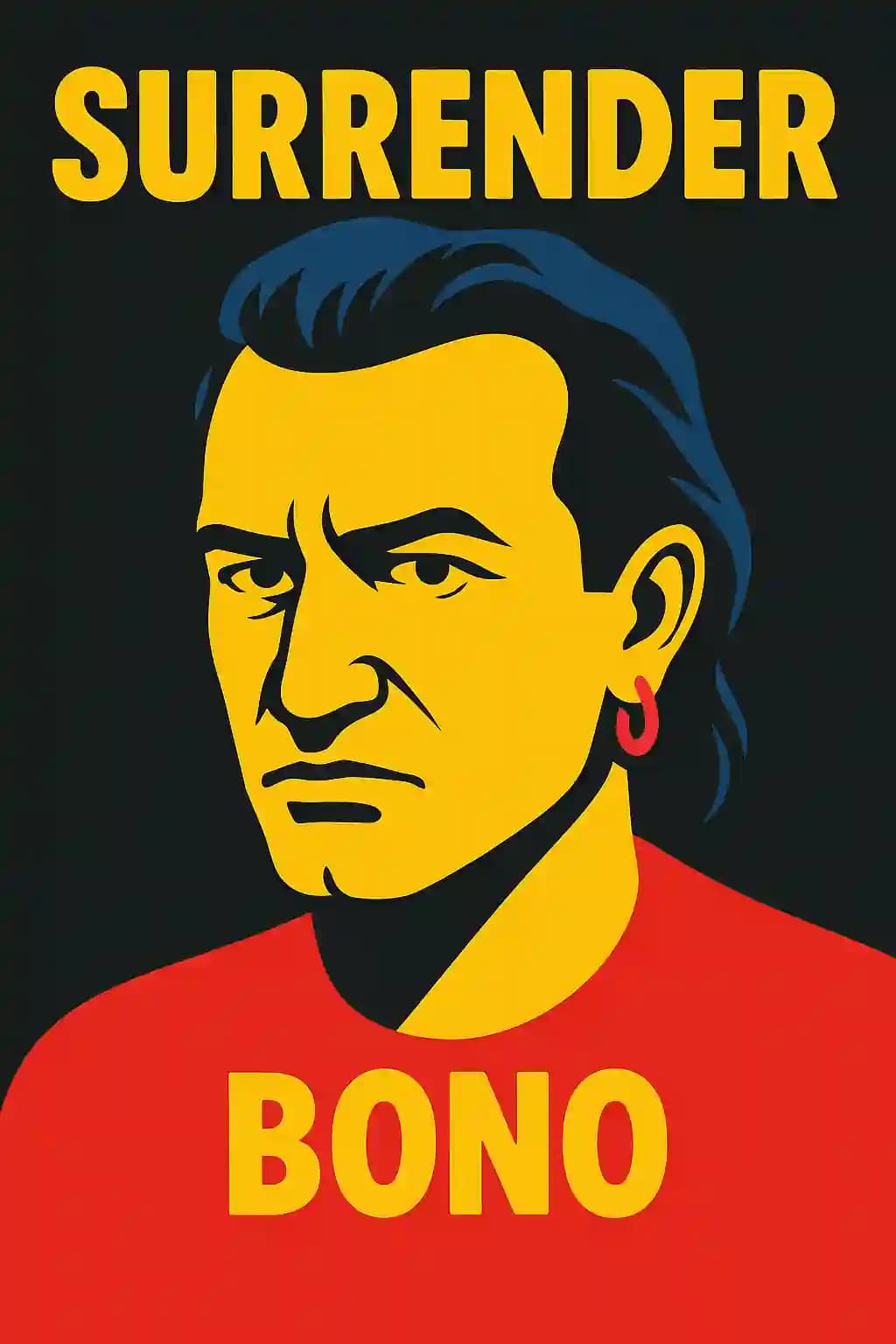
Imagine a world where a skinny Irish kid from Dublin's Cedarwood Road transforms into one of the most influential musicians and activists of our time. Bono's memoir "Surrender: 40 Songs, One Story" has become a cultural phenomenon, landing on Barack Obama's reading list and earning praise from literary giants like Zadie Smith who called it "a genuine literary achievement." Through forty chapters named after U2 songs, Bono crafts not just his life story but a meditation on faith, activism, art, and love. The book's success reflects our enduring fascination with rock stars who transcend entertainment to become cultural forces - those rare individuals who, as Bruce Springsteen noted, manage to be "thoughtful and intelligent about their own journey."
第 2 章
Losing Iris, Finding Music: The Wounds That Shaped a Voice
When fourteen-year-old Paul Hewson (not yet known as "Bono") watched his mother Iris collapse at her father's funeral on September 9, 1974, his world shattered irreparably. Three days later, after saying goodbye to his barely conscious mother in the hospital, he heard "the sound of a switch" - the life support machine being turned off. In the aftermath, Cedarwood Road became "its own opera" of three men - Bono, his brother Norman, and their father Bob - living in "rage and melancholy," dealing with grief by never speaking of it.
"In our house, when she died, she was never spoken of again," Bono writes. "We were three Irish males, and we avoided the pain that we knew would come from thinking and speaking about her." This silence created a void that music would eventually fill. His brother Norman, a practical "fixer" and music lover, taught him guitar chords and shared his vast music collection stored on a reel-to-reel tape recorder. Despite their fights, Norman was his lifeline, pulling him to shore on "a raft that is a guitar, both lifeline and weapon."
The relationship with his father deteriorated after Iris died, with verbal arguments occasionally escalating. Bono harbored "wild, irrational blame" toward his father as "the head of the house" for its destruction. Bob was a fine tenor who once put down Bono as "a baritone who thinks he's a tenor" - an assessment that would haunt and drive the young musician. Their relationship was "operatic" - a melodrama where "son blames father for the loss of his mother."
This early trauma froze part of Bono at fourteen, when puberty coincided with his mother's death. His face changed from "open and round" to angular, while his worldview "froze" with "pimples growing on the inside." The void left by Iris would fuel his lifelong search for surrogate families - from his neighborhood "Lypton Village" crew to U2 to activism - and his songs became prayers, his home, the place where emotions he couldn't express found voice.
第 3 章
The Birth of U2: Four Boys and a Kitchen Rehearsal
In September 1976, responding to Larry Mullen's school notice "Drummer seeks musicians to form band," Bono joined several other wannabe musicians crammed into Larry's kitchen. Despite the chaotic noise and lack of musical cohesion, Larry's drumming impressed Bono with its "primal power" and "beautiful violence." Adam Clayton was there on bass, looking the part even if his playing wasn't clear, while David Evans (Edge) maintained the "coolest aura" despite the din, seemingly "in tune with himself" regardless of what others played.
Edge first caught Bono's attention as an angular-faced, Native American-looking boy leaning against a wall at Mount Temple School, playing a complicated Yes guitar part. While Bono had taught his girlfriend Ali to play "Something" despite barely playing guitar himself, Edge "could play anything he wanted." Their personalities complemented each other perfectly: "Edge is a minimalist by nature. I am not. I am a maximalist." Edge was "the silence inside every noise. He's the light inside the paint."
Adam Clayton was a true rock 'n' roll believer with "the style, the attitude, the ambition" - his only problem was he "couldn't play." Despite this, he became the band's first manager, printing business cards and recruiting Steve Averill from The Radiators from Space, who gave them their name: U2 - "a letter and a number, perfect to print large on a poster or a T-shirt."
Their third rehearsal space was a small cottage they called the "Yellow House" that backed onto the graveyard where Bono's mother was buried. Rehearsals were often tense, with Bono screaming at his bandmates despite being the least skilled musician. He describes this behavior as possibly "hurting to avoid the hurt" or simply "a very bad attitude." During one session where Bono was trying to get Edge to create a sound like "an electric drill into your brain," he grabbed Edge's Gibson Explorer in frustration. This moment unexpectedly led to the creation of "I Will Follow," with its repetitive "walk away, walk away" hook - a song Bono initially described as "a suicide note" without consciously connecting it to his mother's nearby grave.
第 4 章
Faith, Crisis, and Rock 'n' Roll: The Spiritual Journey
The tension between faith and art nearly destroyed U2 in their early years. As their band gained success with their debut album "Boy," tensions grew with the Shalom community - a group of Christian radicals practicing a "naive first-century Christian life" with few possessions but expectations of miracles. The group's leader Chris couldn't reconcile the band's growing fame with his vision of humble Christian service, questioning whether their music was ephemeral and whether preaching the gospel should be their real calling.
"There's no greater insult to a young man than questioning his fervor," Bono writes. Eventually, Edge couldn't reconcile being in a globally successful band with this humbler calling. When Bono visited him one evening, he didn't know that "when I arrived I was in a band, and when I left, I wouldn't be." Edge explained he couldn't solve the problem in U2 - whether they could be both a band and believers. When Edge said he was out, Bono responded that if Edge was out, he was out too.
Driving home, Bono felt a strange calm mixed with immense sadness. Larry understood their decision; only Adam didn't get it, though he stood in solidarity when they met with their manager Paul McGuinness to quit the tour. McGuinness cleverly asked if God would want them to break a legal contract - a checkmate moment that made them reconsider.
Eventually, they realized their music should reflect who they were, contradictions and all. Their second album, "October," was created in desperation after Bono's lyrics were stolen in Seattle. He improvised, even singing in Latin on "Gloria." Through this struggle, they discovered music's true purpose wasn't saving the world but saving themselves first. "The in or out Christianity never sat right with us, especially the judgmentalism toward Adam, who wasn't a believer," Bono reflects.
This spiritual journey would continue throughout their career, with Bono developing a more nuanced faith that embraced doubt and questions rather than certainty. Years later, he would write "I Still Haven't Found What I'm Looking For" - a pilgrim's progress without arrival, a quest rather than a destination. "Yes, I'm still running," as Bono puts it.
第 5 章
The Joshua Tree and Global Stardom: America in Their Sights
By 1986, U2 was approaching a creative peak. Recording "The Joshua Tree" at Danesmoate, an imposing Georgian villa with a little river winding through forested grounds in the mountains overlooking Dublin, Bono could hardly sleep from excitement. The album had a vague concept he called "The Two Americas" - a clashing vision of real versus imagined America, rich versus poor, native versus nativist. For the Irish, America was a promised land, ours to play with, a landscape to get lost in.
Producers Brian Eno and Danny Lanois returned as their "professors of different departments," with Brian operating the studio as a single instrument and Danny turning any piece of plywood into a sacred object. Their engineer Mark "Flood" Ellis had "the look of the engine room about him," often quoting Scotty from Star Trek.
During this period, Bono struggled with writing a love song that could capture his complex relationship with his wife Ali. "I was in love and terrified I would never write a truly great love song because my heart was full, not broken," he confesses. The tension in his mind was a choice between artist and family. Could he do both well? Must he surrender to domestication or embrace the selfish life of the artist?
His breakthrough came in realizing he had to write about the moment he was in - "the tearing, the tension, this fear of either losing creativity or mistreating creation." The result was "With or Without You," a song that captured some of Ali's "dark beauty and our bittersweet duality." They wanted a sound no one had heard before, influenced by Suicide's "Cheree," Scott Walker, and Roy Orbison. But when they finally created it, they overshot and landed in "saccharine territory - an ugly pop song." The person who pulled it out of the trash was Bono's childhood friend Gavin Friday, who insisted, "What's wrong with pop music? Listen to the melody; it's a classic."
The album's success would catapult them to global superstardom, with their trajectory becoming "meteoric" - from six hundred people at the Reseda Country Club to eighty thousand at the Coliseum in just seven years. The band moved to Los Angeles, where they began living it up - riding motorcycles, drinking tequila, occasionally simultaneously, returning to their shared house as the orange sun rose over eastern mountains.
第 6 章
Reinvention and Crisis: From Achtung Baby to ZOO TV
By 1990, Bono sensed U2 needed radical reinvention. On New Year's Eve 1989, playing their hometown with B.B. King at the Point Depot, he blurted out: "This is just the end of something for U2; we have to go away and dream it all up again." Despite their massive success with "The Joshua Tree," Bono couldn't shake the feeling that at their most successful, they were most vulnerable.
Arriving in Berlin on October 3, 1990, to record "Achtung Baby," they landed as the wall was being demolished. At Hansa Studios, they could see the Berlin Wall from the windows. Despite the prestigious location, they faced a critical problem: the songs weren't there. They had fragments - bits of "Mysterious Ways," "Even Better Than the Real Thing," and "Until the End of the World" - but nothing complete. The cold Berlin winter matched the growing tension between them as they struggled with their artistic direction. Adam and Larry questioned abandoning their successful sound, while Bono pushed for reinvention. They were closer to breaking up than they'd been since 1982.
The breakthrough came with "One," which emerged from two discarded chord sequences Edge created for "Mysterious Ways." When combined, they invited a brand-new song. Bono had recently written to the Dalai Lama declining his Festival of Oneness invitation, adding "One, but not the same" as a postscript. This became the song's philosophical core. "We don't have to see things the same way to be one; we get to carry each other, not got to," Bono explains. The lyrics emerged as conversations between a son telling his religious father he was gay, and a lover explaining infidelity in a sexless marriage.
For their subsequent ZOO TV tour, Bono created a fantastical uber-rock star character called "The Fly" who understood humor as a weapon and knew comedians could say things songwriters couldn't. Part Dada, part Shakespearean fool, this contrarian court jester liberated him from the earnest Bono persona. The costume was spectacular - Elvis's leather jacket, Morrison's leather pants, Lou Reed's Ray-Bans, and bug-eyed goggles.
The tour became a multimedia extravaganza, with televisions covering the stage and East German Trabants hanging above them. Mockery became their weapon against fascism, as Bono believed ridicule could deflate the machismo appeal of neo-Nazis. But his flippancy ended when the tour reached Italy, where the Bosnian War revealed genocidal tendencies they thought had been banished from Europe.
第 7 章
The Breaking Point: Adam's Collapse and the Pop Misfire
The mischievous Adam Clayton who once streaked through Mount Temple's corridors was now streaking through luxury hotels worldwide. His youthful high from oxygen and cigarettes had been replaced with stronger substances. Though he'd eventually start his day with a bucket of coffee and remain professional, the fire he played with was now playing with him. Drinking had become his boss, and drugs merely prolonged his ability to function.
In November 1993, Adam was so excited about filming their ZOO TV Tour finale in Sydney that he forgot to go to bed. After an epic binge, he ended up unconscious in a hotel room. The band only learned about this when Paul McGuinness walked onstage during sound check to announce Adam wouldn't be showing up - not just for rehearsal, but for the night's performance. With 45,000 fans and TV cameras waiting, they faced an impossible choice: cancel or perform without him. Adam's tech Stuart Morgan knew the bass parts better than anyone except Adam himself, so they proceeded with the show. Walking onstage without being the four of them, they felt their "superpower was gone." They survived, and Adam has been in recovery ever since.
By the mid-1990s, U2 was exploring new musical territories, attempting to incorporate electronic and dance music influences for their album "Pop." The album was meant to be their exploration of their "New Orderness," returning U2 to the mainstream with a fresh 12-inch spin. It was supposed to be popular music - contemporary like Andy Warhol's take on news events and celebrity. But as long days in '95 turned into longer days and nights in '96, it became evident they weren't good at the instant, and the eternal was nowhere to be found.
With "Pop" entering the charts at number one in twenty-seven countries, it didn't matter to Bono - he was convinced they'd peaked. Jimmy Iovine called "Pop" "the most expensive set of demos in music history" - they never had time to finish it properly with the PopMart Tour already booked. The album wasn't the party they sought; it was the hangover after it. Opening the tour in Las Vegas proved disastrous. Their supersized production looked humdrum next to the city's genuine excess. They hadn't rehearsed properly, Bono's daughter got bitten by a dog, he lost his voice to desert weed allergies, and they couldn't play their new songs well.
"Pop" marked the sound of their balloon bursting - the end of their '90s carnival. It was time to wake up to what they really were: "a not-half-bad rock band with some big tunes when on our A-game."
第 8 章
From Rock Star to Activist: The Jubilee 2000 Campaign
In March 1999, Bono walked through the cream oak doors of the Oval Office looking "more like a cat burglar than the serious activist I was pretending to be" - black T-shirt and combat pants instead of his discarded respectable coat. He was meeting President Clinton as part of Jubilee 2000, a global movement advocating for debt cancellation for the world's poorest countries.
Jubilee 2000 wasn't just another NGO but a social movement where religion made practical sense even to non-believers. It was about justice, not charity - a biblical concept where every seventh cycle of seven years, debts were forgiven and the oppressed freed. The idea of a debt write-off for poor nations came from Desmond Tutu and African churches, but two Brits connected it to the millennium.
Bono sensed this might be a band he could join, not as a solo career but as a way to spend his fame-currency on something meaningful. The campaign grew to a record-breaking 24 million signatures from 155 countries. To succeed, they needed America on board, which meant understanding both sides of the argument. Following Eunice Kennedy Shriver's advice, Bono arranged lunch with liberal economist Jeffrey Sachs and conservative Robert Barro - his model for the next twenty years, bringing left and right together before positions hardened.
Washington, D.C. became Bono's second home over twenty-five years. To succeed in this city, he had to grow up, putting his ideas second to the collective. Their drop-the-debt campaign needed a tent big enough for nuns and punks, football moms and trade unionists, left and right alike.
Treasury Secretary Lawrence Summers initially didn't want to "waste precious time meeting a rock star with one name who sang with a group named after a spy plane." Despite Bono's stumbling presentation, Summers eventually supported the initiative. With the Democratic administration on board, they needed Republican Congress support. Arnold Schwarzenegger suggested Congressman John Kasich, who surprised Bono by discussing Radiohead albums.
The campaign gained moral authority when Pope John Paul II received their delegation in September 1999. During their meeting, Bono gifted him Seamus Heaney's Collected Poems and, impulsively, his blue-tinted glasses. To everyone's delight, the Pope put them on with a devilish grin as cameras flashed. Days later, while visiting family in Nice, Bono learned Clinton had unexpectedly announced complete debt forgiveness for 36 poor countries, rewriting his speech in the motorcade on the way to the World Bank.
第 9 章
Fighting AIDS: From Awareness to Action
In hospitals across Africa, Bono encountered the devastating reality of the AIDS pandemic - facilities without basic supplies, patients three or four to a bed, and the crushing absence of life-saving treatments that were readily available in wealthy nations. The contrast was stark and infuriating: in the West, HIV was manageable; in Africa, it remained a death sentence.
In Malawi, he visited a hospital with Professor Jeff Sachs, meeting Sister Anne Carr, an Irish medical missionary. The hospital operated at 300% capacity, resembling a multi-story car park with patients lining corridors. What struck Bono wasn't rage from the patients, but their graceful acceptance and politeness in the face of certain death. The anger came from healthcare workers forced to diagnose without treating.
In Kampala, women from TASO calmly explained their "Rules of Preparing to Die": find families for your children and create memory books full of love, educate your community about HIV, and support each other through the process. They showed Bono memory books containing photos, family history, and messages of undying love for the children they would leave behind. Holding three antiretroviral pills in his hand, he felt they contained life or death. This injustice - that where you live should determine whether you live - became a hook in his life.
When George W. Bush became president in 2001, Bono's contacts in the previous administration vanished. He was seen as the Clintons' friend who had mockingly crank-called Bush Sr. from stage during U2's ZOO TV tour. Yet they needed this new administration to help cancel poor countries' debts and address the AIDS crisis devastating Africa.
To reach the Bush administration, Bono needed to convince "compassionate conservatives" that fighting AIDS was both compassionate and conservative. He began meeting influential religious leaders, reminding them of the 2,003 Bible verses about the poor and that concern for the poor was the dominant biblical theme after personal redemption.
After meeting President Bush for the first time and handing him three ARV pills ("Paint these pills red, white, and blue if you have to"), they launched a "Heart of America Tour" through the Midwest to build public support for AIDS funding. On January 28, 2003, Bono watched President Bush's State of the Union address from Dublin, where Bush announced $15 billion over five years in new money for PEPFAR (President's Emergency Plan for AIDS Relief), targeting fourteen hard-hit countries. Until COVID-19, it would be the largest health intervention against a single disease in medical history.
第 10 章
Reconciliation and Surrender: Coming Full Circle
In the final chapters, Bono reflects on his complex relationship with his father Bob Hewson, who died in 2001. Their Sunday midday meetings at Finnegan's pub in Dalkey had become a ritual. Bob would order Bushmills Black Bush, a Protestant whiskey, and they'd talk around each other more than to each other. One Sunday in 1999, when Bono turned his father's usual question "Anything strange or startling?" back on him, Bob's deadpan response was: "I have cancer."
After Bob passed, Ali noticed Bono's increasing agitation and suggested therapy. Instead, Bono found himself on Jann Wenner's journalistic couch during a Rolling Stone interview, where Wenner surprised him: "Your father deserves an apology. Imagine his perspective - he loses his wife, raises two kids, and one charges at him, achieving all the ambitions he feared having."
Easter 2002, in a small chapel in Eze, France, Bono sat alone after service and apologized to his father. He had forgiven his father's "crimes of passion" but never asked forgiveness for his own. He wrote "Sometimes You Can't Make It on Your Own" acknowledging their similarities: "We fight all the time, you and I, that's alright, we're the same soul." Mysteriously, after his father died, Bono's voice changed - he gained extra notes in his range, becoming a real tenor instead of a pretend one. "Bob Hewson's final gift enlarged the one he gave me long before - I was now truly a tenor, no longer 'a baritone who thinks he's a tenor.'"
In September 2000, Bono learned from his brother Norman that their cousin Scott Rankin was actually their half-brother - the product of an affair between Bono's father Bob and his aunt Barbara. This revelation helped Bono understand his father's emotional distance - "this man wasn't with me growing up, even when he was." When Bono confronted his father, asking twice if he had loved Iris, his father insisted he did, explaining simply, "Things happen."
During the final Berlin show of their 2018 tour, Bono experiences a transcendent moment where time stops and the crowd disappears, leaving just the four band members. He reflects on their journey together - Larry, the drummer who started it all; Adam, who transformed from potential rock casualty to centered family man; and Edge, the musical genius whose dedication shaped their sound. Despite occasional breakups and tensions, Bono recognizes their bond as something sacred - "this alchemy that turns the base metal of individual talent into the gold fever that makes a good band great."
In the end, Bono comes to understand that surrender - to love, to faith, to his bandmates, to his wife Ali - is not defeat but the ultimate victory. "Surrender doesn't always have to follow defeat and may be all the fuller after victory," he writes. The journey that began with filling "the hole in my heart with music" has come full circle to this moment of surrender - to the realization that in Ali, in U2, in his activism, he has finally found his home.
第 11 章
The Art of Surrender: Finding Home in Music and Love
Back home after a Paris show, Bono wakes early in his bed overlooking Killiney beach, where he and Ali have lived for over thirty years. In this quiet moment, he engages in a "conversation that's actually long overdue" - not in silence, but accompanied by Ali's breathing, which he finds "better than silence." Using his phone's light, he gazes at his sleeping wife, seeing "all your different selves, the finite to the infinite." In this moment of clarity, he realizes that his decades-long search for home has ended: "it is you / I am home / no longer in exile."
Throughout his memoir, Bono returns to the theme of surrender - to music, to faith, to activism, to love. Brian Eno suggests to him that "surrender" might be the most powerful word in the lexicon - the only true way to be victorious is to surrender to each other, to love, to a higher power. For Bono, this surrender has meant accepting his contradictions, embracing his flaws, and recognizing that his greatest strength comes not from control but from letting go.
His relationship with Ali embodies this surrender. They married young at twenty-two and twenty-one, defying the statistics with what Bono calls "a grand madness, jumping off a cliff believing we could fly." Through decades of fame, activism, and family life, they've evolved from passionate lovers to co-parents to best friends - a "lower-temperature take on romance" that proves enduring. "Great friendships survive almost anything," Bono writes, "thriving on shared disappointments and dramas."
The same surrender applies to U2. Despite their differences and occasional conflicts, the four members have remained together for over forty years - an extraordinary feat in rock music. Their bond transcends music, becoming "some kind of sacrament" - the divine signal Bono has been seeking throughout his life. Through surrender, they've found not just success but meaning, not just fame but purpose.
In the end, Bono's journey from Cedarwood Road to global stardom to activism and back to himself completes a circle of surrender - to the music that saved him, to the bandmates who sustained him, to the wife who grounded him, and to the faith that guided him. "There is no promised land," he concludes. "Only the promised journey."