第 1 章
The Visionary Who Reshaped Our World
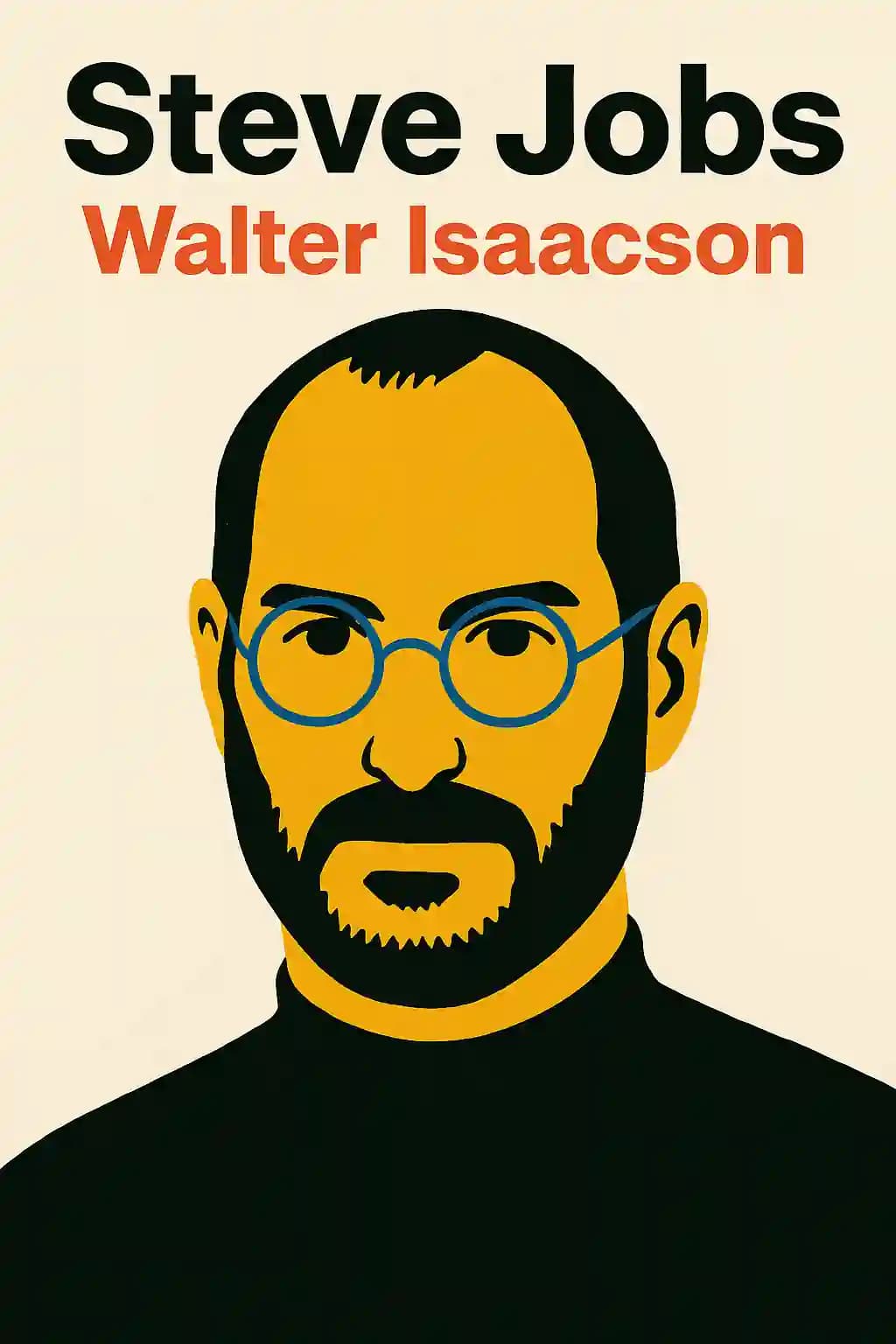
In the heart of Silicon Valley, a college dropout with bare feet and questionable hygiene convinced the world that technology could be beautiful. Steve Jobs wasn't just a tech entrepreneur-he was a cultural force who transformed seven industries: personal computers, animated movies, music, phones, tablet computing, retail stores, and digital publishing. His story reads like modern mythology, captivating figures from Bill Gates to Barack Obama. When Walter Isaacson's biography was published shortly after Jobs' death in 2011, it became an instant cultural touchstone, offering unprecedented access to the mind of a notoriously private innovator. The book reveals a complex man driven by demons and dreams in equal measure-a perfectionist who believed that the rules that governed ordinary people simply didn't apply to him. Through interviews with over 100 family members, friends, adversaries, and colleagues, Isaacson crafted what TIME magazine called "the template for modern business biography." Jobs himself requested this biography, saying he wanted his children to know him through an honest account of his life, warts and all.
第 2 章
The Rebellious Genius: Early Years and Influences
Steve Jobs' origin story contains all the elements that would define his life: abandonment, specialness, and a belief that ordinary rules didn't apply to him. Born to unwed graduate students Joanne Schieble and Abdulfattah Jandali in 1955, he was adopted by Paul and Clara Jobs, a working-class couple from Mountain View, California. When a childhood neighbor asked if this meant his real parents didn't want him, he ran crying to his adoptive parents, who assured him: "We specifically picked you out." This dual sense of being both special and abandoned became fundamental to his identity.
Growing up in Silicon Valley during its transformation from orchards to electronics firms, Jobs absorbed his father's love for craftsmanship and attention to detail. Paul Jobs, a mechanic and craftsman, taught young Steve that even the parts no one would see should be crafted perfectly-a philosophy that would later define Apple products. Their Eichler home, with its clean modernist design, instilled in Jobs an appreciation for accessible elegance that would later manifest in Apple's design ethos.
At school, Jobs proved brilliant but difficult. Before entering kindergarten, he could already read at a high school level. Bored with traditional education, he became a troublemaker until fourth grade teacher Imogene Hill recognized his potential and bribed him with candy and money to complete projects. "It took her about a month to get me hooked," Jobs recalled. "After that, I couldn't get enough learning."
His spiritual and technical education developed in parallel. At thirteen, Jobs questioned his pastor about starving children in Biafra, and when receiving unsatisfactory answers, abandoned organized religion. Yet he spent years studying Zen Buddhism, seeking enlightenment through meditation and simplicity. Meanwhile, his technical education accelerated when neighbor Larry Lang, an HP engineer, introduced him to electronics. By fifteen, Jobs was calling HP's CEO Bill Hewlett directly to request parts, earning himself a summer job assembling frequency counters.
The most formative partnership of Jobs' early years began when his friend Bill Fernandez introduced him to Stephen Wozniak, a self-taught electronics genius five years his senior. Their first collaboration involved building "blue boxes" that allowed free long-distance calls by mimicking telephone switching tones. Jobs immediately saw the commercial potential in Wozniak's technical wizardry, selling the devices for $150 each. "If it hadn't been for the blue boxes, there wouldn't have been an Apple," Jobs later reflected. "I'm 100% sure of that."
This pattern-Wozniak's technical brilliance paired with Jobs' vision for its commercial potential-would define their relationship and ultimately lead to the creation of Apple. But first, Jobs would embark on a journey of self-discovery that included dropping out of Reed College after just one semester, although he continued auditing classes that interested him, particularly calligraphy. "If I had never dropped in on that single calligraphy course in college, the Mac would have never had multiple typefaces or proportionally spaced fonts," he later said. This intersection of technology and the humanities would become Jobs' defining philosophy.
第 3 章
The Birth of Apple: From Garage to Corporation
In 1976, the personal computer revolution was brewing in Silicon Valley garages and hobbyist clubs. The Homebrew Computer Club had become the epicenter for enthusiasts fascinated by the potential of microprocessors to create accessible computing. While most members were content to share ideas freely, Jobs saw commercial opportunity in Wozniak's brilliant engineering.
When Wozniak showed Jobs the computer he had built using a $25 microprocessor, Jobs immediately proposed they start a company. "For the first time in our lives, we had a product," Jobs recalled. They named it "Apple Computer," a name Jobs suggested after returning from an apple farm during one of his fruit-only diet phases. The name was "fun, spirited and not intimidating," and would put them ahead of Atari in the phone book.
With $1,300 raised by selling Jobs' VW bus and Wozniak's HP calculator, they launched Apple Computer on April Fools' Day, 1976. Their first product, the Apple I, was essentially a circuit board that hobbyists could connect to a keyboard and monitor. When Jobs secured an order for 50 units from Paul Terrell's Byte Shop, he convinced a local parts distributor to extend credit based on the purchase order. The young entrepreneurs set up production in the Jobs family garage, with Clara Jobs answering business calls and Paul Jobs building a workbench for assembly.
The Apple I sold for $666.66 (Wozniak liked repeating digits), but Jobs was already thinking bigger. He recognized that to reach beyond hobbyists, they needed a fully integrated computer with keyboard, screen, and attractive case. This vision became the Apple II, which would transform personal computing.
To fund this ambitious project, Jobs sought venture capital. After being rejected by Nolan Bushnell of Atari and Chuck Peddle of Commodore, he connected with Mike Markkula, a recently retired Intel marketing manager. Impressed by Jobs' vision and Wozniak's engineering, Markkula invested $250,000 for a third of the company and helped secure a line of credit from Bank of America.
Markkula's contribution went beyond money. He wrote "The Apple Marketing Philosophy" emphasizing three principles: empathy with customers, focus on doing only what matters, and imputing quality through careful presentation. This last principle particularly resonated with Jobs, who became obsessive about packaging, presentation, and product design.
With Markkula's backing, Apple hired its first president, Mike Scott, primarily to manage the volatile Jobs. The company also engaged Regis McKenna's public relations firm, which created the iconic rainbow apple logo and positioned Apple as a company bringing computing power to ordinary people.
For the West Coast Computer Faire in April 1977, Jobs insisted on a professional exhibition booth with plush carpet and backlit displays, while competitors used folding tables. The Apple II stood out not just for its marketing but for its revolutionary design: a fully assembled computer in an elegant beige case with integrated keyboard, power supply, and color graphics capability. Orders poured in, and Apple was on its way to becoming the fastest-growing company in American history.
第 4 章
Visionary Leadership: Jobs' Management Style
Jobs' management approach combined visionary inspiration with brutal honesty and occasional cruelty. He developed what colleagues called a "reality distortion field"-a charismatic ability to convince himself and others of practically anything, bending reality to his will through a mixture of charm, charisma, bravado, and persistence.
"The reality distortion field was a confounding melange of a charismatic rhetorical style, indomitable will, and eagerness to bend any fact to fit the purpose at hand," explained Andy Hertzfeld, an early Apple engineer. This ability to inspire people to accomplish seemingly impossible tasks drove Apple to create revolutionary products but also led to unrealistic deadlines and exhausted teams.
Jobs divided the world into two categories: "enlightened" and "bozos." People and products were either "insanely great" or "shit." This binary thinking extended to his management style-he could be charming and inspirational one moment, then brutally critical the next. "He would be talking about some pretty mundane subject, then all of a sudden he would say, 'It's shit!'" recalled Jony Ive, Apple's chief designer.
His infamous temper tantrums and harsh criticism were legendary. He would publicly humiliate employees whose work didn't meet his standards. Yet many who worked with Jobs considered this brutal honesty valuable. "I've learned over the years that when you have really good people, you don't need to baby them," Jobs explained. "By expecting them to do great things, you can get them to do great things."
Jobs' focus was legendary. At annual retreats, he would ask his top 100 people to list Apple's ten priorities, then cross off the bottom seven: "We can only do three." This ruthless prioritization extended to product development. When he returned to Apple in 1997, he slashed the product line by 70%, focusing on just four products that fit into a simple two-by-two grid: consumer/professional and desktop/portable.
Unlike most executives who delegated details, Jobs was obsessively hands-on. He would scrutinize every aspect of a product, from the curvature of its case to the exact shade of yellow in an icon. This perfectionism extended to Apple's manufacturing processes, retail stores, and even packaging. When designing the original Macintosh box, he repeatedly had the cardboard refolded and the graphics adjusted until the unboxing experience was perfect.
Jobs also fostered a unique corporate culture that blended counterculture rebellion with technological excellence. The original Macintosh team worked under a pirate flag, embodying Jobs' ethos: "It's better to be a pirate than join the navy." He created a company where engineers and designers were treated as artists, not merely technical staff. This emphasis on creativity and craftsmanship attracted brilliant people willing to endure Jobs' demanding style.
Perhaps most importantly, Jobs insisted on end-to-end control of the user experience. Unlike Microsoft, which licensed its software to hardware manufacturers, Apple created tightly integrated products where hardware, software, and services worked seamlessly together. This "closed system" approach was criticized as controlling, but Jobs defended it as necessary for creating truly great products: "People who know what they're talking about don't need PowerPoint."
第 5 章
The Macintosh Revolution and Jobs' Exile
The Macintosh project began as Jef Raskin's vision for an affordable, user-friendly computer, but transformed dramatically when Jobs took control in 1981. After being pushed out of the Lisa project (ironically named after the daughter he initially refused to acknowledge), Jobs needed his own product to "make a dent in the universe."
Assembling a team of brilliant misfits and pirates, Jobs infused the project with his vision of computing for ordinary people. The breakthrough came when he visited Xerox PARC and saw their experimental graphical user interface with icons, windows, and a mouse. "I thought it was the best thing I'd ever seen in my life," Jobs recalled. "Within ten minutes, it was obvious to me that all computers would work like this someday."
While critics later accused Jobs of "stealing" Xerox's ideas, he countered: "Picasso had a saying-'good artists copy, great artists steal'-and we have always been shameless about stealing great ideas." More importantly, Apple significantly improved what they saw at PARC, making it more intuitive and commercially viable.
The Macintosh team worked grueling hours under Jobs' demanding leadership. His reality distortion field pushed them to achieve the impossible, creating innovations like overlapping windows and smooth scrolling that even Xerox hadn't accomplished. The team's dedication was captured in their signatures, which Jobs had molded into the inside of each Macintosh case: "Real artists sign their work."
When the Macintosh launched in January 1984, Jobs orchestrated a masterful media campaign, including the iconic "1984" Super Bowl commercial directed by Ridley Scott. At the launch event, Jobs dramatically pulled the Mac from a bag while Chariots of Fire played. The computer spoke: "Hello, I'm Macintosh. It sure is great to get out of that bag!" The audience erupted in applause.
Initial sales were strong, but by late 1984, they plummeted. The Mac was underpowered for its ambitious software, and at $2,495, it was too expensive for the mass market Jobs envisioned. Meanwhile, Jobs' relationship with CEO John Sculley deteriorated. Originally, Jobs had wooed Sculley from Pepsi with the famous line: "Do you want to sell sugar water for the rest of your life, or do you want to come with me and change the world?"
Their partnership collapsed as Sculley grew concerned about Jobs' management style and erratic behavior. In May 1985, after Jobs attempted to organize a coup against Sculley, the board sided with the CEO. Jobs was stripped of operational responsibilities and relegated to a ceremonial chairman role.
Devastated, Jobs sold almost all his Apple stock and resigned in September 1985. "What had been the focus of my entire adult life was gone," he later recalled. "It was devastating." At 30, the wunderkind who had appeared on magazine covers was now an industry exile. This painful period would ultimately prove transformative, as Jobs later reflected: "Getting fired from Apple was the best thing that could have ever happened to me. The heaviness of being successful was replaced by the lightness of being a beginner again."
第 6 章
Wilderness Years: NeXT and Pixar
Jobs' exile from Apple lasted twelve years, during which he founded two companies that would profoundly shape his future return. The first was NeXT, a computer company targeting higher education and business markets. With $7 million of his own money and eventually $20 million from billionaire Ross Perot, Jobs assembled a team of Apple veterans to build his perfect computer.
At NeXT, Jobs' obsession with aesthetic perfection reached new heights. He paid renowned designer Paul Rand $100,000 to create a single logo option. The NeXT computer was designed as a perfect black cube, requiring expensive custom manufacturing. Even the factory was a showcase of perfection, with robots painted in bright colors and walls repainted monthly. This perfectionism extended to the unseen parts of the computer-Jobs insisted that the internal circuit boards be beautiful despite never being visible to customers.
When the NeXT computer launched in October 1988, Jobs orchestrated a theatrical unveiling at San Francisco's Symphony Hall. The machine was technically impressive but prohibitively expensive at $6,500. After years of struggle and shifting strategy, NeXT abandoned hardware in 1993 to focus on its operating system, NeXTSTEP. Though commercially unsuccessful, NeXT's software innovations would eventually provide the foundation for Apple's renaissance.
Meanwhile, Jobs made what would become his most profitable investment. In 1986, he purchased the computer graphics division of Lucasfilm for $10 million, renaming it Pixar. Initially, Jobs saw Pixar as a hardware company selling high-end computer systems for medical imaging and graphic design. But the company's animation department, led by John Lasseter, captured Jobs' imagination with short films that perfectly blended technology and art.
When Pixar struggled financially, Jobs continued funding it personally, investing nearly $50 million over the years. His faith was rewarded when Pixar partnered with Disney to produce Toy Story. Released in 1995, the film became the highest-grossing movie of the year and established Pixar as an animation powerhouse.
The success transformed Jobs. "Steve went through an incredible evolution during those next years at Pixar," recalled Alan Kay. "He learned how to be a good leader of creative people rather than a dictator." Jobs discovered the value of giving talented people room to create, a lesson he would later apply at Apple.
These wilderness years also brought personal growth. Jobs reconnected with his biological family, discovering he had a sister, novelist Mona Simpson. He married Laurene Powell in 1991, and they had three children: Reed, Erin, and Eve. He also gradually improved his relationship with Lisa Brennan-Jobs, the daughter he had initially denied.
By 1996, Jobs had matured as both a businessman and a person. When Apple-now struggling under CEO Gil Amelio-sought to acquire NeXT for its operating system, Jobs was positioned for one of the greatest comebacks in business history.
第 7 章
The Great Comeback: Saving Apple
When Jobs returned to Apple in 1997, the company was 90 days from bankruptcy. Years of mismanagement had reduced Apple's market share to just 4%, and the company had lost over $1 billion in the previous year. Initially returning as an "advisor," Jobs quickly consolidated power, orchestrating the ouster of CEO Gil Amelio and eventually taking the title of interim CEO-or "iCEO"-for himself.
Jobs' turnaround strategy was ruthlessly simple: focus on making great products. He slashed Apple's confusing product lineup by 70%, focusing on just four products that fit into a simple grid: consumer/professional and desktop/portable. He ended the failed strategy of licensing the Mac operating system to clone manufacturers, believing that Apple needed to control both hardware and software to create superior products.
To stabilize Apple financially, Jobs made a shocking alliance with Microsoft. At the 1997 Macworld conference, he announced that Microsoft would invest $150 million in Apple and commit to developing Office for the Mac for five years. When Bill Gates appeared on the giant screen above Jobs, the audience gasped and booed. Jobs calmed them: "We need to look forward to Microsoft as a partner in this industry."
With Apple stabilized, Jobs launched the "Think Different" advertising campaign, celebrating "the crazy ones, the misfits, the rebels" who change the world. The campaign featured black-and-white portraits of visionaries like Einstein, Gandhi, and Dylan-people Jobs admired for their creative genius and willingness to challenge convention. The campaign wasn't just aimed at customers but also at Apple employees, reminding them of the company's rebellious spirit.
In May 1998, Jobs introduced the iMac, a breakthrough all-in-one computer designed by Jonathan Ive. With its translucent blue case, the iMac broke from the beige boxes dominating the industry. "It looks like it's from another planet," Jobs said at the launch. "A good planet. A planet with better designers." The iMac became the fastest-selling computer in Apple history.
Jobs also revolutionized Apple's operations, bringing in Tim Cook from Compaq to streamline manufacturing and supply chains. Cook reduced inventory from months to days and established relationships with component suppliers that gave Apple technological advantages while keeping costs competitive.
Perhaps Jobs' most revolutionary move was opening Apple retail stores when conventional wisdom said computer manufacturers couldn't succeed in retail. Working with former Target executive Ron Johnson, Jobs created stores that embodied Apple's values: simplicity, beauty, and an exceptional customer experience. From the signature glass staircases to the Genius Bar help desk, every detail was meticulously planned. Critics predicted failure, but the stores became the most profitable retail space per square foot in America.
By 2001, Jobs had officially dropped the "interim" from his CEO title, and Apple had returned to profitability. But the true transformation was just beginning. Jobs had positioned Apple to lead a digital revolution that would transform multiple industries and make it one of the world's most valuable companies.
第 8 章
Digital Hub Strategy: iPod, iTunes, and Beyond
In 2001, as the tech industry reeled from the dot-com crash, Jobs unveiled a bold new strategy: the Mac would become a "digital hub" for emerging digital lifestyle devices like cameras, music players, and video recorders. Rather than diversifying into multiple hardware categories as competitors were doing, Apple would create software that made the Mac the center of users' digital lives.
The first manifestation of this strategy was iTunes, software that helped users organize and enjoy their music collections. Initially, Jobs had resisted allowing third-party apps on Apple devices, but was convinced to acquire SoundJam MP, a popular MP3 management program. Jobs worked directly with the developers to simplify the interface, removing unnecessary features and creating a cleaner design. When iTunes launched in January 2001, it embodied Jobs' philosophy of simplicity and integration.
The next step was hardware. Existing MP3 players were "big and clunky or small and useless," according to Jobs. When Apple's hardware chief Jon Rubinstein discovered a tiny 1.8-inch hard drive made by Toshiba, Jobs immediately saw the potential for a breakthrough music player. He assembled a team led by engineer Tony Fadell to create what would become the iPod.
Jobs' directives for the iPod were characteristically demanding: it needed to launch in under eight months, hold thousands of songs, have a battery that lasted all day, and be dead simple to use. The team delivered with an elegant device featuring a revolutionary scroll wheel interface and simple menu system. Jobs insisted on the now-famous tagline: "1,000 songs in your pocket."
When the iPod launched in October 2001, it stood apart from competitors not just in design but in its seamless integration with iTunes. Users could easily sync their music libraries between computer and device-a level of simplicity unheard of at the time. The white earbuds became a cultural icon, and the iPod's success transformed Apple from a computer company to a consumer electronics leader.
The final piece of Jobs' music strategy came in 2003 with the iTunes Store. While the iPod made managing music easier, acquiring digital music legally remained difficult. The music industry was in crisis, with CD sales plummeting due to piracy. Jobs convinced reluctant record executives that the solution wasn't technical protection but a better business model: selling individual songs for 99 cents with a simple user experience.
"You can't compete with piracy by trying to make it inconvenient," Jobs argued. "You have to compete by offering a more attractive alternative." The iTunes Store launched with 200,000 songs and sold one million tracks in its first week. By 2010, it had sold 10 billion songs, becoming the world's largest music retailer and saving the recording industry from collapse.
The success of the iPod and iTunes established a pattern Apple would repeat with the iPhone and iPad: identify categories with existing but deeply flawed products, reimagine them with elegant design and seamless integration, then create an ecosystem that locked in customers. This approach not only generated enormous profits but also gave Apple unprecedented control over multiple industries.
第 9 章
Redefining Industries: iPhone, iPad, and Apple's Legacy
In 2005, despite the iPod's enormous success, Jobs grew concerned that mobile phones incorporating music players would eventually render the iPod obsolete. "If we don't cannibalize ourselves, someone else will," he told his team. This thinking led to Apple's most revolutionary product: the iPhone.
Initially, Apple partnered with Motorola to create the ROKR, an iTunes-compatible phone. The result was so disappointing that Jobs decided Apple must build its own phone. The project combined two separate initiatives: a tablet computer with multi-touch technology and a phone with iPod features. When Jobs saw the multi-touch interface that allowed pinching, swiping, and zooming, he immediately decided it should be applied to a phone first.
Jobs drove the iPhone team with characteristic intensity, demanding seemingly impossible features while rejecting conventional wisdom. He insisted on using glass rather than plastic for the screen, leading to a partnership with Corning to resurrect their shelved "Gorilla Glass" technology. He demanded the elimination of a physical keyboard in favor of a virtual one that could adapt to different applications. And he insisted on a radical simplification of the user interface, removing instruction manuals and complex menus.
When Jobs unveiled the iPhone in January 2007, he presented it as "three revolutionary products" in one: a widescreen iPod, a revolutionary mobile phone, and a breakthrough internet communicator. The audience erupted when they realized these weren't separate devices but a single product. The iPhone fundamentally changed not just mobile phones but computing itself, shifting the industry toward mobile, touch-based interfaces.
The iPad, launched in 2010, represented the fulfillment of Jobs' long-held dream of a tablet computer. Though many analysts initially dismissed it as "just a big iPhone," the iPad created an entirely new category between smartphones and laptops. Jobs positioned it as a more intimate computing device for browsing the web, reading books, watching videos, and playing games. Within months, it was selling faster than the Mac.
Throughout these innovations, Jobs maintained his focus on the intersection of technology and liberal arts. At the iPad 2 launch in 2011, already visibly ill from cancer, he emphasized this philosophy: "It's in Apple's DNA that technology alone is not enough-it's technology married with liberal arts, married with the humanities, that yields us the result that makes our heart sing."
Jobs' final major project was Apple Park, the company's new headquarters. Working with architect Norman Foster, he envisioned a circular "spaceship" campus surrounded by thousands of trees. The building would embody Apple's values: innovative engineering, beautiful materials, and seamless integration with nature. Though Jobs didn't live to see it completed, the campus stands as a physical manifestation of his legacy.
When Jobs resigned as CEO in August 2011, he wrote: "I have always said if there ever came a day when I could no longer meet my duties and expectations as Apple's CEO, I would be the first to let you know. Unfortunately, that day has come." He died six weeks later on October 5, 2011, at age 56.
Jobs' legacy extends far beyond the products he created. He established a model for integrating technology and design that transformed multiple industries. He proved that controlling the entire user experience-hardware, software, and services-could create products that "just work." And he showed that a relentless focus on simplicity, beauty, and quality could build not just successful products but the world's most valuable company.
As Jobs himself reflected near the end of his life: "My passion has been to build an enduring company where people were motivated to make great products. Everything else was secondary."