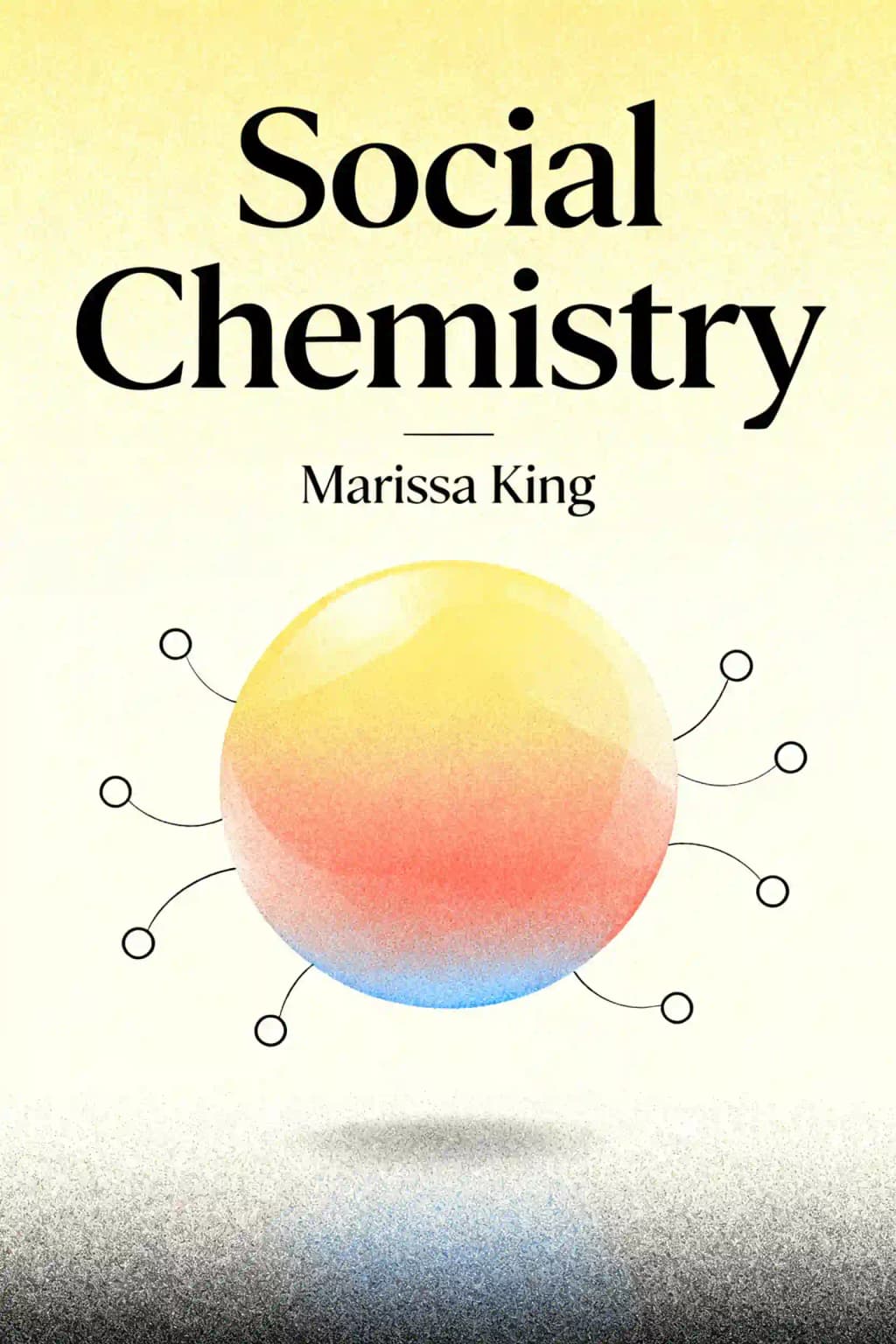
In "Social Chemistry," Yale professor Marissa King decodes the science of human connection, revealing why Jim Cramer thrives with expansive networks while Anna Wintour succeeds through deep, interconnected ones. What's your networking style - broker, expansionist, or convenor?
Marissa King, PhD, is the acclaimed author of Social Chemistry and a leading expert on human connection and social networks. A professor at the Wharton School of the University of Pennsylvania, where she holds the Alice Y. Hung President’s Distinguished Professor chair, King combines rigorous academic research with practical insights into how relationships shape health, behavior, and organizational success.
Her work, funded by the National Institutes of Health, has been published in JAMA, Health Affairs, and top management journals, and she previously taught at Yale School of Management.
Social Chemistry, a blend of sociology and behavioral science, draws from King’s decades of research on social influence and network dynamics. The book decodes how interpersonal connections drive outcomes in healthcare, workplace culture, and personal well-being—themes amplified through her frequent contributions to The New York Times, Wall Street Journal, and NPR.
King’s frameworks are applied by healthcare institutions and Fortune 500 companies to tackle challenges ranging from clinician burnout to team productivity. Recognized for bridging scholarly depth with accessibility, her work has shaped both academic discourse and real-world strategies for building meaningful networks.
Social Chemistry explores how the structure and quality of social networks—not just size—impact personal and professional success. Marissa King identifies three networking styles: Expansionists (broad networks), Brokers (bridging diverse groups), and Conveners (deep, tight-knit circles). The book combines neuroscience, psychology, and real-world examples to show how intentional relationship-building enhances resilience, creativity, and career outcomes.
Professionals, leaders, and anyone seeking to improve relationships or career trajectories will benefit. It’s ideal for those navigating career changes, leadership roles, or remote work dynamics. The research-backed insights also appeal to readers interested in sociology, organizational behavior, or self-improvement.
Yes. Critics praise its blend of academic rigor and accessibility, with Publishers Weekly calling it “wise, well-reasoned advice” for career growth. Kirkus notes its “personable approach” to social dynamics, making complex concepts like network analytics relatable through celebrity examples (e.g., Anna Wintour, Yo-Yo Ma).
King argues that hybridizing these styles maximizes impact.
The book shifts focus from transactional interactions to cultivating “high-quality connections” that boost cognitive function and job satisfaction. King emphasizes authenticity, showing how networks affect health and longevity as much as smoking or obesity.
Adam Grant endorsed it as “one of the most interesting and useful books ever written on networking.” Another standout insight: “The structure of your network predicts your pay and ideas more than your IQ.”
By teaching readers to audit their network’s diversity and depth. Brokers, for instance, excel in innovation-driven roles by linking unrelated fields, while Conveners thrive in stable industries requiring trust.
Some reviewers note it leans more on conceptual frameworks than step-by-step guides. The Open Letters Review highlights its balanced tone but suggests practical applicators might crave more tactics.
While Atomic Habits focuses on individual behavior change, Social Chemistry examines how social structures shape outcomes. Both emphasize small, intentional shifts but target different levers of success.
Yes. King explains how “relationship audits” identify underinvested connections. For example, Conveners’ deep ties correlate with emotional resilience, while Brokers’ bridging reduces workplace conflict.
As remote work and AI reshape collaboration, King’s strategies for intentional networking help maintain creativity and trust in hybrid environments. Her research on digital communication’s limits remains timely.
Pair with Never Eat Alone (tactical networking) or Dare to Lead (trust-building). For deeper dives into social science, try Connected by Nicholas Christakis.
通过作者的声音感受这本书
将知识转化为引人入胜、富含实例的见解
快速捕捉核心观点,高效学习
以有趣互动的方式享受这本书
Networks are far more than just collections of individual relationships.
Strategic networking [can trigger] feelings of moral impurity.
Authenticity may be the antidote to networking discomfort.
People consistently underestimate how much others enjoy conversations.
Everyone has something to offer.
将《Social Chemistry》的核心观点拆解为易于理解的要点,了解创新团队如何创造、协作和成长。
将《Social Chemistry》提炼为快速记忆要点,突出坦诚、团队合作和创造力的关键原则。

通过生动的故事体验《Social Chemistry》,将创新经验转化为令人难忘且可应用的精彩时刻。
随心提问,选择声音,共同创造真正与你产生共鸣的见解。

"Instead of endless scrolling, I just hit play on BeFreed. It saves me so much time."
"I never knew where to start with nonfiction—BeFreed’s book lists turned into podcasts gave me a clear path."
"Perfect balance between learning and entertainment. Finished ‘Thinking, Fast and Slow’ on my commute this week."
"Crazy how much I learned while walking the dog. BeFreed = small habits → big gains."
"Reading used to feel like a chore. Now it’s just part of my lifestyle."
"Feels effortless compared to reading. I’ve finished 6 books this month already."
"BeFreed turned my guilty doomscrolling into something that feels productive and inspiring."
"BeFreed turned my commute into learning time. 20-min podcasts are perfect for finishing books I never had time for."
"BeFreed replaced my podcast queue. Imagine Spotify for books — that’s it. 🙌"
"It is great for me to learn something from the book without reading it."
"The themed book list podcasts help me connect ideas across authors—like a guided audio journey."
"Makes me feel smarter every time before going to work"

免费获取《Social Chemistry》摘要的 PDF 或 EPUB 版本。可打印或随时离线阅读。
Think about the last time you landed a job, met someone who changed your trajectory, or felt truly understood in a moment of crisis. Chances are, the architecture of your relationships-not just your talent or credentials-made it possible. Vernon Jordan understood this instinctively. When an insurance company rejected him for an internship after discovering he was Black, he didn't retreat. Instead, he methodically built connections across racial and professional divides until he became what Henry Louis Gates called "the Rosa Parks of Wall Street"-a presidential confidant sitting on nine corporate boards. Jordan's story isn't just about resilience; it's about recognizing that our networks are invisible structures that either amplify or constrain everything we attempt in life. Your network isn't just a collection of contacts-it's an architecture that determines what you can see, whom you can reach, and what becomes possible. Just as carbon atoms arrange themselves into either soft graphite or hard diamond, the same relationships configured differently yield entirely different outcomes. Most of us fall into one of three patterns. Expansionists maintain enormous networks and excel at working rooms, but often struggle with depth. They're the ones who seem to know everyone at the conference but might not have anyone to call at 3 a.m. Brokers connect disconnected worlds-they're the chef who collaborates with chemists, the executive who bridges politics and business. They generate value by standing at the intersection of separate spheres. Conveners build dense, interconnected circles where everyone knows each other, creating environments rich in trust but sometimes insular.