第 1 章
The View from Above: Where Wonder Meets Reality
When Sandra Bullock was preparing for her role in the blockbuster film "Gravity," she needed to understand what living in space truly felt like. She turned to astronaut Cady Coleman, who shared intimate details about the sensation of weightlessness, the sounds of the International Space Station, and how to move in zero gravity. "If Hollywood wants to tell better space stories," director Alfonso Cuaron later remarked, "we need to share space the way Cady shares space." This perfectly captures Coleman's mission: making the extraordinary experience of spaceflight relatable and accessible to everyone. As one of only 50 women who have ever flown in space, Coleman's perspective offers a rare window into a world few will ever experience firsthand. Her journey from chemistry student to astronaut, spanning three spaceflights and 180 days in orbit, reveals not just the technical marvels of space exploration but the deeply human experience of seeing our planet from above-a perspective that transforms how we understand our place in the universe.
第 2 章
Reimagining What's Possible
Life in zero gravity means navigating the ISS by flying through its corridors, using handrails to direct myself and tucking toes under rails to stay in place. The toilet roars like a jet engine, using suction to manage waste in space. My favorite spot is the Cupola - a hexagonal dome with 360-degree views of Earth, where I brush my teeth while "surfing" over the Pacific at 17,500 miles per hour. It's surreal being one of only six humans not on Earth. After our Daily Planning Conference with Houston, I dress (pulling clothes on two legs at a time), eat uninspiring dehydrated breakfast, and fly to the lab for my meticulously scheduled day of science experiments, repairs, and inventory - all transformed by the magical absence of gravity.
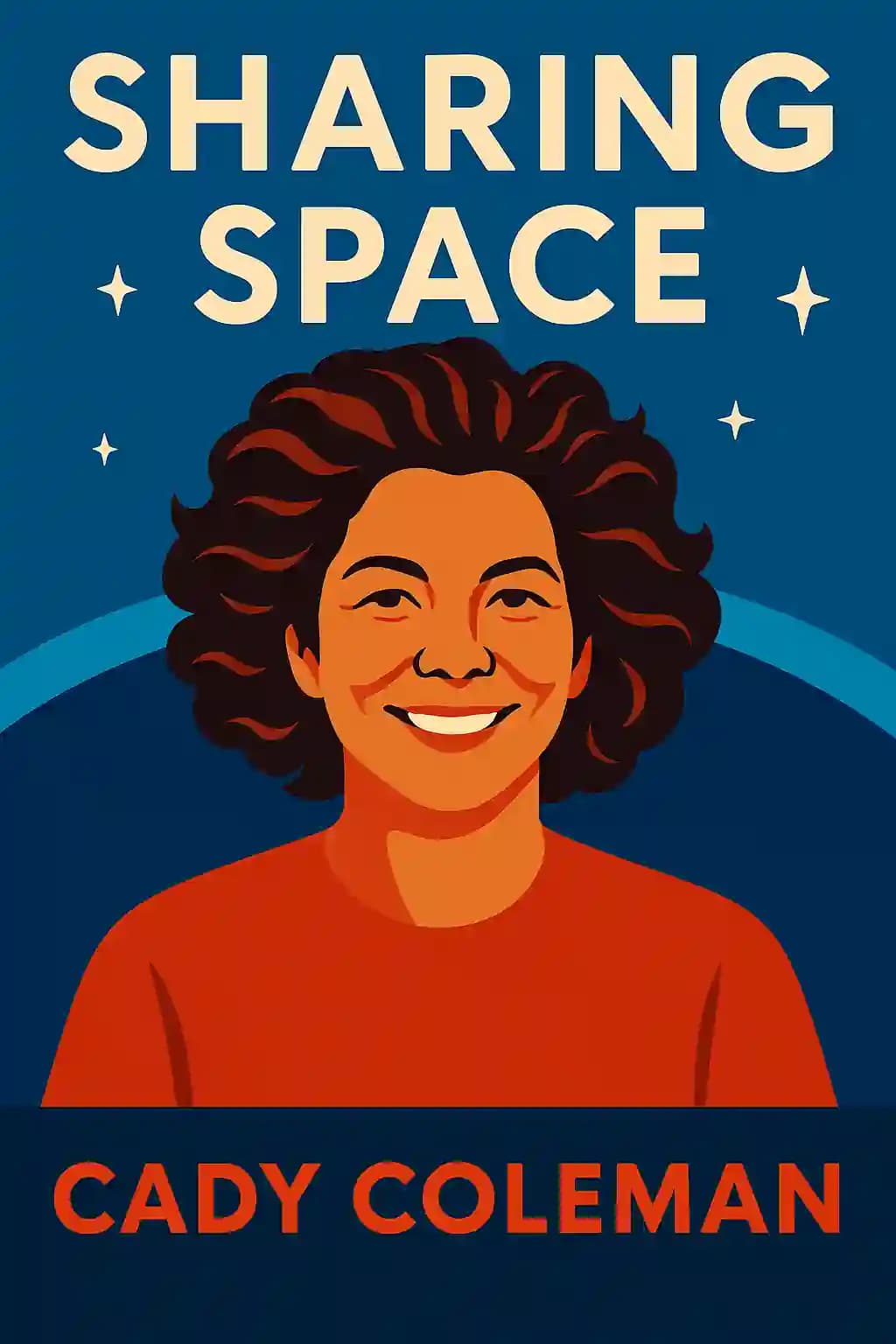
I never dreamed of becoming an astronaut until spring 1982 at MIT, when I saw a poster of Sally Ride - America's first female astronaut. As a chemistry major who loved lab work but craved adventure, I attended her talk, captivated by this young woman with wavy brown hair like mine in a blue flight suit. Unlike the all-male, all-white astronauts I'd grown up seeing, Sally was relatable yet accomplished - an astrophysicist who flew jets and practiced spacewalking. Growing up with a father who led naval diving units, exploration seemed normal, but never for women like me. When Sally shook my hand at the reception - her grip small, strong, female - something shifted. A quiet thought ignited: Maybe I could have that job.
Without knowing it, Sally gave me permission that day - not explicitly, but through her example. She made being an astronaut real for me, not just possible-for-someone-else. By showing me an astronaut could look and feel like me, she transformed what I could imagine for myself. Some might cringe at needing "permission," thinking it sounds disempowering. But in our imperfect world, seeing someone like us doing something extraordinary can be the catalyst we need. Representation matters profoundly - it changes the menu of options we feel we can reach for. Despite progress toward inclusivity, there's always someone who needs that unspoken permission from those who've gone before.
第 3 章
The Power of Being Underestimated
When Mr. Peterson told me I wasn't qualified for NASA's 1990 astronaut selection, needing four years of service instead of my two, he said, "You would have to be some kind of exception, Miss Coleman." I told him I was indeed an exception, and to write my name down - because someday I'd be calling him from NASA.
This determination was partly shaped by experiences of being underestimated. In high school, I was the only girl among MIT-obsessed boys who thought I couldn't make it. Their doubt made me apply, and I got in. At MIT, I nearly dismissed a "Miss California" blonde as my lab partner, until Laura Kiessling proved herself brilliant - now an internationally respected chemist and MacArthur fellow.
At the Air Force Research Laboratory, Tommy would challenge me with "You think a girl can do this?" During centrifuge testing, I broke records - lasting 18 minutes when others managed only six. Even skeptical Boeing engineers changed their minds when Tommy said, "If anybody can show your idea works, it's the girl. She can do anything."
I discovered I thrive under pressure, using it to focus when situations intensify. I'm a world-class procrastinator who uses deadline pressure effectively. When people believe in me, their expectations create positive pressure that keeps me focused. High-pressure situations reveal our vulnerabilities and become valuable teachers, especially during emergency drills.
A wrong number changed my life when I accidentally called Josh Simpson's studio. Known for his glass "planets," he answered with a comical Slavic accent as "Olga Ezneechko Eahvorskyah Gupta Mehmet Ali Aghar Manop Boonyavatana." I called back pretending to be KGB investigating "glass breaking." When we met at his studio, I told him confidently, "I'm applying to be an astronaut." He simply believed in the impossible as I did.
After securing my military service waiver, I applied to NASA in March 1991. From 2,054 applicants, I made it to the final 90 for interviews at Johnson Space Center. During my panel interview, astronaut Hoot Gibson surprisingly asked about high school and my flute playing. His wife, Rhea Seddon, later assured me I could have both family and career. On April 1, 1992, Don Puddy called asking, "Would you still like to come and work with us at NASA?" Everyone who had underestimated me - including myself - was proven wrong.
第 4 章
The Long Road to Liftoff
The space shuttle launch is a sensational event - a relentless, irreversible surge of power that propels astronauts skyward. From inside, it feels like becoming part of the rocket itself - everything shakes intensely while your body remains motionless, strapped tightly to your seat. After eight and a half minutes of raw power and momentum, the engines suddenly cut off, leaving shocking silence and weightlessness as you enter orbit.
But for astronauts, the launch isn't the beginning - it's merely an exciting interlude in a multi-year journey of preparation. Like entrepreneurs developing products or artists perfecting their craft before opening night, those who succeed commit to the unseen legwork as much as the visible liftoff. My NASA career spanned 8,888 days, with only 180 spent in space and a mere 25 minutes and 34 seconds actually launching. Success comes from creating your own momentum when no one is watching or counting down.
My space journey truly began on August 3, 1992, over three years before my first launch. My astronaut class of twenty-four (nicknamed "The Hogs" after the Muppets' "Pigs in Space") was introduced at a press conference, all of us grinning with excitement. At my new desk, I found a two-foot stack of workbooks - my first indication of the intensive learning ahead.
Early experiences with my officemates Dave Wolf and Shannon Lucid taught me that astronauts had a responsibility to speak up when our perspective could provide important insights. One day, Dave asked me to film him drawing blood from Shannon to prove her veins were suitable for an upcoming mission, countering assumptions from higher-ups who wanted to remove her based on her age.
Our training quickly bonded us through shared challenges. Within days, we headed to Washington State for survival training - learning navigation, shelter building, and food scavenging. We also tackled water survival skills, where I learned a valuable lesson about staying calm under pressure after struggling to manually inflate my life vest while everyone watched. My classmate Mike Lopez-Alegria later told me I was "the lucky one" because I'd learned to slow down while scared - advice that would serve me well throughout my career.
Those early months felt like being freshmen in college again, except we were mostly in our thirties and forties. We absorbed massive amounts of information about shuttle systems, practiced in simulators, and learned a new language where words like "nominal" (meaning everything is performing as expected) became our most desired outcome. We practiced mission scenarios in teams, memorized every switch and circuit breaker, and learned to think in terms of backup systems. Some simulators were like amusement park rides that mimicked launch and landing sensations, while others taught us to work with Mission Control. We mastered robotics, rendezvous techniques, spacewalking basics, and even took classes on space food and bathroom facilities. Throughout all this training, we were constantly evaluated - excellent practice for performing under the public scrutiny we'd face on actual missions.
Flying T-38 jets was crucial to developing my operational mindset - learning to make decisions under high-speed, high-pressure conditions with real risks. For a scientist-astronaut like me without military background, this training was invaluable. The moment I strapped into that aircraft, I had to be 100% present, leaving all distractions behind.
My friend and housemate Mark Polansky, an accomplished instructor-pilot, taught me to look ahead to the next step without skipping critical procedures. When I'd get caught in theoretical thinking, he'd bring me back with a simple "Ah, so, how are we doing?" After a formation flight where we flew just feet from another T-38, he noticed my tense shoulders and gave me advice I still use: "Wiggle your toes, because you just can't stay tense if you're wiggling your toes!" Years later during critical space operations, my toes were definitely moving.
Flying T-38s also tested my emergency response abilities. Once while flying with Rick Hull to Cape Canaveral, an orange warning light indicated we'd lost one of two electrical generators. If we lost the other, we'd have only 18 minutes of battery power. Despite my stomach dropping, my mind remained clear. We switched instantly from light banter to focused operational mode, working through our checklists for an expedited landing in poor weather conditions in Orlando. That real emergency gave me a new kind of confidence - the kind that comes only when you're tested and rise to the challenge because you've trained to do so.
第 5 章
Science in Orbit
Our experiments on STS-73 would help develop sustainable technologies both for space and Earth. We studied how plants grow in challenging conditions, which is crucial for Mars missions and Earth's food sustainability. We also used ourselves as test subjects, as our accelerated bone density loss in space provides valuable medical insights.
As a pathfinder mission for the International Space Station, we tested how science would be conducted there. Our mission patch even featured a design representing the future ISS Cupola window. We had to ensure experiment procedures were clear and equipment was "astronaut-proof" - if something could break on Earth, it would likely break while orbiting at 17,500 mph.
Years of work by countless scientists and engineers went into creating these experiments. Each represented someone's career work, making us feel tremendous responsibility as their eyes, hands, and ears in space. Though some astronauts avoided laboratory flights, I considered my assignment a gift. Our science crew included Kathy Thornton, an experienced spacewalker, and payload specialists Fred Leslie and Al Sacco, with Commander Ken Bowersox, pilot Kent Rominger, and flight engineer Mike Lopez-Alegria joining later.
The lab crew formed an especially tight bond during our 22 months of training. We lived together during simulations in a shuttle replica, practicing experiments and sharing elaborate practical jokes, including our video "10 Reasons Why Spuds Would Rather Go to Space" - though we did successfully grow five potatoes in orbit. These experiments led to innovations like vertical farming that benefit Earth today.
Our launch from Cape Canaveral was scheduled for September 25, 1995. We entered two weeks of quarantine beforehand, with the first week in Houston before flying to the Cape in T-38s. During quarantine, only spouses or significant others could visit, though we saw family and friends from a distance at traditional pre-launch events.
The Night Viewing was particularly moving - our families arrived to see Columbia illuminated brilliantly, visible for miles. At the Wave Across the Ditch ceremony, we talked with family and friends across a five-foot water-filled divide, with my brothers performing charades to mimic Florida wildlife. Looking at my mom's proud face, I thought she'd have climbed into my spacesuit given the chance - she'd been as courageous as any astronaut in her own way.
Our launch slipped seven times over thirty days. The first delay allowed me to attend my own launch party at Space Camp, giving me unexpected closure as people from every era of my life celebrated my achievement. I also got to take my family on a tour of Columbia on the launchpad, making the enormity of the mission real to all of us. My mother's face showed a poignant mix of joy and wistfulness, while my father's navy background gave him special appreciation for the historic significance.
The night before we finally launched, Josh and I drove through Cape Canaveral, stopping at Launch Complex 34 where Apollo 1's crew had died. The words "Abandon in Place" and the bronze plaque with Grissom, White, and Chaffee's names reminded me of the risks, but I wasn't having second thoughts. You make your decision about risks long before sitting on a rocket. I had faith in NASA's team and felt honored to follow those pioneering astronauts.
There's always risk in launching any meaningful endeavor. When nervous before a milestone event, I remind myself of three things: the hard work I've put in, the mission's importance, and how my skills serve that mission. When you've done everything to prepare and serve something bigger than yourself, you can trust life to unfold as it will.
第 6 章
Mission Accomplished: Chandra's Journey
When I gaze at the night sky from our Massachusetts hilltop, I'm filled with the same wonder humans have experienced for millennia. Modern astronomy has revealed that each pinprick of light represents entire galaxies, yet there's still so much we don't know. The James Webb Space Telescope now shows us swirling galaxies and cosmic formations at the edge of the universe, reminding us of our cosmic insignificance. Yet paradoxically, these very images that diminish our importance were made possible by our remarkable human ingenuity - engineers and astronomers who built powerful telescopes, and astronauts who carried them to orbit.
This paradox defines what it means to be part of a mission: you're simultaneously insignificant yet essential. Though "mission-driven" has become corporate jargon, the authentic concept remains powerful. A true mission is something bigger than yourself, yet it depends on your unique contribution. Without you, it couldn't succeed.
Every astronaut journey is called a mission for good reason. Being selected acknowledges that you bring the specific skills needed for success. Whether it's a science mission like my first flight conducting microgravity experiments, an exploratory mission like the moon landings, an astronomical mission launching telescopes, a construction mission building the space station, or testing equipment for future Mars flights - we always go to space for reasons bigger than ourselves.
The power of mission stretches you beyond yourself while bringing out your unique qualities. This sense of purpose bridges personal differences and disagreements, enabling achievements we might never have thought possible. The shared mission bonds a crew throughout years of training and often long after the specific task is completed.
I was in Russia working on English-language labels for the International Space Station when I learned about my assignment to STS-93, the Chandra mission. After days of arguing with Russian colleagues about labeling protocols, I insisted we move our discussions to the ISS simulators where we could see concrete examples. Inside the main module, which resembled an industrial kitchen with equipment lining every wall and ceiling, our conflicts resolved more easily as we agreed on appropriate words, abbreviations, and placement. Though painstaking, this work helped me know the station intimately.
The assignment call came from Colonel Eileen Collins, the first woman to pilot the space shuttle, whom I'd first met at the Air Force Research Laboratory. For her first launch, she'd invited the surviving Mercury 13 women - those who'd undergone astronaut testing in the early 1960s only to have the program abruptly shut down. Standing among those pioneers watching Eileen make history had made me acutely aware of being part of that lineage of boundary-breaking women.
Now Eileen was calling to tell me I'd join her on STS-93, where she would make history again as NASA's first female shuttle commander. I would serve as lead mission specialist for delivering the Chandra X-ray Observatory and be designated as one of the spacewalkers. When I shared this news with my Russian colleagues, most were thrilled except for the senior Russian, who looked at me regretfully and said, "Katya, you are so beautiful. Why you want to spacewalk? Why you want to be astronaut?" When I asked if I couldn't be both beautiful and an astronaut, he shook his head and firmly said "No!" as if it were impossible.
Our five-person crew included pilot Jeff Ashby, veteran astronomer Steve Hawley, and French astronaut Michel Tognini. I appreciated Eileen's consensus-building leadership style, which differed from the more directive approach of other commanders. To understand the complex electrical systems of the telescope, I developed my own learning method - using colored pencils to highlight different connections in the engineering diagrams. Though some instructors thought this was a waste of time, my approach worked so well that my diagram of the data communication system was ultimately adopted by all Mission Control teams.
Chandra, named after astrophysicist Subrahmanyan Chandrasekhar, was the largest and heaviest object ever carried into space. The telescope would detect X-rays from high-energy cosmic events like exploding stars and black holes - phenomena impossible to study from Earth because our atmosphere absorbs X-rays. Our mission was to deploy Chandra 250 miles above Earth so its rocket could boost it to its final orbit 86,000 miles away. I studied intensely, determined to understand not just the technical aspects but the scientific purpose of the telescope. Working with Steve Hawley, I discovered how rapidly our understanding of astronomy was evolving - textbooks from just ten years earlier contained outdated information. This mission would change what everyone knew about the universe.
第 7 章
Balancing Earth and Space
In 2001, I worked as a CAPCOM (Capsule Communicator) at NASA's Mission Control, serving as the critical liaison between ground controllers and astronauts in space. This demanding role required translating messages between worlds, standing up for astronaut needs, and maintaining constant focus during nine-hour shifts. But I was bridging worlds in another way too - as a new mother with a breastfeeding baby boy named Jamey while working as a full-time astronaut.
During simulations and actual missions, I arranged with supervisors to have extra minutes added to scheduled communication blackout periods so I could pump milk. When I heard "CAPCOM, you are GO for launch!" over my headset, it wasn't about rockets - it was my signal to sprint for the door during these brief windows of opportunity. I pumped in the janitors' closet right outside Mission Control, where the female janitors welcomed me with flowers and magazines. While male supervisors were generally accommodating, I had to carefully navigate conversations about pumping to minimize discomfort. This was just one of countless arrangements I had to negotiate to be both a mother and an astronaut in a role never designed for people like me.
Josh and I never had a conventional relationship from the moment our eyes met. Our connection was immediate, but we knew we wouldn't live together anytime soon - Josh had an established glass studio in Massachusetts where he employed locals and shared custody of his son Josiah, while my astronaut career kept me in Houston. Neither of us could ask the other to move.
We made regular weekend visits at our own expense, enduring strangers' skeptical questions about our future. Finding "boyfriend" inadequate to convey our commitment, we used "sweetheart" instead. NASA struggled to categorize Josh in their traditional classification schemes, leading to awkward moments like when I finally blurted to an administrator, "He's the guy I've been sleeping with for three years!" to get him access to a special tour.
When Josh proposed in 1997 by a Hawaiian waterfall with a handcrafted ring featuring his grandmother's sapphire, I needed time to think - typical of my decision-making style. Two weeks later, I surprised him at the airport with a "YES!" sign and champagne, though I had to wait hours when he missed his connection.
Josh and I married on our farm in Shelburne Falls with friends and family from everywhere, including NASA colleagues. My sister Cari stood for me, Josiah for Josh, and we toasted with handblown wineglasses resembling the night sky.
Though I hadn't given much thought to children, Josh and I decided to have a baby a few years after marrying. I knew other astronaut mothers like Kathy Thornton who balanced parenthood with space careers, so I approached our situation with naive optimism. After STS-93 in 1999, I became pregnant quickly, sharing the news with Josh just before Thanksgiving.
The timing worked well professionally - I wouldn't be assigned to another flight immediately, allowing me to be temporarily grounded from T-38 flying and spacewalk training. I was eager to be considered for the next wave of International Space Station crews, as living in space had always felt like my true calling. I spent the summer of 2000 in Massachusetts with Josh - the longest consecutive time we'd ever spent together - feeling contentedly grounded despite my usual active lifestyle. Jamey arrived in August, and though I was scheduled to return to work in September, Ellen Ochoa encouraged me to take more time, assuring me that family priorities wouldn't be judged as lack of dedication.
Returning to Houston with Jamey revealed the challenges of being a geographically single mom with an astronaut's duties. I perfected the run-and-pump routine during simulations, and when shuttle missions were active, I'd send Jamey to Massachusetts with Josh along with my milk on dry ice - often sprinting to FedEx before closing.
We developed a rhythm with Josh visiting Houston, me traveling to Massachusetts during breaks, and Jamey shuttling between us. The frequent flier miles piled up, with Jamey often accumulating more than either parent. Our arrangement wasn't perfect but worked as we traded parenting responsibilities to pursue our passions.
The emotional toll was real - I was known as "the astronaut who cries at the airport" by sympathetic United counter staff. One photo Josh sent of two-year-old Jamey hugging the television when he heard my voice on NASA Channel brought both laughter and tears. Though we mostly kept our complicated family life balanced, some moments tested us - like when I was invited to throw the first pitch at Boston's Fenway Park, feeling unprepared despite last-minute coaching from Mark Polansky.
第 8 章
The Space Station Experience
I was woken at 3 a.m. by a phone call from my friend Bob Young with incomprehensible news: "They lost Columbia." For moments I couldn't process it. Then reality hit me hard - my friends on STS-107, their landing day, were gone. All seven crew members lost when the shuttle broke apart during reentry on February 1, 2003.
Cut off from news in remote New Zealand after returning from Antarctica, I wouldn't have known about the accident for days if Bob hadn't called. Josh and I left immediately, needing to be home to help, to grieve, and to support the families. During our long journey home, seeing a newspaper photo of a battered helmet in a Texas field brought the tragedy into agonizing clarity.
I'd been thrilled to serve as Lead CAPCOM for STS-107, a sixteen-day laboratory mission similar to my first flight. I'd trained with the crew for nearly a year until being reassigned to Antarctica. Just a week before the accident, I'd organized a teleconference between the women at McMurdo Station and astronauts Laurel Clark and Kalpana Chawla aboard Columbia.
I remember Laurel's wonder-filled voice during that call, mentioning how good she and KC looked in their colorful shirts - advice I'd given them before the mission. Laurel, nicknamed "Floral" for her love of floral dresses, had lent me her maternity clothes and helped with medical and new mom questions.
KC had been my flight instructor for small planes, bringing her calm, compassionate presence to the cockpit. Brilliant at robotics, she generously stayed after hours to help me train on the robotic arm.
Dave Brown had accompanied me wedding dress shopping during a layover in Dayton, offering critiques from a chaise lounge in his flight suit. On another memorable flight, I accidentally went supersonic over Kennedy Space Center during Apollo anniversary celebrations, and Dave joked that the Apollo astronauts below were probably cheering me on rather than complaining.
Rick was a kind, soft-spoken pilot from Amarillo who always brought pies back from our training flights for the maintenance crew. I got to know the entire STS-107 crew during a NOLS hiking trip where I witnessed their transformation into a tighter, more connected team as they conquered Wind River Peak together.
After the disaster, I threw myself into the tile repair team, using both my material science expertise and communication skills to bring scientific rigor to the project. I even brought a cake to demonstrate the challenges of applying repair "goo" to crumbly tiles. The Columbia disaster grounded the shuttle for two and a half years, but we eventually returned to flight in July 2005 with STS-114, commanded by Eileen Collins. I still think of the Columbia crew as if they're just on orbit, wearing their brightly colored shirts and doing the job they loved most.
The Columbia disaster devastated NASA, grounding the shuttle for two and a half years. Even as we grieved and investigated the causes, we knew we would eventually return to spaceflight.
On the eve of our return with STS-114 in July 2005, our astronaut band Bandella played at a bar called Shuttles near the Space Center. We performed "Big Smoke," a song about rocket launches carrying "precious cargo" of brothers and sisters into space. The line "more fragile than you seem" resonated deeply as we cried, made music, and laughed together before the launch.
Though the launch went well, video analysis showed debris had broken off the fuel tank. As Robotics Branch chief, I rushed back to Houston to oversee robotic arm inspections of the shuttle tiles. We discovered two gap fillers sticking out on the shuttle's belly and coordinated a complex operation enabling astronaut Steve Robinson to remove them with pliers. The shuttle landed safely at Edwards Air Force Base.
I thought of the Columbia crew that day, believing they'd want us to continue their mission. Because of them, spaceflight became safer for every astronaut who followed. Their legacy lives on, though I still sometimes think of them as if they're just still in orbit, wearing their colorful shirts and doing what they loved most.
第 9 章
Making Space for Everyone
My name is Cady Coleman, and I'm an astronaut. Even years after retirement, I still speak in the present tense because being an astronaut means more than going to space-it means being an explorer, ambassador, and bridge between worlds. Each of us has unique skills and perspectives that create ripples in the world. After my ISS mission, I transferred to NASA headquarters in Washington, D.C., working in innovation, education, and sustainability. There I discovered my Earth-based strengths: bringing diverse groups together, having difficult but necessary conversations, and most importantly, storytelling-"sharing space the way Cady shares space."
Storytelling may seem like a "soft" skill, but it's extraordinarily powerful. Throughout my NASA career, I embraced public relations opportunities despite a culture that discouraged astronauts from enjoying the spotlight. I knew how important it was to make space accessible to everyone through relatable, human stories. Sometimes this meant routine press interviews, but occasionally brought Hollywood connections-like when my brother connected me with Sandra Bullock as she prepared for her role in "Gravity." Though the film took creative liberties, it gave millions of viewers the feeling of witnessing Earth from space through a woman's eyes. As NASA prepares to send the first woman to the moon, I think about how different our world might be if a woman had taken those first lunar steps in 1969. The stories we see shape the narratives we write for ourselves-when you see someone who looks like you doing what you aspire to do, you realize that could be you someday. That's why I've made it my mission to ensure diverse representation in space storytelling, from insisting women and people of color be included in "Live from the Space Station" to wearing bright colors at MIT astronaut reunions so I'd stand out in photos for future students.
My natural focus on representation expanded when I witnessed how the "It Gets Better" project impacted NASA colleagues. One engineer confessed he hadn't felt comfortable displaying his family photo until our video made him feel differently. Working with AstroAccess showed me another dimension of inclusion - seeing Dana Bolles, born without arms or legs, maneuvering in zero gravity with remarkable precision, and CeCe Mazyck, a wheelchair user, experiencing the freedom of weightless movement ("I can go ANYWHERE up here!"). These experiences made me realize how my notion of inclusion had still excluded people with disabilities, whose problem-solving abilities would make them invaluable crewmates. The European Space Agency's selection of John McFall, an amputee and Paralympian, as a parastronaut feasibility study member signals progress. Inclusive design ultimately serves everyone - like tactile emergency indicators that help in smoke-filled environments. The work requires confronting our limited perspectives and biases shaped by our backgrounds.
From space, Earth never looked the same twice - shifting lights, textures, and colors reflecting changing seasons captivated me. Watching continents pass beneath me, I felt connected to all places, even those I'd never visited. The profound realization from orbit is how connected all humans could be if they recognized their shared home. From space, political boundaries fade, revealing one human family on a precious life-supporting planet. I realized we've always been in space - Earth itself is like a spaceship sailing through the universe, and we are its crew. Just as the six of us on the ISS were solely responsible for our mission, we earthlings are the only ones who can care for our planet. This perspective fuels my current mission on the ground, whether speaking to young women engineers or advocating for inclusion. As crew members, we're all essential - our voices, votes, perspectives, and contributions critical to our shared mission. While I hope my work helps make future space outposts possible, my current mission is making space for everyone right here on planet Earth.