第 1 章
The Transformative Power of Asking Better Questions
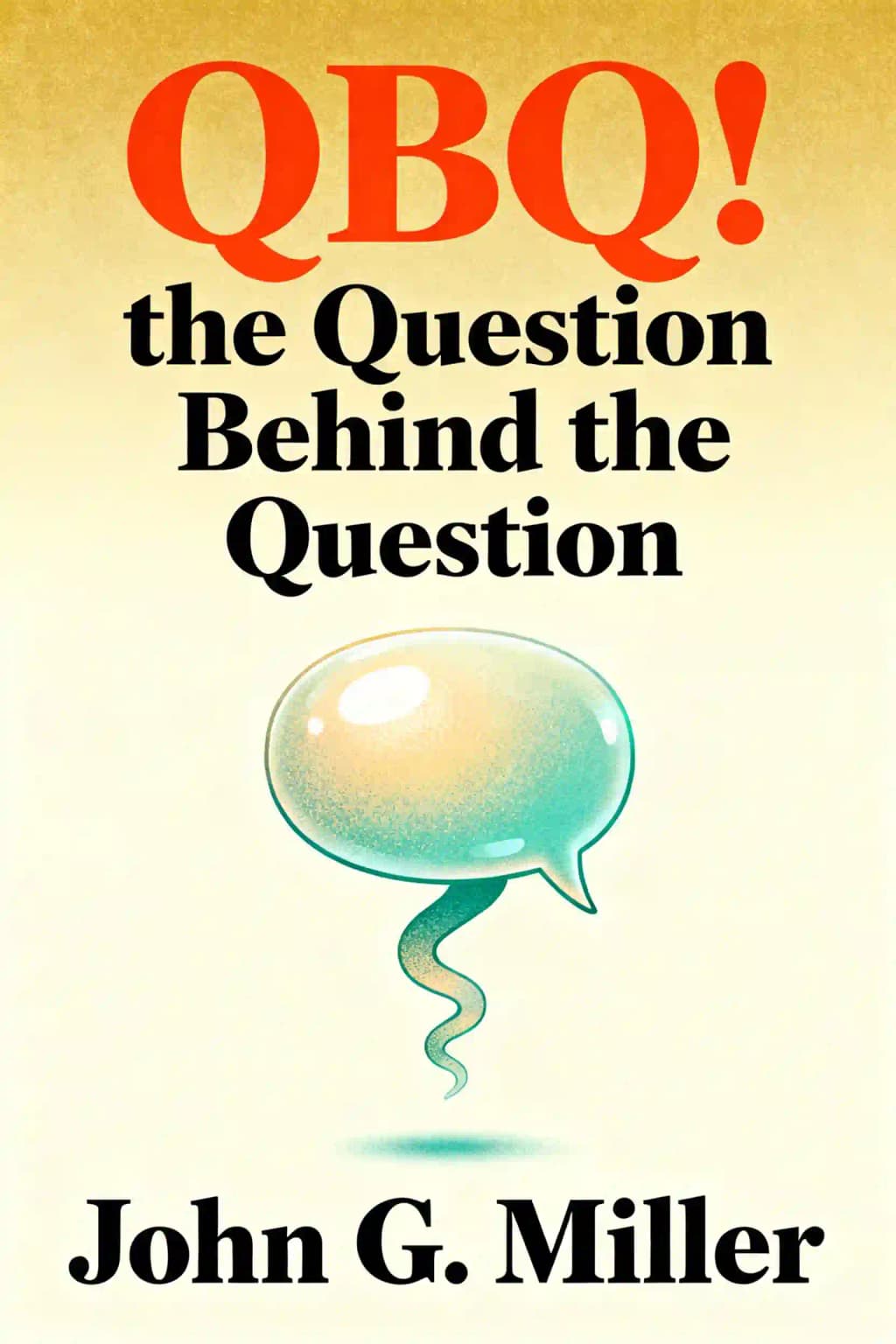
Have you ever noticed how a single question can completely change your perspective? Imagine standing at a crossroads in your career or personal life, feeling stuck and frustrated. What if the solution wasn't finding better answers, but asking better questions? This is the profound insight at the heart of John G. Miller's revolutionary approach to personal accountability. Since its publication, "QBQ! The Question Behind the Question" has become a cornerstone text in corporate training programs across America, with over a million copies sold worldwide. Endorsed by leadership giants like Stephen Covey and Ken Blanchard, the book has transformed countless organizations from blame-centered environments into accountability powerhouses. What makes this slim volume so impactful is its elegant simplicity - it offers a practical tool anyone can use immediately to break free from victim thinking and take ownership of their circumstances. As Oprah Winfrey once remarked about similar accountability principles, "When you know better, you do better" - and QBQ shows exactly how to do better, one question at a time.
第 2 章
When Personal Responsibility Disappeared
"Whatever happened to personal responsibility?" This provocative question appeared on a billboard I once saw, and it immediately resonated with me. Why? Because I've witnessed countless examples of people refusing to take responsibility in everyday situations.
There was the gas station attendant who, when asked about coffee, shrugged and said, "Not my department." The flight attendant who blamed "catering" for movie headset problems. The customer service representative who insisted, "That's not my job." These deflections reveal a troubling pattern in our society - a widespread lack of personal accountability.
We hear it constantly: "It's not my fault." "There's nothing I can do about it." "That's just how it is." These phrases have become the modern mantras of irresponsibility, and they're poisoning our workplaces, our relationships, and our ability to solve problems effectively.
This accountability crisis manifests in questions we ask daily: "When will that department do its job right?" "Who dropped the ball this time?" "Why don't they communicate better?" These questions might feel natural, even justified, but they reveal a fundamental misunderstanding of how problems get solved and how progress happens.
The truth is that nothing improves until people stop blaming others and start asking better questions - questions that focus on what they can do rather than what others should do. This insight isn't just philosophical; it's practical. Organizations where people take ownership outperform those where blame is the default response. Teams that focus on solutions rather than culprits accomplish more with less stress.
Personal accountability isn't about accepting blame for everything that goes wrong. It's about recognizing that regardless of circumstances, we always have choices about how we respond. It's about understanding that even when we can't control the situation, we can control our reaction to it. Most importantly, it's about asking questions that lead to action rather than accusation.
The good news is that personal accountability is a skill anyone can develop. It begins with recognizing the questions we typically ask when facing challenges and learning to ask better ones. This simple shift in thinking can transform not just our work lives but every aspect of our existence.
第 3 章
The Remarkable Power of Choosing Accountability
Let me share a powerful example of personal accountability in action. While dining at Rock Bottom Restaurant during a busy lunch rush, I encountered Jacob Miller, a server carrying a full tray of food. Despite his workload, Jacob noticed me and took my drink order - a Diet Coke. When he returned to inform me they only carried Diet Pepsi, I mentioned I'd prefer Diet Coke if possible.
What happened next astonished me. Instead of shrugging it off or suggesting an alternative, Jacob asked his manager to purchase a Diet Coke from a nearby store. Minutes later, I had exactly what I wanted.
Consider the contrast between Jacob's approach and what we typically encounter. Most people, when faced with challenges, ask "Incorrect Questions" like: "Why do I have to do everything around here?" "When are we getting more staff?" "Who's going to help me with this impossible customer?" These questions lead nowhere productive.
Jacob chose accountability instead. He asked himself better questions like: "What can I do to solve this problem?" "How can I provide exceptional service?" "What action can I take right now?" His choices made all the difference - not just for me as a customer, but for his own career trajectory. Unsurprisingly, he was soon promoted to management.
The ripple effects of personal accountability extend in all directions. When we practice it consistently:
• Customers receive better service
• Coworkers enjoy more supportive relationships
• Organizations become more efficient and innovative
• Most importantly, we ourselves experience greater fulfillment and success
Jacob's story illustrates a fundamental truth: accountability isn't something imposed from outside - it's a choice we make moment by moment. Even in situations where we feel constrained by circumstances, policies, or limited resources, we always have the freedom to choose our response.
This doesn't mean ignoring real constraints or pretending everything is within our control. Rather, it means focusing our energy on what we can influence instead of wasting it on what we cannot. It means recognizing that even small choices accumulate to create significant impact over time.
Personal accountability transforms not just outcomes but the experience itself. Jacob didn't just solve my problem; he did it with enthusiasm that made the interaction memorable. He turned what could have been a minor disappointment into a story worth sharing years later.
第 4 章
The Mental Thorns That Trip Us Up
After moving to Denver, my family and I discovered "goatheads" - vicious little thorns that puncture bicycle tires and embed themselves in shoes. These physical thorns have a powerful parallel in our mental lives - the thorny thoughts that puncture our potential and embed themselves in our thinking patterns.
Just as we must carefully navigate physical terrain to avoid goatheads, we must navigate our mental landscape with equal care. Choose the wrong thought, and we fall into blame, procrastination, and victim thinking. Choose the right thought, and we experience fulfillment, productivity, and accomplishment.
This is the fundamental truth of the QBQ method: we are always accountable for our choices, even when we tell ourselves otherwise. When we say "I have to work late" or "I can't make the meeting," we're denying our agency. The reality is that we're choosing to work late or choosing not to attend the meeting based on our priorities and values. We always have a choice - even deciding not to choose is itself a choice.
Our thoughts create patterns that become mental habits. If we habitually think in terms of blame ("Who messed this up?"), our default response to challenges becomes finding someone to fault rather than finding solutions. If we habitually procrastinate ("I'll deal with that later"), we train ourselves to avoid difficult tasks until they become crises.
These mental thorns are particularly dangerous because they often disguise themselves as reasonable responses. It seems reasonable to ask who made a mistake so it doesn't happen again. It seems reasonable to postpone a difficult conversation until we feel more prepared. But these seemingly reasonable responses often lead to unreasonable consequences - damaged relationships, missed opportunities, and persistent problems.
The good news is that we can learn to spot these mental thorns before they cause damage. By becoming aware of our typical thought patterns and the questions we ask when facing challenges, we can begin to make better choices. Instead of asking "Who dropped the ball?" we can ask "What can I do to help?" Instead of thinking "I'll handle that tomorrow," we can ask "What small step can I take right now?"
Making better choices doesn't mean ignoring reality or pretending everything is perfect. It means acknowledging challenges while focusing on constructive responses. It means recognizing that while we can't always control what happens to us, we can always control how we respond.
Want to avoid life's goatheads and make great things happen? Start by making better choices about the questions you ask yourself.
第 5 章
The QBQ Method: A Tool for Personal Accountability
The Question Behind the Question (QBQ) is a practical tool that brings personal accountability to life. I've observed that our first reactions to challenges are often negative, leading to what I call Incorrect Questions (IQs). These questions focus on blame, justify inaction, or position us as victims of circumstance.
The QBQ method helps us look behind these initial reactions to find better questions - questions that lead to solutions rather than excuses. It's important to understand that QBQs are primarily questions we ask ourselves, not others. They're internal tools for shifting our perspective and prompting constructive action.
Creating a QBQ follows three simple guidelines:
1. Begin with "What" or "How" (not "Why," "When," or "Who")
2. Contain an "I" (not "they," "we," or "you")
3. Focus on action
For example, "What can I do to solve this problem?" follows all three guidelines perfectly. It starts with "What," contains "I," and focuses on action ("do"). Compare this with an Incorrect Question like "Why don't they communicate better?" which begins with "Why," focuses on "they," and contains no action.
Despite its simplicity, the QBQ has many powerful facets that can transform our approach to challenges:
• It eliminates victim thinking by focusing on what we can control
• It prevents procrastination by emphasizing immediate action
• It stops blame by directing attention to our own contributions
• It builds ownership by personalizing responsibility
• It promotes learning by encouraging self-reflection
The beauty of the QBQ method is that it works in any context - professional or personal, with complex organizational issues or simple daily frustrations. Whether you're dealing with a difficult colleague, a challenging project, or a personal setback, asking better questions leads to better results.
Some people initially resist the QBQ because it seems to place all responsibility on the individual, even in situations where others have clearly made mistakes. But this misunderstands the purpose of the tool. The QBQ isn't about assigning blame - even to ourselves. It's about finding the most effective path forward regardless of how we got here.
When we ask "What can I do now?" we're not saying the problem is our fault. We're saying that regardless of fault, we choose to be part of the solution. This subtle but crucial distinction makes the QBQ empowering rather than burdensome.
The QBQ method doesn't deny the reality of difficult circumstances or the impact of others' actions. It simply acknowledges that focusing on factors beyond our control wastes energy we could direct toward effective action.
第 6 章
Breaking Free from Victim Thinking
Questions like "Why don't others work harder?" or "Why is this happening to me?" make us feel powerless and victimized. These "Why me?" questions lead straight to pity parties and victim thinking - a mindset that paralyzes action and perpetuates problems.
Even successful people can fall into this trap. I once heard a manager joke that only "about half" his people actually worked. While he thought he was being clever, he was actually embracing victim thinking - positioning himself as helpless to improve the situation rather than asking what he could do differently as a leader.
Victim thinking is particularly insidious because it often feels justified. When others make mistakes that impact us, when circumstances seem unfair, or when we face genuine obstacles, asking "Why is this happening to me?" feels natural. But these questions, however justified they might seem, only deepen our sense of helplessness and prevent us from taking constructive action.
Consider the former military man who lived by "No excuses!" for ten years, then found himself asking his manager questions like "Why don't I get more of your time?" and "Why isn't our pricing competitive?" He realized with dismay that he had become what he disliked most: the victim. When we play victim, we serve no one - not even ourselves.
Stress provides another powerful example of how victim thinking affects us. Many people blame external factors for their stress - management decisions, difficult colleagues, demanding customers, heavy traffic. But stress is ultimately a choice. Different people react differently to identical situations because they choose different responses. When we ask "Why is this happening to me?" we create a victim mindset that increases our stress rather than relieving it.
Change presents similar challenges. When Stacey and her father faced an engine failure in their small plane over Lake Michigan, her father didn't waste time asking "Why is this happening?" Instead, he calmly said, "I'm going to need to fly the plane differently." He understood that changing conditions require different strategies. After putting the plane into a controlled dive twice to restart the engine, they landed safely. Had he resisted change or asked "Why do we have to go through all this change?" the outcome might have been tragic.
Communication problems offer yet another example. In workshops, when asked about their organization's biggest problem, people often cite "communication," framing it as "Why don't they communicate better?" This perspective misses that effective communication isn't someone else's job and doesn't begin with being understood - it starts with understanding others.
The antidote to victim thinking is asking better questions: "How can I adapt to the changing world?" "What can I do to become a more effective listener?" "How can I manage my response to this situation?" These questions shift us from passive victims to active participants in creating solutions.
第 7 章
Defeating Procrastination Through Better Questions
Questions like "When will they take care of the problem?" or "When will someone improve this place?" lead directly to procrastination. These "When" questions imply we must wait for action rather than initiating it ourselves.
Though most people don't intentionally procrastinate, it's a sneaky problem that compounds over time. Procrastination wastes time, reduces productivity, causes missed deadlines, and increases stress. It transforms small, manageable issues into major crises.
I learned this lesson the hard way after leaving a large sheet of glass leaning against my basketball hoop. Despite repeated warnings to move it to a safe place, I kept thinking "I'll do it later" while busy with other tasks. When we returned home from dinner one evening, my nine-year-old son Michael ran into the glass, shattering it and falling onto hundreds of deadly shards. Miraculously, he wasn't injured, but the incident happened because of my procrastination - I knew what needed to be done but kept putting it off until it nearly became catastrophic.
"I'll do it later" thinking can be costly in countless ways. The report not finished, the difficult conversation avoided, the small maintenance task neglected - all can grow into serious problems when procrastination becomes our default response.
The QBQ approach teaches us to replace "When" questions with action-oriented alternatives. Instead of asking "When will we get more tools and better systems?" we ask "How can I achieve with the resources I already have?" True creativity isn't thinking outside the box - it's succeeding within the box, hitting targets and making a difference with what we already have.
Every organization has imperfect systems and finite resources, but dwelling on what we wish we had only causes procrastination. Ironically, succeeding with current tools often leads to receiving more tools, as Deb Weber of State Farm noted: "Every time I do the job with the tools I have, I tend to receive more tools." Focusing on what we lack wastes energy and kills innovation.
Similarly, when salespeople ask what's next after basic training, I answer "NOTHING!" Success comes from consistently practicing fundamentals - getting up early, contacting prospects, building relationships. The principles of service, integrity, and accountability aren't new - the old stuff is the good stuff. Organizations often chase quick fixes with multiple programs in rapid succession, but these rarely solve long-term problems.
Personal accountability isn't timely - it's timeless. It worked yesterday, works today, and will work tomorrow. Instead of asking "When are we going to hear something new?", we should ask "How can I apply what I'm hearing?" - even if we've heard it before.
Remember: The answers are in the questions. Ask better questions, and you'll find better answers.
第 8 章
Breaking the Circle of Blame
Questions like "Who made the mistake?" or "Who dropped the ball?" are really about finding scapegoats. Blame may be the most pervasive and counterproductive dynamic in organizations today.
The "Company Coat of Arms" - arms crossed with fingers pointing outward - accurately depicts what happens daily in most workplaces. Even in small companies, blame circulates endlessly in what I call the "Circle of Blame." Marketing blames sales for unrealistic promises, sales blames engineering for product issues, engineering blames management for impossible deadlines, and management blames marketing for poor messaging.
This epidemic prevents progress at every level, from small teams to large corporations. Instead of brainstorming solutions together, we "blame-storm" and accomplish nothing. Personal accountability breaks this cycle with questions like "What can I do today to solve the problem?" or "How can I help move the project forward?"
The saying "A poor sailor blames the wind" reflects a universal truth: accountable people look for solutions, not scapegoats. They blame no one - not even themselves. Rather than mentally tormenting themselves, they ask constructive questions like "What could I have done differently?" and "How can I learn from this experience?" These questions keep blame at bay while promoting personal growth.
Organizational silos exacerbate the blame problem. Like farm silos that stand separate from each other, organizational silos divide departments like accounting, sales, manufacturing, and marketing. People claim "That's not my job" while walls grow taller and stronger. Despite resources spent on team-building, groups still work at cross-purposes, draining organizational life like riders on a tandem bike facing opposite directions.
My father, Jimmy Miller, Cornell University's wrestling coach for over twenty-five years, taught me I had three people to beat: my opponent, myself, and the referee. He'd say, "Even if you lose in overtime by one point, even if some questionable calls are made, you cannot blame the person in black and white. If you want to win, you must be good enough to beat the ref!"
This means being a salesperson who admits "I was outsold!" instead of blaming products or prices. It means being a team member who never asks "When will others pull their weight?" Instead of focusing on barriers beyond our control, we should work to become so good we'll succeed regardless of bad calls.
On a delayed, overcrowded flight from Houston, tensions ran high as passengers dealt with seat assignment problems and an unexplained hour-long wait on the tarmac. When we finally took off, I met Bonita, a flight attendant wearing a Santa Claus cap who pranced down the aisle distributing free headphones with genuine enthusiasm and humor. What's remarkable is that none of the problems were Bonita's fault, yet her response was outstanding. Instead of asking blame-focused questions, she asked "What can I do right now to make a difference?" With one simple choice, Bonita changed the experience for everyone on that flight.
That's how personal accountability changes the world: one choice at a time.
第 9 章
Making Accountability Personal
After multiple failed attempts to fix static on my phone line, a third repairman arrived. Rather than blaming his colleagues, he simply said, "Mr. Miller, I can't explain it, but I sure can apologize for it and see what I can do to solve your problem!" This is true ownership - not requiring an equity stake or leadership position, but facing problems head-on without blame or excuses. Ownership is personal accountability in its purest form, a commitment of head, heart, and hands to fix problems and never again affix blame.
This brings us to the second QBQ guideline: all QBQs contain an "I." Two myths exist about accountability: that it's about holding others accountable, or that it's a team thing. While teams matter, they're built on individuals practicing personal accountability. Some say "There's no 'I' in team," but I disagree. Without individuals asking "What can I do?" everyone just asks "What can we do?" and nothing changes.
Questions with "I" focus on what we can control - our own thoughts and actions - making us more effective and happier. Who's the only person I can change? Myself. Yet how often do we think, "I wish they could hear this message!" A nonprofit director claimed, "I'm not trying to change my assistant," then added, "I just think she should set more long-term goals." Translation: "I want her to be what I want her to be."
Some managers believe changing people is their job, but managers can only coach and guide - change comes from within. When asked what one thing they'd change to enhance their organization, people list products, programs, policies, processes, procedures, pricing, and people. Nobody ever says, "Me! I would change me." The QBQ works because it's based on the truth that I can only change myself.
A Jostens manager shared how she struggled with a difficult employee who later transferred across the country. Years later, they worked together again, but this time successfully. She initially wondered when he had changed, then realized: he hadn't - she had! "How?" I asked. Her powerful response: "I stopped trying to change him."
Executives retreat to mountaintops, create mission statements and values, then distribute laminated cards to staff. Soon employees huddle near water coolers whispering, "I'll practice these values when they do!" We easily spot integrity gaps in others - managers who claim to help but publicly reprimand, executives who "empower" but demand approval, organizations declaring "people are our greatest asset" while cutting training budgets.
True integrity means being what I say I am by acting according to my words. Instead of asking "When will others walk their talk?" the QBQ prompts us to ask "How can I practice the principles I espouse?" Let's walk our own talk first.
第 10 章
Taking Action: The Heart of Accountability
The third guideline for creating QBQs is that they must focus on action. A manager demonstrated this perfectly when, instead of complaining about headquarters' problems, he booked a flight to solve the issue directly. QBQs incorporate action verbs like "do," "make," "achieve," and "build" combined with "What" or "How" and "I" to create questions like "What can I do right now?"
Personal accountability requires three steps: disciplining our thoughts, asking better questions, and taking action. Without action, nothing gets accomplished. Taking action may seem risky, but doing nothing is the greater risk. A financial leader once warned that inaction guarantees obsolescence in a world where others are constantly innovating.
Action brings learning and growth while inaction leads to stagnation. Action moves us toward solutions while inaction keeps us stuck in the past. Action requires courage and builds confidence, while inaction stems from fear and creates doubt. As my friend said, "It's better to be one who is told to wait than one who waits to be told."
When a customer with only a $100 bill needed to pay for a small purchase, new cashier Judy made a bold choice. Rather than following standard procedure that would delay everyone, she paid the $2.89 from her own purse and let him keep his $100 bill. This small act of service had unexpected consequences - the grateful customer turned out to be the son of a major contractor who subsequently decided to source all their supplies from Home Depot. Judy's willingness to take action rather than hide behind policy exemplifies personal accountability in service.
Leadership isn't about titles, position, tenure, or possessions - it's about how we think. Anyone can be a leader regardless of their role or level in an organization. From receptionists to engineers, parents to volunteers, leadership comes from practicing personal accountability and choosing to make positive contributions.
Jacob Miller's manager at Rock Bottom demonstrated true leadership when she immediately agreed to get a Diet Coke for a customer. She didn't question Jacob's request or remind him of her superior position. Instead, she embodied servant leadership - putting others' needs before her own status. She operated from the principle "I will serve you so you can succeed" rather than "You succeed and then I'll serve you." This exemplifies the QBQ approach to leadership, which requires both a humble spirit and a servant's heart.
Personal accountability doesn't mean doing other people's work for them. When managers close sales for their teams, project leaders carry the whole load, or parents clean their children's rooms, they teach nothing valuable. While leaders ask "How can I help?" and "What can I do to contribute?", they don't take over others' responsibilities. Setting good boundaries is essential - accountable people focus first on excelling in their own work.
第 11 章
Living the QBQ Way
There's a distinction between the "letter" and "spirit" of the QBQ. The letter consists of the guidelines: QBQs begin with "What" or "How," contain an "I," and focus on action. The spirit embodies personal accountability: no victim thinking, complaining, procrastinating or blaming. It's possible to construct questions that follow the letter but violate the spirit, like "What can I do to make you change?" or "How can I avoid responsibility?" For a question to be a true QBQ, it must follow both letter and spirit.
Most importantly, QBQs are primarily asked in our own minds to enable personal accountability, not directed at others. The goal isn't better questions for coworkers or family, but better questions for ourselves.
Wisdom is what we learn after we think we know it all. Personal accountability isn't a destination where we suddenly "arrive" and become forever accountable. Rather, it's a daily, moment-to-moment practice of avoiding Incorrect Questions and asking QBQs instead. None of us are finished products on this journey.
We attend too many seminars, take too many classes, and buy too many books - all wasted if we misunderstand what learning truly is. Learning isn't merely attending, listening, reading, or gaining knowledge. Real learning means translating knowing into doing - it's about change. If we haven't changed, we haven't learned.
While driving with my family, we spotted a man in a wheelchair desperately trying to gather newspapers scattered across a field in the Denver wind. We stopped to help, and when I asked why he was attempting this seemingly impossible task alone, he replied simply, "I couldn't just leave them. It was my mess." This powerful image of personal accountability perfectly illustrates the QBQ philosophy.
Like Jacob the server, Stacey's father the pilot, Bonita the flight attendant, and Judy from Home Depot, this man embodied the QBQ spirit without knowing it. Most of us need the QBQ to transform our organizations from places of finger-pointing and procrastination into collaborative environments where we bring out the best in each other.
Repetition is the motor of learning. To truly internalize the QBQ principles, we should revisit them again and again. No, we're not banishing "Why," "When," and "Who" questions entirely - just avoiding them when they lead to blame, procrastination, or victim thinking. The QBQ isn't about finding culprits but solving problems. It enhances teamwork by making individuals accountable. It's not about holding others accountable but holding ourselves accountable.
The QBQ extends beyond the workplace into all aspects of life. If more people practiced personal accountability, the world would be a far better place - and that transformation begins with each of us asking better questions, one moment at a time.