第 1 章
Finding Peace in the Present Moment: The Art of Mindful Living
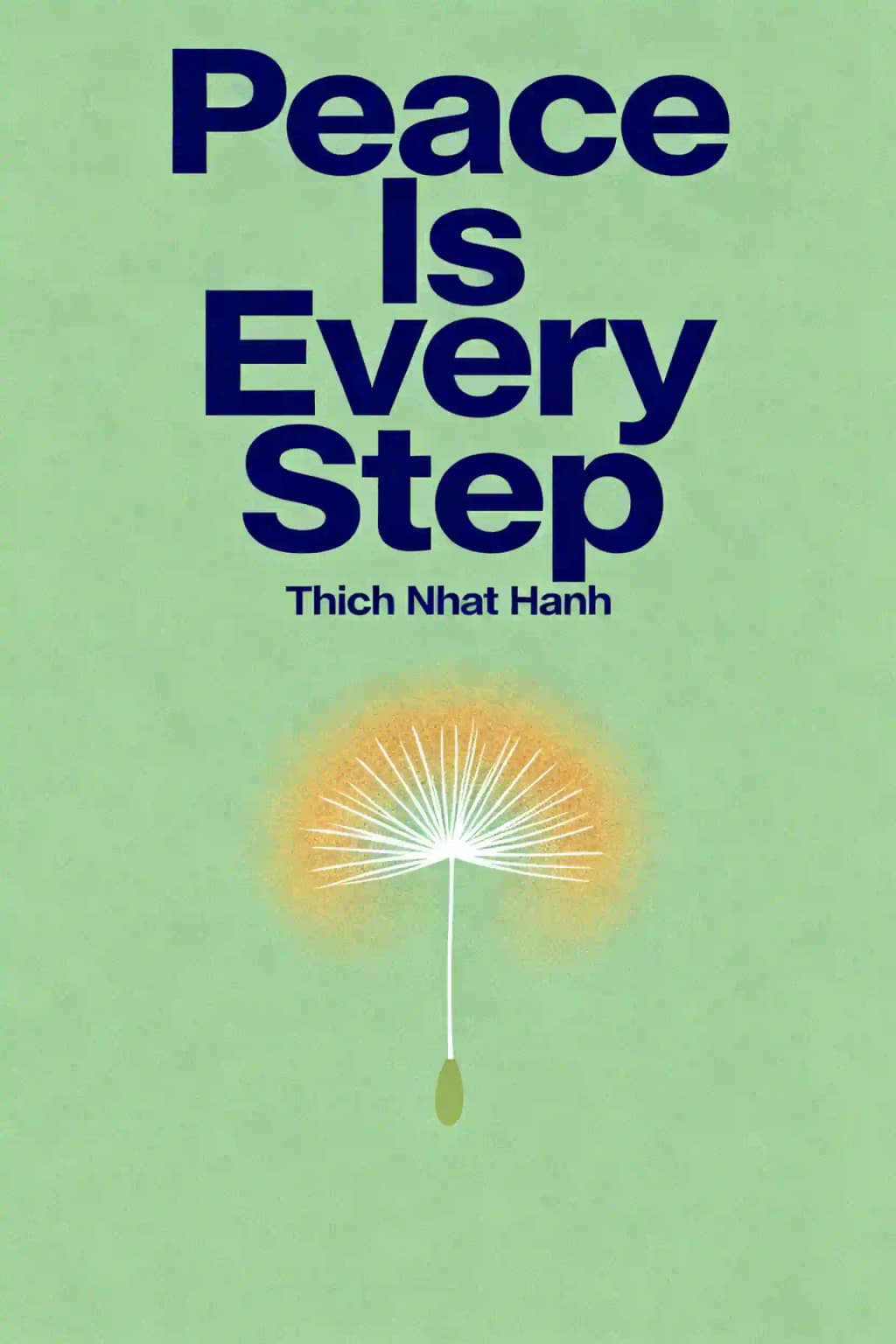
In a world where we constantly rush from one task to another, rarely pausing to truly experience our lives, Thich Nhat Hanh offers a radical yet simple solution: be fully present in each moment. This gentle Buddhist monk, exiled from his native Vietnam during the war, has become one of the most influential spiritual teachers of our time. His book "Peace Is Every Step" has touched millions worldwide, including celebrities like Oprah Winfrey and tech leaders like Marc Benioff, who credit its teachings with transforming their approach to life. The Dalai Lama himself endorsed this work as essential reading for anyone seeking inner peace. What makes this slim volume so powerful is not complex philosophy but practical wisdom: the revolutionary idea that peace isn't something to be found somewhere else or sometime later-it exists right here, right now, in the simple act of mindful breathing, in the deliberate enjoyment of a tangerine, in the conscious washing of dishes. As we enter an age of increasing distraction and anxiety, Nhat Hanh's teachings have only grown more relevant, offering a path to genuine happiness that requires no special conditions-only our full presence in this moment.
第 2 章
The Gift of Twenty-Four Brand-New Hours
Each morning when we wake, we receive an extraordinary gift: twenty-four brand-new hours to live. This perspective transforms our relationship with time from one of scarcity to one of abundance. Rather than rushing through our days preparing to live, we can actually live fully in each moment. Like receiving a fresh canvas each morning, these hours offer unlimited potential for creation, connection, and meaningful experience. Just as we wouldn't carelessly spend an inheritance, we can learn to treat each hour with reverence and intention.
The key to unwrapping this gift is mindfulness-the practice of bringing full awareness to whatever we're doing. When we're mindful, we aren't dwelling on the past or worrying about the future; we're completely present with what's happening now. This presence allows us to access the peace that already exists within and around us. Whether washing dishes, walking to work, or sharing a meal with friends, each activity becomes an opportunity for deep engagement and joy. The simple act of drinking tea can become a meditation when we fully experience the warmth of the cup, the rising steam, and the subtle flavors.
A genuine smile is both the expression and nourishment of this mindful awareness. Upon waking, we can place a reminder by our bed to smile, though eventually this practice becomes natural. Even a slight smile relaxes hundreds of facial muscles and shifts our mental state from worry to peace. Research has shown that the physical act of smiling triggers positive neurochemical changes in our brain, reducing stress hormones and increasing endorphins. This simple gift costs nothing yet brings immense happiness to ourselves and others, creating a ripple effect in our daily interactions.
Sometimes we may feel we've lost our smile, but nature holds it for us. Looking deeply at a flower-a dandelion growing beside the path-we can reclaim our smile. The flower smiles with the sun, the clouds, and the whole universe. When we smile, we become one with that universal smile. Nature serves as our constant teacher in mindfulness, demonstrating perfect presence in every leaf, raindrop, and sunset. Each natural element exists fully in its moment, neither rushing toward the future nor clinging to the past.
Conscious breathing forms the foundation of mindful living. By simply acknowledging "Breathing in, I know I am breathing in" and "Breathing out, I know I am breathing out," we create a bridge between body and mind. This gentle awareness produces peace in both, allowing us to recover ourselves completely and encounter life in the present moment-the only moment we truly have. The breath serves as an anchor, always available to bring us back to the present when our minds wander into worry or regret.
When practiced regularly, conscious breathing becomes a source of joy and nourishment. As Thich Nhat Hanh reminds us: "Breathe, you are alive!" This simple recognition transforms ordinary moments into opportunities for profound happiness. Each breath becomes a celebration of life itself, a reminder of our deep connection to all living things. Through conscious breathing, we can touch the miracle of being alive in each moment, transforming routine activities into sacred experiences. The practice helps us develop a deeper appreciation for life's simple pleasures and cultivates a sustainable sense of contentment that doesn't depend on external circumstances.
第 3 章
Transforming Ordinary Activities into Mindful Practices
Mindfulness isn't reserved for special occasions or formal meditation sessions-it can infuse every aspect of daily life, transforming mundane activities into sources of joy and peace.
When washing dishes, for instance, we can be fully present with the warm water, the soap bubbles, and the movements of our hands. If we rush through dishwashing to get to dessert, both activities become unpleasant. But when we wash dishes to wash dishes-fully present with the process rather than focused on finishing-the task itself becomes enjoyable. Though it takes longer, we're fully alive in each moment.
Walking becomes meditation when we walk purely for the joy of walking, not to arrive somewhere. Moving slowly and coordinating our breathing with our steps, we walk as if kissing the Earth with our feet. Every step creates a cool breeze for our body and mind, making flowers bloom beneath our feet-but only when we remain in the present moment.
Even modern technology can become a mindfulness bell. When the telephone rings, we can stay where we are, breathe consciously, smile, and recite: "Listen, listen. This wonderful sound brings me back to my true self." After three mindful breaths, we walk to the phone with sovereignty rather than anxiety. Before making calls, we can practice three mindful breaths. This simple meditation counteracts stress while bringing awareness into daily life.
Driving meditation begins with a verse: "Before starting the car, I know where I am going. The car and I are one." This helps us question whether our journey is necessary or if we're just trying to escape ourselves. Red lights become bells of mindfulness rather than enemies, reminding us to breathe and smile. Even traffic jams offer opportunities to practice compassion rather than frustration.
Eating mindfully transforms ordinary meals into profound experiences. We begin by turning off distractions and working together to prepare food. Before eating, we practice breathing to calm ourselves, then look at each person present with awareness. We contemplate our food, seeing in it the sun, earth, and universe. This awareness reveals our connection to everything and cultivates compassion for those without food.
The barrier between formal meditation and daily life must be removed. Mindfulness isn't something far away-it can penetrate each minute of our day through simple practices like breathing between phone calls, smiling while cutting vegetables, or relaxing after hard work.
第 4 章
The Art of Handling Difficult Emotions
Our feelings direct all thoughts and actions. Inside flows a river where each drop is a different feeling-pleasant, unpleasant, and neutral. Rather than suppressing or being overwhelmed by difficult emotions, we can practice mindful observation.
When strong feelings arise, we sit on the riverbank of our consciousness, identifying each feeling as it surfaces, flows by, and disappears. Naming feelings helps identify them clearly: "Hello, Anger. I know you're there." Our breathing connects us with our feelings, allowing acceptance without judgment.
The first step with any difficult emotion is recognition through mindfulness. With fear, for example, we bring out mindfulness to recognize it. Both fear and mindfulness spring from us-not fighting but one caring for the other. We become one with the feeling rather than rejecting it: "Hello, Fear. How are you today?" We welcome it as we might welcome a guest, with mindfulness serving as chaperone.
We then calm the feeling through mindful presence, like a mother holding her crying baby. Once calmed, we can release the feeling and look deeply into its source, even after it's gone. Like a therapist working with a patient, we examine the beliefs causing suffering. Understanding the causes and nature of feelings begins their transformation.
Anger requires special attention because it burns like a blazing flame, destroying self-control and causing regret. When anger arises, we acknowledge: "Breathing in, I know anger is in me. Breathing out, I know I am my anger." Following our breath while observing anger prevents it from monopolizing consciousness.
When angry, we typically focus on the person who angered us, fueling our rage. But the root problem is the anger itself. Like firefighters, we must first extinguish the blaze before investigating its cause. We put all energy into caring for our anger, avoiding actions we might regret.
Walking meditation outdoors helps tremendously with anger. We practice breathing with awareness while giving full attention to our feet contacting earth. After enjoying our breathing, walking, and surroundings, the anger subsides, and we become strong enough to observe and understand it.
Through mindful observation, we discover anger's primary causes-misunderstanding, clumsiness, injustice, resentment, or conditioning-within ourselves and others. Observation brings understanding, which leads to liberation, love, and compassion. We don't discard our anger but transform it, like cooking raw potatoes. The fire of mindfulness transforms anger into understanding and compassion.
第 5 章
Nurturing Relationships Through Mindfulness
When living with others, we must help each other transform the internal knots we create together. Happiness is no longer individual-if one person isn't happy, neither will be the other. Through understanding and loving speech, we can address difficulties as soon as they arise, before they become too numerous or heavy.
To live peacefully with someone, we must understand their true nature-both their beautiful qualities and their difficulties. Like natural gas which can be dangerous yet useful when we understand it, people too can be appreciated when we know their complete reality. We don't expect someone to always be a flower; we must understand their garbage as well.
Real love requires understanding the needs, aspirations, and suffering of the person we love. Without this understanding, our love becomes mere possession. We must have the courage to ask, "Do I understand you enough? Am I making you suffer?" This openness creates the possibility for genuine connection.
Compassion means "to suffer with." We must spend enough time in deep contact with another's suffering until compassion penetrates our being and transforms into action. True compassion isn't just feeling-it effectively removes suffering. We practice until our love isn't contingent on the other person being lovable.
Even physical contact can become mindful practice. Hugging becomes meditation when we breathe consciously during the embrace. By breathing in and out three times while holding someone, our happiness multiplies tenfold. This conscious breathing returns us to the present moment, making both people fully real and present. Without mindfulness, we might be physically present but mentally elsewhere, like ghosts.
Building a community of friends is a better investment than money in the bank. During difficult times, friends provide support, helping us connect with healing elements within and around us. To create a good community, we must first transform ourselves into a good element, then help others do the same.
Good communities center on creating joyful, happy daily life. Unlike today's small nuclear families where problems affect everyone intensely, mindful communities can provide the extended family network that once offered children refuge during parental conflicts. We can transform our homes into mindful communities through shared breathing, sitting, and tea drinking practices.
第 6 章
Breaking the Cycle of Transmitted Suffering
Many of us carry seeds of suffering planted by our parents. Yet these parents likely received similar seeds from their own parents, creating a cycle of transmitted suffering. Through mindfulness practice, we can break this cycle.
A fourteen-year-old boy at Plum Village recognized his father's anger arising in himself when his sister fell, but through mindful breathing, he transformed it and realized his father was also a victim of transmitted anger. When we look at our bodies mindfully, we see they are gifts from our parents and ancestors. The giver, the gift, and the receiver are one-all our ancestors and future generations are present in us.
Consciousness exists as seeds and their manifestations. Every time a seed manifests, it produces new seeds of the same kind. If we're angry for five minutes, we plant new anger seeds in our unconscious. Some seeds were planted during our lifetime, others transmitted by ancestors and society.
Mindful living strengthens healthy seeds that function like antibodies, transforming negative seeds. We need a reserve of refreshing seeds for difficult moments. When we can't sleep or feel distress, we can invite positive images-like beautiful trees or a delightful child-into our consciousness.
We often ask "What's wrong?" inviting painful seeds of sorrow to manifest. Instead, we should learn to ask "What's not wrong?" to stay in touch with wholesome elements within and around us. Life offers countless wonders-the blue sky, sunshine, our breathing-that we can enjoy in each moment. By practicing awareness of these precious elements of happiness, we plant seeds of peace and joy that grow strong within us.
When plants don't grow well, we don't blame them-we look into the reasons and adjust their care. Yet with people, we blame them when problems arise. This never helps. No blame, no reasoning, no argument-just understanding. When we truly understand someone and show that understanding, we can love them, and the situation will change.
Understanding is the foundation of true love. When we understand deeply, we naturally act in ways that relieve suffering. With understanding, the one we love will flower like a plant receiving proper care and nourishment.
第 7 章
The Profound Concept of Interbeing
A cloud floats in every sheet of paper. Without clouds, rain, trees, and countless other elements, paper cannot exist. This interconnection is "interbeing"-nothing exists by itself alone. Looking deeply at paper reveals sunshine, the logger who cut the tree, the wheat that became his bread, his parents, and even ourselves in our perception. Everything co-exists with this sheet of paper. If we return any element to its source-sunshine to the sun, logger to his mother-the paper cannot exist.
Our concepts of purity and defilement are merely surface perceptions. Looking deeply, a beautiful rose becomes garbage in days, and garbage transforms into vegetables and roses in months. They inter-are, equally precious and dependent on each other. Similarly, a young prostitute in Manila carries the feeling of being defiled, but looking deeply, we see her situation exists because of how society is structured. The "good family" and the prostitute inter-are.
To truly understand something, we must enter deeply into it and become one with it. "Comprehend" comes from Latin roots meaning "to grasp with"-we must pick something up and be one with it. This is non-duality. When translating applications for Vietnamese orphans, Thich Nhat Hanh would look at a child's picture for thirty seconds until they became one, and together they would do the translation.
Just as our heart is essential for life, the sun is our second heart outside our body. Without its warmth, all life would cease. Plants absorb the sun's energy to produce food, sustaining all animals and humans. Our body extends beyond our skin-it includes the atmosphere around Earth, without which we would instantly perish. Nothing in the universe, from a pebble to distant galaxies, is separate from us.
We must look deeply to truly see. A swimmer enjoying a river should also be able to be the river. Forests are our external lungs as the sun is our external heart, yet we've destroyed millions of square miles of forest and damaged the ozone layer. By transcending our small selves to become our true, larger selves-the river, forest, sun-we gain understanding and hope.
Contemplating a small autumn leaf reveals it's also a mother to the tree, transforming rough sap into nourishment with help from sun and gas. Though our umbilical cord was cut at birth, giving us the illusion of independence, we continue relying on many mothers. The Earth is our mother, with countless stems connecting us to everything in the cosmos-clouds, rivers, forests, farmers. Without you, I cannot exist.
第 8 章
From Personal Peace to Global Transformation
If Earth were our body, we would feel its many areas of suffering-war, oppression, famine, pollution, dying rivers, and nuclear threats. Many compassionate people engage in social and environmental work but become discouraged without sustainable inner strength. True strength comes not from power or weapons but from deep inner peace.
During the Vietnam War, monks had to decide whether to stay in meditation halls or help bombing victims. They chose both-engaged Buddhism. Mindfulness must lead to action; seeing without acting has no purpose. We must be aware of real problems and know what to do and not do to help. By maintaining awareness of our breathing and practicing smiling even in difficult situations, we can benefit many beings.
Without the vision of non-duality, America and Vietnam suffered immense destruction that continues to hurt both peoples. At a retreat with Vietnam veterans, many still carried deep wounds-one lost 417 men in a single battle, another couldn't be alone with children after killing some in revenge. Through mindful breathing, walking, and eating together, they slowly opened up after years of isolation.
In sports and wars, we take sides, identifying with one team and experiencing their victories and defeats as our own. Peace movements often arise from this same impulse to protect the threatened side. A Vietnamese saying notes, "In order to fight each other, the chicks born from the same mother hen put colors on their faces." We can only shoot others when they become strangers. True reconciliation comes when we see with compassionate eyes and understand the interbeing of all beings.
When we've hurt others who now consider us enemies, we must first apologize sincerely: "I am sorry, I hurt you out of my ignorance and lack of mindfulness. I will try to change myself." Then we must transform ourselves, bringing out our best qualities. When we become fresh and pleasant, the other person will notice. We may not need words-just seeing our transformation, they may accept and forgive us.
Our daily lives-how we drink, eat, consume-directly connect to the world's political situation. If we make it possible for governments to change policies, they will. Meditation helps us look deeply into how we can transform both ourselves and our situation, which are inseparable. As we live more responsibly, we must encourage political leaders to move in the same direction, stopping pollution of both environment and consciousness.
第 9 章
Finding Peace in Every Step
We need a "policy" for dealing with our suffering-not to condone it but to transform it into something beneficial. The twentieth century brought immense suffering: world wars, concentration camps, killing fields, and refugees with nowhere to go. We must use this suffering as compost to create flowers for the twenty-first century.
In Plum Village, Thich Nhat Hanh receives hundreds of letters weekly from refugee camps across Southeast Asia. One letter told of a twelve-year-old girl who drowned herself after being raped by a Thai pirate. Initially, he felt angry at the pirate, but through meditation, realized that if he had been born in the same conditions, he might have become a pirate too. If we don't address the root causes, many babies born today will become pirates in twenty-five years.
For thirty years, practitioners of "engaged Buddhism" have brought mindfulness to places of worst suffering. Confronting intense suffering actually brings a kind of relief and joy, as you become an instrument of compassion. Through meditation, we can be aware of global suffering without leaving our cushion. From this awareness, compassion and understanding arise naturally, enabling social action wherever we are.
When we sit down to dinner, we can nourish awareness of the 40,000 children who die daily from hunger and malnutrition. Looking deeply at our plate, we see Mother Earth, farm workers, and the tragedy of hunger. Many fine foods exported from developing countries are never seen by their own hungry children. This awareness alone can help overcome our own psychological pains.
The peace movement often contains anger, frustration and misunderstanding. We need to learn to write letters to Congress and the President that they'll actually want to read, not throw away. Without being peace ourselves, we cannot contribute to the peace movement. If we cannot smile, we cannot help others smile.
Peace requires respect for all life-human beings, animals, vegetables, and minerals. We need not just deep ecology but universal ecology, because pollution exists in our consciousness too. Television sows seeds of violence and anxiety in our children, polluting their minds just as chemicals pollute our environment. Protecting the ecology of the mind is essential to prevent violence from spilling into other areas of life.
Peace education can be as simple as sitting with a child on the grass, contemplating nature while breathing and smiling together. Peace is available in every moment, every breath, every step. The secret to happiness is happiness itself; we don't need to travel anywhere to enjoy the present moment.