Paula Fredriksen's groundbreaking work reframes Paul as a Jewish thinker navigating first-century diversity. Why did scholars praise this "gem to Pauline studies" for challenging centuries of anti-Jewish interpretations? Discover how Paul's radical mission wasn't converting pagans to Judaism - but something far more revolutionary.
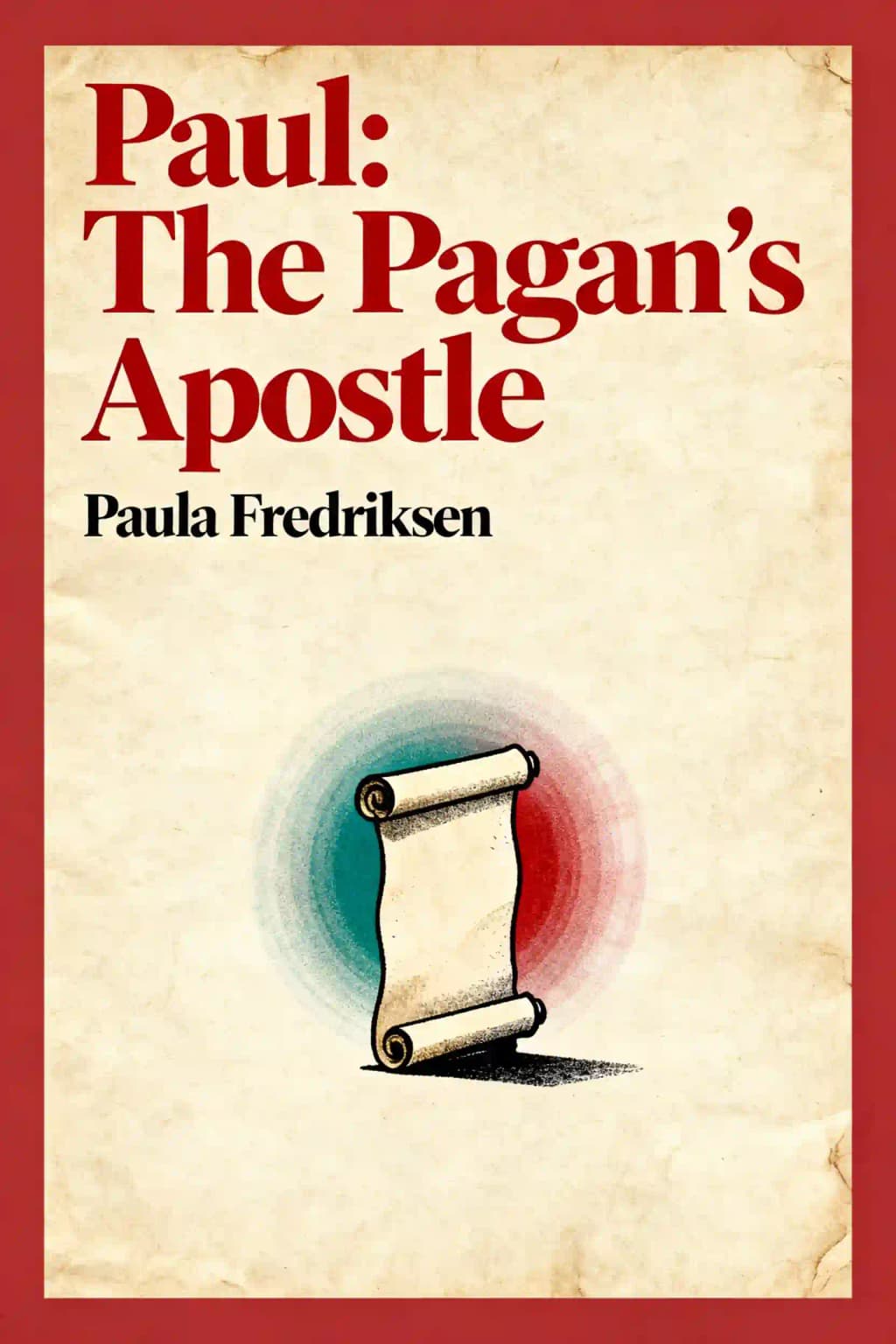
Paula Fredriksen, acclaimed historian of early Christianity and author of Paul: The Pagans’ Apostle, brings decades of expertise in ancient Judaism and Christian origins to this groundbreaking work.
The Aurelio Professor of Scripture emerita at Boston University and Distinguished Visiting Professor at Jerusalem’s Hebrew University, Fredriksen explores Paul’s mission to non-Jews within the diverse religious landscape of the Roman Empire, arguing for his enduring Jewish identity amid cross-cultural theological innovation.
A fellow of the American Academy of Arts and Sciences, she is also known for From Jesus to Christ—the basis for PBS’s Frontline documentary The First Christians—and Jesus of Nazareth, King of the Jews, winner of the National Jewish Book Award. Her research reshapes understandings of ancient Mediterranean religions while bridging academic and public audiences through media collaborations with BBC and U.S. News & World Report.
Paul: The Pagans’ Apostle earned the 2018 PROSE Award for theology, cementing Fredriksen’s reputation for blending rigorous scholarship with accessible narratives.
Paul: The Pagans' Apostle examines the apostle Paul’s mission to integrate Gentiles into early Christianity while maintaining their ethnic identity as non-Jews. Fredriksen argues that Paul, rooted in Jewish apocalyptic thought, envisioned Gentiles abandoning pagan practices to worship Israel’s God through Christ—without requiring full conversion to Judaism (e.g., circumcision). The book situates Paul’s theology within Roman-era Jewish diversity and Gentile social dynamics.
This book is ideal for scholars and students of early Christianity, Jewish-Christian relations, or New Testament studies. It also appeals to readers interested in historical analyses of Paul’s letters, Gentile inclusion in apocalyptic Judaism, or critiques of traditional Christian interpretations of Paul’s teachings.
Fredriksen contends that Paul remained a devout Jew, viewing Gentile inclusion as fulfillment of Jewish eschatological hopes—not a rejection of Judaism. She emphasizes that Paul required Gentiles to abandon pagan idolatry but not adopt Jewish law, framing baptism as marking their inclusion in God’s covenant. The book challenges stereotypes of Paul as a “founder of Christianity”.
Fredriksen distinguishes “Gentiles” (non-Jewish ethnic groups) from “pagans” (those practicing idolatrous religions). Paul’s mission, she argues, aimed to transform pagans into Gentiles aligned with Israel’s God—abandoning polytheism but retaining ethnic distinction from Jews. This nuanced terminology clarifies Paul’s inclusive yet boundary-aware theology.
The book draws on Paul’s letters, Second Temple Jewish texts (e.g., Dead Sea Scrolls), and Roman-era inscriptions. Fredriksen contextualizes Pauline theology within Jewish apocalyptic expectations and Greco-Roman cultic practices, contrasting it with later Christian interpretations.
Unlike traditions framing Paul as rejecting Judaism, Fredriksen portrays him as a Jewish thinker expecting imminent divine intervention. She rejects the notion that Paul invented Christian theology, instead presenting his teachings as deeply rooted in Jewish messianism and eschatology.
Fredriksen critiques modern projections of Christian theology onto Paul’s Jewish worldview. She challenges assumptions that Paul opposed Torah observance for Jews or viewed Judaism as obsolete, arguing these misreadings stem from later church conflicts, not Paul’s writings.
While Sanders highlighted Judaism’s covenantal grace, Fredriksen focuses on Paul’s apocalyptic urgency and Gentile-specific ethics. Both scholars reject caricatures of legalistic Judaism but differ in emphasizing Paul’s eschatological timetable vs. Sanders’ “participationist eschatology”.
The book explores Romans 11:25-26 (Gentiles’ role in Israel’s redemption) and Galatians 3:28 (unity in Christ). Fredriksen interprets these as apocalyptic declarations, not theological universalism, stressing Paul’s expectation of imminent cosmic transformation.
Some scholars argue Fredriksen overemphasizes Jewish apocalypticism, underplaying Paul’s ethical teachings. Others note the dense academic style may challenge general readers. However, the book is widely praised for recontextualizing Paul within Second Temple Judaism.
By framing Paul as a Jew addressing Gentiles, Fredriksen undermines supersessionist theology. Her work supports interfaith dialogue by reclaiming Paul’s Jewish identity and challenging historical anti-Judaism in Christian interpretations.
Fredriksen’s focus on Roman-era social dynamics and Gentile-specific ethics offers fresh insights. Unlike doctrinal analyses, she prioritizes historical context, revealing how Paul’s Jewish worldview shaped his mission to pagan communities.
通过作者的声音感受这本书
将知识转化为引人入胜、富含实例的见解
快速捕捉核心观点,高效学习
以有趣互动的方式享受这本书
Paul lived forward in time, racing against what he perceived as history's final moments.
Paul never wavered.
Jesus himself became central to the message-no longer just the messenger but the message itself.
Paul's vision of universal redemption.
Paul couldn't have imagined that his urgent messages...would become foundational texts for a world religion.
将《Paul》的核心观点拆解为易于理解的要点,了解创新团队如何创造、协作和成长。
将《Paul》提炼为快速记忆要点,突出坦诚、团队合作和创造力的关键原则。

通过生动的故事体验《Paul》,将创新经验转化为令人难忘且可应用的精彩时刻。
随心提问,选择声音,共同创造真正与你产生共鸣的见解。

"Instead of endless scrolling, I just hit play on BeFreed. It saves me so much time."
"I never knew where to start with nonfiction—BeFreed’s book lists turned into podcasts gave me a clear path."
"Perfect balance between learning and entertainment. Finished ‘Thinking, Fast and Slow’ on my commute this week."
"Crazy how much I learned while walking the dog. BeFreed = small habits → big gains."
"Reading used to feel like a chore. Now it’s just part of my lifestyle."
"Feels effortless compared to reading. I’ve finished 6 books this month already."
"BeFreed turned my guilty doomscrolling into something that feels productive and inspiring."
"BeFreed turned my commute into learning time. 20-min podcasts are perfect for finishing books I never had time for."
"BeFreed replaced my podcast queue. Imagine Spotify for books — that’s it. 🙌"
"It is great for me to learn something from the book without reading it."
"The themed book list podcasts help me connect ideas across authors—like a guided audio journey."
"Makes me feel smarter every time before going to work"

免费获取《Paul》摘要的 PDF 或 EPUB 版本。可打印或随时离线阅读。
Imagine everything you thought you knew about the Apostle Paul was fundamentally wrong. Far from being Christianity's architect who broke from Judaism, the historical Paul emerges as a passionate Jewish apocalypticist convinced he was living at history's final moment. Paula Fredriksen's groundbreaking work reveals Paul not as the founder of a new religion but as a devoted Jew whose mission to gentiles was thoroughly grounded in Jewish apocalyptic expectations. This Paul would be shocked to discover his urgent letters to specific communities became foundational texts for a world religion that would eventually separate from its Jewish roots. The tragic irony? The man who lived and died committed to Israel's redemption became the primary theological resource for those seeking to divorce Christianity from Judaism. To understand the authentic Paul, we must see him as he saw himself: not Christianity's founder, but God's prophetic messenger racing against time's end.