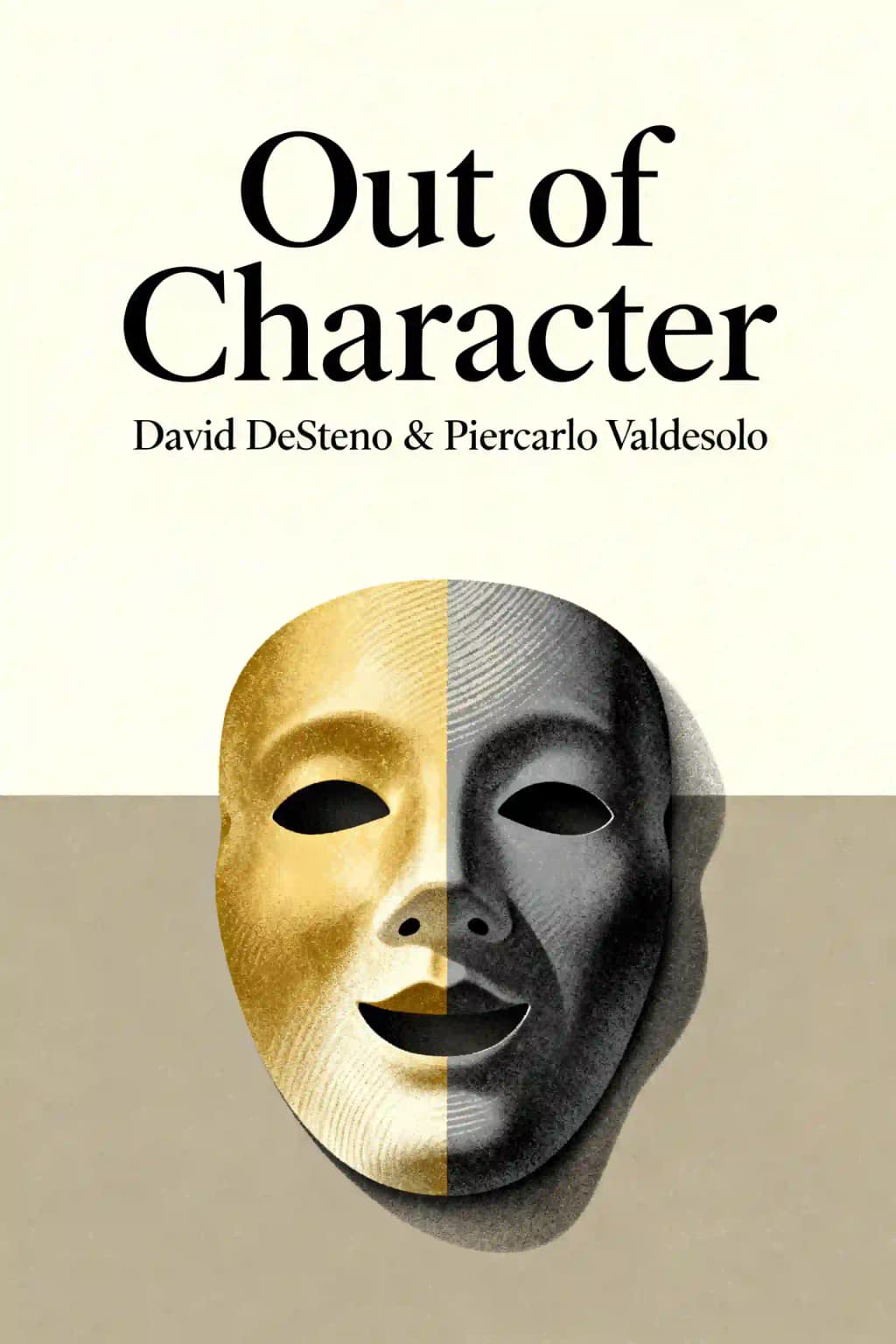
In "Out of Character," DeSteno and Valdesolo shatter our belief in fixed personality traits. Based on experiments with 2,000+ participants, they reveal how saints become sinners and vice versa depending on context. Are you really who you think you are?
David DeSteno and Piercarlo Valdesolo, psychologists and co-authors of Out of Character: Surprising Truths About the Liar, Cheat, Sinner (and Saint) Lurking in All of Us, combine rigorous academic research with accessible storytelling to challenge conventional views of human morality.
DeSteno, a professor at Northeastern University and director of its Social Emotions Lab, serves as editor of the American Psychological Association’s journal Emotion. Valdesolo, a psychology professor at Claremont McKenna College, explores the intersection of emotion and social behavior.
Their collaborative work, featured in The New York Times, Wall Street Journal, and NPR, dismantles the myth of static character, arguing instead for a dynamic interplay of psychological forces shaping decisions. DeSteno’s follow-up bestseller, Emotional Success, further examines how prosocial emotions drive achievement.
Out of Character has been praised by thought leaders like Daniel Gilbert and Paul Bloom for its revelatory insights into hypocrisy, altruism, and moral conflict, cementing its status as a seminal text in behavioral psychology.
Out of Character explores how unconscious processes, emotions, and social contexts shape human behavior, challenging the notion of fixed character. David DeSteno and Piercarlo Valdesolo argue that actions often stem from internal conflicts between short-term desires (the "grasshopper") and long-term goals (the "ant"), revealing why people act against their own values.
This book is ideal for psychology enthusiasts, behavioral science students, or anyone seeking to understand why people (including themselves) behave inconsistently. It offers insights for leaders, educators, and those navigating moral dilemmas or interpersonal conflicts.
Yes—the book combines rigorous research with relatable examples, making complex psychological concepts accessible. Its exploration of hypocrisy, gratitude, and risk-taking provides practical frameworks for self-awareness and decision-making.
The metaphor illustrates the mental tug-of-war between immediate rewards (grasshopper) and future planning (ant). For example, choosing to splurge now versus saving for retirement. The authors show how context and emotions tip this balance, often unconsciously.
DeSteno reveals hypocrisy as a byproduct of competing mental systems. Experiments show people often condemn others’ actions while excusing their own, driven by emotional biases rather than rational principles.
Emotions like gratitude or pride act as "moral barometers," subtly guiding decisions. For instance, gratitude fosters cooperation, while unchecked pride can lead to self-sabotage. These feelings operate below conscious awareness, shaping behavior unpredictably.
The book demonstrates that environment overrides intentions—e.g., stress prompts dishonesty, while group settings amplify conformity. Even minor cues (like scents or colors) can unconsciously trigger generosity or prejudice.
Some argue the book oversimplifies neurobiology or underplays cultural influences on behavior. Others note that its focus on lab experiments may not fully capture real-world complexity.
While Kahneman’s work focuses on cognitive biases, Out of Character emphasizes emotional and social drivers of behavior. Both highlight unconscious influences, but DeSteno’s framework ties more directly to moral decision-making.
Yes—by recognizing how context and emotions cloud judgment, readers can create environments that align short-term impulses with long-term goals. Strategies include pre-commitment devices and fostering gratitude.
The book explains why ethical lapses occur under pressure and how leaders can design systems that reduce hypocrisy. For example, transparent processes minimize unconscious biases in hiring or promotions.
通过作者的声音感受这本书
将知识转化为引人入胜、富含实例的见解
快速捕捉核心观点,高效学习
以有趣互动的方式享受这本书
Acting "out of character" isn't rare-it's commonplace.
Hypocrisy isn't merely violating your own moral beliefs-it's shifting those beliefs.
Our ethics and morality aren't fixed-they're surprisingly elastic and changeable.
In every one of us lurks the potential to lie, cheat, and sin.
The potential for hypocrisy lurks in all of us.
将《Out of Character》的核心观点拆解为易于理解的要点,了解创新团队如何创造、协作和成长。
将《Out of Character》提炼为快速记忆要点,突出坦诚、团队合作和创造力的关键原则。

通过生动的故事体验《Out of Character》,将创新经验转化为令人难忘且可应用的精彩时刻。
随心提问,选择声音,共同创造真正与你产生共鸣的见解。

"Instead of endless scrolling, I just hit play on BeFreed. It saves me so much time."
"I never knew where to start with nonfiction—BeFreed’s book lists turned into podcasts gave me a clear path."
"Perfect balance between learning and entertainment. Finished ‘Thinking, Fast and Slow’ on my commute this week."
"Crazy how much I learned while walking the dog. BeFreed = small habits → big gains."
"Reading used to feel like a chore. Now it’s just part of my lifestyle."
"Feels effortless compared to reading. I’ve finished 6 books this month already."
"BeFreed turned my guilty doomscrolling into something that feels productive and inspiring."
"BeFreed turned my commute into learning time. 20-min podcasts are perfect for finishing books I never had time for."
"BeFreed replaced my podcast queue. Imagine Spotify for books — that’s it. 🙌"
"It is great for me to learn something from the book without reading it."
"The themed book list podcasts help me connect ideas across authors—like a guided audio journey."
"Makes me feel smarter every time before going to work"

免费获取《Out of Character》摘要的 PDF 或 EPUB 版本。可打印或随时离线阅读。
Picture a respected governor, devoted family man, and Eagle Scout who simply vanishes from his post-not for a crisis, but to pursue an affair in Argentina. Mark Sanford's stunning fall from grace forces an uncomfortable question: Was his character always flawed, just hidden? Or is something more unsettling at play? We cling to the comforting belief that character is stable-good people do good things, bad people do bad things. Yet history tells a different story. During World War I's Christmas truce, British and German soldiers exchanged gifts and played soccer, only to resume killing each other days later. The same individuals capable of tender compassion became instruments of violence almost overnight. This isn't about a few broken people-it's about all of us. The potential for both virtue and vice doesn't live in separate people; it lives within each of us, waiting for the right conditions to emerge. We've been telling ourselves the wrong story about character. The classic image-an angel and devil on our shoulders-suggests we simply choose between good and evil. But that's not how our minds actually work. Think instead of Aesop's ant and grasshopper. The grasshopper represents our impulse for immediate pleasure: the dessert when we're trying to lose weight, the affair when we're committed, the shortcut when integrity demands the long road. The ant embodies our capacity for long-term thinking-the voice reminding us that today's pleasure becomes tomorrow's regret. Neither is inherently good or evil. Both served our ancestors well: immediate rewards kept them fed and reproducing, while long-term planning built communities and relationships. The tension between them isn't a bug in our psychology-it's a feature. But here's what makes character so slippery: this internal scale tips constantly based on factors we barely notice. A messy room, a pleasant scent, even how much sleep we got-all these shift the balance without our awareness. When we act "out of character," we haven't revealed our true nature. We've simply tipped the scale.