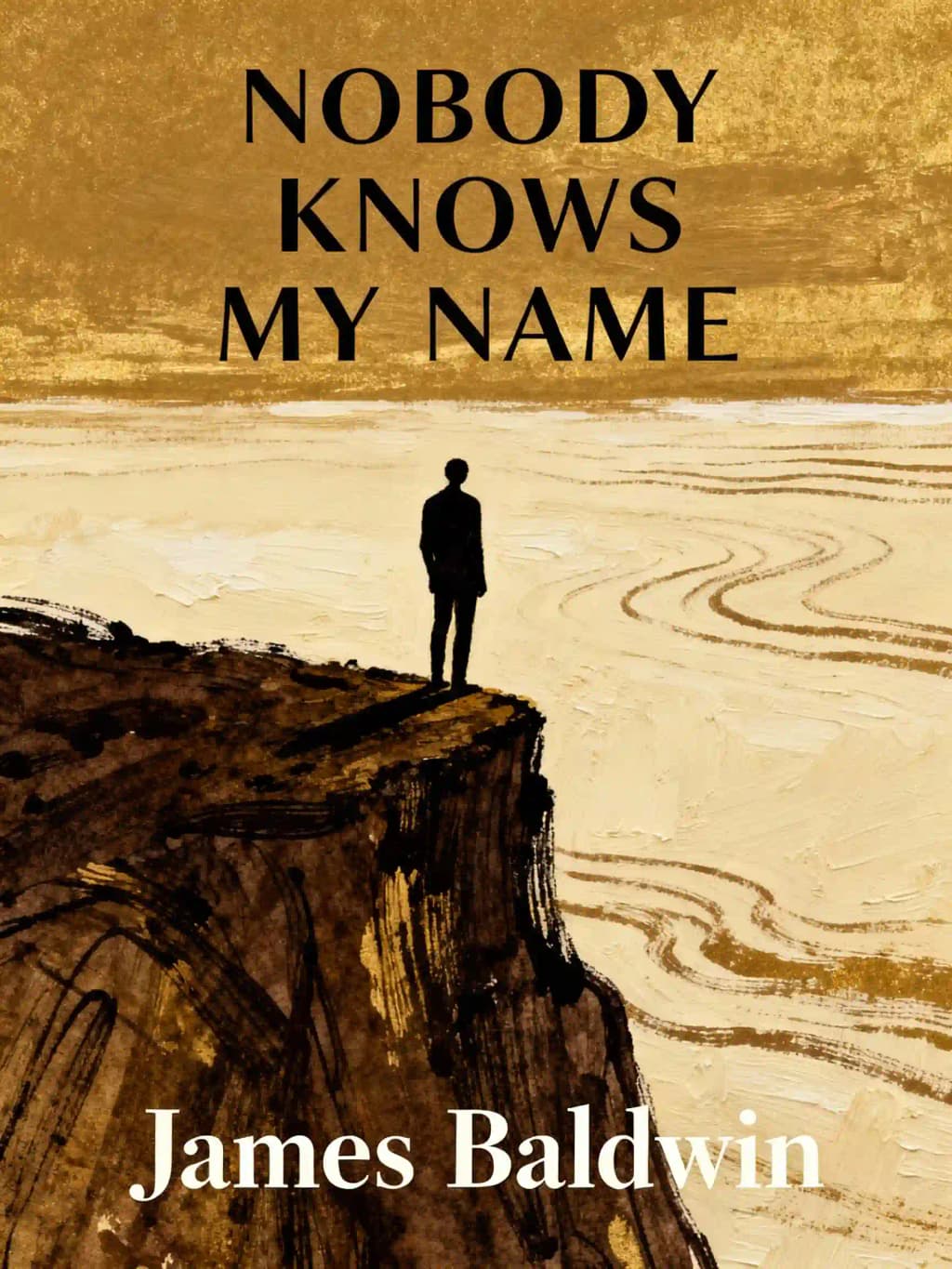
In "Nobody Knows My Name," Baldwin's searing 1961 essays illuminate the Black experience during the Civil Rights Movement. Praised by Studs Terkel and Robert Penn Warren, these powerful reflections on identity continue to challenge America's racial consciousness. What truths about yourself remain invisible to others?
James Arthur Baldwin (1924–1987), the acclaimed essayist and civil rights luminary, explores America’s racial divides in Nobody Knows My Name, a seminal collection of essays blending autobiographical reflection and social critique.
A Harlem-born writer whose works defied genre boundaries, Baldwin became a defining voice of 20th-century literature through novels like Go Tell It on the Mountain and incendiary essays such as The Fire Next Time. His experiences as a Black queer man in 1950s Paris and his frontline reporting during the Civil Rights Movement informed his penetrating analyses of identity, power, and injustice.
Baldwin’s essays and novels, including Giovanni’s Room and If Beale Street Could Talk, remain pillars of American letters, taught in universities worldwide and adapted into award-winning films. A frequent commentator on national television and collaborator with civil rights leaders, he transformed personal struggle into universal truth.
Nobody Knows My Name cemented his reputation as an unflinching chronicler of racial trauma and moral awakening, its insights still cited in contemporary social justice movements. Baldwin’s works have been translated into over 30 languages, with The Fire Next Time named one of Time magazine’s 100 best nonfiction books.
Nobody Knows My Name is a collection of essays by James Baldwin that explores race, identity, and the African American experience through personal reflections and societal critiques. Baldwin examines the complexities of black-white relationships, the psychological impact of systemic racism, and his own expatriate journey in Europe, which provided a lens to analyze American racial dynamics.
This book is ideal for readers interested in civil rights literature, intersectional identity studies, and mid-20th-century American history. Scholars, students, and general audiences seeking Baldwin’s incisive commentary on race relations and self-discovery will find it particularly impactful.
Yes—it remains a seminal work for understanding racial tensions and personal identity struggles in America. Baldwin’s eloquent prose and unflinching analysis offer timeless insights into systemic oppression and the human condition, making it essential for both historical and contemporary discourse.
Baldwin analyzes race through personal anecdotes and historical context, arguing that systemic racism perpetuates mutual distrust. He highlights interactions with figures like Norman Mailer and Southern activists to illustrate the entrenched biases and false narratives shaping black-white dynamics.
Living in Paris and Switzerland enabled Baldwin to observe American race relations with critical distance. This detachment revealed the contradictions of U.S. identity and deepened his understanding of global racial hierarchies.
While Notes of a Native Son establishes his early voice, this collection delves deeper into systemic racism’s psychological toll. Unlike his novels, it blends memoir with polemic, offering a raw, essayistic critique of 1950s America.
The book was praised for its intellectual rigor and lyrical prose, solidifying Baldwin’s reputation as a leading civil rights-era thinker. Critics noted its unflinching examination of racial hypocrisy and its relevance to ongoing social justice movements.
He frames identity as a negotiation between self-perception and societal labels, particularly for African Americans. Essays like “Alas, Poor Richard” dissect how racial and cultural expectations fragment personal authenticity.
Baldwin critiques post-WWII America’s racial segregation, the Civil Rights Movement’s challenges, and Southern resistance to integration. He responds to figures like William Faulkner, arguing against delaying racial equity.
Its themes—systemic racism, identity crises, and cultural alienation—resonate in modern debates over police brutality, voter suppression, and intersectional discrimination. Baldwin’s call for empathy and systemic change remains urgent.
通过作者的声音感受这本书
将知识转化为引人入胜、富含实例的见解
快速捕捉核心观点,高效学习
以有趣互动的方式享受这本书
To be a Negro in this country and to be relatively conscious is to be in a rage almost all the time.
I love America more than any other country in the world, and, exactly for this reason, I insist on the right to criticize her perpetually.
It is a terrible, an inexorable, law that one cannot deny the humanity of another without diminishing one’s own: in the face of one’s victim, one sees oneself.
The questions which one asks oneself begin, at last, to illuminate the world, and become one’s key to the experience of others.
将《Nobody knows my name》的核心观点拆解为易于理解的要点,了解创新团队如何创造、协作和成长。
将《Nobody knows my name》提炼为快速记忆要点,突出坦诚、团队合作和创造力的关键原则。

通过生动的故事体验《Nobody knows my name》,将创新经验转化为令人难忘且可应用的精彩时刻。
随心提问,选择声音,共同创造真正与你产生共鸣的见解。

"Instead of endless scrolling, I just hit play on BeFreed. It saves me so much time."
"I never knew where to start with nonfiction—BeFreed’s book lists turned into podcasts gave me a clear path."
"Perfect balance between learning and entertainment. Finished ‘Thinking, Fast and Slow’ on my commute this week."
"Crazy how much I learned while walking the dog. BeFreed = small habits → big gains."
"Reading used to feel like a chore. Now it’s just part of my lifestyle."
"Feels effortless compared to reading. I’ve finished 6 books this month already."
"BeFreed turned my guilty doomscrolling into something that feels productive and inspiring."
"BeFreed turned my commute into learning time. 20-min podcasts are perfect for finishing books I never had time for."
"BeFreed replaced my podcast queue. Imagine Spotify for books — that’s it. 🙌"
"It is great for me to learn something from the book without reading it."
"The themed book list podcasts help me connect ideas across authors—like a guided audio journey."
"Makes me feel smarter every time before going to work"

免费获取《Nobody knows my name》摘要的 PDF 或 EPUB 版本。可打印或随时离线阅读。
What happens when you flee a country to escape its crushing weight, only to discover you've carried it with you across an ocean? In 1961, James Baldwin's "Nobody Knows My Name" landed on American bookshelves like a confession nobody wanted to hear but everyone needed. The collection spent months on bestseller lists, not because it offered comfort, but because it named something unnameable-the way America builds prisons out of identity itself, locking everyone inside cells marked by race, gender, and the desperate need to belong somewhere, anywhere.