第 1 章
The Global Chess Game: Power, Technology, and the New Era of Superpower Competition
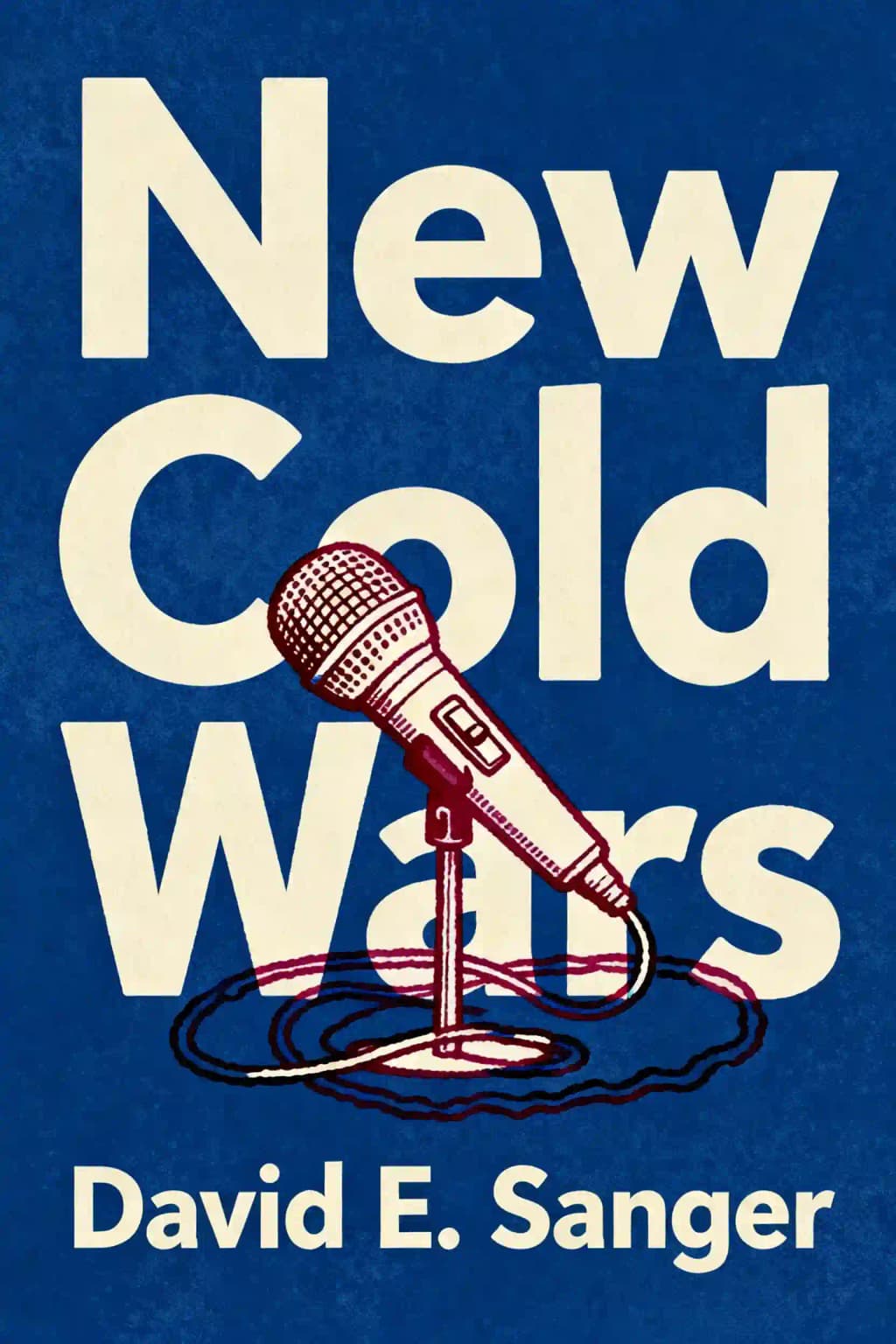
In the heart of winter 2021, as Russian troops massed on Ukraine's border, President Biden received what intelligence officials called the "mother lode" - definitive evidence of Putin's invasion plans. This wasn't supposed to happen three decades after the Soviet Union's collapse. Meanwhile, across the Pacific, Xi Jinping was orchestrating China's most aggressive technological and military buildup in generations. David E. Sanger's "New Cold Wars" captures this pivotal moment when America's post-Cold War dreams shattered against the reality of resurgent authoritarian powers. The book has become required reading in diplomatic circles and national security classrooms alike, with Barack Obama including it on his influential reading list and The Economist naming it one of 2023's most insightful geopolitical analyses. Sanger, drawing on his four decades of national security reporting, delivers a sobering assessment of how America's unipolar moment ended not with celebration but with a dangerous new era of simultaneous confrontations that may define the next half-century.
第 2 章
The Shattered Promise of a Peaceful World Order
For thirty years after the Berlin Wall fell, Western leaders operated on the assumption that the Cold War's end marked a permanent era of peace among nuclear superpowers. Each president from Clinton through Biden embraced variations of this assumption, though with diminishing conviction. Clinton believed the internet would democratize China, Bush thought he could partner with Putin against terrorism, Obama distrusted Putin but was reluctant to confront Russian cyberattacks, and Trump admired Putin's strength while seeking deals with China.
The early signs of trouble appeared in 1999, a pivotal year that damaged U.S.-Russia relations irreparably. NATO expansion became a flashpoint - though Secretary of State James Baker had hypothetically suggested to Gorbachev in 1990 that NATO wouldn't expand eastward if Soviets retreated from East Germany, no formal promise was documented. In the post-Soviet unipolar moment, America pursued both German reunification and NATO expansion.
George Kennan warned NATO expansion would "inflame nationalistic, anti-Western and militaristic tendencies in Russian opinion" and restore Cold War tensions. Despite these concerns, Clinton proceeded with NATO expansion, admitting Poland, Czech Republic, and Hungary in March 1999. Two weeks later, NATO's bombing campaign in Kosovo - unauthorized by the UN Security Council - further alienated Russia. While the West saw this as protecting Albanian minorities from Serbian persecution, Russians viewed it as America destroying an ally during its "arrogant unipolar moment."
By 2007, Putin delivered a blistering speech against American hegemony at the Munich Security Conference, dressed in black and facing the allies he'd spent his KGB career fighting. He condemned the "almost uncontained hyper use of force" by America that was "plunging the world into an abyss of permanent conflicts." He questioned NATO expansion, asking pointedly: "Against whom is this expansion intended?" Though the audience responded with polite applause, most dismissed his concerns - as David Ignatius later noted, "Putin's Russia seemed too feeble to worry about."
Looking back, the West was naive about Putin despite his clear signals about his intentions. Most Western leaders clung to the theory that Putin would increasingly value relations with Europe, oil revenues, and nuclear power status over imperial reconstruction.
第 3 章
The China Miscalculation: From Engagement to Competition
When Treasury Secretary Robert Rubin first visited China in 1997, it was still considered merely an "emerging market" with a GDP of just $961 billion compared to America's nearly $32 trillion. Yet China was growing at a remarkable 8-11% annually, maintaining the world's largest standing army of 2.8 million personnel and wielding significant diplomatic power through its permanent seat on the UN Security Council. The country's rapid industrialization was already transforming global markets, from steel to consumer goods.
The belief underpinning American policy toward China was that economic and diplomatic engagement would transform the country. Western norms would seep into Chinese society through increased trade, cultural exchange, and business partnerships. The theory held that newly acquired wealth would create a middle class that would demand capitalist and political reforms, while internet expansion would foster free expression and democratization. As Bill Clinton famously quipped in 2000, trying to control the internet would be "like trying to nail Jell-O to the wall." This optimistic view was reinforced by China's 2001 entry into the World Trade Organization, which many saw as a watershed moment for international integration.
The unstated final goal was deep economic interdependence that would make conflict too costly for both sides. Washington expected China might evolve to resemble Europe economically - regulated but essentially market-driven, with increasing transparency and rule of law. American companies rushed to establish operations in China, viewing it as both a massive consumer market and a manufacturing hub.
This narrative fit America's global agenda so perfectly that few questioned it, despite warning signs. For decades, Washington downplayed mounting evidence of China's territorial ambitions in the South China Sea and East China Sea, its systematic cyber theft of industrial and state secrets estimated at hundreds of billions annually, and how its growing economic power would naturally foster political ambitions. Some misreading was encouraged by Chinese leadership's strategy to "hide one's strength and bide one's time" (), a doctrine attributed to Deng Xiaoping that guided Chinese foreign policy for decades.
China's subsequent growth was remarkable - per capita GDP nearly tripled from $2,099 in 2000 to $5,618 by 2007, then tripled again to $15,309 by 2017. This unprecedented economic expansion transformed global supply chains and trade patterns. But looking back, America had misjudged "China's changing intentions" and failed to recognize Xi Jinping's "insatiable desire to dominate" both regionally and globally through initiatives like Belt and Road and Made in China 2025.
By 2015, Obama administration officials grew increasingly alarmed about China's economic nationalism and industrial policies. Commerce Department officials faced a stark reality when meeting with struggling American steelworkers in states like Pennsylvania and Ohio, who were being devastated by subsidized Chinese steel flooding global markets - they had exhausted nearly all policy options except tariffs, which the administration considered politically and economically unviable. Just days later, they met with the Semiconductor Industry Association board, who expressed palpable fear about China's plans to invest $150 billion to subsidize semiconductor manufacturing under "Made in China 2025." The security implications were obvious: Chinese dominance of semiconductors - the foundation of all modern technology from smartphones to military systems - would give Beijing dangerous leverage over global supply chains and technological development.
第 4 章
Trump's Disruption and the Return to Great Power Competition
In February 2017, H.R. McMaster received Trump's offer to become national security advisor while preparing to discuss how the U.S. was falling behind Russia's advancing warfare capabilities. McMaster brought the beginnings of a strategy for dealing with a new age of superpower conflict, believing America had failed to recognize that while counterterrorism wasn't over, great power competition had already arrived.
His national security strategy, released in December 2017, represented a significant shift by acknowledging America had grown complacent after the Cold War while rivals implemented long-term plans to challenge U.S. dominance. Yet Trump himself seemed to miss this central point, still talking about building "great partnerships" with Russia and China while questioning NATO's relevance.
Despite McMaster's strategic vision, Trump consistently undermined his own administration's Russia policy. While McMaster could point to concrete actions like imposing more sanctions on Russia in Trump's first four months than during Obama's entire presidency and selling Javelin missiles to Ukraine, he admitted "the audio didn't match the video." Trump believed he could break through with Putin personally, falling into the same trap as his predecessors despite McMaster's explicit warnings.
Bolton aimed to transform America's approach to China but found Trump fixated solely on trade deficits. While Bolton wanted to address China's challenges across space, cyber, and the Pacific, Trump viewed China purely through the lens of trade imbalances, clinging to what Bolton called "eighteenth-century mercantilist" thinking. By spring 2018, Trump launched a tit-for-tat tariff war, convinced economic pain would force China into a major trade deal.
In 2019, Pottinger discovered a declassified 2013 speech by Xi Jinping that he considered a "Rosetta Stone" revealing China's true intentions. In this address to party leaders, Xi had declared a "zero-sum struggle to the finish with the United States" and predicted the inevitable triumph of socialism over capitalism. Xi called for "laying the foundation for a future where we will win the initiative and have the dominant position" while preparing for "a long period of cooperation and conflict." This confirmed for Pottinger that Xi's occasional conciliatory tone merely aimed to "lull or flatter the United States into continued complacency."
第 5 章
Biden's Inheritance: Crises Converge
Anne Neuberger, a rising star at the National Security Agency and grandchild of Holocaust survivors, received an urgent call in November 2020 from Kevin Mandia, CEO of cybersecurity firm FireEye. "I have something extremely sensitive," he told her cryptically, requesting an in-person meeting.
When they met on November 24, Mandia revealed that someone had stolen FireEye's prized "red-teaming tools" - sophisticated software used to simulate cyberattacks for clients. Within thirty minutes of discovering the breach, Mandia suspected Russian involvement, which intelligence agencies later confirmed as the work of Russia's SVR intelligence service.
The Russian hackers had executed a masterful supply chain attack: rather than targeting individual organizations, they compromised SolarWinds' software development process, inserted malicious code, and let the company unwittingly distribute it through routine updates. This gave them access to choose high-value targets across government and corporate America. Neuberger would later view this as the first indication that the incoming Biden administration was on a collision course with Vladimir Putin.
Biden, despite slowing with age, was uniquely prepared for this cyber crisis. He had participated in designing Operation Olympic Games - the sophisticated U.S.-Israeli cyberattack against Iran's nuclear program during the Obama administration. This experience gave him firsthand knowledge of cyber capabilities that few incoming presidents possessed. When asked if he could trust the government systems he was inheriting, Biden snapped, "Of course I can't."
Meanwhile, Trump refused to confront Putin about the hack, even tweeting that "everything is well under control" and suggesting China might be responsible despite clear intelligence briefings identifying Russia. This left Biden, still president-elect, to publicly declare "Enough's enough" and promise accountability. However, his message was quickly overshadowed by the January 6 Capitol attack, providing America's adversaries with powerful imagery of democratic breakdown.
The Capitol riot provided Russia and China perfect propaganda material, though they exploited it differently. Russia broadcast the chaos globally to undermine American credibility, while China focused on domestic audiences to discredit the democratic model. Senator Chris Coons observed the attack had "a huge impact on how the world sees us - and how we see ourselves."
第 6 章
The Ukraine Crisis: Testing American Resolve
In the early morning hours of August 12, 2021, National Security Advisor Jake Sullivan received an urgent call from Joint Chiefs Chairman Mark Milley that would mark the beginning of one of America's most challenging foreign policy crises. For days, Sullivan and Biden's national security team had watched in mounting alarm as Taliban forces captured one provincial capital after another with stunning speed. Afghan troops, demoralized by American withdrawal, unpaid wages, and lack of air support, were surrendering entire military bases without firing a shot, leaving behind vast stores of U.S.-supplied weapons and equipment.
The Afghanistan situation had been deteriorating for years, despite optimistic public assessments from military leaders. While the CIA and military had initially succeeded in toppling the Taliban government in 2001 with a combination of special forces, air power, and Northern Alliance fighters, subsequent nation-building efforts proved deeply flawed. The creation of a centralized government in a historically decentralized country, endemic corruption, and the inability to build truly independent Afghan security forces all contributed to the failure. Biden had long been skeptical about the war, even during Obama's administration when he forcefully opposed the 2009 troop surge, arguing that no foreign power had ever successfully unified Afghanistan's tribal regions.
When Biden took office in early 2021, he inherited what many considered an impossible situation. The Trump administration had negotiated a May withdrawal deadline with the Taliban, reducing forces to just 2,500 troops while the insurgent group was at its strongest position in twenty years. Despite Pentagon officials, including Defense Secretary Lloyd Austin and General Milley, urging him to maintain 2,500-4,500 troops in Afghanistan indefinitely, Biden made his decisive break by March 2021. Having watched three predecessors promise victory with diminishing results over twenty years at a cost of over $2 trillion and 2,400 American lives, Biden ordered a complete withdrawal by September 11, the symbolic 20th anniversary of the attacks that had started the war.
This assessment of an orderly withdrawal proved catastrophically wrong. By May, the Taliban launched a major offensive across the south and central regions, capturing district after district with minimal resistance. The U.S. embassy issued increasingly urgent warnings for Americans to leave the country immediately. While refugee groups and veterans' organizations pleaded for expedited visas for thousands of vulnerable Afghans who had worked with U.S. forces, President Ashraf Ghani personally asked Biden not to begin mass evacuations, fearing it would signal American loss of faith in his government and accelerate the collapse.
The chaotic withdrawal that followed, culminating in desperate scenes at Kabul airport and a devastating ISIS-K suicide bombing that killed 13 U.S. service members, reminded the world that even superpowers have limits. The rapid collapse gave America's adversaries, particularly in Moscow and Beijing, reason to believe the U.S. had no appetite for further international entanglements and would retreat from its global commitments when challenged. This perception would soon be tested in ways few could have predicted.
第 7 章
The Taiwan Dilemma and Technological Competition
Just southwest of Taipei lies Taiwan's greatest commercial treasure: the Hsinchu Science Park, home to Taiwan Semiconductor Manufacturing Company (TSMC). This company produces nearly 90% of the world's most advanced computer chips, from those powering F-35s and HIMARS artillery to iPhone processors with 19 billion transistors. These chips are essential components in everything from advanced weapons systems to consumer electronics, medical devices, and autonomous vehicles. This dominance represents a technology America surrendered through a series of profit-driven decisions to move production overseas without considering national security implications.
Taiwan's dominance in semiconductor manufacturing resulted from three key factors: skillful state planning as Taiwan emerged as a democracy, the vision of Morris Chang (a Harvard-MIT educated engineer who left Texas Instruments), and poor business judgments by American companies. Chang, recruited by Taiwan's technology minister K.T. Li in 1987, pioneered the "foundry" concept - focusing exclusively on manufacturing custom-designed chips for others rather than designing them. This model proved perfect timing as semiconductor fabrication grew increasingly complex and expensive, costing billions per facility. TSMC's success was further bolstered by generous government subsidies, tax incentives, and a highly skilled workforce trained specifically for semiconductor manufacturing.
American companies chose to focus on chip design while outsourcing manufacturing, believing in the reassuring myth that globalized supply chains eliminated concerns about where production occurred. Companies like Intel, AMD, and Qualcomm increasingly relied on TSMC's manufacturing capabilities while maintaining their design expertise. The COVID pandemic shattered this illusion as supply chain disruptions left new vehicles sitting in factory lots awaiting single chips worth just a few dollars. The automotive industry alone lost an estimated $210 billion in revenue in 2021 due to chip shortages. By 2020, America's share of semiconductor manufacturing had plummeted from 37% in 1990 to just 12%, with Taiwan's vulnerability to Chinese blockade or invasion representing an existential economic risk.
On October 7, 2022, Biden's Commerce Department issued two immediate rules that fundamentally disrupted the global chip supply chain. The first blocked sales to China of advanced chips (particularly those for AI) and chipmaking equipment; the second simplified banning trade with specific entities. These restrictions specifically targeted chips with computing capabilities above certain thresholds and equipment used in their production. Intelligence reports had revealed China was acquiring Western chips to build military technologies from surveillance satellites to hypersonic missiles, and using advanced AI chips for military applications and surveillance systems. The administration realized they needed both domestic semiconductor production and a denial strategy to maintain America's edge. National Security Advisor Jake Sullivan described the approach as building a "high fence" around a "small yard" of critical technologies, focusing restrictions on specific advanced technologies while maintaining trade in less sensitive areas. This strategy was complemented by the CHIPS and Science Act, which allocated $52 billion to rebuild domestic semiconductor manufacturing capacity.
第 8 章
The Digital Battlefield: Ukraine as Testing Ground
The war in Ukraine has become a pivotal testing ground for modern digital warfare capabilities, with the United States establishing sophisticated intelligence operations that walk a delicate line between supporting Ukraine and directly engaging in combat. At an American base in Europe, a secretive facility known as "the Pit" brings together U.S. and British military officers, Ukrainian personnel, and Silicon Valley contractors to gather and analyze battlefield intelligence. This unprecedented collaboration represents a new model of hybrid warfare where commercial technology meets military necessity.
The centerpiece is a revolutionary "single pane of glass" display that integrates multiple data streams: commercial satellite imagery providing near real-time battlefield updates, social media data tracking troop movements and civilian reports, radio transmissions intercepted from Russian forces, facial recognition technology identifying key personnel, geolocational data from Russian soldiers' phones, and selectively, classified intelligence from American spy satellites and NSA intercepts. This operation represents a fundamental shift in digital warfare technology, with an estimated 80% built on unclassified commercial sources, challenging traditional military reliance on classified systems.
While America contributed sophisticated digital tools to Ukraine's war effort, Ukrainian innovations proved equally impressive - and often faster to implement. Ukrainian soldiers deployed mobile 3D printing units directly to battlefield positions, enabling rapid repair of artillery parts within hours rather than the weeks required for traditional logistics chains through Poland. They designed $5,000 tank-killing drones using commercially available components and developed AI-enabled swarm tactics to overwhelm Russian air defenses. One Silicon Valley tech executive noted: "Ukraine is inventing stuff in two to three years that will take thirty years to be worked out by everybody else." This rapid innovation cycle has forced military strategists worldwide to reassess their approach to weapons development.
In a converted factory in a Kyiv suburb, Ukrainian high school students spent summer 2023 assembling kamikaze drones, representing a new model of civilian-military production. Selected for their "steady hands for soldering" and technical aptitude, these teenagers mounted sophisticated electronic components on carbon-fiber airframes, creating $350 drones capable of carrying small explosive charges to disable Russian vehicles or kill artillery operators. The factory achieved production rates of twenty drones daily when components were available, with field data showing pilots typically needed 4-10 drones to successfully destroy a target. This cost-effective approach meant Ukraine could lose multiple drones while still maintaining a significant economic advantage over traditional military hardware.
The operation highlighted Ukraine's remarkable adaptation to drone warfare despite having minimal experience before the invasion. Former Google CEO Eric Schmidt, after visiting Ukrainian facilities, noted their "remarkable progress" in drone development, particularly their ability to produce effective weapons "at a price point that is inconceivable in America." This agile development contrasted sharply with the Pentagon's decade-long development cycles for expensive systems like the $32 million Predator drone. Ukraine's success has demonstrated that modern warfare increasingly favors rapid innovation and cost-effective solutions over traditional military-industrial development models, forcing military establishments worldwide to reconsider their approach to weapons development and deployment.
第 9 章
Navigating the New Multipolar World
Secretary of State Antony Blinken's admission that "This is not the world we wanted, or were trying to shape, after the Cold War" captures the messy transition to a new geopolitical era. For fifteen years, world leaders warned against slipping back into Cold War habits, believing cooperation would sustain wealth production and technological progress. Instead, collaboration grew increasingly fleeting.
The new era's outlines are emerging: globalization giving way to self-reliance, resurgent nationalism, strengthened autocratic alliances, and nuclear threats. The "new cold wars" represent a combustible mix of simultaneous, high-stakes conflicts that will likely outlive current leaders and persist for decades.
Yet this isn't simply a replay of the twentieth century. The addition of new players makes today's era far more complex than the original Cold War, which followed predictable patterns after establishing red lines. Today, China shows no signs of Soviet-style collapse, and Putin's alignment with China and Iran has given Russia staying power despite sanctions.
Technology has both complicated and accelerated these struggles, with AI integration potentially escalating minor conflicts before humans can reconsider. As Robert Gates warned, America now faces "four allied antagonists" - Russia, China, North Korea, and Iran - whose collective nuclear arsenal could soon nearly double America's own. With each flashpoint from Ukraine to the Pacific to the Middle East, direct superpower conflict remains just one miscalculation away.
When Henry Kissinger was asked about U.S.-China relations in his final years, he compared it to an alpine military campaign. "We are still in the foothills of a Cold War," he said, initially expressing hope that disaster could be avoided. But his optimism waned; by 2020 he claimed the world was in "the mountain passes" and by 2021 "through the mountain pass, on a precipice." Yet even months before his death, as Xi celebrated his hundredth birthday, Kissinger insisted conflict could still be avoided.
Navigating this new era will be exceptionally challenging, with three major powers and dozens of smaller ones creating more potential for conflict than the world has faced before. Our time echoes both the early Cold War and the great power competition before World War I, carrying all the fears of escalation that defined those periods.
Yet we should remember that one of the most remarkable achievements of the old Cold War was that great powers never escalated their differences into direct conflict - an eight-decade streak we cannot afford to break.