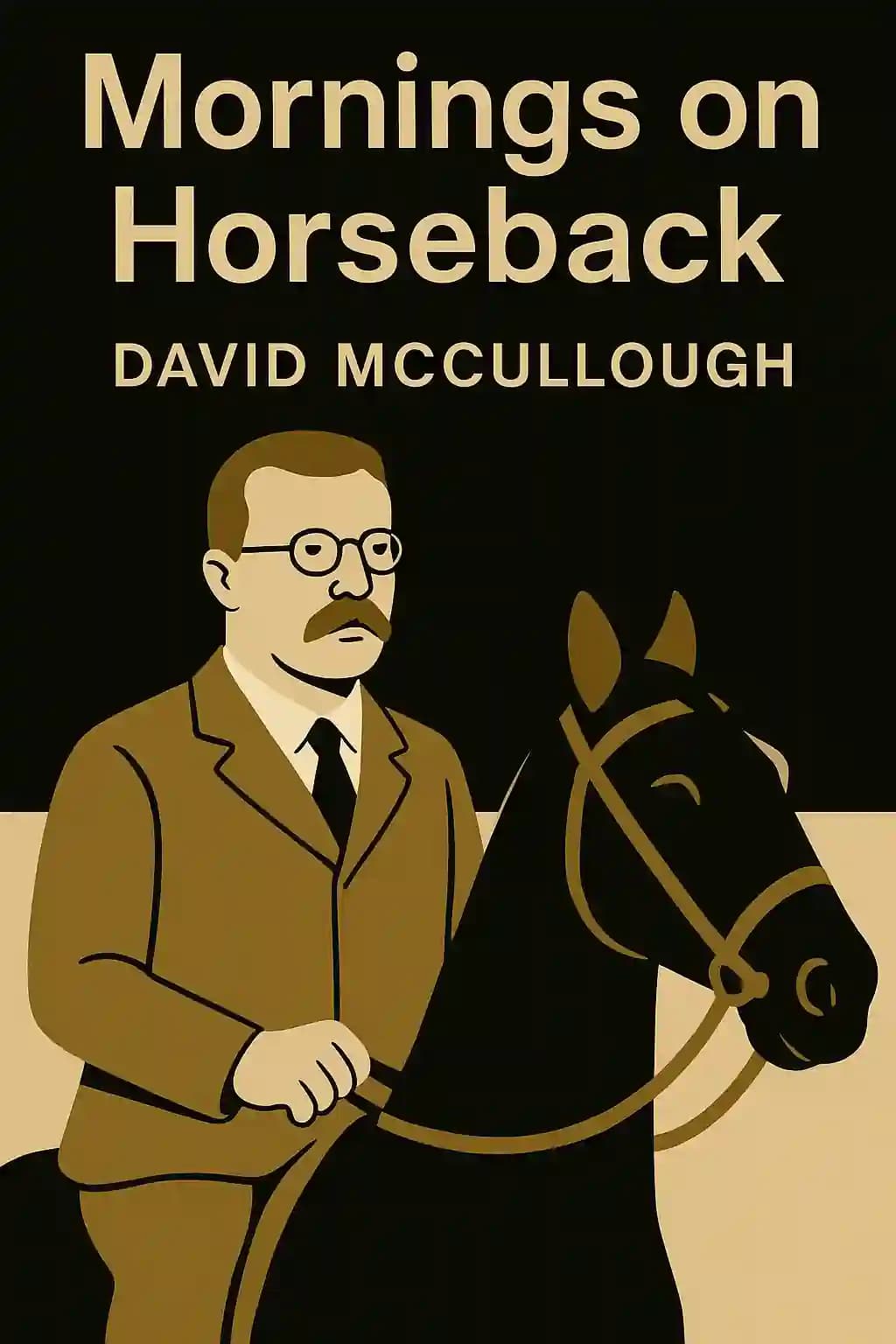
Before Theodore Roosevelt became a legend, he was a sickly boy transformed by family values. McCullough's National Book Award-winning biography reveals how a fragile child - guided by an extraordinary father - developed the resilience that would reshape America. Kenneth Davis calls it essential American history.
David Gaub McCullough (1933–2022) was a Pulitzer Prize-winning historian and the author of Mornings on Horseback. He specialized in meticulously researched biographies that brought American history to life.
This National Book Award-winning work explores Theodore Roosevelt’s formative years, blending political insight with vivid storytelling—a hallmark of McCullough’s approach honed through decades at American Heritage and acclaimed titles like Truman and John Adams, both Pulitzer recipients.
A Yale graduate and Presidential Medal of Freedom honoree, his narratives often became cultural touchstones, adapted into HBO films and documentaries like Ken Burns’ The Civil War. Mornings on Horseback cemented his reputation for illuminating leadership and resilience, themes echoed in his bestsellers 1776 and The Wright Brothers.
Translated into multiple languages, his works have collectively sold millions, with John Adams alone spending over a year on The New York Times bestseller list.
Mornings on Horseback chronicles Theodore Roosevelt’s formative years, exploring his upbringing in a wealthy New York family, his battle with debilitating asthma, and the influences that shaped his resilient character. The National Book Award-winning biography highlights his transformation from a sickly child into a dynamic leader, emphasizing family dynamics, personal grit, and the societal pressures of late 19th-century America.
This book appeals to history enthusiasts, biography readers, and those interested in leadership development. David McCullough’s narrative depth makes it ideal for students of American history, fans of Roosevelt’s presidency, and readers seeking insights into overcoming adversity through personal discipline and familial support.
Yes. David McCullough’s Pulitzer Prize-winning storytelling and meticulous research bring Roosevelt’s early life to vivid life, offering a compelling study of resilience. The book’s blend of historical detail and psychological depth makes it essential for understanding how Roosevelt’s upbringing fueled his progressive policies and larger-than-life persona.
Key themes include resilience against physical adversity, the impact of family privilege and expectations, and the societal shifts of America’s Gilded Age. McCullough emphasizes how Roosevelt’s father, Theodore Sr., instilled values of civic duty and perseverance that defined his political career.
The book details Roosevelt’s severe childhood asthma and his rigorous physical regimen to strengthen his body. McCullough frames these struggles as central to his development, showing how overcoming illness forged his famed determination and “strenuous life” philosophy.
McCullough examines the family’s wealth, social status, and emotional complexities, particularly the influence of Roosevelt’s father and his Southern-born mother, Mittie Bulloch. Their contrasting personalities and values created a nurturing yet demanding environment that shaped his ambitions.
Unlike biographies focused on Roosevelt’s presidency, McCullough’s work prioritizes his formative years, offering a psychological portrait rather than a political chronicle. It contrasts with Edmund Morris’s trilogy by delving deeper into familial and medical challenges.
The book won the 1982 National Book Award for Biography and the Los Angeles Times Biography Prize. These accolades underscore McCullough’s reputation for combining scholarly rigor with accessible storytelling.
McCullough uses letters, diaries, and historical archives to reconstruct Roosevelt’s world with vivid detail. His immersive approach helps readers grasp the emotional and cultural forces that shaped Roosevelt’s character.
The book underscores how resilience, intellectual curiosity, and ethical grounding can transform adversity into strength—a relevant lesson for leaders navigating personal or professional challenges today.
In an era marked by rapid change, Roosevelt’s story of adapting to physical and societal challenges resonates with readers seeking inspiration on perseverance, leadership, and balancing tradition with progress.
The title metaphor reflects Roosevelt’s dawn rides in the Badlands, symbolizing renewal, self-reliance, and the pursuit of vigor. These moments encapsulate his journey from fragility to forceful action.
通过作者的声音感受这本书
将知识转化为引人入胜、富含实例的见解
快速捕捉核心观点,高效学习
以有趣互动的方式享受这本书
You must make your body.
This mandate to strengthen his physical self would become a defining quest.
将《Mornings on horseback》的核心观点拆解为易于理解的要点,了解创新团队如何创造、协作和成长。
将《Mornings on horseback》提炼为快速记忆要点,突出坦诚、团队合作和创造力的关键原则。

通过生动的故事体验《Mornings on horseback》,将创新经验转化为令人难忘且可应用的精彩时刻。
随心提问,选择声音,共同创造真正与你产生共鸣的见解。

"Instead of endless scrolling, I just hit play on BeFreed. It saves me so much time."
"I never knew where to start with nonfiction—BeFreed’s book lists turned into podcasts gave me a clear path."
"Perfect balance between learning and entertainment. Finished ‘Thinking, Fast and Slow’ on my commute this week."
"Crazy how much I learned while walking the dog. BeFreed = small habits → big gains."
"Reading used to feel like a chore. Now it’s just part of my lifestyle."
"Feels effortless compared to reading. I’ve finished 6 books this month already."
"BeFreed turned my guilty doomscrolling into something that feels productive and inspiring."
"BeFreed turned my commute into learning time. 20-min podcasts are perfect for finishing books I never had time for."
"BeFreed replaced my podcast queue. Imagine Spotify for books — that’s it. 🙌"
"It is great for me to learn something from the book without reading it."
"The themed book list podcasts help me connect ideas across authors—like a guided audio journey."
"Makes me feel smarter every time before going to work"

免费获取《Mornings on horseback》摘要的 PDF 或 EPUB 版本。可打印或随时离线阅读。
In 1869, a sickly boy named "Teedie" Roosevelt struggled for breath in his family's New York brownstone. Who could have imagined this frail child would become the embodiment of American vigor and presidential power? David McCullough's masterpiece doesn't simply chronicle Theodore Roosevelt's path to the White House-it excavates the soil from which this extraordinary American grew. The Roosevelt household was a study in contrasts: Theodore Sr., a philanthropist whose "maniacal benevolence" earned both praise and satire, balanced by Mittie, a vivacious Southern belle whose charm captivated New York society. Their brownstone on East 20th Street housed not just a family but a laboratory for character formation. What transforms a chronically ill child into a force of nature? The answer lies in this intimate portrait of family dynamics, personal tragedy, and indomitable will that shaped one of history's most fascinating leaders.




