第 1 章
Unlocking the Language of Dreams: Jung's Exploration of the Unconscious Mind
When Carl Jung completed his final work, "Man and His Symbols," in June 1961-just days before his final illness-he had no way of knowing it would become one of psychology's most enduring classics. The book originated from an unusual source: a BBC television interview that introduced Jung's complex ideas to ordinary viewers. Surprised by the enthusiastic public response, Jung had a profound dream of addressing multitudes who actually understood him, convincing him to create a book that would make his revolutionary concepts accessible to non-specialists.
What makes this work particularly fascinating is its cultural impact. Unlike Freud's ideas, which quickly permeated popular culture, Jung's deeper concepts of archetypes and the collective unconscious remained relatively inaccessible until this book's publication. Today, Jung's ideas have influenced everyone from filmmaker Federico Fellini to novelist Ursula K. Le Guin, and even inspired elements of Star Wars' mythology. The book represents Jung's final gift to humanity-a comprehensive guide to understanding the rich symbolic language through which our unconscious communicates with us daily.
第 2 章
Dreams as Meaningful Messages, Not Random Noise
Dreams serve as bridges between our conscious and unconscious minds, carrying vital messages that maintain our psychological health. Unlike Freud, who viewed dreams primarily as starting points for free association leading to repressed thoughts, Jung discovered that the specific imagery and structure of dreams themselves contain purposeful meaning.
Consider the difference in approach: Freud might use a dream about a key to discuss repressed sexuality, while Jung would ask why the unconscious chose a key rather than another phallic symbol like a stick. The specific form matters tremendously. Sometimes dreams aren't sexual allegories at all but convey different psychological messages. A patient once dreamed his refined wife was vulgar and drunken-not because she actually was, but because the dream was revealing the patient's own degenerate "anima" or female aspect.
Most people dismiss their dreams as meaningless simply because they don't understand them. I once encountered East African tribesmen who claimed only chiefs and medicine men had significant dreams-a perfect example of how we devalue what we don't comprehend. Yet even without conscious interpretation, dreams subtly alter our moods and influence our daily lives.
Dream interpretation requires extraordinary caution. No systematic guides or symbol dictionaries can replace individual analysis, as no dream symbol exists separate from the dreamer. While certain motifs recur frequently-falling, flying, being pursued, inappropriate clothing-these must be understood in context, not as universal ciphers.
Recurring dreams deserve special attention as they often attempt to compensate for particular attitude defects or prejudices. Jung himself had a recurring dream of discovering unknown rooms in his house-ultimately revealing an ancient library with symbolic pictures-which preceded his actual discovery of alchemy texts that would become central to his psychological research. The unconscious was preparing him for a major intellectual breakthrough long before his conscious mind could grasp it.
第 3 章
The Unconscious: More Than a Repository of Repression
The unconscious continues to guide our actions even when we've forgotten our conscious purpose. Have you ever walked across a room for something, forgotten what you wanted, yet unconsciously groped among objects until remembering? This demonstrates how our unconscious mind maintains continuity even when consciousness falters.
In neurotic individuals, this disconnect between conscious intention and unconscious guidance becomes more pronounced, creating behavior that appears deceptive but stems from genuine unconscious interference. Hysterical patients demonstrate this dramatically through fluctuating awareness-their skin may feel a needle prick one moment but not the next, or their body might become completely anesthetized when attention focuses elsewhere.
Jung documented a remarkable case of a woman in his clinic who, while in an apparent stupor, unconsciously recorded precise details about her admission that she couldn't recall consciously. The unconscious registers everything, even when consciousness is impaired.
Symbols differ fundamentally from signs. While signs are less than the concepts they represent (like a road sign indicating a curve), symbols always point to something beyond their obvious meaning. Symbols arise naturally and spontaneously, particularly in dreams, which happen rather than being invented. They appear in all psychic manifestations: thoughts, feelings, acts, and situations. Even inanimate objects seem to participate in symbolic patterns, as evidenced by clocks stopping at owners' deaths or mirrors breaking during emotional crises.
Many important symbols are collective rather than individual, especially religious images. These aren't divine revelations as believers claim, nor conscious inventions as skeptics assert, but "collective representations" from primeval dreams and creative fantasies-spontaneous manifestations rather than intentional creations.
第 4 章
The Challenge of Psychological Types
Psychology stands apart from other sciences due to its uniquely personal nature, where the subjective experiences and personalities of both analyst and patient become inextricably intertwined in the therapeutic process. While other sciences can maintain objective distance between observer and subject, psychological treatment inevitably draws both parties into deep personal engagement. Even when beginning with intentions of clinical objectivity, the complex dynamics of human interaction take over as therapy progresses.
Jung's identification of psychological types provides a crucial framework for understanding these interpersonal dynamics. The cornerstone of his typology is the distinction between extraverted and introverted personalities. Extraverts direct their energy and attention primarily toward the external world of objects and people, while introverts focus inward on concepts and feelings. These fundamental orientations can create significant communication barriers when analyst and patient fall on opposite ends of the spectrum. An extraverted therapist might push for active engagement and concrete solutions, while an introverted patient needs time for internal processing and reflection.
Beyond this primary distinction, Jung outlined four functional types that represent different modes of experiencing and processing reality: sensation, thinking, feeling, and intuition. Sensation types focus on direct sensory experience and concrete facts. Thinking types seek logical order and conceptual understanding. Feeling types evaluate experiences through personal and cultural values. Intuitive types perceive patterns and possibilities beyond immediate evidence. These functions typically develop in hierarchical order, with individuals showing natural preferences and strengths in some while struggling with others.
The therapeutic relationship demands engagement of the analyst's complete personality, not just their technical expertise. Theoretical knowledge, while valuable, can create a false sense of security if relied upon too heavily. This becomes particularly evident in dream interpretation, where context is paramount. For example, a dream about flying might represent grandiose inflation in one person but liberation from constraints in another. A dream about being lost could indicate psychological disorientation or a healthy questioning of old certainties.
The analyst must therefore remain aware of both their own psychological type and the patient's, recognizing how these differences influence their interaction. An intuitive therapist working with a sensation-type patient must bridge this gap rather than imposing their natural mode of understanding. Similarly, a thinking-type analyst must develop their feeling function to work effectively with patients who process primarily through emotional evaluation.
Understanding psychological types helps avoid the trap of universal interpretations while providing a map for navigating individual differences. This framework allows for appreciation of diverse psychological realities without becoming rigid or deterministic in approach.
第 5 章
Archetypes: The Ancient Patterns Within Us
Dreams serve as compensatory mechanisms, transmitting unconscious reactions to consciousness. While ordinary dreams can be interpreted through the dreamer's personal associations, highly emotional or obsessive dreams often contain elements Freud called "archaic remnants"-mental forms that cannot be explained by the individual's personal experience.
Just as our bodies are museums of evolutionary organs, our minds contain prehistoric, unconscious developments from archaic humans. This ancient psyche forms the foundation of our mind. The psychologist needs a "comparative anatomy of the psyche" including knowledge of dreams and mythology to recognize these patterns.
The archetypes Jung describes are not inherited specific images but tendencies to form representations that may vary in detail while maintaining their basic pattern. They are instinctive trends, like birds' nest-building impulses, that manifest through symbolic images. These archetypes appear without known origin across different times and cultures where transmission through descent or migration is impossible.
Jung encountered many educated people, even psychiatrists, baffled by dreams containing inexplicable images. One professor feared insanity after having a vision until Jung showed him a 400-year-old woodcut depicting his exact experience. Another striking case involved a 10-year-old girl's series of dreams with profound philosophical themes-including the death and rebirth of animals through divine intervention, cosmic origins, and transformations-despite having minimal religious education.
These dreams contained revolutionary notions like the relativity of moral values worthy of Nietzsche. The child was approaching both puberty and death, with dream symbolism suggesting impending disaster rather than normal adult life. Her dreams provided preparation for death through short stories resembling primitive initiations or Zen koans, originating from prehistoric psychic sources rather than Christian doctrine.
第 6 章
The Soul of Modern Man: A Battleground of Opposites
Modern consciousness has progressively detached itself from our basic instincts, but these instincts haven't disappeared-they've merely lost direct contact with our awareness. They now assert themselves indirectly through neurotic symptoms, inexplicable moods, forgetfulness, and slips of the tongue.
Despite believing himself master of his soul, modern man remains controlled by unconscious factors that infiltrate his decisions in countless hidden ways. We protect ourselves from seeing this split state through compartmentalization-keeping different areas of life separate and never confronting their contradictions.
This compartment psychology manifests in cases like the alcoholic who believed himself miraculously cured by religious conversion, only to relapse weeks later when the novelty faded. The religious organization, rather than integrating this contradiction, simply reclassified his case as "pathological" and sent him to doctors instead.
Humanity collectively behaves like a neurotic individual, tucking uncomfortable problems into separate drawers. The world's divisions reflect this dissociation. Western man defends against Eastern aggression while failing to recognize that communism merely throws back at him his own shadow-the diplomatic lies, deception, and veiled threats he has practiced but kept hidden behind good manners.
Our attempts to solve these problems through arms buildup or economic competition fail because the real issues are moral ones requiring psychological immunity. Yet our efforts remain ineffective as long as we refuse to recognize our own shadow and its destructive potential. By failing to see our own darkness, we remain vulnerable to moral infection while hypocritically condemning others.
Both East and West are gripped by the same archetypal myth-the infantile dream of a Golden Age or Paradise where abundance reigns under a wise, just ruler. We too believe in welfare states, universal peace, equality, human rights, and the Kingdom of God on Earth. But the truth is that life consists of inexorable opposites-day and night, birth and death, happiness and misery, good and evil-with no guarantee that one will triumph over the other. Life has always been and will always be a battleground.
第 7 章
The Hero's Journey: From Ancient Myth to Modern Psychology
The hero myth, found across cultures from ancient Greece to primitive tribes, follows a universal pattern despite geographic separation. These stories typically feature a miraculous birth, early displays of superhuman strength, rapid rise to power, triumph over evil, fall through pride, and death through sacrifice or betrayal. The hero's journey symbolizes the development of ego-consciousness-awareness of one's strengths and weaknesses.
Most hero myths include tutelary figures or guardians who help the hero accomplish impossible tasks, representing the larger psyche that supports the personal ego. The Winnebago Indians' hero cycles illustrate four evolutionary stages: the Trickster (dominated by physical appetites), Hare (the culture-founder), Red Horn (the human hero with superhuman powers), and the Twins (representing dual human nature).
The archetypal hero pattern continues to manifest in modern individuals' dreams, revealing how the ego requires strengthening to accomplish psychological development. A mature man's dream illustrated this process: he journeyed through India (symbolizing exploration of the unconscious) and complained that a woman (his anima) failed to provide black rainhats for protection. Later in the dream, he finds his rainhat, witnesses a young man playing Perseus (actually confusing Perseus with Theseus), and ultimately sees a harbor town that represents his goal.
This dream sequence reveals his psychological journey from mother-attachment toward mature relationship with the feminine principle. The Perseus/Theseus confusion proved meaningful-both heroes had to overcome terrifying maternal powers (Medusa/Minotaur) to liberate feminine figures (Andromeda/Ariadne). This symbolizes the dreamer's need to free his anima from the devouring mother archetype to achieve genuine relationships with women.
第 8 章
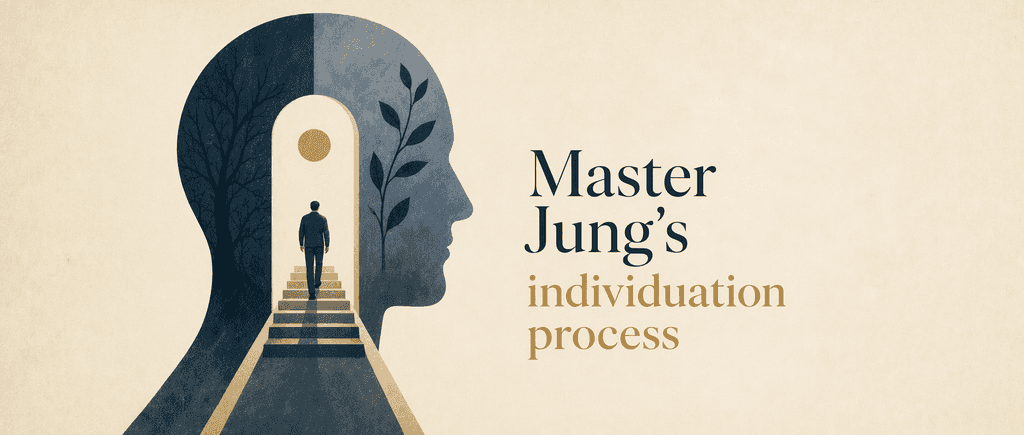
The Individuation Process: Finding the Self
Dreams aren't just isolated psychological events but form part of a vast interconnected web that follows a pattern Jung called "the process of individuation." Though dreams produce different images nightly, careful long-term observation reveals certain contents that emerge, disappear, and return in slowly changing forms. This meandering pattern reveals a hidden regulating tendency creating imperceptible psychic growth.
At the center of this process lies what Jung called the "Self"-the totality of the whole psyche, distinct from the "ego" which constitutes only a small part. Throughout history, cultures have recognized this inner center through different concepts: the Greeks' daimon, Egypt's Ba-soul, Romans' genius, or primitive protective spirits.
The Naskapi Indians of Labrador exemplify pure awareness of this Self, calling it "Mista'peo" or "Great Man." Without organized religion, these solitary hunters rely on dreams for guidance, believing the Great Man dwells in the heart and sends better dreams to those who pay attention. Dreams guide them not only in their inner world but also in hunting and weather prediction.
To truly engage with the individuation process, one must surrender to the unconscious rather than imposing conscious planning. This is illustrated by Chuang-Tzu's story of the useless oak tree that survived precisely because it served no utilitarian purpose, instead fulfilling its own unique destiny beneath an earth-altar-symbolizing how individuation requires submission to the Self rather than ego-driven goals.
Each person's individuation journey is uniquely their own. Like pine trees that share common features yet remain distinct individuals, we cannot simply copy another's path. The process defies systematic description because psychic material is living, irrational, and ever-changing-similar to how modern physics struggles to define whether light consists of particles or waves.
第 9 章
The Shadow: Confronting Our Darker Side
The shadow manifests differently depending on the dreamer's gender. In dreams and myths, it typically appears as a person of the same sex as the dreamer. This is illustrated by the dream of a 48-year-old man who lived a disciplined life that repressed his spontaneity. He dreams of a house with unknown rooms and unlocked cellar exits that make him uneasy about potential intruders. In the back yard, he meets an old school friend who represents his forgotten childhood qualities-his capacity for enjoyment and extraverted side.
The shadow typically contains values needed by consciousness but in forms difficult to assimilate. For introverts, the shadow often represents neglected extraversion; for extraverts, it's the opposite. The shadow can manifest in political conflicts through projection-seeing one's own unconscious tendencies in others rather than acknowledging them within. These projections fill political agitation and gossip, obscuring genuine human relationships.
The shadow becomes hostile only when ignored or misunderstood. It typically embodies qualities we dislike most in others, though sometimes it represents positive qualities we've repressed. Integrating the shadow isn't simply a matter of insight-the passionate drives within it often overpower reason. Sometimes external events or heroic decisions with help from the Self are needed to halt shadow impulses.
The ethical difficulties of confronting the shadow are illustrated by the Koran's story of Moses and Khidr, whose seemingly evil actions ultimately proved beneficial. When dark figures appear in dreams, we cannot easily determine whether they represent shortcomings to overcome or meaningful aspects of life to accept. In such ethical uncertainty, we must patiently watch for further dreams and listen to subtle inner guidance.
第 10 章
Anima and Animus: The Inner Woman and Man
The anima emerges as a personification of all feminine psychological tendencies in a man's psyche-vague feelings, prophetic hunches, receptiveness to the irrational, capacity for love, and connection to the unconscious. She often first appears in dreams and fantasies as a mysterious woman who embodies both allure and danger. She manifests in various forms: as a destructive femme fatale who lures men to their doom through fantasy or illusion; as a negative force expressing itself through poisonous remarks, touchiness, or sentimentality; or as a positive guide who helps a man find the right marriage partner and access deeper inner values. In literature and mythology, the anima appears as sirens, goddesses, and enchantresses - from Helen of Troy to the Lorelei.
The development of the anima typically progresses through four stages: from primitive sexual object (Eve), to romantic, aesthetic figure (Helen), to spiritual guide (Mary), and finally to transcendent wisdom (Sophia). Each stage represents increasing psychological maturity and integration of feminine qualities within the male psyche. When properly developed, the anima serves as a bridge between the conscious and unconscious mind, enabling deeper self-understanding and emotional awareness.
The animus-the male personification of the unconscious in women-manifests differently than the anima. Rather than appearing as erotic fantasies, it typically emerges as hidden "sacred" convictions expressed with masculine insistence or through emotional scenes. Even in outwardly feminine women, the animus can be an obstinate, cold, and inaccessible power. It often produces repetitive thoughts like "The only thing I want is love-and he doesn't love me" or presents false dilemmas with only two equally bad possibilities. The animus frequently appears in dreams as a group of male figures, from primitive man to spiritual guide, reflecting its evolution from raw opinion to meaningful insight.
When possessed by the animus, a woman may experience passivity, insecurity, or nullity, identifying with these alien thoughts until the possession lifts. This can manifest as argumentativeness, rigid opinions, or an overwhelming sense of inadequacy. Yet the animus also has positive aspects, building a bridge to the Self through creative activity, as shown in the dream where threatening burglars transform into artists, revealing the dreamer's creative potential. When properly integrated, the animus provides women with qualities like courage, objectivity, and spiritual wisdom.
The relationship between anima and animus plays a crucial role in romantic relationships, where each partner may project their inner opposite onto the other. Understanding and integrating these aspects leads to more authentic relationships and greater psychological wholeness. Through conscious work with these archetypal figures, individuals can develop a more balanced personality that embraces both masculine and feminine qualities.
第 11 章
Symbolism in Art: From Sacred Stones to Modern Abstraction
The circle represents the Self-the totality of psyche in all aspects, including humanity's relationship with nature. Whether appearing in primitive sun worship, modern religion, myths, dreams, Tibetan mandalas, city plans, or early astronomy, it consistently symbolizes ultimate wholeness.
In modern art, the circle returns but transformed-no longer dominant and centered but asymmetrical, multiplied, or fragmented. Artists like Delaunay, Richards, Matisse, Kandinsky, and Nash use circles that float, drift, or appear mysteriously in landscapes, reflecting modern man's existential dilemma where traditional wholeness has been disrupted.
Modern art's retreat from reality reflects a profound connection to both psychology and nuclear physics. As Franz Marc prophetically stated, "The art that is coming will give formal expression to our scientific conviction." Nuclear physics revealed matter's mysterious nature-mass and energy became interchangeable, cause and effect limited, creating a revolutionary concept of reality where an irrational dimension exists behind our "natural" world.
Artists sought to express this "life behind things." Kandinsky, deeply affected by atomic theory, wrote: "The collapse of the atom was the collapse of the whole world... Everything turned unstable, insecure, and soft." This disillusionment led to withdrawal from nature. Franz Marc rejected appearance: "Things cease to speak the more we hold up to them the visual mirror of their appearance." Paul Klee sought "formative powers" rather than "formal products," while Mondrian pursued "pure reality" through "pure form."
By mid-century, a subtle but significant shift emerged within abstract painting. As Alfred Manessier articulated: "What we have to reconquer is the weight of lost reality... The painter's true reality lies neither in abstraction nor in realism, but in the reconquest of his weight as a human being." This movement represents a conscious reunion of inward reality with the reality of nature-a healing of the great rift between abstraction and realism.
第 12 章
Science and the Unconscious: Bridging Two Worlds
The connection between psychology and microphysics reveals surprising parallels. Many basic physics concepts originated as intuitive, semi-mythological ideas from ancient Greek philosophers that gradually evolved into mathematical terms. Even modern scientists like Descartes and Kepler relied on archetypal ideas when building new concepts, showing how scientific thinking remains linked to unconscious mental tendencies.
Most strikingly, Jung discovered that analytical psychology had developed concepts remarkably similar to those in microphysics, particularly Niels Bohr's idea of complementarity. Just as light manifests as either particles or waves depending on experimental conditions, the relationship between conscious and unconscious forms a complementary pair of opposites. In microphysics, the observer interferes with experiments in unmeasurable ways, making absolute natural laws impossible and requiring statistical probability instead. Similarly, Jung's archetypes function as "primary possibilities" of psychic reactions rather than fixed laws.
Mathematicians like Gauss and Poincare have reported experiences where mathematical insights emerged spontaneously from the unconscious, with solutions appearing "like lightning strikes" without conscious reasoning. These accounts suggest our mental representations are ordered before becoming conscious. Jung and physicist Wolfgang Pauli believed the study of basic mathematical axioms-what Pauli called "primary mathematical intuitions"-would be particularly fruitful for investigating the relationship between matter and psyche.
Natural numbers especially fascinated Jung, as they serve not only conscious calculation but have historically been used in divination practices like astrology and numerology. From a psychological perspective, numbers must be archetypal representations, as we're compelled to think about them in specific ways. They aren't merely conscious inventions for calculation but spontaneous, autonomous products of the unconscious, like other archetypal symbols.
Natural numbers appear to form a tangible connection between matter and psyche-they exist both as qualities of outer objects (two stones, three trees) and as abstract concepts we can study mentally. Even when stripping objects of all other qualities, their "manyness" remains. This dual nature makes numbers a promising field for further investigation into the relationship between matter and psyche.