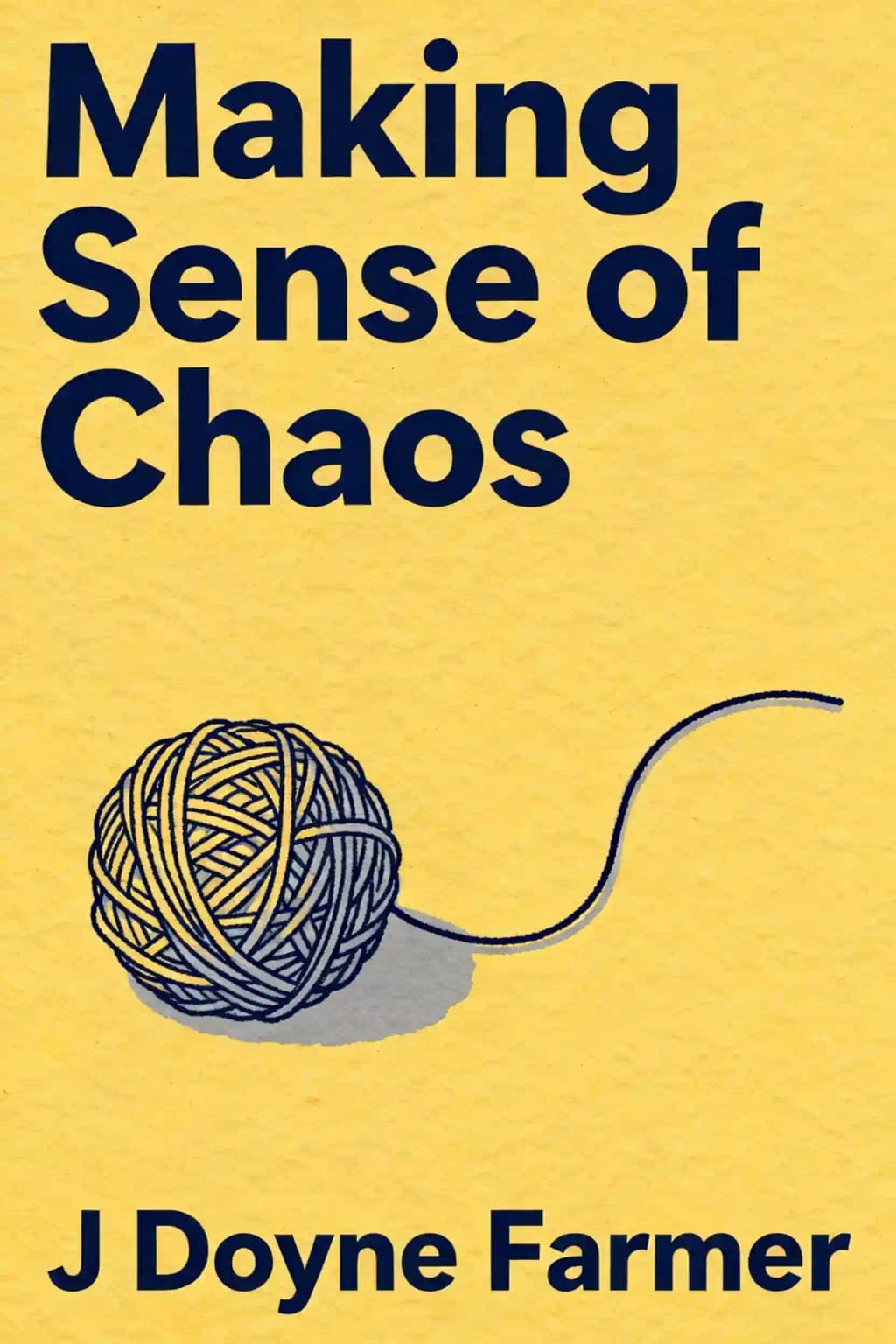
In "Making Sense of Chaos," complexity pioneer J. Doyne Farmer revolutionizes economics with big data insights that predict market crashes and climate impacts. "The world's leading thinker on technological change," according to Max Roser, reveals how chaos theory can build a more sustainable future.
通过作者的声音感受这本书
将知识转化为引人入胜、富含实例的见解
快速捕捉核心观点,高效学习
以有趣互动的方式享受这本书
Imagine a world where butterfly wings in Brazil truly can trigger tornados in Texas. This isn't fantasy - it's the reality of complex systems that J. Doyne Farmer has spent his life decoding. Once a physicist who built the world's first wearable computer to beat roulette in Las Vegas casinos, Farmer has pioneered a revolutionary approach to economics that views markets not as rational, predictable machines but as living ecosystems. When COVID-19 hit in 2020, traditional economic models failed spectacularly, but Farmer's team at Oxford built a simulation that predicted the UK's GDP contraction with astonishing accuracy: 21.5% versus the actual 22.1%. Why? Because they recognized what mainstream economics misses - our economy isn't a clockwork mechanism but a complex adaptive system where patterns emerge from countless interactions. The revelation came to Farmer in 1977 when he witnessed a demonstration of Edward Lorenz's mathematical model - a beautiful butterfly-like pattern that never repeated exactly despite following deterministic equations. This insight explained why predicting seemingly simple systems like roulette proved so difficult: tiny differences in initial conditions become dramatically amplified. This is chaos theory's essence: sensitive dependence on initial conditions and endogenous motion - systems that never settle into steady states despite no external forces acting upon them. Consider business cycles - those mysterious oscillations between boom and bust. What if these aren't caused by external shocks but emerge naturally from internal dynamics? Farmer demonstrated this through an elegant model where households simply copy their most successful neighbors' savings rates. At a critical threshold, the economy spontaneously begins oscillating between growth and recession while simultaneously splitting the population into distinct rich and poor groups - eerily reminiscent of real-world wealth inequality.
将《Making Sense of Chaos》的核心观点拆解为易于理解的要点,了解创新团队如何创造、协作和成长。
将《Making Sense of Chaos》提炼为快速记忆要点,突出坦诚、团队合作和创造力的关键原则。

通过生动的故事体验《Making Sense of Chaos》,将创新经验转化为令人难忘且可应用的精彩时刻。
随心提问,选择声音,共同创造真正与你产生共鸣的见解。

"Instead of endless scrolling, I just hit play on BeFreed. It saves me so much time."
"I never knew where to start with nonfiction—BeFreed’s book lists turned into podcasts gave me a clear path."
"Perfect balance between learning and entertainment. Finished ‘Thinking, Fast and Slow’ on my commute this week."
"Crazy how much I learned while walking the dog. BeFreed = small habits → big gains."
"Reading used to feel like a chore. Now it’s just part of my lifestyle."
"Feels effortless compared to reading. I’ve finished 6 books this month already."
"BeFreed turned my guilty doomscrolling into something that feels productive and inspiring."
"BeFreed turned my commute into learning time. 20-min podcasts are perfect for finishing books I never had time for."
"BeFreed replaced my podcast queue. Imagine Spotify for books — that’s it. 🙌"
"It is great for me to learn something from the book without reading it."
"The themed book list podcasts help me connect ideas across authors—like a guided audio journey."
"Makes me feel smarter every time before going to work"

免费获取《Making Sense of Chaos》摘要的 PDF 或 EPUB 版本。可打印或随时离线阅读。