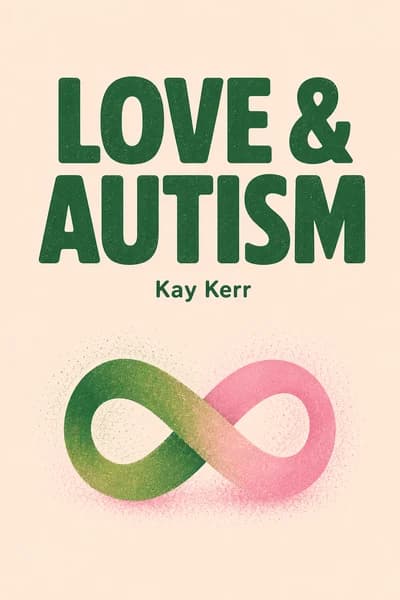
"Love & Autism" reveals five authentic stories of neurodivergent love beyond stereotypes. Kay Kerr's tender exploration has sparked revelations among parents of autistic children - some discovering their own undiagnosed traits. What does radical acceptance truly mean in a world craving authentic connection?
Kay Kerr is an autistic author, journalist, and advocate celebrated for her groundbreaking work in neurodiverse storytelling. Her narrative non-fiction book Love & Autism (Pan Macmillan) draws from her lived experience and journalistic background to explore autistic relationships, identity, and community with nuance and warmth. A former newspaper editor with a Bachelor’s degree in Journalism, Kerr’s writing has appeared in The Guardian, SBS Voices, and ABC, establishing her as a respected voice in disability representation.
She first gained recognition for her debut YA novel Please Don’t Hug Me, shortlisted for the Australian Book Industry Awards and named a Children’s Book Council of Australia Notable Book. Its follow-up, Social Queue, further cemented her reputation for crafting authentic autistic protagonists in coming-of-age stories. Kerr’s work bridges fiction and advocacy, informed by her diagnosis during the drafting of her first novel and her ongoing contributions to autism discourse through essays and public speaking.
Love & Autism continues her mission to reframe neurodiversity narratives, combining memoir elements with journalistic interviews. Her books are widely recommended by autism advocacy groups and educators for their compassionate, own-voices approach.
Love & Autism explores the intersection of neurodivergence and love through personal stories of autistic individuals, challenging stereotypes about emotional capacity and relationships. Kay Kerr highlights diverse experiences—from romantic partnerships to self-acceptance—emphasizing how autistic people navigate communication, sensory sensitivities, and societal expectations while building meaningful connections.
This book is essential for autistic individuals seeking relatable narratives, neurotypical readers aiming to understand neurodiverse relationships, and educators/therapists working with autism. It offers insights into fostering empathy, adaptive communication strategies, and dismantling harmful myths about love and autism.
Yes—it combines rigorous research with intimate storytelling, offering a nuanced perspective on autistic experiences. Readers praise its celebration of neurodivergent resilience and practical examples of successful relationships built on mutual understanding.
The book reframes communication differences, showing how autistic individuals often use direct language, written notes, or tailored methods to express emotions. For example, couples like Maia and Aaron thrive by prioritizing clarity over neurotypical norms like eye contact or metaphorical speech.
Sensory needs—such as touch preferences or noise tolerance—are depicted as central to relationship dynamics. The stories emphasize how partners collaborate to create comfortable environments, balancing intimacy with sensory boundaries.
As an autistic author, Kerr interweaves her journey of diagnosis and self-discovery with interviewees’ stories, creating a tapestry of autistic voices. Her narrative style embraces associative thinking, mirroring neurodivergent communication patterns.
Some readers note the book focuses more on positive examples than systemic barriers. However, critics acknowledge its value in centering autistic perspectives rarely seen in mainstream media.
Unlike clinical guides, Kerr’s work prioritizes lived experiences and emotional depth. It avoids deficit-based language, instead framing autism as a lens for redefining love’s possibilities.
Yes—it provides actionable insights into supporting autistic loved ones without forcing assimilation. Themes like respecting communication styles and sensory needs offer frameworks for healthier family dynamics.
“Why are eye contact and ‘I love you’ considered the markers of love?” This question challenges neurocentric norms, urging readers to embrace diverse expressions of care and commitment.
Kerr dedicates chapters to friendship, self-acceptance, and community bonds. For instance, she discusses how autistic individuals often find profound connection through shared interests or advocacy work.
As conversations about neurodiversity grow, the book remains a critical resource for dismantling stereotypes. Its stories of adaptive love align with broader societal shifts toward inclusivity and intersectional understanding.
通过作者的声音感受这本书
将知识转化为引人入胜、富含实例的见解
快速捕捉核心观点,高效学习
以有趣互动的方式享受这本书
Reality proves them spectacularly wrong.
The language we use to discuss autism matters profoundly.
What if we moved beyond these limiting frameworks?
Early intervention frequently encourages masking, making someone appear to function well while suffering internally.
将《Love & Autism》的核心观点拆解为易于理解的要点,了解创新团队如何创造、协作和成长。
将《Love & Autism》提炼为快速记忆要点,突出坦诚、团队合作和创造力的关键原则。

通过生动的故事体验《Love & Autism》,将创新经验转化为令人难忘且可应用的精彩时刻。
随心提问,选择声音,共同创造真正与你产生共鸣的见解。

"Instead of endless scrolling, I just hit play on BeFreed. It saves me so much time."
"I never knew where to start with nonfiction—BeFreed’s book lists turned into podcasts gave me a clear path."
"Perfect balance between learning and entertainment. Finished ‘Thinking, Fast and Slow’ on my commute this week."
"Crazy how much I learned while walking the dog. BeFreed = small habits → big gains."
"Reading used to feel like a chore. Now it’s just part of my lifestyle."
"Feels effortless compared to reading. I’ve finished 6 books this month already."
"BeFreed turned my guilty doomscrolling into something that feels productive and inspiring."
"BeFreed turned my commute into learning time. 20-min podcasts are perfect for finishing books I never had time for."
"BeFreed replaced my podcast queue. Imagine Spotify for books — that’s it. 🙌"
"It is great for me to learn something from the book without reading it."
"The themed book list podcasts help me connect ideas across authors—like a guided audio journey."
"Makes me feel smarter every time before going to work"

免费获取《Love & Autism》摘要的 PDF 或 EPUB 版本。可打印或随时离线阅读。
What if autism isn't a barrier to love but offers a unique lens through which to experience it? Kay Kerr's groundbreaking exploration flips the traditional narrative on its head. Instead of focusing on what autistic people lack in relationships, she celebrates what they uniquely bring to them. In a world increasingly recognizing neurodiversity, this perspective arrives at the perfect cultural moment - offering validation for autistic readers and illumination for everyone else. The language we use matters profoundly. Many autistic people prefer identity-first language ("I am autistic") over person-first ("person with autism") because autism shapes their fundamental experience of the world - it's not something separate from identity but integral to it, similar to how we say "gay person" rather than "person with gayness." Harmful oversimplifications like "high-functioning" or "low-functioning" create a false dichotomy - either your challenges aren't taken seriously, or your capabilities are underestimated. The reality is far more nuanced: an autistic person might excel professionally while struggling with basic daily tasks, or may be non-speaking yet highly intelligent and capable. Masking - hiding autistic traits to appear neurotypical - further complicates this picture. Many learn to present as less autistic for safety and acceptance, often at tremendous personal cost. This might involve forcing eye contact, suppressing stimming behaviors, or mimicking social cues they don't naturally feel. The mental health implications are significant: chronic anxiety, depression, and burnout often result from sustained masking. What if we moved beyond these limiting frameworks? What if we recognized autism as a neurological difference with its own strengths and challenges rather than a collection of deficits?