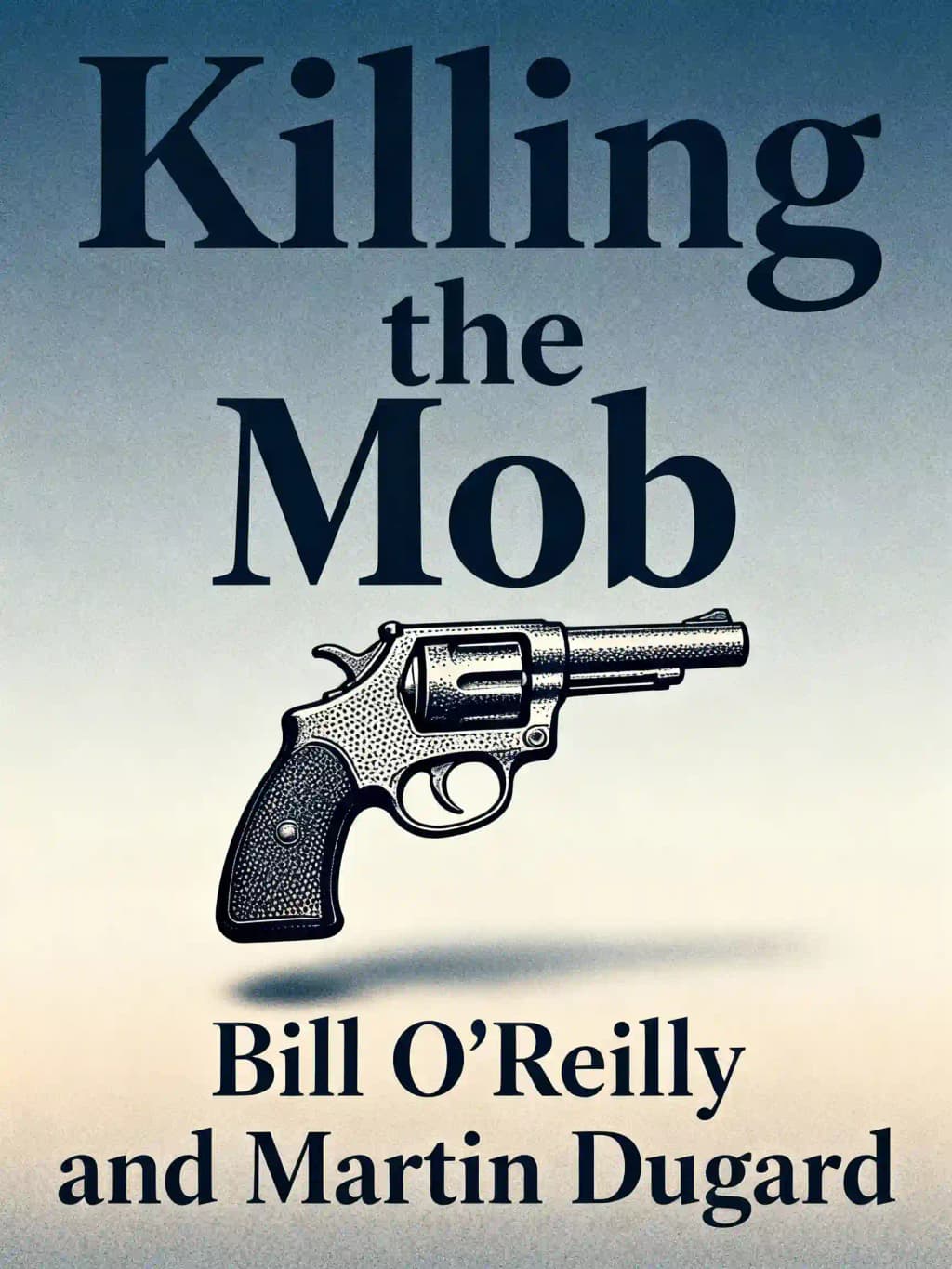
Explore the brutal underworld of American organized crime in O'Reilly's #1 bestseller that's sold millions worldwide. From Bonnie and Clyde to the Five Families, discover how J. Edgar Hoover's FBI battled the mob's iron grip on America's soul.
Bill O’Reilly and Martin Dugard are New York Times bestselling authors of Killing the Mob: The Fight Against Organized Crime in America, leveraging their expertise in historical true crime narratives.
O’Reilly, a Harvard-educated journalist and former host of The O’Reilly Factor, combines his broadcast journalism background with a master’s in public administration to dissect institutional conflicts.
Dugard, an adventurer and historian, contributes his knack for chronicling pivotal moments, honed through works like The Murder of King Tut and his endurance sports journalism in Runner’s World.
Together, they’ve crafted a gripping exploration of Depression-era outlaws, Mafia power struggles, and J. Edgar Hoover’s FBI, building on their acclaimed Killing series (Killing Lincoln, Killing Kennedy). Their collaborative works, adapted into documentaries and praised for cinematic pacing, blend meticulous research with vivid storytelling. The Killing series has dominated bestseller lists, with film and TV adaptations amplifying their cultural impact.
Killing the Mob chronicles America’s 20th-century battle against organized crime, exploring iconic figures like Bonnie and Clyde, John Dillinger, and Mafia bosses such as John Gotti. Co-authored with Martin Dugard, it blends FBI history (J. Edgar Hoover’s reforms) with political clashes (Bobby Kennedy vs. Jimmy Hoffa) and mob influence in Cuba, Las Vegas, and Hollywood. The narrative highlights law enforcement’s gritty efforts to dismantle criminal empires.
True crime enthusiasts, history buffs, and fans of O’Reilly’s Killing series will appreciate this deep dive into organized crime. Its fast-paced, journalistic style suits readers seeking vivid accounts of Depression-era bank robbers, Mafia power struggles, and the Kennedys’ anti-crime campaigns. Those sensitive to graphic violence or abrupt pacing may find sections challenging.
Yes, for its engaging storytelling and well-researched insights into mob history. Reviewers praise its cinematic details (e.g., Bonnie and Clyde’s final shootout) and exposure of crime syndicates’ societal impact. However, critics note rushed conclusions and uneven focus on certain figures. Rated 4.5/5 on StoryGraph.
Key themes include the allure of rebellion (romanticized outlaws), systemic corruption (FBI reforms), and the cyclical nature of crime. It critiques how poverty and prohibition fueled criminal legacies while celebrating law enforcement’s relentless pursuit of justice. The book also examines the Mob’s infiltration of politics and entertainment.
Unlike earlier entries focusing on political figures, this volume emphasizes organized crime’s cultural impact. It retains the series’ signature brisk pacing but delves deeper into underworld mechanics (e.g., Mafia Commission dynamics) and controversial ties (JFK’s alleged mob links). Fans consider it among the series’ best for its scope.
Yes. It details Bobby Kennedy’s feud with Teamsters leader Jimmy Hoffa and explores theories about JFK’s assassination ties to mob retaliation. The book probes the Kennedys’ complex relationship with organized crime, including Marilyn Monroe’s speculated connections.
Some reviewers note abrupt transitions, underdeveloped sections (e.g., John Gotti’s minimal coverage), and excessive focus on the Kennedys. The graphic violence, while historically accurate, is more intense than other Killing series books. Audio listeners found tracking numerous characters challenging.
Yes. Standout chapters include Bonnie and Clyde’s tragic love story, J. Edgar Hoover’s flawed FBI strategies, and John Dillinger’s cinematic demise outside a Chicago theater. The book also reveals lesser-known Mob attempts to control Havana casinos pre-Castro.
Organized crime’s legacy persists due to systemic inequality and corruption, but relentless law enforcement efforts (e.g., wiretapping, undercover ops) have curtailed its power. The book underscores how crime syndicates shaped American culture, from Hollywood to labor unions.
O’Reilly and Dugard blend primary sources (FBI files, court transcripts) with narrative flair. While dramatized dialogue raises minor factual debates, the book is praised for contextualizing events like the St. Valentine’s Day Massacre and Hoffa’s disappearance.
For deeper Mafia insights, pair with Five Families by Selwyn Raab or The Godfather Effect by Tom Santopietro. Fans of crime-era drama may enjoy The Road to Jonestown (Jeff Guinn) or Public Enemies (Bryan Burrough).
通过作者的声音感受这本书
将知识转化为引人入胜、富含实例的见解
快速捕捉核心观点,高效学习
以有趣互动的方式享受这本书
The brutality shocked the nation and prompted President Herbert Hoover to declare war on gangsters.
"We're bigger than U.S. Steel," boasted Meyer Lansky.
This romanticized view conveniently overlooked the trail of bodies these criminals left behind.
By 1936, Hoover believed he had crime under control.
将《Killing the Mob》的核心观点拆解为易于理解的要点,了解创新团队如何创造、协作和成长。
将《Killing the Mob》提炼为快速记忆要点,突出坦诚、团队合作和创造力的关键原则。

通过生动的故事体验《Killing the Mob》,将创新经验转化为令人难忘且可应用的精彩时刻。
随心提问,选择声音,共同创造真正与你产生共鸣的见解。

"Instead of endless scrolling, I just hit play on BeFreed. It saves me so much time."
"I never knew where to start with nonfiction—BeFreed’s book lists turned into podcasts gave me a clear path."
"Perfect balance between learning and entertainment. Finished ‘Thinking, Fast and Slow’ on my commute this week."
"Crazy how much I learned while walking the dog. BeFreed = small habits → big gains."
"Reading used to feel like a chore. Now it’s just part of my lifestyle."
"Feels effortless compared to reading. I’ve finished 6 books this month already."
"BeFreed turned my guilty doomscrolling into something that feels productive and inspiring."
"BeFreed turned my commute into learning time. 20-min podcasts are perfect for finishing books I never had time for."
"BeFreed replaced my podcast queue. Imagine Spotify for books — that’s it. 🙌"
"It is great for me to learn something from the book without reading it."
"The themed book list podcasts help me connect ideas across authors—like a guided audio journey."
"Makes me feel smarter every time before going to work"

免费获取《Killing the Mob》摘要的 PDF 或 EPUB 版本。可打印或随时离线阅读。
A bulletproof Cadillac cruises through Chicago's streets, its passenger wearing a $500 custom suit and diamond pinky ring. He waves to crowds like a celebrity, occasionally stopping to serve soup at charity kitchens. Behind this carefully crafted image lies a man who controls prostitution, illegal alcohol, and gambling across an entire city-a man whose organization employs over 1,000 gunmen and has half the police force on his payroll. This was Al Capone at twenty-six, and he represented something terrifying: crime had become big business. While Americans struggled through the Great Depression with 21.7% unemployment and daily foreclosures, a shadow economy thrived. The Mafia didn't just break laws-they rewrote the rules of American society, infiltrating everything from Hollywood studios to the White House. This is the story of how organized crime became America's most successful criminal enterprise, and how the nation finally fought back.
