第 1 章
A City That Transcends Time and Space: The Eternal Significance of Jerusalem
Jerusalem stands alone among the world's cities-a place that exists twice, once on earth and once in heaven. For three millennia, this modest provincial town in the Judean hills has captivated humanity's imagination, becoming the most contested piece of real estate on earth. Former British Prime Minister Boris Johnson calls it his favorite city, while Oprah Winfrey describes her visit as "life-changing." Even Mark Twain, typically cynical, admitted being moved to tears upon seeing it. Jerusalem's magnetic pull has drawn pilgrims, conquerors, and dreamers throughout history, each arriving with their own vision of what this sacred city should be. As author Amos Oz observed, Jerusalem is like "an old nymphomaniac who squeezes her lovers dry and then turns them into orphans once she's had her way with them."
Jerusalem's transformation from obscure hilltop settlement to holy city began with King David's conquest around 1000 BCE. When David captured the Jebusite fortress of Zion, it was already ancient-Egyptian texts mention "Rushalimum" centuries earlier. The small mountain stronghold was strategically valuable because of its defensible position and access to the Gihon Spring, the region's only reliable water source.
David's genius lay in transforming this practical acquisition into something transcendent. By bringing the Ark of the Covenant-the physical manifestation of God's presence for the Israelites-to Jerusalem, he made the city sacred. In a famous scene that scandalized his wife Michal, David danced ecstatically before the Ark "with all his might," wearing only a linen ephod. This public display of religious fervor established Jerusalem as both political capital and spiritual center.
The king's charisma and military prowess attracted a cosmopolitan court. Rather than slaughtering the conquered Jebusites, David incorporated them into his administration, establishing a pattern of cultural synthesis that would characterize Jerusalem throughout its history. His court included Hittites, Moabites, and Philistines alongside Israelites, creating a multicultural environment where different traditions mingled.
David's Jerusalem was tiny by modern standards-covering just nine acres on what's now called the City of David, south of today's Old City walls. Archaeological excavations have uncovered the foundations of what may be his palace, along with administrative buildings and the famous Warren's Shaft, part of the water system that allowed the city to withstand sieges. Though modest in size, this settlement represented something revolutionary: the first time a city had been established primarily for religious significance rather than economic or strategic value.
第 2 章
The First Temple Era: Solomon's Splendor and the Babylonian Catastrophe
Solomon inherited a unified kingdom and transformed Jerusalem into a glorious capital befitting his reputation for wisdom and wealth. His crowning achievement was the First Temple, built atop Mount Moriah-a site sacred since Abraham's near-sacrifice of Isaac. Construction took seven years and required massive resources: cedar from Lebanon, gold from Ophir, and skilled craftsmen from Phoenicia.
The Temple's design followed ancient Near Eastern patterns but with distinctive monotheistic adaptations. Unlike neighboring temples housing idol statues, the Holy of Holies contained only the Ark of the Covenant beneath two enormous golden cherubim. The Temple complex featured bronze pillars named Jachin and Boaz, a massive bronze "sea" for ritual purification, and golden lampstands illuminating the sanctuary. When completed, according to biblical accounts, "the cloud" of divine presence filled the house of the Lord, establishing Jerusalem as the eternal home of sanctity in the Judeo-Christian-Islamic world.
Solomon's Jerusalem extended beyond religious splendor. He constructed a royal palace complex that took thirteen years to complete-nearly twice as long as the Temple itself. His court featured unprecedented luxury: 700 wives, 300 concubines, and extravagant feasts served on golden plates. Foreign dignitaries like the Queen of Sheba traveled vast distances to witness his wisdom and wealth, cementing Jerusalem's international reputation.
This golden age proved fleeting. Solomon's heavy taxation and forced labor bred resentment, while his religious compromises-building shrines for his foreign wives' gods-angered religious purists. After his death around 930 BCE, the kingdom split, with the northern tribes rejecting his son Rehoboam and establishing a separate Kingdom of Israel. Jerusalem remained capital of the smaller Kingdom of Judah, ruled by Solomon's descendants but diminished in power and prestige.
For the next four centuries, Jerusalem's fortunes waxed and waned under the Davidic dynasty. Kings like Hezekiah strengthened the city's defenses and religious reforms, while others like Manasseh embraced pagan practices, even sacrificing his own son in the Valley of Hinnom-which would later give its name "Gehenna" to the concept of hell in Jewish, Christian and Islamic traditions.
Throughout this period, prophets like Isaiah and Jeremiah walked Jerusalem's streets, condemning corruption and warning of divine judgment. Isaiah's vision of Jerusalem as "the mountain of the Lord's house...established above the hills" where nations would "beat their swords into plowshares" would profoundly influence all three Abrahamic faiths' understanding of the city's cosmic significance.
In 586 BCE, Jerusalem faced catastrophe when Babylonian King Nebuchadnezzar besieged the city. After an eighteen-month ordeal that reduced residents to cannibalism, Jerusalem fell. The Temple was burned, the walls demolished, and most survivors deported to Babylon. King Zedekiah watched his sons executed before being blinded and taken away in chains. This disaster-the "abomination of desolation"-should have ended Jerusalem's story.
Instead, it transformed Jerusalem from physical city to spiritual idea. In Babylonian exile, Jewish communities developed new religious practices centered on prayer, scripture study, and Sabbath observance rather than Temple sacrifice. The Torah took final form during this period, while prophets like Ezekiel offered visions of Jerusalem restored. The city became what scholar Simon Schama calls a "portable homeland," carried in memory and text.
第 3 章
From Exile to Herod's Magnificence: The Second Temple Era
When Persian King Cyrus conquered Babylon in 539 BCE, he astonished the Jews with a decree allowing them to return and rebuild their Temple. This unprecedented religious tolerance reflected Persian imperial policy of respecting local gods. Under Persian governors Zerubbabel and Nehemiah, returning exiles rebuilt Jerusalem's walls and constructed the Second Temple, though many wept that it paled compared to Solomon's splendor.
Jerusalem under Persian rule remained a modest provincial capital, but its religious significance grew. The high priest now functioned as both religious and political leader, while the Temple became the center of an increasingly regulated religious system. During this period, many biblical texts took their final form, establishing Jerusalem's central place in Jewish religious imagination.
When Alexander the Great conquered the Persian Empire in 332 BCE, Jerusalem entered the Hellenistic world. Though Alexander himself likely never visited, his successors-first the Ptolemies of Egypt, then the Seleucids of Syria-controlled the city. Greek culture penetrated Jewish society, with some embracing gymnasiums, Greek education, and cosmopolitan values, while others resisted what they saw as dangerous foreign influences.
This cultural tension erupted into open conflict under Seleucid ruler Antiochus IV Epiphanes. In 167 BCE, he banned Jewish religious practices, desecrated the Temple by sacrificing pigs and installing a statue of Zeus, and executed those who resisted. This provoked the Maccabean Revolt, led by the priest Mattathias and his sons. After years of guerrilla warfare, the Maccabees recaptured Jerusalem, cleansed the Temple, and established the Hasmonean dynasty-the last independent Jewish kingdom until modern Israel.
In 63 BCE, Roman general Pompey captured Jerusalem, ending Hasmonean independence. After decades of civil war and political intrigue, Rome installed Herod the Great as client king in 37 BCE. Despite being half-Edomite and culturally Hellenized, Herod transformed Jerusalem into one of the ancient world's most magnificent cities, earning it Pliny's description as "the most famous city of the East."
Herod's crowning achievement was rebuilding and expanding the Temple. This massive project doubled the Temple Mount's size to 35 acres, supported by massive retaining walls including the Western Wall still standing today. The sanctuary was faced with so much gold that "when the sun rose upon it, it radiated such a fiery splendor that those looking at it had to turn their eyes away." Construction continued long after Herod's death, with Jesus's disciples marveling, "What massive stones! What magnificent buildings!"
Beyond the Temple, Herod built three massive towers (Phasael, Hippicus, and Mariamne), a theater, amphitheater, and luxurious palace with gardens and pools. He constructed an aqueduct bringing water from Solomon's Pools near Bethlehem and expanded the city northward with new residential quarters for the wealthy. Jerusalem's population grew to perhaps 80,000, making it one of the larger cities in the Roman East.
Herod's personal life contrasted sharply with his architectural achievements. Pathologically suspicious, he executed his beloved wife Mariamne and several sons when he suspected conspiracy. On his deathbed, he allegedly ordered noble hostages executed so Jerusalem would mourn his passing-though his sister countermanded this final cruelty.
第 4 章
Jesus to Byzantine Rule: Jerusalem's Christian Transformation
After Herod's death in 4 BCE, Jerusalem came under direct Roman rule through prefects like Pontius Pilate. The city became increasingly volatile, with religious zealots resenting Roman authority and messianic expectations growing among the populace. It was in this charged atmosphere that Jesus of Nazareth entered Jerusalem for his final week, hailed by crowds as "Son of David" before being crucified as "King of the Jews."
Jesus's brief ministry in Jerusalem-cleansing the Temple, debating religious authorities, and ultimately facing crucifixion-would transform the city's significance for billions of future followers. Though his execution outside the city walls was just one of thousands performed by Roman authorities, his followers' belief in his resurrection made Jerusalem Christianity's birthplace.
The early Christian community, led by Jesus's brother James "the Just," remained centered in Jerusalem for decades. They continued worshipping at the Temple while gathering in homes to break bread and share teachings about Jesus as Messiah. Only gradually did Christianity spread beyond its Jewish roots to become a predominantly gentile movement.
Meanwhile, tensions between Jews and Romans continued mounting. In 66 CE, riots against corrupt Roman officials escalated into full-scale revolt. Initially successful, Jewish rebels controlled Jerusalem for four years before Emperor Vespasian sent his son Titus with overwhelming force. After a brutal five-month siege, Romans breached the walls in 70 CE. They burned the magnificent Temple, slaughtered thousands, and carried sacred treasures like the menorah to Rome (depicted on the Arch of Titus that stands today).
Jerusalem lay devastated, though Jewish communities gradually returned. In 132 CE, another rebellion erupted under Simon Bar Kokhba, whom Rabbi Akiva proclaimed the Messiah. Emperor Hadrian's response was genocidal-hundreds of thousands killed, survivors sold into slavery, and Jerusalem transformed into the pagan colony Aelia Capitolina, with Jews banned from entering except once yearly to mourn their Temple's destruction.
For nearly two centuries, Jerusalem remained a minor Roman provincial town, with pagan temples where the Jewish Temple had stood. This changed dramatically in 313 CE when Emperor Constantine legalized Christianity. His mother Helena visited Jerusalem in 326, identifying sites associated with Jesus's life and commissioning the Church of the Holy Sepulchre over his supposed tomb. Jerusalem rapidly transformed into a Christian pilgrimage center, with monasteries, churches, and hospices replacing pagan structures.
Under Byzantine rule, Jerusalem became thoroughly Christianized. Empress Eudocia expanded the city walls to their largest extent and built numerous churches. Emperor Justinian constructed the massive Nea Church, declaring "Solomon, I have surpassed thee!" The Temple Mount remained deliberately desolate, fulfilling Jesus's prophecy while demonstrating Christianity's supposed triumph over Judaism.
Christian pilgrims flooded Jerusalem from across the empire, following elaborate liturgical calendars that reenacted Jesus's life events at their traditional locations. The Holy Sepulchre became Christianity's most sacred site, with rituals like the miraculous Holy Fire ceremony drawing thousands. Though Jews were officially banned, some were permitted to pray once yearly at the Western Wall, keeping alive hopes of eventual restoration.
第 5 章
Islamic Jerusalem: From Conquest to Crusades
In 637 CE, Caliph Omar accepted Jerusalem's surrender from Patriarch Sophronius. Unlike previous conquerors, Omar showed remarkable restraint. Finding the Temple Mount covered with garbage, he personally helped clear it. He established a small prayer area south of the Foundation Stone, where Muslims believed Muhammad had ascended to heaven during his Night Journey.
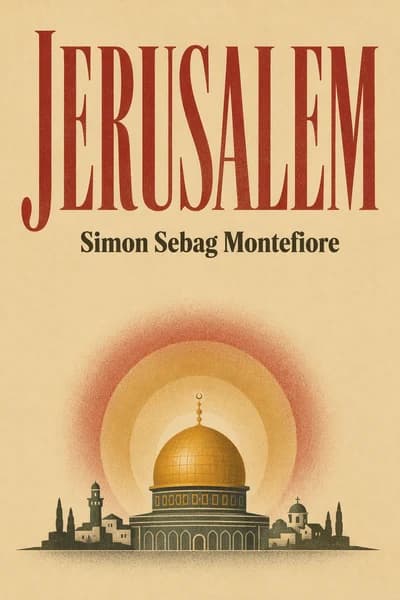
Under Umayyad Caliph Abd al-Malik, this modest structure was replaced in 691 by the magnificent Dome of the Rock-the golden-domed octagonal building that still defines Jerusalem's skyline. Its architecture brilliantly synthesized Byzantine and Persian elements, while Quranic inscriptions proclaimed Islamic theology: "Say not three...God is One." Nearby, al-Aqsa Mosque was constructed as Jerusalem's main congregational mosque.
These buildings transformed the Temple Mount into the Haram al-Sharif (Noble Sanctuary), Islam's third holiest site after Mecca and Medina. For Muslims, Jerusalem became al-Quds (the Holy), where Muhammad had led all previous prophets in prayer before his heavenly ascent. Islamic tradition held that the Last Judgment would occur here, with souls crossing a hair-thin bridge from the Mount of Olives to the Temple Mount.
Early Islamic rule was relatively tolerant. Jews returned to Jerusalem after centuries of Byzantine exclusion, while Christians maintained their churches and pilgrimages. The city flourished as a multicultural center where scholars of different faiths sometimes engaged in respectful dialogue. This "golden age" continued under the Abbasid caliphs, though Jerusalem's importance diminished as Baghdad became the empire's focus.
Jerusalem's fortunes declined in the 10th century as the Abbasid caliphate fragmented. In 1009, the mentally unstable Fatimid Caliph al-Hakim ordered the destruction of the Church of the Holy Sepulchre and other Christian sites. Though his successors permitted rebuilding, this destruction became a rallying cry for European intervention.
On July 15, 1099, European knights of the First Crusade stormed Jerusalem after a month-long siege. What followed was unprecedented slaughter-Muslims and Jews massacred regardless of age or gender, with chroniclers boasting that knights rode "in blood up to their bridles." Crusaders gathered at the Holy Sepulchre to give thanks, even as streets remained strewn with decomposing bodies.
第 6 章
The Crusader Kingdom and Saladin's Restoration
The Crusaders established the Latin Kingdom of Jerusalem with Godfrey of Bouillon as its first ruler, taking the humble title "Advocate of the Holy Sepulchre" rather than king. After his death a year later, his brother Baldwin I was crowned Jerusalem's first Latin king. For nearly nine decades, this unlikely kingdom survived, surrounded by hostile Muslim powers but sustained by Italian maritime support and fresh waves of European crusaders.
Crusader Jerusalem was transformed into a European city. The Temple Mount became headquarters of the Knights Templar, who believed they occupied Solomon's Temple. Al-Aqsa Mosque became a royal palace, while the Dome of the Rock was consecrated as Templum Domini (Temple of the Lord). New churches, monasteries, and markets gave the city a distinctly Western character, though Eastern Christians maintained their own quarters and institutions.
Queen Melisende, daughter of an Armenian princess and French crusader, exemplified Jerusalem's hybrid culture. Her exquisite psalter combined Byzantine, Islamic, and Western artistic elements. During her reign (1131-1153), Jerusalem enjoyed relative stability and cultural flourishing, with new buildings like the Church of St. Anne and expanded Holy Sepulchre.
This Latin kingdom remained a colonial enterprise, with Franks (European crusaders) forming a military aristocracy over the native population. Though they gradually adopted Eastern customs-wearing lighter clothing, enjoying local cuisine, and sometimes learning Arabic-the fundamental division between conquerors and conquered remained. Muslims and Jews were excluded from the city except as visitors, while Eastern Christians faced discrimination despite shared faith.
The kingdom's fall began with the rise of Zengi and his son Nur al-Din, who united Muslim Syria against the crusader states. In 1187, Saladin-Kurdish sultan of Egypt and Syria-decisively defeated crusader forces at the Horns of Hattin, capturing King Guy and the True Cross. Jerusalem surrendered after brief resistance, ending 88 years of Christian rule.
Unlike the crusaders' bloody entry, Saladin's conquest of Jerusalem in October 1187 demonstrated remarkable restraint. He negotiated surrender terms allowing Christians to depart after paying ransom, personally freed many captives, and protected Eastern Christians who chose to remain. This magnanimity enhanced his reputation even among European Christians, who would later mythologize him as the noble adversary of Richard the Lionheart.
Saladin immediately restored Jerusalem's Islamic character. The golden cross atop the Dome of the Rock was pulled down, and the building reconsecrated as a Muslim shrine. Al-Aqsa Mosque was cleansed and restored after decades as a Templar headquarters. The Temple Mount once again became the Haram al-Sharif, with Friday prayers drawing thousands.
Yet Saladin's tolerance extended to other faiths. He allowed Eastern Christians continued access to their churches, though the Holy Sepulchre was briefly closed. He invited Jews to return to Jerusalem after their century-long exclusion, with scholars like Maimonides visiting the city. Saladin established religious endowments (waqfs) supporting Islamic institutions while respecting existing Christian sites.
第 7 章
From Mamluks to Ottomans: Medieval Jerusalem
In 1250, the Mamluks-elite slave soldiers who had overthrown their Ayyubid masters-seized control of Egypt and Syria. Under Sultan Baibars, they defeated both Crusaders and Mongols, eventually eliminating the last Crusader strongholds in 1291. Jerusalem, though no longer a political capital, enjoyed renewed importance as an Islamic center.
Mamluk sultans embellished the Haram al-Sharif with exquisite additions: madrasas, fountains, and minarets featuring their distinctive architectural style of alternating light and dark stone courses. Sultan Qaitbay built the elegant Ashrafiyya madrasa beside the Dome of the Rock, while Tankiz constructed markets and bathhouses throughout the city.
The Mamluks enforced strict Islamic hierarchy, with Jews and Christians relegated to clearly inferior status. They were required to wear distinctive clothing (yellow for Jews, blue for Christians) and faced periodic persecution. Nevertheless, small communities persisted-Rabbi Moses ben Nahman (Nahmanides) established a synagogue in the Jewish Quarter in 1267 that would survive in various forms until 1948.
Jerusalem's population remained modest, perhaps 10-15,000 inhabitants. The city faced periodic crises from plague, earthquake, and Mongol threats. When Timur (Tamerlane) approached in 1400, Jerusalem's leaders surrendered the keys to avoid destruction. By the early 16th century, Mamluk power was declining, with corruption and factional struggles weakening their once-formidable military state.
In 1517, Ottoman Sultan Selim "the Grim" conquered Jerusalem from the Mamluks. His son Suleiman "the Magnificent" transformed the city with magnificent building projects, most notably the walls that still define the Old City today. Completed in 1541, these massive fortifications with their distinctive gates and towers have survived largely intact for nearly five centuries.
Suleiman also restored the city's water supply through aqueducts and cisterns, built public fountains, and renovated the Dome of the Rock with its distinctive blue-and-white tiles. His wife Roxelana established charitable foundations including a soup kitchen, mosque, and pilgrim hostel. These projects reflected both religious devotion and imperial prestige-Jerusalem remained important to Ottoman sultans who claimed the caliphate and leadership of the Islamic world.
Under Ottoman rule, Jerusalem's religious communities operated under the millet system, with each faith governing its internal affairs. The Jewish population grew significantly, particularly after the 1492 expulsion from Spain brought Sephardic refugees with their distinctive language (Ladino) and traditions. By the late 16th century, Jews formed the largest religious group in Jerusalem, concentrated in their quarter near the Western Wall.
第 8 章
European Influence and the Birth of Modern Jerusalem
The 19th century brought dramatic changes to Jerusalem as European powers competed for influence. Russia established massive pilgrim hostels and churches on the Mount of Olives, while France claimed protectorate status over Catholics. Britain, motivated by evangelical interest in Jewish restoration, established a consulate in 1838 under James Finn, who actively supported Jewish communities.
European visitors transformed Jerusalem's economy and landscape. Thomas Cook organized the first package tours in the 1860s, building hotels and establishing regular steamship connections. Mark Twain, visiting in 1867, found Jerusalem "mournful, dreary and lifeless," yet couldn't help being moved by its ancient power. Melville, Flaubert, and other literary figures recorded their impressions, usually combining fascination with disappointment at the city's squalor.
This period saw the first modern Jewish immigration as persecution in Eastern Europe drove thousands to seek refuge in their ancestral homeland. Sir Moses Montefiore, Anglo-Jewish philanthropist, built the first Jewish neighborhood outside the walls (Mishkenot Sha'ananim) in 1860, complete with windmill and almshouses. Other neighborhoods soon followed as the Jewish population grew from 2,000 in 1800 to over 25,000 by 1914.
European archaeological expeditions uncovered Jerusalem's ancient layers. Charles Warren's tunnels along the Temple Mount revealed Herodian foundations, while Conrad Schick mapped the city's complex water systems. These discoveries strengthened connections between modern Jerusalem and its biblical past, fueling both scholarly interest and religious enthusiasm.
The late Ottoman period brought modernization to Jerusalem-the first road to Jaffa (1869), telegraph connections, newspapers, and eventually a railway (1892). Yet the city remained deeply traditional, with religious pilgrims from all faiths maintaining centuries-old practices alongside these innovations.
World War I transformed Jerusalem forever. After four centuries of Ottoman rule, British General Edmund Allenby captured the city in December 1917, famously entering on foot through Jaffa Gate out of respect for its sanctity. The British Mandate that followed (1920-1948) established Jerusalem as an administrative capital with modern institutions and infrastructure.
The Mandate period was shaped by three intersecting forces: British imperial administration, Zionist Jewish immigration, and emerging Arab nationalism. The 1917 Balfour Declaration had promised "a national home for the Jewish people" in Palestine, creating expectations that increasingly clashed with Arab aspirations for independence.
第 9 章
Divided and Reunited: Jerusalem in the Modern Era
When the British Mandate ended in May 1948, Jerusalem immediately became a battlefield. The newly declared State of Israel fought Arab forces for control of the city. After bitter fighting that included the Jewish Quarter's fall and massacre of a medical convoy, the city was divided: Israel held the western neighborhoods, while Jordan controlled the Old City and eastern sectors.
For nineteen years, Jerusalem remained physically divided by barbed wire, minefields, and sniper positions. Israelis could not access the Western Wall or other Jewish holy sites, while Palestinian refugees from western neighborhoods couldn't return to their homes. The armistice line ran through the heart of the city, with Jordanian soldiers stationed just yards from Israeli positions.
Jordan annexed East Jerusalem, making it part of the West Bank. King Abdullah was assassinated while praying at al-Aqsa Mosque in 1951, but his grandson Hussein maintained Hashemite control of the city. Jordan renovated Islamic sites and developed limited tourism, though East Jerusalem remained economically stagnant compared to the Israeli sector.
Israel declared West Jerusalem its capital in 1950, moving government offices from Tel Aviv despite international non-recognition. The western city developed rapidly with new neighborhoods, universities, and the Knesset (parliament) building. Yet it remained an isolated frontier city, accessible only by a narrow corridor through the Judean hills.
This abnormal situation ended dramatically in June 1967. When war erupted between Israel and its Arab neighbors, Jordan shelled West Jerusalem despite Israeli pleas to stay neutral. Israeli forces responded by capturing the Old City and all of East Jerusalem. Defense Minister Moshe Dayan declared at the Western Wall: "We have returned to our holiest places...and we shall never depart from them again."
Israel immediately annexed East Jerusalem, declaring the "reunified" city its eternal capital. The Moroccan Quarter adjacent to the Western Wall was demolished to create a plaza for Jewish worshippers, while new Jewish neighborhoods were constructed on annexed land. Palestinians in East Jerusalem received "permanent resident" status rather than citizenship, creating an ambiguous legal situation that persists today.
International reaction was overwhelmingly negative, with UN Resolution 242 calling for Israeli withdrawal from territories occupied in the war. Most countries maintain their embassies in Tel Aviv, though the United States moved its embassy to Jerusalem in 2018, recognizing Israeli sovereignty.
Jerusalem today remains deeply divided despite physical unification. The city's population of nearly one million is approximately 60% Jewish and 40% Palestinian, with small Christian communities. Jewish Jerusalem spans from ultra-Orthodox neighborhoods like Mea Shearim to secular districts and modern settlements. Palestinian Jerusalem includes the Muslim and Christian Quarters of the Old City and eastern neighborhoods like Silwan and Sheikh Jarrah, many facing eviction pressures and settlement expansion.
第 10 章
Jerusalem's Spiritual Guardians and Contested Future
At dawn each morning, Jerusalem's ancient rhythms continue through the actions of families who have maintained sacred traditions for centuries. The Judeh family has safeguarded the key to the Church of the Holy Sepulchre since Saladin's time, while the Nusseibehs serve as doorkeepers-positions they've held since at least the 12th century. Though once wealthy landowners, the Nusseibehs now make their living primarily as tour guides, having lost most of their property over generations.
Meanwhile, Adeb al-Ansari begins his daily ritual of opening the gates of the Haram al-Sharif, a responsibility his family has fulfilled since Saladin appointed them custodians. It takes him a full hour to unlock the four main gates of the Dome of the Rock and ten gates of al-Aqsa. Though proud of this "noble and sacred work," he supplements his meager income with a hotel job.
As the sun rises, Naji Qazaz, whose family has served as muezzins at al-Aqsa for five centuries, prepares for the dawn call to prayer. After twenty minutes of stretching and vocal preparation, he faces Mecca and begins the adhan that echoes across the Old City, joining thousands of muezzins who have preceded him in this ritual.
These families embody Jerusalem's living continuity-ordinary people maintaining extraordinary traditions across centuries of political upheaval. Their daily routines connect present-day Jerusalem to its rich past, demonstrating how the city's sacred character transcends the conflicts that so often dominate headlines.
The Temple Mount/Haram al-Sharif remains the most sensitive flashpoint in contemporary Jerusalem. After capturing the site in 1967, Israel granted administrative control to the Islamic Waqf while maintaining security oversight. Jews can visit but not pray openly, a restriction that religious nationalists increasingly challenge. Periodic violence erupts around this sacred space, most recently in May 2021 when clashes sparked wider conflict.
Despite these tensions, daily life continues. Jerusalem hosts world-class universities, museums, and cultural institutions. Its markets bustle with activity, restaurants serve diverse cuisines, and religious celebrations mark the calendar year-round. The ancient and modern coexist as light rail trains pass medieval walls, and archaeological excavations reveal new layers of the city's 3,000-year history.
Jerusalem defies simple solutions. Proposals for its future range from continued Israeli sovereignty to Palestinian capital, international administration, or various forms of shared control. Each option faces fierce opposition from those who see exclusive possession as essential to their identity and security.
Yet Jerusalem's history reveals that nothing was inevitable; there were always choices. The city has known periods of tolerance and coexistence alongside episodes of terrible violence. Its sacred sites have been shared, borrowed, and transformed across centuries. Jerusalem's essence lies not in exclusive possession but in its universal significance-a city that belongs to everyone and no one.
Perhaps Jerusalem's paradoxical nature offers wisdom for its future. As philosopher Sari Nusseibeh suggests, peace requires mutual recognition of each other's historical claims and sacred narratives. The city's physical spaces might be shared politically while allowing each community to maintain its spiritual connections. After all, Jerusalem has always been a place where heaven and earth meet, where the divine and human intersect in complex, sometimes contradictory ways.
As morning light illuminates the ancient stones, all three faiths engage in prayer: Muslims at the Dome, Jews at the Western Wall, Christians at the Holy Sepulchre. The sun catches the golden dome that "glints back at the sun" and eventually falls on the sealed Golden Gate, which "remains locked, until the coming of the Last Days"-a reminder that for billions worldwide, Jerusalem represents not just a contested city but the ultimate destination of human history.