第 1 章
The Straight-A Secret: Work Smarter, Not Harder
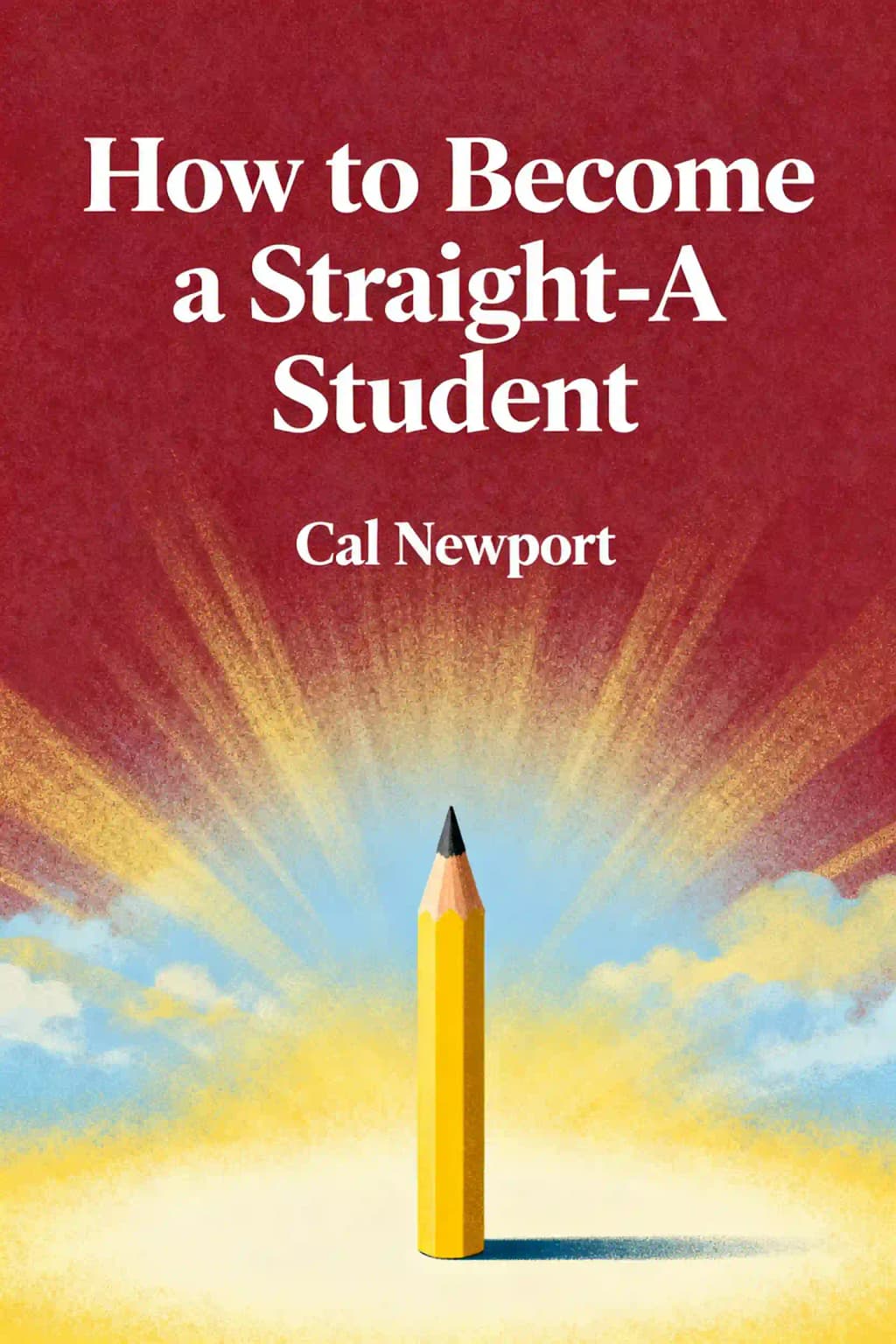
When Cal Newport arrived at Dartmouth College, he quickly realized that his high school study habits wouldn't cut it. Through experimentation, he developed a revolutionary approach that earned him 35 perfect A's out of 36 courses-while spending less time studying than his peers. The secret wasn't endless grinding but ruthless efficiency. At his Phi Beta Kappa induction, Newport discovered that the thirty highest-GPA students weren't just bookworms-they were well-rounded individuals who had independently discovered similar secrets to academic success.
Unlike study advice from professors suggesting unrealistic schedules, Newport's methods are battle-tested by actual students. "How to Become a Straight-A Student" has become a cult classic among high-achieving college students, with many reporting that it transformed their academic experience. Even productivity guru Tim Ferriss has recommended it as essential reading for anyone looking to maximize their learning efficiency. What makes this book so powerful is its practicality-these aren't theoretical techniques but real strategies used by top performers at elite universities.
第 2 章
The Fundamental Problem: Pseudo-Working vs. True Productivity
Most college students aren't lacking time-they're lacking efficiency. They exist in what one Brown University student calls "a state of permanent catch-up," constantly feeling behind despite spending hours "studying." The culprit is pseudo-working: appearing busy while accomplishing little.
The straight-A formula is deceptively simple: work accomplished = time spent x intensity of focus. Top students maximize intensity to minimize time. A ten-hour study session with low intensity (3/10) produces the same results as three one-hour bursts at maximum intensity (10/10)-but the latter approach frees up your entire day.
This principle explains how straight-A students maintain robust social lives while excelling academically. They're not studying more; they're studying smarter. When you observe a student spending all night in the library, surrounded by energy drinks and snacks, you're witnessing inefficiency in action. Their environment is distracting, and their marathon approach guarantees diminishing returns as mental fatigue sets in.
The solution isn't scheduling more study hours but transforming how you use the hours you have. This requires mastering three foundational skills: basic time management to distribute intense work sessions, self-motivation to overcome procrastination, and strategic planning about when, where, and how long to study. With these basics in place, you'll not only improve your grades but also enjoy more free time, better sleep, and a more balanced college experience.
第 3 章
Time Management in Five Minutes a Day
Contrary to popular belief, straight-A students aren't obsessive planners. They use time management not to maximize work but to minimize stress. When deadlines and obligations float unorganized in your mind, you can never fully relax.
The ideal college time-management system requires minimal effort (5-10 minutes daily), avoids rigid scheduling, prevents cramming, and can be quickly restarted after periods of neglect. You need just two tools: a calendar with space for multiple daily entries and a simple list you carry throughout the day.
The process works in three steps: First, throughout the day, jot down new tasks and assignments on your portable list. Second, each morning, transfer these items to your calendar. Third, take a few minutes to plan your day by time-labeling tasks-assigning specific periods for completion.
When scheduling, be realistic about how long things take. Group small tasks together, leave plenty of time for breaks, and end your day at a reasonable hour. If everything doesn't fit, simply move remaining items to future dates. The key is being honest with yourself about what's possible in a day.
Consider Stephen's experience: A busy student with multiple classes, assignments, and social commitments, he uses this simple system to maintain control. On Monday, he completes his morning classes and scheduled tasks, then adapts when unexpected events arise. After finishing his government reading early, he joins a friend for an unplanned Wal-Mart run. When he discovers an email about a study group, he quickly modifies his schedule. Throughout the day, he captures new tasks in his "Things to Remember" column, ensuring nothing falls through the cracks.
Because Stephen completed significant work before evening, he could truly relax and enjoy a party without stress. Without this simple approach, he likely would have forgotten small tasks, possibly missed working on his Anthropology paper, and completed far less schoolwork overall.
第 4 章
Winning the War on Procrastination
Even straight-A students feel the urge to procrastinate. The difference is they've developed specific strategies to sidestep this urge when it arises. They don't "defeat" procrastination-they simply limit its destructive impact through battle-tested rules.
The first strategy is keeping a work progress journal. Buy a spiral notebook and each morning write down your most important scheduled tasks. At day's end, note whether you completed them-if not, record your explanation. Having to document your procrastination exposes the foolishness of your rationalizations, especially when the same task is delayed day after day. The journal acts like a personal drill sergeant, making you accountable to yourself.
The second strategy is "feeding the machine" by maintaining high energy. Your brain needs proper fuel to resist procrastination. Drink water constantly to increase energy and reduce sleepiness. Monitor caffeine carefully-no more than one large caffeinated beverage per hour, starting with something strong but then switching to decaf, tea, or water. Choose snacks for sustained energy rather than quick satisfaction-vegetables, fruit, whole grains, lean proteins, and natural granola provide steady fuel, while refined carbohydrates cause energy crashes. Never skip meals, even on busy days.
For particularly dreadful tasks, transform them into special events. Find an out-of-the-way restaurant or coffee shop-preferably beyond walking distance from campus. Set a specific time to work there and tell everyone about your horrible task. The novelty of the location and its distance from campus's distractions will jump-start your motivation. You'll feel awkward sitting alone doing nothing in a public place, which naturally pushes you to begin working.
Another effective strategy is building a routine. Identify at least one consistent free hour on each weekday-preferably in the morning or early afternoon. Use these protected hours to do the same work each week. The goal is transforming these work periods into habits that require no willpower to begin. While these five weekly hours won't complete all your work, they represent guaranteed productivity that can break the seal on your motivation for the day.
Finally, choose your hard days in advance. Scout out one or two days to preemptively designate as "hard," spacing them so you never have two consecutive difficult days. Plan relaxing activities before and after to ease their impact. Prepare mentally by telling friends which days will be tough. This psychological preparation transforms the experience-instead of feeling drained by an unexpected work marathon, you'll feel invigorated by conquering a challenge you anticipated.
第 5 章
The Science of Study Environments
The seemingly small details of studying can dramatically impact your productivity. When during the day should you study? Where should you go? How long should you work before taking a break? Getting these basics right will allow you to squeeze more work out of less time.
Study between when you wake up and when you eat dinner-this is when your mental energy peaks. Though many students believe evenings are ideal for work, nighttime is actually shorter than you think, filled with social temptations, and when your body naturally winds down. Instead, bring study materials everywhere and fill small daytime gaps between classes and activities with productive work.
Be efficient by heading straight to study spots near your next class, mentally preparing to begin working immediately. Avoid your dorm room during the day to separate work from relaxation. This approach offers better focus, higher energy, and feels less strenuous than marathon evening sessions. By maximizing daytime study pockets, you free up valuable evening hours for social experiences.
Where you study matters tremendously. Identify multiple isolated spots across campus and rotate through these hidden locations. Avoid your dorm and busy public study spaces where distractions abound. Seek out less-visited libraries away from campus centers, carrels high in the stacks or buried in basements, small libraries in student organization buildings, hole-in-the-wall coffee shops, or local public libraries.
Multiple locations prevent burnout and ensure you always have a nearby spot as you move between classes. Isolation shields you from the "procrastination devil" who can sell you on any visible alternative to studying. The dramatic nature of quarantining yourself in a study bunker psychologically elevates the importance of your work-a mental edge nearly every straight-A student leverages.
How long should you study? No more than one hour at a time without a break. Take five to ten minute breaks every hour to intellectually disengage by concentrating on something unrelated-read an article, send emails, or work on a personal project. Many students bring novels or newspapers to read during breaks. Even when feeling "on a roll," keep taking breaks as they maximize energy and retention over time.
Research suggests 40-50 minute increments are optimal for retention. The evidence is overwhelming-nearly every straight-A student follows this pattern: "Not more than an hour" (Chris), "One hour, then get up and do something else" (Melanie), "About forty minutes to an hour" (Ryan). Through trial and error, dozens of high-performing students have individually discovered this same technique.
第 6 章
The Art of Smart Note-Taking
Always attend class! As one Dartmouth student explains: "it'll take twice as long studying to make up for what you missed." But attendance alone isn't enough-you must take quality notes that capture the essence of what's being taught.
Use a laptop whenever possible for better speed and legibility, though math and science courses with equations may require paper. Keep one folder per class for handouts and assignments. Avoid complicated color-coding systems-content matters more than appearance.
When taking notes, be ruthlessly practical about formatting. Use aggressive text formatting-bold fonts, lists, underlining, indentations, boxes, bullet points-anything that helps emphasize important points. Don't worry about consistency; develop your own shorthand that makes sense to you. Skip lines freely, use tabs, change font sizes, capitalize entire sentences-whatever helps you visualize key concepts.
For humanities and social sciences, structure your notes using Question/Evidence/Conclusion format. Don't try recording lectures verbatim-it's impossible and counterproductive. Instead, identify the questions being explored, record relevant evidence, and formulate conclusions. Professors often structure lectures this way, even if they don't explicitly state the questions or conclusions.
For example, in a lecture on the Roman Empire's decline, you might first record evidence points on the fly, then add the question ("Was there really a big 'fall' of the Roman Empire?") and conclusion once the professor's direction becomes clear. The conclusion might note that the idea of catastrophic decline overstates reality and places too much emphasis on European developments.
For class discussions, simplify your strategy. Label the discussion topic, then record only insightful points made by students or yourself. Ignore mistaken or irrelevant comments. Most importantly, write down and heavily underline anything the professor contributes.
For technical courses (math, science, engineering, economics), forget about big ideas and focus on recording sample problems. These become your most important study resource. Counterintuitively, don't do technical readings before class-the same material will be covered by the professor. Instead, bring your textbook to class and follow along as the professor presents examples.
Since professors move quickly through examples, prioritize what you record. First, capture problem statements and answers-even if you miss intermediate steps. Second, ask questions when confused or mark confusing sections with question marks for later review. Third, try to record the steps of sample problems, especially for the first example of a new technique. Finally, if time permits, annotate the steps with explanations of what they accomplish or why they're important.
第 7 章
The Secret to Efficient Assignments
Most students spend excessive time on reading assignments and problem sets, leaving no time to prepare for exams and projects. Straight-A students have mastered minimizing assignment time while still learning what they need.
Avoid "day-before" assignment planning, which makes large assignments tedious and creates problems when multiple assignments are due simultaneously. Instead, work constantly in small chunks every day. Complete one problem set problem daily rather than five hours the night before. For readings, tackle a chapter a day. Even when caught up, continue working ahead-easy weeks rarely come in pairs.
It's impossible to read everything assigned in college-there simply aren't enough hours in the day. Prioritize "favored sources" (textbooks or course readers that appear consistently) and read these completely. For supplemental readings, follow this hierarchy: readings that make arguments are most important, followed by those describing events or people, with contextual readings (speeches, press clippings) being least important.
For favored sources, take notes using the question/evidence/conclusion framework. Type your notes for better organization and speed. First, identify the question being answered by the author. Next, find the author's conclusion or thesis. Then skim the entire reading, making checkmarks next to important paragraphs that support the conclusion. A typical article should take no more than 20-30 minutes and produce about one page of notes.
When tackling problem sets, work on them constantly in small chunks rather than all at once. When stuck, leverage available resources-collaborate with classmates of similar skill level, scheduling group work 2-3 days before deadlines to focus on the most challenging problems. Always attend office hours with specific questions prepared.
For difficult problems requiring creative insight, don't force solutions during scheduled study blocks. Instead, prime yourself by first understanding what makes the problem challenging, then think about it during everyday activities-while walking across campus, waiting in line, or taking a shower. This mobile problem-solving approach works because your subconscious continues working on the problem.
Save time by recording problem solutions formally the first time you write them down. Many students waste effort by first jotting informal answers and later reformatting them for submission. Instead, write carefully and deliberately from the start, producing submission-quality work immediately.
第 8 章
Mastering Exam Preparation
Straight-A students don't consider studying a big deal because they've already done most of the work through smart note-taking and assignment completion. If you've followed the previous steps, preparing for an exam requires only organizing your material and conducting targeted review.
Before studying, clearly define the exam's scope by determining which lectures and readings are covered, what types of questions will be asked, whether it's open-note or open-book, if formulas must be memorized, and how much time will be allowed. If your professor hasn't provided these details two weeks before the exam, don't hesitate to ask.
For nontechnical courses, create a study guide by gathering all relevant notes and organizing them into topic-based "chapters." Print out typed notes or gather written pages, cluster them by general topic, label each pile clearly, and fasten them together for easy transport between study locations.
For technical courses, create "mega-problem sets" by gathering all relevant problem sets and supplementing them with sample problems from lecture notes. For each lecture, copy just the questions (not solutions) onto separate sheets labeled with the lecture date, then attach these to the corresponding problem set. Additionally, create "technical explanation questions" that test your understanding of fundamental concepts rather than just problem-solving steps.
The most effective way to imprint concepts is through active recall rather than passive review. Whether studying philosophy or calculus, first review a concept, then try to explain it in your own words without aids. If you can articulate an argument or reproduce a solution from scratch, you've truly mastered it-unlike merely reading over material repeatedly.
For nontechnical courses, create practice quizzes using questions from your notes. When reviewing, articulate answers out loud in complete sentences or write them down-never just answer in your head! Mark questions you struggle with, review them, take breaks, and repeat until you can answer all questions. This method is efficient because you spend more time on difficult material and have a clear endpoint.
For technical courses, start with conceptual explanation questions before moving to sample problems from your mega-problem set. After mastering your materials, try past exams under timed conditions as a final check of your understanding.
第 9 章
Test-Taking Strategies That Win Points
Even well-prepared students can bomb exams due to poor test-taking skills. The two most common pitfalls are running out of time and providing incomplete answers. Straight-A students follow five key strategies to maximize performance.
Always begin by reviewing all exam questions before answering any. This familiarizes you with the length and difficulty of what lies ahead, primes your brain for upcoming topics, and helps you relax. Even while working on early questions, part of your brain will begin retrieving information for later questions.
Build a time budget by taking the exam time, subtracting ten minutes for a safety buffer, then dividing by the number of questions. For exams with few questions, mark start and finish times for each question directly on the test. For many questions, divide the exam into fourths and note when each section should be completed.
Never tackle exam questions in order. Start with the easiest questions to ensure maximum points on what you know best. This approach prevents panic when encountering difficult questions early on. When you face challenging questions at the end, you'll feel less pressure since everything else is completed.
Never start writing essays without planning. First, carefully reread the question and underline each "mini-question" within it. Next, jot down relevant points in the margin using brief keywords. Check that your notes address all underlined parts of the question, then number these points in presentation order. Only then should you begin writing.
If you have extra time after finishing an exam, always review your answers. You'll be surprised how often this reveals mistakes in technical problems or important concepts you forgot to mention. Don't worry about neatness when adding information with carets and arrows-content matters more than appearance. Resist the temptation to leave early; using every available minute can make the difference between being above average and becoming an academic star.
第 10 章
The Paper-Writing System That Eliminates Stress
Paper writing is challenging but doesn't need to be as difficult as most students make it. While college-level papers require serious thinking that can't be reduced to the simple high school format, the process can be broken into three components: sifting through existing arguments, forming your own argument, and communicating it clearly.
Most students inefficiently combine these into one draining process, constantly cycling between research, thinking, and writing. The straight-A approach separates these components into distinct challenges, each handled with efficient systems across eight steps.
First, target a titillating topic. For research papers, find a subject that genuinely interests you, as your enthusiasm will make the entire process easier. Start looking early-from the first day of class, note readings or questions that grab your attention.
Next, conduct a thesis-hunting expedition. For research papers, find enough material to develop a strong thesis without drowning in information. Start with basic sources like recent histories or biographies, then examine their bibliographies to find more focused sources. A great thesis should be provocative, nuanced, direct, and inclusive while leaving room for complexity.
When researching, follow a mechanical process: find sources, make personal copies of all sources, annotate the material, and decide if you're done. Use Library of Congress topic classifications in online catalogs, search journal databases like JSTOR, and ask reference librarians for help. Photocopy or print all relevant material rather than relying on original books or digital files. Read through sources quickly, jotting down page numbers and brief descriptions whenever you encounter relevant information.
With a compelling thesis and well-organized research material, it's time to craft a powerful story. Create a topic-level outline-a list of self-contained points presented in logical order. Start with a topic skeleton that captures your paper's flow, then fill in supporting details by inserting actual quotes from your research under each topic heading.
Getting input on your paper significantly improves its quality. Scale your expert panel to match the assignment's importance. Your professor should be your first choice, followed by smart friends from the same class who understand the assignment constraints.
If you've followed these steps, writing should be straightforward-you already know what to say and in what order. Keep your research, writing, and editing phases separate. Write in quiet isolation during your daily energy peaks. Use your outline as a guide and build your paper one paragraph at a time.
For editing, follow a three-pass system: The Argument Adjustment Pass (focusing on content and structure), the Out Loud Pass (reading aloud to catch grammatical errors and awkward constructions), and the Sanity Pass (a final quick review before submission). This balanced approach ensures thorough editing without endless revisions.
第 11 章
The Power of Academic Systems
The strategies in this book aren't just about grades-they're about taking control of your education and future. By mastering these skills, you're declaring that college is about expanding knowledge and mental abilities while having fun. Exceptional grades open doors to competitive opportunities, allowing you to decide your post-college path rather than having it dictated by your major or job market conditions.
The two crucial insights from Newport's approach are that brute force study habits are inefficient, and better techniques require much less time while producing superior results. Once you experience the benefits of these methods, you'll wonder how you ever studied differently.
What makes these strategies so powerful is that they're not theoretical-they're the actual methods used by real straight-A students at elite universities. They've been tested in the crucible of competitive academic environments and proven effective across disciplines from humanities to hard sciences.
By implementing these systems, you'll not only improve your academic performance but also reclaim hours of your life previously lost to inefficient study habits. The result is a college experience that's both more successful and more enjoyable-the true definition of working smarter, not harder.