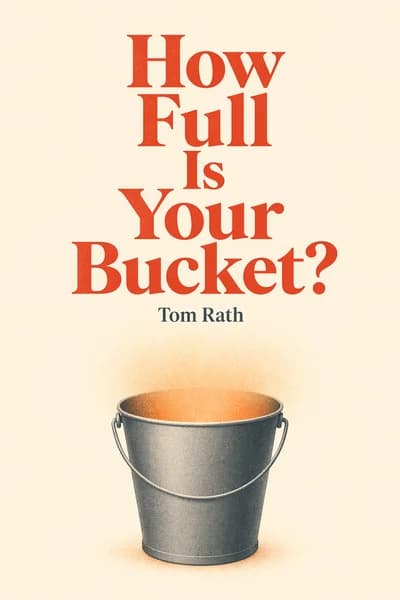
How Full Is Your Bucket?
Positive Strategies for Work and Life
《How Full Is Your Bucket?》概述
Discover why "How Full Is Your Bucket?" became a #1 NYT bestseller, transforming workplace dynamics with its simple yet profound question: are you filling or emptying others' emotional buckets? Universities nationwide use this 10-million-copy phenomenon to revolutionize human interactions.
《How Full Is Your Bucket?》核心主题
- positive reinforcement
- emotional intelligence
- workplace recognition
- interpersonal dynamics
- strengths-based leadership
《How Full Is Your Bucket?》经典语录
When it's full, you feel great. When it's empty, you feel awful.
The number one reason people leave their jobs is that they don't feel appreciated.
The choice is yours.
Positivity transforms your world, one interaction at a time.
《How Full Is Your Bucket?》主要人物
- Tom RathAuthor and researcher of positive interactions
- CharlotteManager who implemented bucket-filling strategies
下载《How Full Is Your Bucket?》摘要
免费获取《How Full Is Your Bucket?》摘要的 PDF 或 EPUB 版本。可打印或随时离线阅读。
关于本书的常见问题
How Full Is Your Bucket? explores the impact of positivity and negativity through the metaphor of an invisible "bucket" and "dipper." Positive interactions fill buckets, boosting well-being and productivity, while negativity drains them. The book combines 50 years of research with actionable strategies to cultivate positivity in work, relationships, and daily life, emphasizing how small gestures create lasting change.
This book is ideal for leaders, managers, and individuals seeking to improve workplace morale, personal relationships, or emotional resilience. It’s particularly valuable for those navigating team dynamics, parenting challenges, or self-improvement goals, offering tools to foster gratitude and reduce negativity.
Key concepts include:
- The Bucket Metaphor: Everyone has an emotional bucket; positivity fills it, negativity empties it.
- The 5:1 Ratio: Five positive interactions counteract one negative one for healthy relationships.
- Five Strategies: Prevent bucket-dipping, highlight positives, build friendships, give unexpectedly, and personalize praise.
The book advocates for recognition, gratitude, and constructive feedback to boost employee engagement. For example, Gallup studies show teams with regular praise see 20–50% productivity increases. Managers are urged to replace criticism with strengths-based coaching to reduce turnover and improve morale.
The "dipper" represents actions that add to or drain others’ emotional buckets. Criticizing or ignoring someone dips from their bucket, while encouragement fills it. This theory underscores reciprocity: filling others’ buckets also enriches your own.
Some argue the metaphor oversimplifies complex emotions, potentially dismissing valid negative experiences. Others note the focus on individual actions may overlook systemic workplace issues. However, its practicality and research-backed strategies remain widely praised.
Unlike Atomic Habits (focusing on routines) or The Power of Now (mindfulness), this book emphasizes interpersonal dynamics. Its actionable framework—like the five strategies—differentiates it from abstract self-help guides. Fans of The 5 Love Languages may appreciate its focus on personalized positivity.
- “Each interaction fills or empties your bucket.”
- “Positivity is a learned skill, not an accident.”
- “The magic ratio: five positives for every negative.”
Parents can model gratitude, praise effort over outcomes, and teach children to recognize "bucket-filling" actions. For example, using a physical bucket prop helps kids visualize how kindness impacts others. The book’s kid-friendly version reinforces these lessons through stories.
The authors cite Gallup studies spanning 40+ years, including 4 million workplace interviews. Findings link positivity to higher productivity, better health, and longevity. For instance, teams with frequent praise report 30% fewer errors and 37% lower absenteeism.
The 2023 edition updates research and adds a 23-page workbook for team-building exercises, self-assessment tools, and actionable worksheets. It strengthens the link between bucket-filling and modern challenges like remote work and mental health.
Rath’s resilience through health struggles (vision loss, cancer) illustrates bucket-filling in adversity. His grandfather, coauthor Donald Clifton, pioneered strengths psychology, grounding the book in family legacy and empirical research. Their collaboration blends storytelling with data-driven insights.


