第 1 章
Intel's Blueprint: How Great Managers Multiply Success
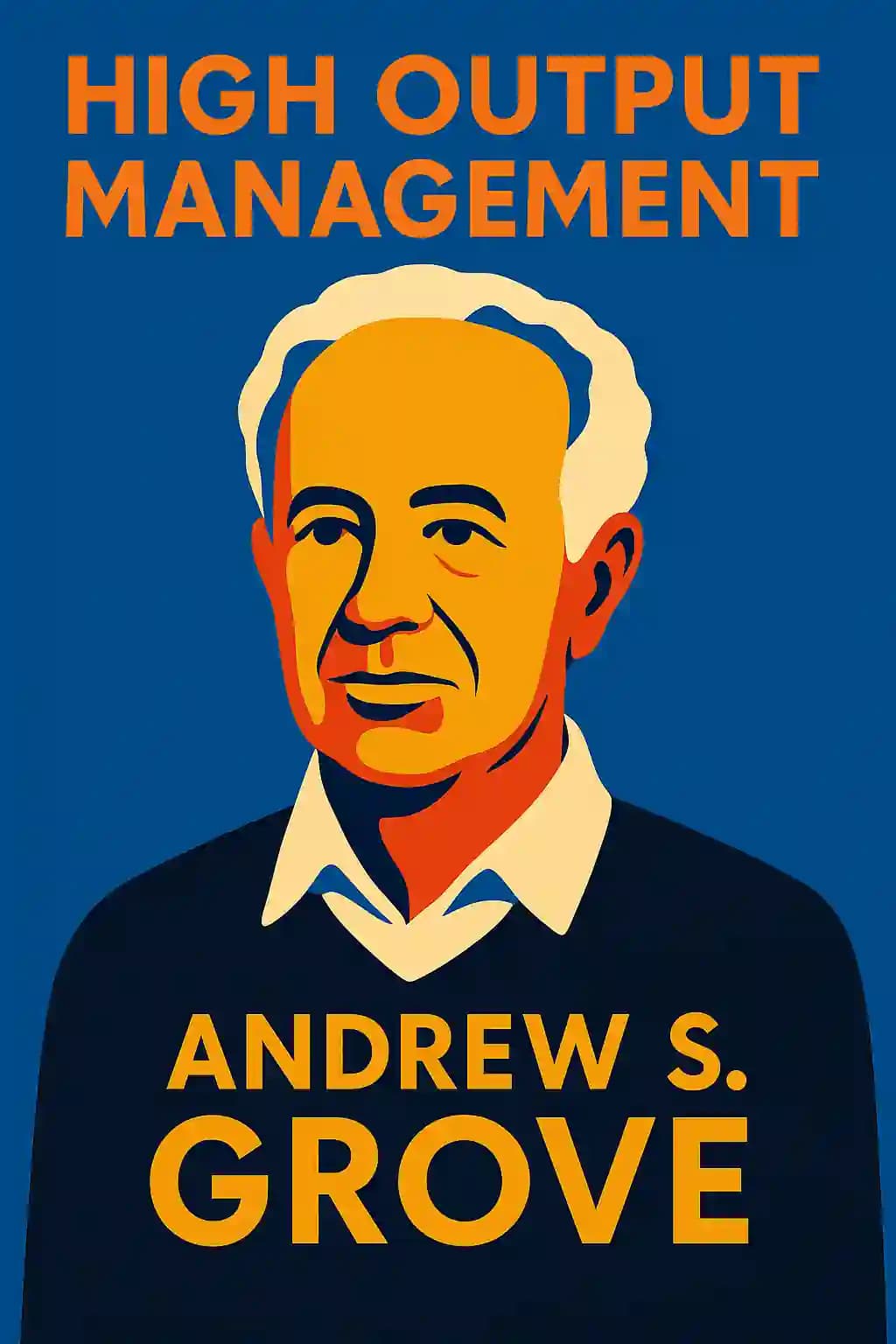
Before Andy Grove transformed Intel into a $20 billion tech giant, he developed a management system so powerful that Steve Jobs considered him "the greatest manager of his or any era." In "High Output Management," Grove delivers the ultimate playbook for creating exponential results through others - a bible that's influenced tech titans from Mark Zuckerberg to Ben Horowitz for decades.
This isn't abstract theory; it's battle-tested wisdom from the Hungarian refugee who escaped both Nazis and Communists before revolutionizing Silicon Valley. Grove dismantles the complexity of management into practical formulas: his famous "leverage" principle shows how small actions can create massive organizational impact.
Whether you're managing two people or two thousand, Grove's counterintuitive insights will transform how you approach meetings, decisions, and performance - revealing why the best managers focus on outputs rather than activities. The productivity framework within these pages doesn't just help you work better; it completely redefines what effective leadership means in our knowledge economy.
The question isn't whether you can afford to read this classic - it's whether you can afford not to.
第 2 章
The Breakfast Factory: A Universal Model of Production
Imagine a breakfast restaurant as the perfect metaphor for understanding any production system. Whether you're serving eggs and toast, developing software, or manufacturing microchips, the fundamental principles remain the same. The goal is delivering quality output at the right time while minimizing costs.
In this breakfast factory, the three-minute egg becomes the "limiting step" around which all other activities must be synchronized. This concept applies universally-in recruiting, the campus interview is the limiting step that dictates the pace of the entire hiring process. In software development, the compiler construction becomes the critical path determining delivery timelines.
What makes Grove's approach revolutionary is how he identifies the universal patterns across seemingly different industries. A college recruitment process follows the same basic flow as manufacturing microprocessors: process (screening resumes), assembly (interviews), and test (evaluation). Even rehabilitating criminals follows this pattern-intake assessment, rehabilitation program, and parole evaluation.
The real challenge comes in navigating the complexities of real-world production. Equipment breaks down. Staff call in sick. Inventory fluctuates. Success depends on understanding how these elements interlink and developing systems to monitor and adjust them in real-time. As Grove notes, "Production flows are like water streams-they're full of fish, and the manager needs to know how to catch them."
第 3 章
Indicators: Windows into the Black Box
How do you know what's happening inside your operation? Through carefully selected indicators that serve as windows into what Grove calls the "black box" of your production system.
Think of arriving at your breakfast factory each morning. What do you need to know immediately? Perhaps five key metrics: yesterday's sales, today's forecast, raw material inventory, staff availability, and equipment status. These indicators don't just tell you what happened-they guide what you should do next.
The most powerful indicators come in pairs that balance each other. For instance, measuring both inventory levels and shortages prevents overreacting to one at the expense of the other. In administrative work, pairing output quantity with quality ensures neither suffers.
"Leading indicators are like headlights on a car," Grove explains. "They illuminate what's ahead before you get there." By spotting trends early, you can intervene before small issues become major problems. A sudden uptick in customer complaints about cold eggs might signal an equipment problem before the toaster fails completely.
The format of indicators matters too. Daily monitors track immediate issues, while stagger charts reveal trends over time. The key is selecting indicators that provide genuine insight rather than just data. As one Intel manager discovered, tracking the number of engineering change orders revealed more about product development health than any other metric.
第 4 章
Managerial Leverage: Multiplying Your Impact
What exactly is a manager's output? It's not what they personally produce-it's the output of their organization plus the output of neighboring organizations under their influence. This perspective transforms how we think about managerial effectiveness.
A manager's activities fall into three categories: information gathering, information sharing, and decision-making. The leverage of these activities-how much output they generate relative to the effort invested-determines a manager's true productivity.
Consider Robin at Intel, who spent three days creating a one-page decision-making guide for handling customer complaints. That single page influenced hundreds of customer service representatives, affecting thousands of customer interactions. That's high leverage-a small input generating massive output.
Conversely, negative leverage occurs when managers show up unprepared to meetings, wasting everyone's time, or when they allow their bad mood to spread depression throughout their team. The magnitude of influence works both ways.
Delegation represents one of the highest leverage activities available, but only when done properly. True delegation means giving someone else the task, the responsibility, and sufficient freedom to determine how to accomplish it. It's not abdication-you remain ultimately accountable-but it multiplies what your team can accomplish.
"When you delegate, you're not just getting something off your plate," Grove writes. "You're creating an opportunity for someone else to grow while multiplying your own effectiveness."
第 5 章
Meetings: The Medium of Managerial Work
If you've ever complained about meetings, Grove offers a perspective shift: meetings aren't a distraction from work-they are the work of management. They're the medium through which managers exchange information, make decisions, and solve problems.
Process-oriented meetings create a regular cadence for handling predictable work. One-on-ones between managers and their direct reports should occur on a rolling schedule, with frequency determined by the subordinate's "task-relevant maturity." For newer employees or those tackling unfamiliar tasks, weekly meetings might be necessary. For experienced veterans, once every few weeks might suffice.
The one-on-one isn't primarily for the manager's benefit-it's for the subordinate. That's why Grove insists these meetings take place in the subordinate's office or workspace. The agenda should focus on what's preoccupying the subordinate, with the manager primarily asking questions rather than giving speeches.
Staff meetings serve a different purpose-creating horizontal communication among peers and allowing the manager to observe team dynamics. The most effective staff meetings balance structured agenda items with free discussion periods, allowing for both focused decision-making and creative problem-solving.
Operation reviews bridge the gap between junior and senior management, providing a forum for information to flow up and down the organizational hierarchy. These meetings serve as training grounds where junior managers learn presentation skills and senior managers demonstrate how to analyze complex problems.
"The medium of management is human beings," Grove reminds us. "And meetings are how human beings in organizations synchronize their activities and align their understanding."
第 6 章
Decision-Making: Balancing Knowledge and Position
As knowledge becomes increasingly specialized, traditional hierarchical decision-making faces challenges. The person with the authority to decide may not have the expertise to make the best decision. This tension between positional power and knowledge power requires a new approach.
Grove advocates for a process that begins with free discussion, where all relevant perspectives are shared openly. This is followed by a clear decision, after which everyone commits to supporting the decision regardless of whether they personally agree with it.
The "peer-group syndrome" often hampers this process. In meetings among peers, people hesitate to express strong opinions until they sense which way the wind is blowing. This leads to circular discussions that only resolve when someone with higher authority enters the room.
To combat this, Grove suggests asking six key questions when making decisions: What decision needs to be made? By when? Who should be consulted? Who decides? Who needs to be informed? Who will follow up to ensure completion?
"A good decision made quickly is far better than a perfect decision made too late," Grove observes. "The timing of decisions is as important as their content."
第 7 章
Planning: Preparing Today for Tomorrow's Challenges
Planning isn't an abstract exercise-it's the practical work of aligning resources with future needs. Grove's three-step approach makes planning concrete and actionable:
First, assess environmental demand by identifying all factors that will place demands on your organization, from customer needs to competitive pressures to technological trends.
Second, evaluate your present status by cataloging current capabilities, ongoing projects, and expected completions or failures. This gives you a realistic picture of what you can deliver without additional action.
Third, develop specific actions to close the gap between future demands and current capabilities. This includes determining what's necessary, what's feasible, and how to sequence implementation.
The distinction between strategy and tactics becomes crucial here. Strategy answers "what" and "why," while tactics address "how" and "when." Different management levels require different strategic horizons-a CEO might plan years ahead, while a first-line supervisor focuses on the coming weeks.
Management by Objectives (MBO) applies this planning process to daily work. By setting clear objectives and tracking progress through defined milestones, MBO ensures everyone knows where they're going and how they'll measure progress.
"Planning is not about predicting the future," Grove explains. "It's about making sure you have a future."
第 8 章
Hybrid Organizations: The Team of Teams
As organizations grow, they inevitably become hybrid structures balancing mission-oriented and functional elements. This reflects the reality that no single organizational model perfectly addresses all business needs.
Consider computer resources in a large company. When centralized, they provide economies of scale and consistent standards. When decentralized, they offer responsiveness to local needs. The optimal approach often oscillates between these poles based on technology changes and management capabilities.
This leads to dual reporting relationships, where employees report to both a functional manager (who maintains technical standards) and a mission manager (who focuses on daily operations). At Intel, security personnel reported to both a corporate security manager and a local plant manager, ensuring both technical excellence and operational effectiveness.
The "two-plane" organization further complicates this picture. Employees like Cindy at Intel operate in two distinct organizational planes simultaneously-the vertical hierarchy of their plant and the horizontal peer group of specialists across multiple plants. This creates a matrix where coordination becomes essential.
"The modern organization isn't a simple hierarchy," Grove notes. "It's a complex network of relationships that must be actively managed."
第 9 章
Modes of Control: Markets, Contracts, and Culture
How do organizations ensure people take appropriate actions? Grove identifies three fundamental modes of control, each suited to different circumstances:
Free-market forces work when self-interest naturally aligns with desired outcomes. When buying tires, both buyer and seller pursue their self-interest through a straightforward transaction.
Contractual obligations become necessary when transactions grow more complex. Service level agreements, performance metrics, and formal reviews create accountability where market forces alone wouldn't suffice.
Cultural values guide behavior in situations too complex for explicit rules or contracts. When employees internalize organizational values, they make decisions aligned with those values even without specific instructions.
The appropriate mode depends on environmental complexity and motivational alignment. In simple environments where self-interest dominates, markets work best. As complexity increases or group interests become more important, contracts and cultural values become more effective.
"The manager's job," Grove writes, "is to select the right mode of control for each situation and to nurture the cultural values that will guide behavior when rules cannot."
第 10 章
Motivation: The Engine of Performance
The single most important task of a manager is eliciting peak performance from their subordinates. Yet motivation cannot be imposed externally-it must be cultivated within an environment that allows it to flourish.
Grove draws on Maslow's hierarchy of needs to explain motivation. As basic needs for sustenance and safety are met, people become motivated by social belonging, esteem, and ultimately self-actualization-the drive to fulfill one's potential.
Money motivates differently at different need levels. For those struggling with basic needs, it's a direct motivator. For those at higher levels, money becomes more a measure of achievement than a motivator itself.
The most powerful motivator for knowledge workers is task-relevant feedback-concrete information about how they're performing. This feedback creates a virtuous cycle where improved performance leads to increased motivation, which in turn drives further performance improvements.
Fear remains a potential motivator, but its nature changes as people move up Maslow's hierarchy. Fear of punishment gives way to fear of failure, which can either spur achievement or lead to excessive caution.
"The sports analogy is apt," Grove suggests. "Athletes are motivated not primarily by money but by the desire to perform at their best and to win. The workplace can tap into the same motivational forces by providing clear goals and meaningful competition."
第 11 章
Task-Relevant Maturity: The Key to Effective Management
One of Grove's most influential concepts is "task-relevant maturity" (TRM)-the combination of achievement orientation, readiness to take responsibility, and education/experience relevant to a particular task.
A manager must adapt their style based on the subordinate's TRM for the specific task at hand. For low TRM, a structured, directive approach works best, with clear instructions and frequent monitoring. For medium TRM, a more supportive style emphasizing two-way communication is appropriate. For high TRM, minimal involvement focused on objectives and resources allows for maximum autonomy.
This explains why the same manager might need different approaches with different subordinates, or even with the same subordinate on different tasks. A brilliant engineer might have high TRM for technical work but low TRM for budget management.
"Management styles are not like clothes that come in only one size," Grove explains. "The effective manager must be able to use different styles for different situations and different people."
第 12 章
Performance Reviews: The Crucial Feedback Loop
Performance reviews serve as a vital cornerstone of organizational development, fulfilling multiple critical purposes: providing structured feedback, enhancing employee motivation, and ensuring alignment between individual performance and company culture. While these reviews often generate anxiety for both managers and subordinates, their importance in professional development cannot be understated.
The most common mistakes managers make in conducting reviews stem from several key areas. First, providing overly general feedback like "you need to be more proactive" without specific examples leaves employees confused about exactly what to improve. Second, managers frequently fail to offer concrete, actionable guidance for improvement, leaving subordinates aware of problems but unclear on solutions. Third, blindsiding employees with unexpected criticism during formal reviews damages trust and effectiveness - feedback should be ongoing rather than saved for annual meetings.
Effective reviews follow a clear structure that balances recognition with development opportunities:
• Begin with specific positive achievements, using concrete examples
• Address no more than 2-3 key areas for improvement
• Provide clear, measurable objectives for future development
• Include specific timeframes and check-in points
• End with an action plan that both parties agree upon
When addressing serious performance issues, managers must understand the psychological journey their subordinates typically experience. Similar to the stages of grief, employees often move through:
1. Denial ("The metrics must be wrong")
2. Anger ("Others are making me look bad")
3. Bargaining ("If I had different resources...")
4. Depression ("Maybe I'm not cut out for this")
5. Acceptance ("I understand what I need to change")
Grove emphasizes that the performance review should be forward-looking: "The performance review is not just about the past," he states. "It's primarily about improving future performance." This perspective shifts the conversation from criticism to development, making reviews more constructive and actionable. Managers should spend at least 50% of the review discussing future goals and development plans rather than dwelling exclusively on past performance.
To maximize effectiveness, reviews should be:
• Regular and predictable
• Well-documented with specific examples
• Focused on behaviors rather than personality
• Connected to clear organizational objectives
• Followed up with ongoing feedback and support
This approach transforms performance reviews from dreaded annual events into valuable tools for professional growth and organizational success.
第 13 章
Training: The Manager's Most Leveraged Activity
Training represents one of the highest-leverage activities a manager can perform, with the potential to create exponential returns on time invested. By personally training subordinates, managers multiply their impact while ensuring alignment with organizational priorities and building stronger teams. This leverage effect occurs because well-trained employees not only perform better themselves but often go on to train others, creating a cascade of improved performance throughout the organization.
Grove insists that managers should conduct training themselves rather than delegating it entirely to HR or external programs. When managers teach, they reinforce their own understanding of principles while demonstrating their commitment to those principles. This direct involvement also allows managers to:
• Share real-world examples from their experience
• Answer specific questions relevant to their team's context
• Identify knowledge gaps in their organization
• Build stronger relationships with team members
• Model the behaviors and standards they expect
The process begins by listing all training needs, from basic tasks to broader organizational goals. Grove recommends creating a comprehensive training matrix that includes:
1. Technical skills specific to the role
2. Process and procedural knowledge
3. Company culture and values
4. Leadership and management skills
5. Industry and market awareness
Starting with a simple course on a critical topic allows for refinement before expanding to more complex subjects. Grove suggests beginning with foundational skills that have immediate practical application. This approach helps build confidence and momentum while providing quick wins for both trainer and trainees.
The training itself should follow several key principles:
• Clear learning objectives
• Interactive elements and hands-on practice
• Real-world examples and case studies
• Regular checks for understanding
• Follow-up assignments to reinforce learning
After teaching, anonymous critiques help improve future sessions. Grove emphasizes the importance of creating a feedback loop that includes:
• Written evaluations from participants
• Performance metrics before and after training
• Long-term follow-up to assess retention
• Peer feedback on implementation
• Suggestions for future topics
"When you train people well," Grove concludes, "you don't just improve their performance-you improve their ability to improve their performance." This multiplicative effect makes training one of the most powerful tools in a manager's arsenal for building organizational capability and maintaining competitive advantage. The investment in training pays dividends far beyond the immediate skill transfer, creating a learning culture that drives continuous improvement and innovation.
第 14 章
The Manager as Micro-CEO
Throughout High Output Management, Grove portrays the manager as a "micro-CEO" responsible for optimizing their organization's output. This perspective elevates management from mere supervision to strategic leadership, requiring managers to think and act with the same comprehensive oversight as a chief executive, regardless of their level in the organization.
Grove emphasizes that like CEOs, managers must excel in three critical domains: resource allocation, strategic planning, and talent development. They need to make decisions about where to invest time and resources, anticipate future challenges, and build teams capable of executing their vision. For example, a product manager must balance engineering resources across different features, plan for market changes, and develop their team's capabilities - much like a CEO does at a larger scale.
In today's rapidly changing environment shaped by globalization and technological revolution, managers must embrace chaos while quickly restoring order. This dual capability requires developing what Grove calls "controlled chaos management" - maintaining enough structure to ensure stability while allowing sufficient flexibility to innovate and adapt. They must plan like fire departments-ready for emergencies yet prepared to respond swiftly when the unexpected occurs. This means creating robust systems and processes while maintaining the agility to pivot when circumstances demand it.
The most successful managers combine analytical thinking with emotional intelligence, technical expertise with people skills, and strategic vision with tactical execution. Grove illustrates this through the "hybrid manager" concept - someone who possesses both deep domain knowledge and strong leadership capabilities. These managers can effectively:
• Translate technical requirements into business outcomes
• Build and motivate cross-functional teams
• Balance short-term needs with long-term objectives
• Navigate both strategic and operational challenges
They understand that management is ultimately about multiplying human effectiveness-enabling people to achieve more together than they ever could separately. This multiplication effect comes through:
• Creating clear objectives and metrics
• Removing obstacles to productivity
• Fostering collaboration and knowledge sharing
• Building systems that scale individual efforts
As Grove reminds us, "The output of a manager is the output of the organizational units under his or her supervision." This means that a manager's success is measured not by their individual contributions, but by their ability to enhance and amplify the work of others. By applying the principles of High Output Management, managers at all levels can dramatically increase that output-and with it, their value to their organizations and their careers. This requires constant attention to both performance indicators and team development, ensuring that both immediate results and long-term capabilities are strengthened.
The micro-CEO mindset ultimately transforms how managers approach their role, encouraging them to think more broadly about their impact and take greater ownership of their organization's success. It pushes them to develop both the strategic acumen and the operational excellence needed to thrive in today's complex business environment.