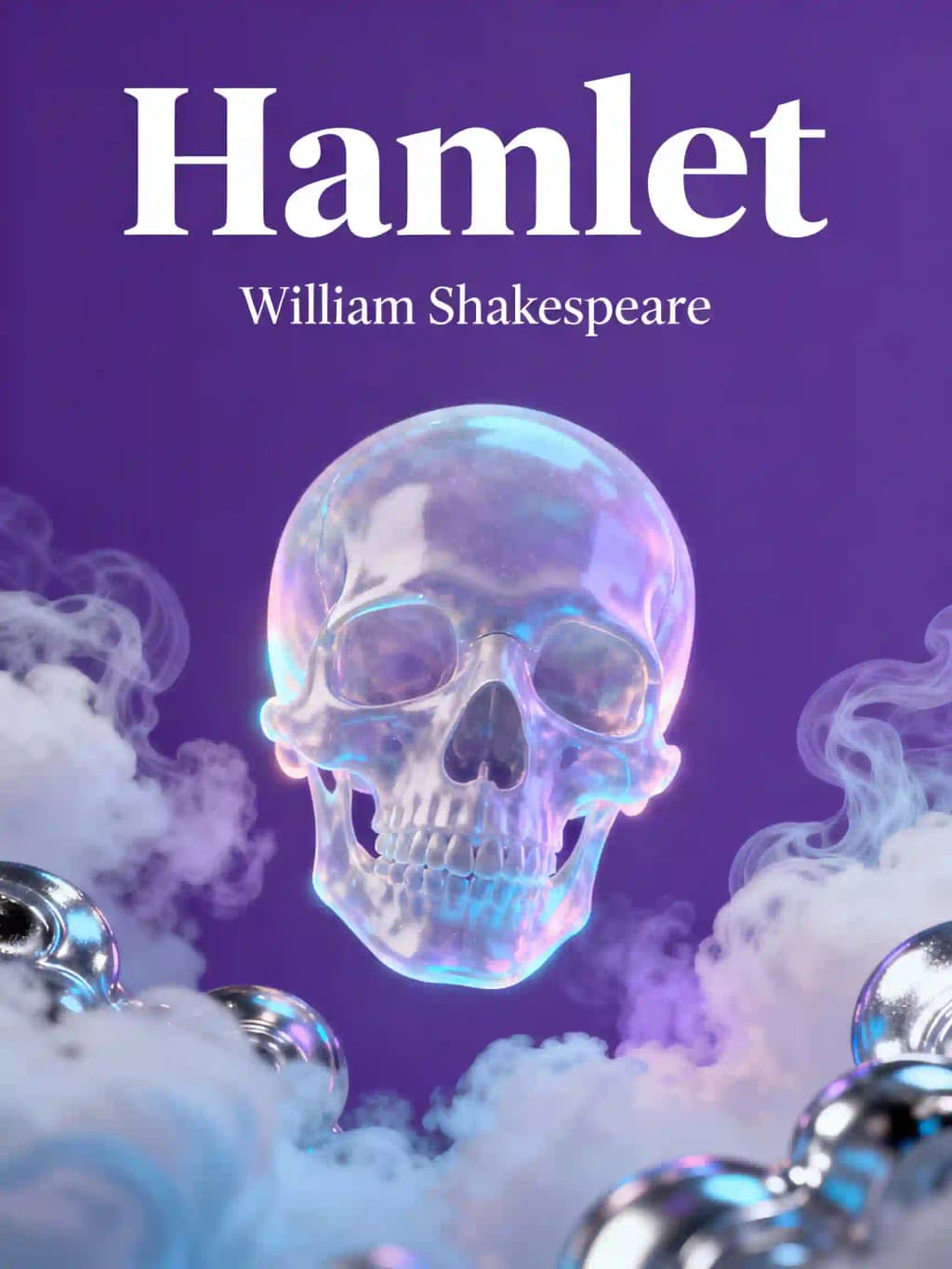
Shakespeare's immortal tragedy about a prince's revenge, madness, and existential crisis. "To be or not to be" - Hamlet's words echo across centuries, inspiring countless adaptations and even winning Olivier an Oscar. Literature's greatest psychological thriller awaits.
William Shakespeare (1564–1616) was the renowned Elizabethan playwright and poet who authored Hamlet, a seminal tragedy exploring themes of revenge, moral corruption, and the complexity of human psychology.
Widely regarded as the greatest writer in the English language, Shakespeare’s 37 plays and 154 sonnets revolutionized drama through their profound character studies and psychological depth. His works, including Macbeth, Othello, and King Lear, remain cornerstones of Western literature, frequently adapted for stage and screen.
Hamlet, his longest play, dissects themes of deception, mortality, and existential doubt, reflecting Shakespeare’s mastery of intertwining personal turmoil with political intrigue. Born in Stratford-upon-Avon, Shakespeare spent his career with London’s King’s Men theater company, blending classical influences with innovative storytelling.
His works have been translated into over 100 languages, with Hamlet alone inspiring countless adaptations, including major films and theatrical productions.
Hamlet follows Prince Hamlet’s quest to avenge his father’s murder by his uncle Claudius, who usurps the Danish throne and marries Hamlet’s mother, Gertrude. Themes of revenge, existential angst, and moral corruption unfold as Hamlet feigns madness, confronts betrayal, and grapples with mortality. The play’s iconic soliloquies, like “To be or not to be,” explore human indecision and the futility of action.
Literature enthusiasts, students of tragedy, and readers exploring existential themes will find Hamlet compelling. Its complex characters, psychological depth, and exploration of power dynamics appeal to those interested in Renaissance drama or philosophical inquiry. Fans of Shakespeare’s linguistic artistry and iconic soliloquies will also appreciate this timeless work.
Yes—Hamlet is a cornerstone of Western literature, offering profound insights into human nature, morality, and revenge. Its rich symbolism, intricate plot, and layered characters (like Ophelia and Claudius) make it a masterpiece of tragedy. The play’s exploration of madness, betrayal, and existential crisis remains culturally and academically relevant.
Key themes include revenge, madness, mortality, and moral corruption. The play examines the consequences of indecision (“To be or not to be”) and the clash between action and inaction. Other themes include familial betrayal, the nature of grief, and the existential search for meaning in a flawed world.
The ghost is Hamlet’s deceased father, King Hamlet, who reveals he was murdered by Claudius. Appearing in Act I, the ghost demands vengeance, catalyzing Hamlet’s internal conflict. Its ambiguous nature—whether a truthful spirit or a manipulative force—fuels the play’s tension and themes of uncertainty.
Hamlet’s hesitation to kill Claudius—stemming from moral doubt and overanalysis—delays revenge, causing collateral tragedies (e.g., Ophelia’s suicide, Polonius’s death). His introspection (“conscience doth make cowards of us all”) highlights the tension between thought and action, ultimately leading to the catastrophic final duel.
This soliloquy encapsulates Hamlet’s existential crisis, debating the merits of life versus death. It reflects his paralysis by overthinking and fear of the unknown afterlife. The line symbolizes universal human struggles with purpose, suffering, and agency.
Hamlet feigns madness to investigate Claudius’s guilt, but his erratic behavior blurs the line between act and reality. Ophelia’s genuine descent into madness after Polonius’s death contrasts Hamlet’s calculated antics, illustrating how trauma and betrayal destabilize the mind.
Ophelia, Hamlet’s love interest, becomes a pawn in political schemes, leading to her psychological breakdown and suicide. Her tragic arc underscores themes of female subjugation and the destructive consequences of manipulation. Her death intensifies Laertes’ vendetta against Hamlet.
Claudius’s regicide, marriage to Gertrude, and manipulation of courtiers (e.g., Rosencrantz and Guildenstern) epitomize moral decay. His guilt manifests in a failed prayer scene, revealing hypocrisy. His reign symbolizes the corrosive nature of unchecked ambition.
The climax occurs during the duel between Hamlet and Laertes, orchestrated by Claudius. Poisoned wine, a rigged sword, and multiple deaths (Gertrude, Laertes, Claudius, Hamlet) resolve the central conflicts. Fortinbras’s arrival restores order, underscoring the futility of revenge.
The play depicts revenge as a destructive cycle: Hamlet’s quest causes unintended deaths (Polonius, Ophelia), while Laertes’ vengeance mirrors Hamlet’s plight. Claudius’s murder of King Hamlet triggers collective tragedy, questioning the morality of retribution versus justice.
通过作者的声音感受这本书
将知识转化为引人入胜、富含实例的见解
快速捕捉核心观点,高效学习
以有趣互动的方式享受这本书
To be, or not to be, that is the question:
Though this be madness, yet there is method in't.
The lady doth protest too much, methinks.
Good night, sweet prince, And flights of angels sing thee to thy rest!
The rest is silence.
将《Hamlet》的核心观点拆解为易于理解的要点,了解创新团队如何创造、协作和成长。
将《Hamlet》提炼为快速记忆要点,突出坦诚、团队合作和创造力的关键原则。

通过生动的故事体验《Hamlet》,将创新经验转化为令人难忘且可应用的精彩时刻。
随心提问,选择声音,共同创造真正与你产生共鸣的见解。

"Instead of endless scrolling, I just hit play on BeFreed. It saves me so much time."
"I never knew where to start with nonfiction—BeFreed’s book lists turned into podcasts gave me a clear path."
"Perfect balance between learning and entertainment. Finished ‘Thinking, Fast and Slow’ on my commute this week."
"Crazy how much I learned while walking the dog. BeFreed = small habits → big gains."
"Reading used to feel like a chore. Now it’s just part of my lifestyle."
"Feels effortless compared to reading. I’ve finished 6 books this month already."
"BeFreed turned my guilty doomscrolling into something that feels productive and inspiring."
"BeFreed turned my commute into learning time. 20-min podcasts are perfect for finishing books I never had time for."
"BeFreed replaced my podcast queue. Imagine Spotify for books — that’s it. 🙌"
"It is great for me to learn something from the book without reading it."
"The themed book list podcasts help me connect ideas across authors—like a guided audio journey."
"Makes me feel smarter every time before going to work"

免费获取《Hamlet》摘要的 PDF 或 EPUB 版本。可打印或随时离线阅读。
A ghost stalks the ramparts of Elsinore Castle in full battle armor, appearing to terrified guards on successive nights. The apparition wears the face of Denmark's recently deceased king, and its silent presence feels like an omen-something is profoundly wrong in the kingdom. When Prince Hamlet learns of these sightings from his trusted friend Horatio, he joins the night watch, desperate to understand why his father's spirit cannot find peace. The encounter that follows transforms grief into purpose: the ghost reveals that King Hamlet was murdered by his own brother Claudius, who poured poison into his ear while he slept. "The serpent that did sting thy father's life now wears his crown," the spirit declares, commanding Hamlet to avenge this crime but spare his mother from harm. This supernatural visitation burdens the young prince with an impossible moral dilemma-how can he fulfill this sacred obligation without corrupting his own soul? The ghost's final plea, "Remember me," becomes both blessing and curse, echoing throughout the play as Hamlet swears to adopt an "antic disposition"-feigned madness-to mask his true intentions while investigating his uncle's guilt.
