第 1 章
The Battle for America's Economic Soul
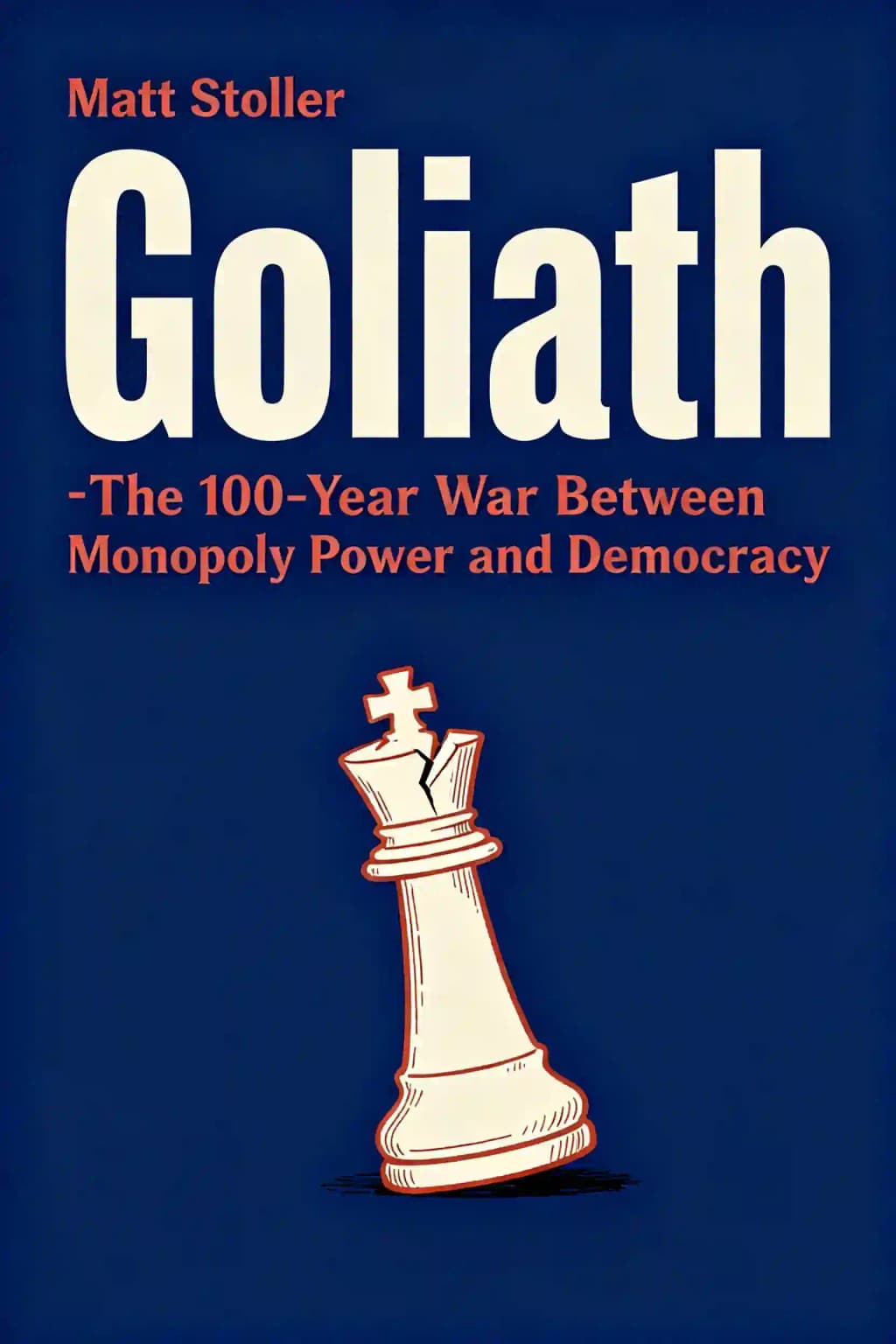
When Wright Patman, the last true populist in Congress, was ousted in 1975 by a crop of young Democrats nicknamed "Watergate Babies," few realized they were witnessing the final act in a century-long war between democracy and monopoly power. These newcomers, focused on antiwar politics rather than anti-bank sentiment, didn't understand they were being manipulated to eliminate the one congressman who had spent forty-five years fighting concentrated financial power. Matt Stoller's "Goliath" has become a sensation among policymakers and economists for revealing this hidden history-how America once built a thriving middle class by actively fighting corporate monopolies, and how we abandoned this tradition at our peril. The book has earned praise from both progressives like Senator Elizabeth Warren and conservatives like Tucker Carlson, reflecting its cross-partisan appeal in our era of renewed concern about corporate power. With America now dominated by two phone makers, four giant banks, four big airlines, and a handful of tech giants controlling our digital lives, Stoller's excavation of our forgotten antimonopoly tradition couldn't be more timely.
第 2 章
The Original Battle: Wilson versus Roosevelt
In August 1910, Theodore Roosevelt stood before a Kansas crowd to position himself as America's leader through its "third great national crisis"-the rise of corporate power. The timing was perfect: the country was experiencing political chaos with violent strikes, political assassinations, and socialist mayors being elected across America. Roosevelt's "New Nationalism" framed America's history as having two previous great crises-the American Revolution against aristocracy and the Civil War against slave-owning plutocracy. Now the third crisis of corporate power was "exactly" like slavery, only with "great special business interests" controlling government.
This crisis had been building since the Civil War. Railroad corporations expanded radically with government subsidies while industrial barons concentrated wealth through political corruption. By the 1890s, Republican Party boss Mark Hanna raised what would be $3 billion in modern prices for William McKinley's campaign, saying "There are two things that are important in politics. The first is money, and I can't remember the second."
The concentration triggered backlash. In 1877, mass unrest erupted across multiple states in response to railroad wage cuts. John D. Rockefeller's Standard Oil Trust became the model for monopoly power. After the Panic of 1893, when a third of American railroads went bankrupt, J.P. Morgan "Morganized" the industry-restructuring debt, eliminating competition, and creating monopolies. Morgan became so powerful that during the Panic of 1907, the government turned to him to organize a bailout of the financial system.
The 1912 election featured four candidates, but the real contest was between Roosevelt and Woodrow Wilson's competing reform visions. Wilson, a Princeton president-turned-governor, had fought corruption while maintaining racist Jim Crow policies. His thinking transformed after meeting Louis Brandeis, "the people's lawyer," who offered a practical framework for breaking monopolies while regulating markets to prevent their return. Wilson embraced Brandeis's "New Freedom" vision of regulated competition.
The campaign became a battle between two progressive visions: Wilson's populist approach to break up power concentrations versus Roosevelt's plan to have experts control monopolies. As Wilson declared, "Once the government regulates the monopoly, then monopoly will see to it that it regulates the government."
Wilson won and immediately moved to smash monopoly power. His Justice Department restructured the New Haven Railroad conglomerate and broke up AT&T's "telephone trust." To counter the "money trust," Wilson created the Federal Reserve to shift economic power from Wall Street to the people. He passed landmark legislation including federal aid to farmers, the income tax, child labor laws, and eight-hour workday regulations. He established the Federal Trade Commission to structure fair trade rules and prevent monopolization, and passed the Clayton Act to protect labor and stop predatory pricing.
By 1919, after Roosevelt's crusades, Wilson's election, Brandeis's battles, and a horrific world war, the stage was set to challenge concentrated power worldwide.
第 3 章
The Rise of Mellonism
When Warren Harding took office in 1921, Andrew Mellon's appointment as Treasury Secretary marked the end of progressive reform and the return of concentrated financial power. The democratic ideals of 1912 yielded to business dominance and growing democratic skepticism.
Wilson's early reforms had faltered - the Federal Reserve lacked authority and the Federal Trade Commission struggled with weak leadership. World War I's aftermath transformed America into an economic superpower, but strengthened monopolists. The Fed's interest rate hike from 4% to 7% in 1920 triggered an economic collapse, sending unemployment soaring and contributing to global political upheaval.
The 1920 election brought Harding to power, but Andrew Mellon emerged as the true force, serving as Treasury Secretary under three presidents. Mellon, a soft-spoken banking titan, bridged old-world robber baron politics with modern governmental power. His industrial empire spanned automobiles, oil, and banking, with leadership roles in over sixty companies.
Though never matching Morgan's private financial control, Mellon's governmental position gave him unprecedented influence. He shaped tax policy, debt management, and Federal Reserve decisions. His primary mission was dismantling Wilson's wealthy income tax through both legislation and administrative changes, securing billions in corporate refunds - including to his own companies.
The Coolidge administration embraced this pro-business stance, declaring "the business of America is business." The economy boomed, with unemployment reaching a historic low of 1.9% in 1926. However, beneath the Roaring Twenties' prosperity lay deep inequality - coal workers faced brutal conditions, farm prices remained depressed, unions weakened, and wages stagnated despite substantial productivity gains.
Mellonism aligned with global trends toward corporatism and fascism. American business leaders, including Mellon himself, praised Mussolini's authoritarian leadership and anti-Bolshevik stance. The era's superficial prosperity masked dangerous undercurrents, representing the ultimate cost of Wilson's failed reforms.
第 4 章
The Impeachment of the Old Order
The depression worsened as deflation took hold. When banks failed, credit contracted and money disappeared from circulation, reducing purchasing power. This triggered a vicious cycle: people bought less, businesses hired fewer workers, tax revenues fell, and loan defaults increased, causing more bank failures.
By 1932, Americans faced unprecedented hardship. In Philadelphia, 250,000 people risked starvation after relief funds ran out. Toledo saw 60,000 people-one-fifth of its population-standing in breadlines daily. New Yorkers moved into rat-infested basement tenements condemned decades earlier. Nearly eleven million Americans were jobless.
Wright Patman entered Congress in 1929 as a fearless freshman who immediately targeted the banking establishment. Despite being blocked from his desired Banking Committee assignment and relegated to minor committees, Patman launched his crusade against banking interests and monopoly power.
Patman's first major fight targeted a cottonseed oil conspiracy by Swift & Co., Armour & Co., and Procter & Gamble that was depressing prices paid to farmers in his district. Though unsuccessful in getting the Hoover administration to act, this campaign revealed Patman's economic philosophy: monopolies harmed not just individual businesses but the entire economy by stripping purchasing power from small businessmen and farmers.
In 1931, Patman reintroduced his bill for a $2.2 billion veteran payout, while 47 other bonus-related proposals emerged from both parties. The Veterans of Foreign Wars organized marches on the Capitol, while Mellon and Hoover warned the payments would trigger unprecedented economic suffering.
Patman launched an investigation into Mellon's conflicts of interest, declaring "I really have the goods on Uncle Andy." He meticulously gathered evidence from government agencies, congressional research services, and tips from small businessmen, veterans, and Mellon's enemies. His investigation revealed how Mellon's companies benefited from his Treasury position-from Gulf Oil's contracts with government agencies to favorable tax treatment for his businesses.
On January 6, 1932, as Father James Cox led 10,000 men to Washington demanding jobs, Patman introduced his impeachment resolution against Mellon. The charges: willfully breaking the law as Treasury Secretary to benefit his business empire. Three days after the hearings, Hoover established the Reconstruction Finance Corporation, widely seen as a corporate bailout. On February 4, 1932, less than a month after Patman's impeachment filing, Mellon resigned. Hoover appointed him ambassador to England-what Patman called "a presidential pardon."
第 5 章
Populists Take Power
Roosevelt challenged monopolistic power and the notion that only industry "experts" could understand utilities. During his campaign, he directly named financiers who had concentrated power, noting that "two-thirds of American industry" was controlled by just a few hundred corporations and "five human individuals." He won 57.4 percent of the vote - the first Democrat since the Civil War to secure a popular majority.
Between his election and inauguration, the banking system collapsed. Bank numbers had fallen from twenty-four thousand to fourteen thousand since Hoover's term, with Michigan's system freezing first, followed by most other states.
Ferdinand Pecora's Senate Banking Committee investigation exposed Wall Street corruption. He first revealed National City Bank's (now Citibank) fraudulent practices, including selling worthless securities while its president Charles Mitchell evaded taxes. Pecora then uncovered J.P. Morgan's "preferred list" system that offered discounted stock to political and financial elites, revealing how major corporations and banks operated as a de facto private government.
Roosevelt's inauguration coincided with Pecora's revelations, enabling him to immediately confront "unscrupulous money changers." He declared a bank holiday, ended the gold standard, and directed aggressive prosecution of banking violations. The Justice Department soon indicted National City's Mitchell for tax evasion.
The administration's most significant case targeted Andrew Mellon himself. Robert Jackson, a skilled small-town lawyer, led the prosecution, exposing how Mellon had evaded taxes through fake stock sales to family members and maintained control of supposedly charitable donations. Though Mellon avoided jail by offering his art collection to create the National Gallery, the Board of Tax Appeals required him to pay $500,000 in back taxes. His death in August 1937 marked the end of the robber baron era - his family kept their wealth but lost their power.
第 6 章
Trustbusters Against Hitler
Roosevelt's administration tackled industrial power concentration domestically while confronting rising fascism abroad. Robert Jackson's 1935 investigation of Andrew Mellon revealed his control over Pittsburgh's crucial industrial capacity, with his relative economic influence growing despite the Depression's impact on asset values.
The New Deal reflected an ongoing tension between corporatist and antimonopolist approaches. While Roosevelt implemented Wall Street regulations, the National Industrial Recovery Act (NIRA) attempted to centralize industrial power through government-business partnership. The NIRA failed when industry-written codes enabled price-fixing, leading to its Supreme Court rejection in 1935.
Roosevelt explicitly connected fascism to concentrated economic power. In 1938, he warned that other nations had surrendered liberty when faced with economic instability and weak governance, declaring that democracy couldn't survive if private power exceeded state authority.
The aluminum industry became a key battleground through Alcoa's dominance. After World War I, the company protected its monopoly through high tariffs and controlled distribution. In 1937, Jackson launched a historic antitrust case against Alcoa, charging it with complete industry domination. Though Alcoa initially prevailed in court by arguing its monopoly benefited society, its credibility suffered when it failed to meet wartime aluminum demands.
By war's end, the government controlled majority stakes in strategic industries, including 55% of aluminum capacity. In divesting these assets, officials deliberately fostered competitive markets rather than allowing reconcentration, enabling a new generation of entrepreneurs in aluminum and aerospace industries.
第 7 章
A Democracy of Small Businesses
The New Deal restructured not just industrial power but reorganized farming and shopkeeping-fundamental economic units Americans had fought over since the founding. New Dealers attacked the most desperate part of the depressed economy by ensuring land remained widely dispersed, drawing upon Jefferson's vision of family farmers as "the most valuable citizens" and the Civil War's Homestead Act that redistributed land to hundreds of thousands of farmers.
By the 1880s, railroads, banks and trusts had begun rolling up land and turning Americans into tenant farmers, prompting farmers to organize into Greenbacker and populist antimonopoly movements. The Wilson administration investigated the concentrated meatpacking industry and passed the Packers and Stockyards Act in 1921.
At the depths of the Depression, with crop prices having fallen below production costs, Roosevelt's administration passed two key proposals: a law allowing farmers to refinance mortgages at lower interest rates, and the Agricultural Adjustment Act, which imposed processing taxes on farm commodities and paid farmers who agreed to cut overproduction. This "supply management" system helped preserve family farming and protected topsoil.
The fight against chain stores reached a critical point in 1936 when 1,500 small businessmen marched on Washington in the "March of the Little Men," successfully lobbying for the Robinson-Patman Act (nicknamed the "anti-A&P Act"). This law barred discriminatory pricing used to gain monopoly power and outlawed the kickback system chain stores used to extract special bulk discounts disguised as advertising allowances.
The impact was immediate and substantial. When manufacturers complied with Robinson-Patman between 1935-1937, A&P lost $4.5 million (a quarter of annual profits), grocery chain stocks collapsed 58%, and A&P's profit margins never exceeded 2% again. Congress followed with the Miller-Tydings Act in 1937, which allowed states to legalize fair trade laws letting producers set minimum prices for their products.
A&P fought back aggressively, hiring PR expert Carl Byoir who orchestrated a sophisticated campaign using $1.6 million to create fake front groups like the "National Consumers Tax Commission" and secretly fund organizations that appeared to represent housewives and consumers. The company even reversed its anti-union stance in 1938, suddenly embracing organized labor to gain allies against chain store taxes.
Despite these efforts, the Justice Department brought criminal antitrust suits against A&P in 1942 and 1944, proving the company cut prices below cost in competitive areas while raising them elsewhere. By incorporating other stakeholders-labor, farmers, food processors, and small retailers-into its organizational structure, A&P had been effectively tamed, becoming "an aging boxer who had lost his punch."
第 8 章
The New Deal Constitution
By the 1950s, public trust in government reached 73 percent, as the postwar years delivered broad economic gains. Poverty fell from 40 percent in 1945 to 10 percent by 1970, with a third of workers unionized and gaining access to homeownership, healthcare, and pensions.
The New Deal restructured financial markets by establishing key agencies (Federal Reserve, FDIC, Federal Home Loan Bank System, FHA, and Fannie Mae) to regulate banking and ensure system stability. Regulation Q became central to this framework, preventing speculation by limiting what banks could pay for deposits and forcing decentralization in banking by requiring local deposit gathering.
This new system empowered businesses to grow independently of banker control. The government structured industry in three tiers: regulated monopolies in network industries like utilities and telecommunications; competitive markets with multiple firms in scientific-scale production; and protected spaces for small, family-owned businesses in sectors requiring less capital.
By 1956, industrial competition flourished - Alcoa's former aluminum monopoly was divided among four competitors, with total production eight times larger than 1940. Fair trade rules and farm price supports maintained decentralized production in retail, banking, farming, and small business sectors. Nearly half of WWII veterans started their own businesses, reviving America's entrepreneurial spirit.
The Employment Act of 1946, authored by Wright Patman, formalized the government's role in maximizing employment and purchasing power while promoting free enterprise. This approach combined competition policy with fiscal tools to prevent corporate overreach and ensure full employment.
The result was a more equitable society, with wage gains distributed evenly across income brackets through the 1960s. When the technological revolution of the 1950s emerged from wartime innovations, it developed within a framework designed to prevent monopolistic capture. IBM's expansion into computing exemplified how companies could innovate while operating under antitrust oversight, leading to developments like the IBM 650 computer and early programming languages.
第 9 章
Corporatists Strike Back
In 1944, Wright Patman survived a well-funded reelection challenge that accused him of corruption and communist sympathies. This attack marked the emergence of a plutocrat-backed right-wing movement that would later fuel McCarthy's anticommunist hysteria.
After Louis Brandeis's death in 1941, his anti-monopoly legacy lived on through politicians, small business leaders, and populists who had supported FDR while opposing chain stores. However, the anticommunist climate of the 1940s weakened the New Deal coalition. Adolf Berle and other New Dealers used the Americans for Democratic Action to purge leftists from the Democratic Party while cultivating ties with business leaders.
The prosperous postwar period sparked new economic thinking. When Truman resumed antitrust actions and won reelection in 1948 partly on an anti-monopoly platform, business leaders grew concerned. Meanwhile, influential intellectuals like C. Wright Mills, Peter Drucker, and John Kenneth Galbraith began embracing corporate bigness and central planning, viewing Americans primarily as consumers rather than citizens.
Eisenhower's 1952 victory alarmed historian Richard Hofstadter, who developed "consensus history" - a framework that downplayed class conflict in American history and portrayed anti-monopolists as irrational traditionalists resisting modernity. His work, along with Galbraith's bestselling "The Affluent Society" (1958), effectively removed the antimonopoly tradition from mainstream political discourse.
Hofstadter redirected political focus from corporate power toward issues like foreign policy, civil rights, and education. He argued that America's primary moral challenge wasn't big business but the absence of a social safety net, which he blamed on competitive individualism rather than corporate concentration.
第 10 章
The Free Market Study Project
The counterrevolution against New Deal economics began quietly in 1946 when Friedrich Hayek organized the Free Market Study at the University of Chicago. Though its founders disagreed on specifics, they shared a belief that the world was sliding toward leftist totalitarianism amid unprecedented labor unrest in America, socialist government in England, and communist threats in Europe.
Four key figures shaped the Free Market Study. Friedrich Hayek, an Austrian economist marginalized by Keynesians, provided the intellectual foundation. Henry Simons, a conservative University of Chicago economist, was fiercely anticorporate and favored strict banking restrictions and nationalizing trains and utilities.
The project's direction changed dramatically with two additional figures. Harold Luhnow, a wealthy Missouri businessman who ran the Volker Fund, provided financial backing. After hearing Hayek speak against central planning, Luhnow became determined to fund an "American version" of The Road to Serfdom. Aaron Director, a Russian-born Jewish immigrant recruited to run the project, would become the most consequential figure.
The Chicago School developed two strategic rhetorical approaches to overturn the New Deal. First, they appropriated Jeffersonian democratic language about monopolies and individual liberty through Hayek, but with a crucial twist: Director removed corporate power from the list of potential threats to liberty. While using anti-monopoly language that sounded consistent with conservative tradition, they redefined "monopolies" to mean public schools and labor unions rather than corporations.
Second, they adopted the apolitical language of science. Scholars like Stigler, Coase, and Bork wielded technocratic economic terminology as rhetorical weapons, claiming to have discovered new scientific insights that opponents were too unscientific to understand. They rewrote history through works like McGee's revisionist account of Standard Oil (falsely claiming it never engaged in predatory pricing) and Demsetz's assertion that large firms were profitable due to efficiency rather than market power.
Robert Bork cultivated three crucial constituency groups to advance the Chicago School's vision: the corporate legal establishment, business elites, and the conservative grassroots.
With corporate lawyers, Bork built strategic relationships by requesting legal briefs from companies like Procter & Gamble and Reynolds Metals, later working with Alcoa to challenge its 1945 monopoly conviction. He joined the influential ABA Antitrust Section through connections at his former firm Kirkland & Ellis, gaining access to key regulatory officials.
His breakthrough 1963 Fortune article "The Crisis in Antitrust," co-authored with Ward Bowman, argued that antitrust law was fundamentally incoherent and subversive to free markets. The article was a sensation among corporate lawyers, think tanks, and business schools.
Though Chicago School thinkers and liberal economist John Kenneth Galbraith appeared to be enemies, their philosophies actually complemented each other in crucial ways. Both shared an elitist worldview derived from Thorstein Veblen, approving concentration of capital controlled by technical elites. They agreed on the necessity of monopolistic elements for industrial progress and shared skepticism about earlier fears of the money trust. Galbraith's corporatist left perspective had inadvertently opened intellectual space for Chicago School ideas.
第 11 章
Wriston Versus Patman
In 1946, twenty-six-year-old Walter Wriston joined National City Bank (now Citibank), not out of passion for banking but simply seeking employment after his military service. Initially working in the bank's backwater operations, Wriston got his first taste of risk-taking around 1950 when assigned to work with Greek shipping magnate Aristotle Onassis.
Wriston revolutionized lending by financing ships based on their future cash flow rather than replacement value-a subtle but transformative shift from caretaking to profit maximization. This model encouraged businesses to focus on short-term cash generation rather than maintaining quality assets.
In 1961, Walter Wriston became an executive vice president at Citibank just as John F. Kennedy took office with his technocratic economic advisors who believed they could fine-tune the economy through taxes, spending, and interest rates. These economists had mathematized models that remarkably excluded banks entirely.
Wriston's solution was the negotiable certificate of deposit (CD), which revolutionized finance by circumventing Regulation Q restrictions. The CD functioned like a high-interest deposit account but was technically a tradable security. To make this work, Wriston convinced Herbert Repp of Discount Corporation to create a market for CDs with a $10 million loan-violating both bank policy and conflict of interest regulations.
The CD took "the banking community by storm," with outstanding CDs growing from $5.8 billion in 1962 to $90 billion by 1974. Big banks could now access deposits from anywhere, not just their local areas, allowing them to take bigger risks and enter high-margin businesses like credit cards and mortgages. This created a parallel, largely unregulated banking system alongside the regulated one, beginning an era of financial instability as private financiers wrestled control from public regulators.
In 1969, a new wave of financial consolidation swept America as conglomerates-modern versions of pre-Depression investment trusts-began swallowing established companies at an alarming rate. The most audacious attempt came when 29-year-old Saul Steinberg, a Jewish computer leasing entrepreneur from Brooklyn, tried to take over Chemical Bank, the sixth-largest commercial bank in America with $9 billion in assets and directors from America's corporate aristocracy.
When Wright Patman became chairman of the House Committee on Banking and Currency in 1963, he immediately tackled the problem of excessive bank mergers. From 1960 to 1966, bank regulators had approved 1,001 out of 1,035 merger requests despite the Department of Justice finding antitrust problems in over half of them.
第 12 章
The Collapse of the New Deal Consensus
The Penn Central disaster exposed fundamental weaknesses in America's regulatory and financial systems. The Interstate Commerce Commission's credibility was shattered after it failed to prevent the catastrophic merger and conglomerate strategy while helping the corporation evade scrutiny. Congressional investigations revealed not just embarrassing corporate behavior but systemic problems throughout corporate America.
The Federal Reserve's willingness to bail out unregulated financial instruments created a two-tier system: one heavily regulated system for ordinary people and another unregulated realm of exotic financial instruments for big banks and corporations-all implicitly backed by the Fed during crises.
By 1974-1975, Penn Central-like failures became commonplace. Electric utility Consolidated Edison had to sell assets to New York state, Pan Am struggled with debt, and New York City itself nearly went bankrupt, prompting the famous "Ford to City: Drop Dead" headline. The city placed its budget under banker control, cut social spending, and began charging tuition at the previously free city university system.
Populist leaders attacked corporate bigness as the root of economic problems. Senator Philip Hart introduced the Industrial Reorganization Act in 1973, arguing that corporate concentration "contributed to unemployment, inflation, inefficiency, the under utilization of economic capacity and the decline of exports." His bill aimed to break up most large corporations in America to preserve both market economy and democratic society.
As the Chicago School gained influence, corporate America mobilized politically. In 1972, CEOs of Alcoa, Ford, and General Electric formed the Business Roundtable-an organization of chief executives rather than lobbyists. As DuPont's Irving Shapiro explained, since politics had intruded into business, business would respond by entering politics.
Corporate lobbying professionalized and radicalized. The American Bankers Association relocated from New York to Washington, while Lewis Powell's famous memo urged business to seize cultural and legal power through aggressive advocacy. George Stigler's arguments for deregulating banking, trucking, railroads, and utilities gained traction as stagflation emerged.
To Nader and younger political leaders alienated by Vietnam, protecting local retailers seemed like protecting special interests at consumers' expense. This thinking spread beyond consumer rights as the Chicago School began influencing New Left intellectual organs. Charlie Peters' Washington Monthly, advertising itself as "the liberal magazine that questions liberal orthodoxy," often meant repealing New Deal policies, even bragging about making "our case against social security" before Harper's.
第 13 章
The Liberal Crack-Up
In early 1975, the Watergate Babies and their liberal mentors began restructuring the rules for who could do business in America. Their first target was the fair trade laws that protected small businesses from predatory pricing by large chains.
In March 1975, businessman Curtis Bruner testified before the House Judiciary Subcommittee on Monopolies, explaining how fair trade laws had enabled his Classic Car Wax company to compete against industry giants. By guaranteeing retailers that his products would be sold at the same price in both small stores and discount chains, Bruner could convince independent retailers to stock and promote his high-quality product, allowing him to break into a monopolistic market dominated by DuPont and three other companies.
Despite warnings that repealing these laws would lead to a country "dominated by big businesses," the new Congress moved to pass the Consumer Goods Pricing Act of 1975. Consumer groups like the Consumer Federation of America and Ralph Nader's Public Citizen supported repeal, as did Republicans including President Ford's Council on Wage and Price Stability, who claimed it would help fight inflation.
The repeal of fair trade laws, which had been won with so much struggle fifty years earlier, removed citizen control over production. Brandeis had warned in 1913 of the shortsightedness of consumerism: "Thoughtless or weak, he yields to the temptation of trifling immediate gain; and selling his birthright for a mess of pottage, becomes himself an instrument of monopoly."
The congressional attack on fair trade opened opportunity for Sam Walton in Bentonville, Arkansas. Like Andrew Mellon, Walton was a ruthless competitor who had traveled with his father foreclosing on defaulting farmers during the Great Depression. In 1962, he opened his first Walmart discount store in Rogers, Arkansas, the same year K-Mart and Target launched.
In 1976, Walmart advertisements noted that "the repeal of fair trade laws nationally made it possible for Walmart to discount all patterns." This legal shift reshaped American commerce over the next thirty years, concentrating power in larger discounters. From 1970 to 1979, Walmart grew from $44 million to $1.2 billion in annual sales. By 1985, Walton was America's richest man, and by 1993, Walmart achieved over $1 billion in weekly sales.
By the mid-1970s, despite Democrats holding nearly two-thirds of Congress and Republicans in disgrace, Chicago School economics was ascendant. Milton Friedman won the Nobel Prize in 1976, setting the stage for many Mont Pelerin members to follow. While Republicans lost elections, radical libertarian ideology was gaining ground.
The Carter administration's policies ultimately devastated antimonopoly enforcement. While Carter initially aligned with consumer advocate Ralph Nader, his FTC abandoned its small business constituency to focus on consumer-oriented rules. This shift left the agency vulnerable when it challenged powerful interests with rules on cereal, funerals, used cars, and children's advertising.
第 14 章
The Reagan Revolution
Reagan appointed William Baxter, a cold, ideological figure described as having "coal-black slicked-down hair, cold, dark eyes, sunken cheeks, and a sallow complexion," to head antitrust enforcement. Baxter dramatically transformed antitrust policy, openly defying Supreme Court precedents he called "rubbish" and "wacko," refusing to enforce laws he disliked such as Robinson-Patman, and drastically reducing enforcement actions.
By 1987, shopping malls had become "the new Main Streets of America," with 30,000 malls capturing half of all retail spending, employing 8% of the workforce, and generating 13% of national economic output. Consumer Reports called them "air-conditioned, sanitized, standardized" wonders that had revolutionized consumer life.
The retail landscape was transformed by chains that based their business on volume, scale, and price. Companies like The Gap, Benetton, Ann Taylor, and The Limited thrived in the new legal environment that allowed supplier bullying and encouraged offshoring. By 1985, The Limited had become the world's top seller of women's clothing, producing 200 million garments annually-three pieces for every American woman aged 15-55.
William Baxter made one significant exception to his Chicago School approach-pursuing the antitrust case against AT&T. Despite pressure from the Reagan administration to drop it, Baxter pledged to litigate "to the eyeballs," seeing AT&T as using its regulated local telephone monopoly to subsidize its other businesses.
The case had originated partly from the Neal Commission's recommendation to break up large corporations. After seven years of legal battles, AT&T settled in 1981, agreeing to split off its local subsidiaries into seven "Baby Bell" companies. The breakup had profound consequences: local phone rates increased by 35% while long-distance costs fell; competition flourished as Sprint and MCI grew into major competitors; and innovation accelerated in telecommunications technology.
Reagan cemented his economic revolution by appointing Chicago School judges throughout the federal judiciary. He placed four justices on the Supreme Court, including Antonin Scalia, and filled lower courts with law and economics adherents like Douglas Ginsburg, Frank Easterbrook, and Richard Posner.
第 15 章
Tech Goliaths and Too Big to Fail
The stock market soared in 1985-1986, with the Dow Jones rising 27.66% as low interest rates, low inflation, and takeover activity drove unprecedented gains. By 1986, Big Board stocks averaged 14% returns with indexes hitting record highs.
The Democratic Party shifted from defending working people to embracing neoliberalism, adopting Boston Consulting Group's view of abandoning "sunset industries" like steel for "sunrise industries" like computer chips. After Mondale's 1984 loss to Reagan, financiers established the Democratic Leadership Council (DLC) to cement neoliberal philosophy, despite opposition from populists like Senator Metzenbaum and Jesse Jackson.
Though George H.W. Bush reached 89% approval after the fall of communism and Gulf War victory, the end of the junk-bond boom led to a "jobless recovery" that dropped his approval to 29% by 1992. Clinton campaigned on populist rhetoric but his platform, crafted by Al From, notably omitted antitrust concerns - a first since 1880.
Under Clinton, populist rhetoric masked pro-monopoly policies. Despite promises of renewed antitrust enforcement, his administration oversaw an unprecedented merger wave - 166,310 deals worth $9.8 trillion in seven years, far exceeding the Reagan-Bush era's $3.5 trillion over twelve years.
Silicon Valley transformed from a middle-class region of farmers and engineers into a consolidated industry. The Microsoft-Intel alliance, similar to the Pennsylvania Railroad-Rockefeller partnership, gained power when IBM standardized its PC platform around them in 1980. Microsoft, started by Bill Gates commercializing previously shared software, leveraged its operating system control to dominate the PC industry.
Microsoft then targeted internet dominance, crushing browser pioneer Netscape by bundling Internet Explorer with Windows 95. The company expanded beyond software, launching ventures like Expedia and Sidewalk to capture travel and advertising markets.
第 16 章
A New Democratic Moment
Wright Patman understood that dictatorship in politics follows from monopolistic control in business. Americans now find themselves dependent on arbitrary power-exactly what Patman warned against when he called chain stores "un-American" and opposed "monopolistic dictatorship in American business."
Amazon was conceived as a monopoly from its inception. In 1994, Jeff Bezos envisioned an "Everything Store" as the dominant intermediary for all commerce. Like Rockefeller, Bezos exploited every advantage-from tax loopholes to predatory pricing-transforming Amazon into an infrastructure giant controlling nearly half of online retail.
Google has achieved unprecedented surveillance capabilities through eight billion-user products. It tracks thoughts through its "database of intentions," monitors movements via Android and Maps, and follows online behavior through its tracking systems. Combined with its control over information distribution, Google has achieved what Eric Schmidt called near-omniscience.
Like Americans in 1912, we face a crisis of concentrated power. While the Watergate Babies rejected Patman's economic populism, his warnings about monopoly power threatening democracy proved prescient. Today's anxiety stems from unreachable institutions controlling our lives-from Facebook organizing social networks to Amazon dominating commerce.
The 2008 financial crisis sparked renewed interest in economic power. Elizabeth Warren exposed bank misconduct, while Bernie Sanders fought "Too Big to Fail" institutions. The antimonopoly movement has gained bipartisan support, with both parties concerned about big tech's influence. Antitrust enforcement is reviving globally.
Citizens can fight back through education and engagement, despite challenges like fragile supply chains and declining democracies. The key is embracing democratic populism-not blame-based rhetoric, but the belief that informed citizens can protect their interests through democratic systems.
Monopolization isn't inevitable. The corporate structure was built on fantasies of inevitability, whether right-wing visions of progress or left-wing beliefs in unstoppable capitalism. America has always been a nation of tradespeople embedding social justice in commerce. Each generation must choose between liberty for all or rule by commercial aristocracy.