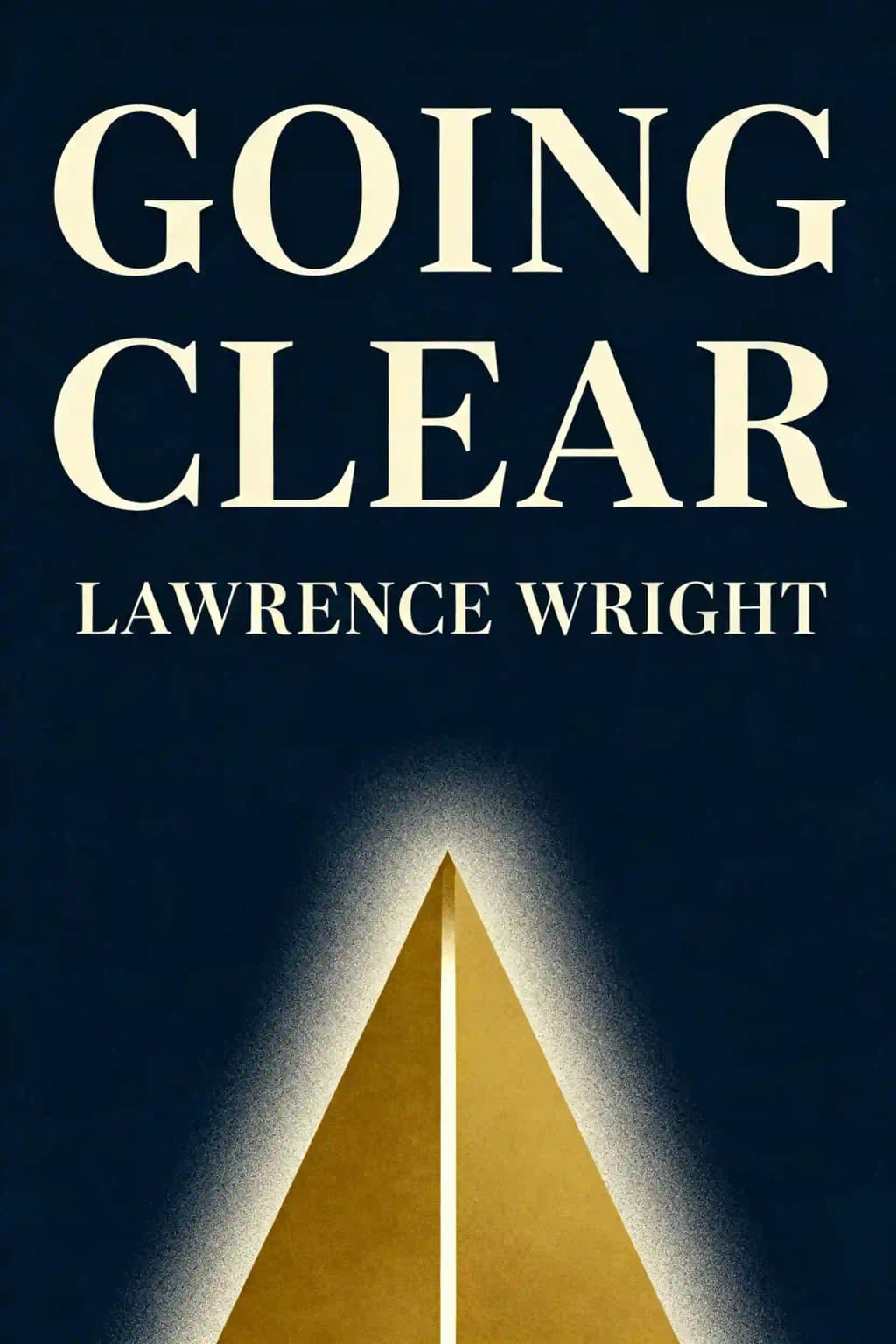
Pulitzer Prize-winner Lawrence Wright exposes Scientology's dark secrets, from Hollywood celebrity recruitment to alleged abuse. The book sparked HBO's controversial documentary, revealed Tom Cruise's involvement, and prompted Oscar-winner Paul Haggis to publicly denounce the church. What powerful forces tried silencing this explosive investigation?
Lawrence Wright, Pulitzer Prize-winning author of Going Clear: Scientology, Hollywood, and the Prison of Belief, is an acclaimed investigative journalist and staff writer for The New Yorker. His deep dives into complex subjects like religion, politics, and extremism have established him as a leading voice in narrative nonfiction.
Going Clear, a New York Times bestseller, meticulously examines the Church of Scientology through interviews with over 200 current and former members, blending rigorous reporting with cinematic storytelling.
Wright’s other notable works include the 9/11 chronicle The Looming Tower—which earned him the Pulitzer Prize—and God Save Texas, a National Book Critics Circle Award finalist exploring his home state’s cultural paradoxes.
A graduate of Tulane University and the American University in Cairo, Wright has received three National Magazine Awards for his reporting. The HBO documentary adaptation of Going Clear won three Emmy Awards and a Peabody, amplifying the book’s impact through its unflinching exposure of institutional abuses.
Going Clear investigates Scientology's secretive history, founder L. Ron Hubbard’s controversial life, and the Church’s modern-day operations under leader David Miscavige. It exposes systemic abuses, celebrity recruitment strategies, and the psychological manipulation of members, while questioning Scientology’s legitimacy as a religion.
This book suits readers interested in cults, investigative journalism, or the intersection of religion and power. It’s particularly valuable for those studying coercive organizations, Hollywood’s ties to Scientology, or Hubbard’s pseudoscientific doctrines.
Yes—it’s a Pulitzer-finalist work praised for rigorous research and balanced storytelling. The book blends shocking revelations (like forced labor camps and celebrity exploitation) with insights into why intelligent people embrace extremist ideologies.
Hubbard, a science fiction writer, framed Scientology as a religion to evade scrutiny while profiting from members. He combined psychotherapy techniques, space opera mythology, and authoritarian control systems to build a lucrative empire.
The Church strategically recruited stars like Tom Cruise and John Travolta, offering tax-free spiritual counseling and leveraging their fame for legitimacy. Celebrities received preferential treatment, shielding them from the harsh realities faced by rank-and-file members.
“Clear” refers to a state achieved through costly auditing sessions, where members purge traumatic memories (“engrams”). The Church markets this as liberation but uses it to deepen financial and psychological dependence.
Both share source material, but the book provides deeper context—detailing Hubbard’s naval career failures, Miscavige’s violent leadership style, and how IRS battles shaped Scientology’s tax-exempt status.
Some argue it overemphasizes extreme cases while downplaying members’ positive experiences. Scientology denounced it as “bigoted fiction,” though Wright extensively corroborated claims with documents and insider testimony.
Unlike older faiths, Hubbard’s 20th-century creation left extensive paper trails—revealing conscious myth-building rather than organic spiritual evolution. The Church’s litigiousness also contrasts with most religions’ tolerance of criticism.
Scientology employs SLAPP lawsuits, blackmail using auditing records, and private investigators to silence detractors. Its “Snow White Program” involved infiltrating government offices to destroy unfavorable records.
The book attributes its resilience to:
通过作者的声音感受这本书
将知识转化为引人入胜、富含实例的见解
快速捕捉核心观点,高效学习
以有趣互动的方式享受这本书
The trouble with China is, there are too many chinks here.
Reality, which he called 'a very detested quantity'.
Cells are evidently sentient in some currently inexplicable way.
Dianetics is no solemn adventure.
将《Going Clear》的核心观点拆解为易于理解的要点,了解创新团队如何创造、协作和成长。
将《Going Clear》提炼为快速记忆要点,突出坦诚、团队合作和创造力的关键原则。

通过生动的故事体验《Going Clear》,将创新经验转化为令人难忘且可应用的精彩时刻。
随心提问,选择声音,共同创造真正与你产生共鸣的见解。

"Instead of endless scrolling, I just hit play on BeFreed. It saves me so much time."
"I never knew where to start with nonfiction—BeFreed’s book lists turned into podcasts gave me a clear path."
"Perfect balance between learning and entertainment. Finished ‘Thinking, Fast and Slow’ on my commute this week."
"Crazy how much I learned while walking the dog. BeFreed = small habits → big gains."
"Reading used to feel like a chore. Now it’s just part of my lifestyle."
"Feels effortless compared to reading. I’ve finished 6 books this month already."
"BeFreed turned my guilty doomscrolling into something that feels productive and inspiring."
"BeFreed turned my commute into learning time. 20-min podcasts are perfect for finishing books I never had time for."
"BeFreed replaced my podcast queue. Imagine Spotify for books — that’s it. 🙌"
"It is great for me to learn something from the book without reading it."
"The themed book list podcasts help me connect ideas across authors—like a guided audio journey."
"Makes me feel smarter every time before going to work"

免费获取《Going Clear》摘要的 PDF 或 EPUB 版本。可打印或随时离线阅读。
What happens when a struggling pulp writer discovers that religion pays better than fiction? In 1949, L. Ron Hubbard allegedly told fellow science fiction writers at a gathering, "If a man really wants to make a million dollars, the best way would be to start his own religion." Whether or not he actually said this, he certainly proved the concept. Within a year, his book *Dianetics* became a bestseller, promising to cure everything from asthma to psychosis in less than twenty hours. Within a decade, he'd transformed his self-help method into a full-fledged religion with devoted followers willing to sign billion-year contracts. Today, Scientology claims millions of members worldwide, though independent surveys suggest closer to 25,000 in America. Yet its influence far exceeds its numbers, bolstered by Hollywood's biggest stars and approximately $1 billion in liquid assets. How did a man who couldn't pay his sailors or pass his college engineering courses create a belief system that still attracts intelligent, successful people - and why do so many who leave describe it as a dangerous cult?