第 1 章
The Struggle for Black Liberation in America's Racial Landscape
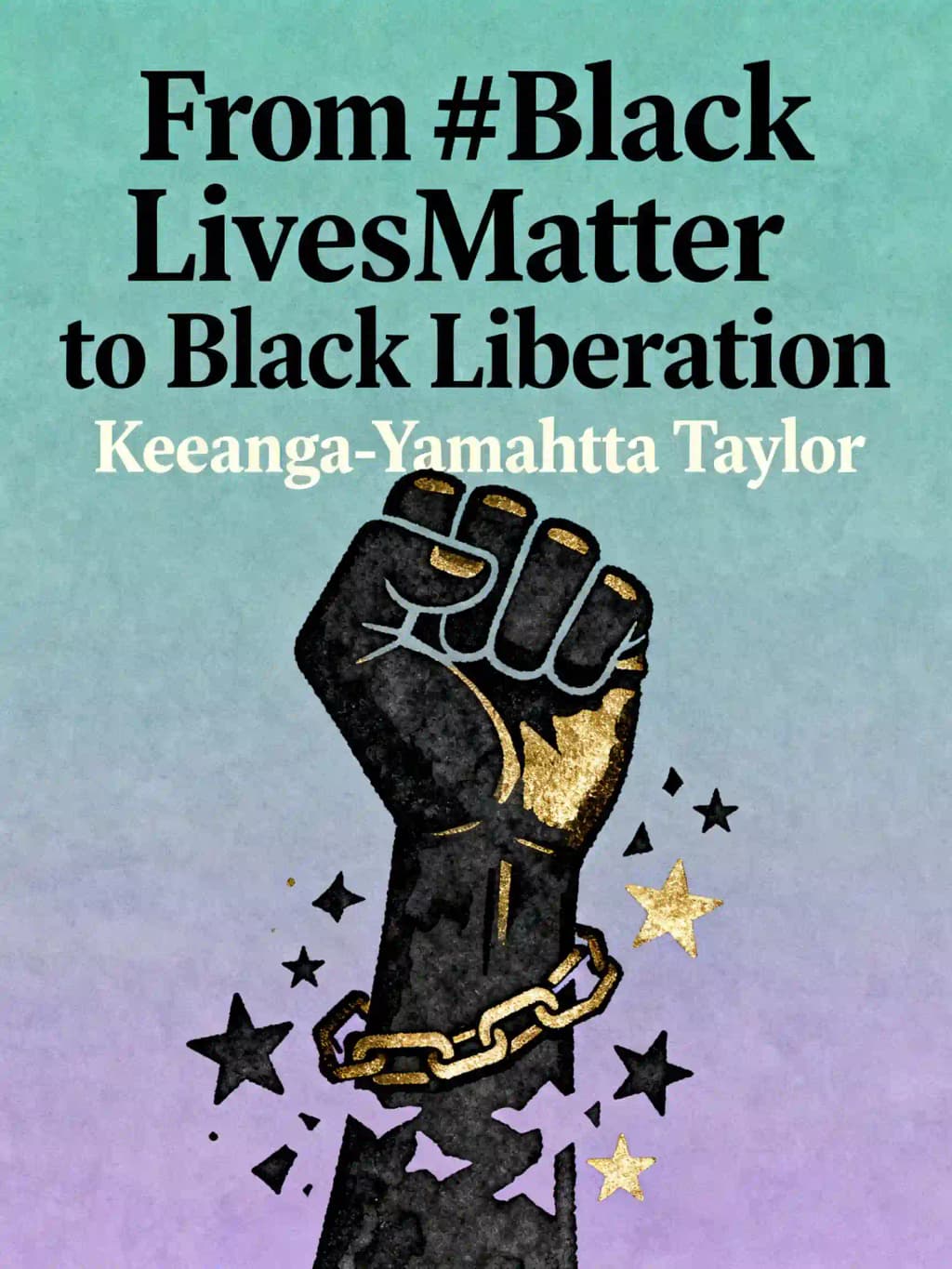
In a nation that prides itself on freedom and equality, Keeanga-Yamahtta Taylor's "From #BlackLivesMatter to Black Liberation" arrives as a thunderbolt of clarity. This unflinching examination of America's racial politics has become required reading for activists and academics alike, with figures from Angela Davis to Cornel West praising its incisive analysis. The book's cultural impact extends far beyond academic circles-it has become a cornerstone text for the Black Lives Matter movement and has been incorporated into community reading groups across the country. Taylor's work doesn't just document history; it actively shapes our understanding of how racism operates in contemporary America, challenging comfortable narratives about progress while offering a roadmap toward genuine liberation.
第 2 章
From Civil Rights to Colorblindness: The Evolution of American Racial Politics
The transition from civil rights to colorblindness marked a pivotal shift in American racial politics. Following the Black Power movement of the 1960s, the political establishment moved away from acknowledging institutional racism toward a "colorblind" approach that separated Black hardship from its material conditions. This shift occurred precisely when the booming post-war economy was grinding to a halt, undermining demands for massive financial investment in Black communities.
Nixon's 1968 victory signaled growing opposition to the radicalism sweeping America. His "Southern strategy" aimed to win white Democrats through appeals to racism while targeting the "silent majority." Yet the Black movement had become the nexus of social protest, inspiring other liberation movements and workplace militancy that united Black and white workers. If whites were truly as racist as the "conservative backlash" narrative suggested, Nixon wouldn't have needed to use colorblindness and racial code words to obscure his efforts to undo Johnson's welfare state.
By the late 1960s, America's elite seriously questioned whether revolution might occur. Business executives felt threatened by changes in the world economy, America's declining global hegemony, and domestic political mobilizations. When executives from powerful corporations were anonymously surveyed in 1974-75, they expressed anxiety about capitalism's future. One lamented the system was facing "its darkest hour," while another complained about "prostitute" Congressmen. Some even questioned democracy itself, asking "Can we still afford one man, one vote?"
Nixon's challenge was restoring business confidence by quieting social unrest. His strategy included physically repressing the Black movement through expanded policing, ideologically attacking poor African Americans as undeserving and violent, and cultivating a Black middle class to politically discipline poorer Blacks while rehabilitating the idea that anyone could prosper in America.
Rather than dismantling Johnson's programs outright, Nixon changed the debate's terms. While the Black movement defined racism as systemic and institutional, Nixon narrowed it to individual intentions while countering institutional racism by emphasizing "freedom of choice" to explain different outcomes. By disconnecting contemporary problems from discriminatory history, Nixon suggested "poor choices" rather than systemic racism caused poverty.
The Nixon administration expanded the law-and-order apparatus through multiple channels. Mass incarceration began taking shape after the Black Power uprisings ended, with prison sentences becoming 50% more likely following arrest and 40% longer in duration. Punitive drug laws like New York's Rockefeller Drug Laws disproportionately targeted Black and Latino neighborhoods despite whites being the predominant drug users.
Colorblindness functions as much more than simple denial of racism - it has become the default framework through which Americans understand race and racism. By suggesting that racial discrimination only exists when explicit racial insults occur, colorblindness obscures persistent inequality between African Americans and whites while elevating politics that blame Blacks for their own oppression. This ideology serves as a critical weapon for the politically powerful and economic elite to divide those who might otherwise unite in demanding better living conditions.
第 3 章
The Double Standard of Justice: Policing Black America
Despite many changes in Black life, politics, and culture over time, police surveillance, scrutiny, violence, and murder have remained remarkably consistent features of Black urban (and increasingly suburban) experience. Police brutality serves as a persistent badge of inferiority and second-class citizenship. When police enforce laws inconsistently and become agents of lawlessness, they tangibly remind African Americans of their contested citizenship.
Police racism isn't simply personal vitriol but flows from their role as armed state agents enforcing the rule of the politically powerful and economic elite. This explains the heavy policing of poor and working-class communities where African Americans are overrepresented. In a fundamentally racist society, "maintaining law and order" takes on specific meaning.
Modern American policing evolved from slave patrols to become a mechanism for controlling Black labor and movement after emancipation. Black Codes criminalized poverty and normal activities for African Americans, creating a system where all whites were deputized to police Black behavior. These laws explicitly linked Blackness with criminality.
After slavery, Southern elites used convict leasing to secure cheap labor through the criminal justice system. The Thirteenth Amendment's loophole allowing slavery for the incarcerated enabled this practice, with police serving as the linchpin in this arrangement. By 1898, nearly 73% of Alabama's revenue came from leasing convicts to coal mines.
"Racial criminalization" - stigmatizing crime as inherently Black while viewing white crime as individual failure - became embedded in American consciousness. As African Americans migrated north, these racist perceptions followed. Northern cities segregated housing, creating overcrowded Black neighborhoods that deteriorated, reinforcing stereotypes. Police routinely harassed, assaulted and executed Black residents with impunity. In 1925 Detroit, 55 Black people were shot by police in just six months.
Three distinct periods define post-civil rights era policing: Reagan's War on Drugs, Clinton's crime regime, and the War on Terror era. These overlapping periods produced mass incarceration with increased surveillance, policing, and imprisonment of working-class people, especially African Americans. As cities became financially independent from federal funding, police also became agents of gentrification and municipal revenue collection.
The U.S. now houses 25 percent of the world's prisoners despite having only 5 percent of the global population. Since 1971, the prison population has grown by 700 percent to 2.4 million, with another 5 million under correctional control.
CompStat and "broken windows" policing spread nationwide, with 58% of large departments adopting CompStat by 2013. This system rewards officers for high arrest numbers while publicly humiliating those with poor statistics, directly contributing to New York's massive increase in stop-and-frisk practices. From 1998-1999, police stopped 175,000 New Yorkers, with Blacks (26% of population) accounting for 51% of stops and Latinos (24% of population) for 33%. By 2011, stops skyrocketed to 684,000, overwhelmingly targeting Black and Latino men.
American police kill at rates unparalleled in developed nations - 7,427 people in seven years, averaging 928 annually. For comparison, only 58 American soldiers died in Iraq in 2014, while Canada reported 78 police killings that year. England had just 4 police killings from 2010-2014, Germany had none in 2013-2014, and China, with 4.5 times the US population, recorded only 12 police killings in 2014.
According to ProPublica, from 2010-2012, young Black men ages 15-19 were 21 times more likely to be killed by police than their white peers - a disparity that worsened over time from 9:1 (2006-2008) to 17:1 (2010) to 21:1 (2012).
第 4 章
Black Awakening in Obama's America: Hope, Disillusionment, and Resistance
Martin Luther King Jr. wrote shortly before his assassination that the "Black revolution is much more than a struggle for the rights of Negroes," but rather exposes "evils rooted deeply in the whole structure of our society" requiring "radical reconstruction of society itself." For most African Americans, unemployment, substandard housing, and police brutality constituted what Malcolm X called an "American nightmare."
These painful continuities between past and present resurfaced dramatically in 2014-2015, when the United States experienced ten months of mass protests led by African Americans responding to police violence. The uprisings began in Ferguson, Missouri after Michael Brown's murder and continued eight months later in Baltimore following Freddie Gray's killing by police.
The simultaneous rise of a Black president, growing Black political class, and small but significant Black economic elite alongside a movement declaring "Black Lives Matter" reveals profound contradictions in American society. Class differences among African Americans have become more pronounced in the neoliberal era. The richest Black families have two hundred times more wealth than the average Black family ($1.2 million versus $6,000). Only 1.4 percent of Black families belong to America's richest 1 percent.
Without formal legal barriers, class differentiation has frayed notions of a unified "Black community" - 40 percent of African Americans believe Blacks "can no longer be thought of as a single race," and 61 percent see growing value differences between middle-class and poor Black people.
The killing of Mike Brown and other unarmed Black people exposed the fallacy that simply doing the "right things" could overcome systemic racism. The nationwide protests that followed shattered "postracial" proclamations and inspired broader resistance against police brutality.
Meanwhile, police killings continued unabated: Eric Garner choked to death in Staten Island gasping "I can't breathe"; Ezell Ford shot multiple times in Los Angeles; John Crawford III killed while talking on his phone in Walmart; Tanisha Anderson slammed to the ground by Cleveland police; and 12-year-old Tamir Rice shot less than two seconds after officers arrived at his playground.
The most significant transformation in Black life over the last fifty years has been the emergence of a Black elite and political class that manages austerity budgets on the backs of Black constituents. "Civil rights entrepreneurs" now oversee privatization of public services in education, housing, and healthcare. When redevelopment promises fail, these Black officials invoke the same racist stereotypes as white officials to mask their own incompetence.
The nascent Black Lives Matter movement already confronts questions similar to those faced by the Black Power movement: Can institutional racism be transformed within capitalism? Can improved housing, wages, education and jobs be achieved on a mass level rather than just for a few?
第 5 章
Black Faces in High Places: The Limits of Representation
Eight months after Ferguson erupted over Michael Brown's death, Baltimore exploded in rage when Freddie Gray died from a brutal police beating. Unlike Ferguson, Baltimore's political establishment was predominantly Black - from the mayor and police commissioner to most of the city council. This stark contrast highlighted one of the most dramatic transformations in Black politics: the rise of Black political power alongside continued oppression of ordinary Black people.
Despite unprecedented Black political representation nationally - including the first Black president, 46 Black House members, and thousands of Black elected officials governing cities - little has changed for most African Americans. In Baltimore, three of the six officers involved in Gray's death were African American, as was the judge who presided over a trial ending in mistrial.
The integration of Black politics into the mainstream coincided with deliberate cultivation of a small but stable Black middle class, primarily through government employment. By 1974, 64 percent of all new federal employees came from minority groups. By 1977, 21 percent of all Black families had incomes between $15,000 and $24,000, with another 9 percent earning above $25,000. Though small in number, these African Americans in banking, commerce, law, education and medicine were distinguished by their relative income parity with whites, educational advancement, political moderation, and advocacy of capitalism.
By the late 1960s, calls for "community control" over cities with large Black populations grew louder as white political control over increasingly Black cities exacerbated tensions over unemployment, poverty, underfunded schools, and substandard housing. Urban rebellions had softened political elites to the idea that more Black control might help calm unrest. The possibility of Black mayors running cities with large Black populations was called the "most amazing political revolution since the end of slavery."
In 1967, Carl Stokes became the first Black mayor of a major American city when elected in Cleveland, Ohio. His campaign was heavily supported by civil rights organizations seeking an alternative to street rebellion. After winning with 15% of the white vote, Stokes made controversial decisions including appointing a white veteran police chief despite police brutality being a catalyst for the 1966 uprising. He prioritized business interests in urban renewal, upgraded police weaponry after a 1968 rebellion, and eventually used fear of crime to rally Black voters.
The 1972 National Black Political Convention brought together over 8,000 delegates from across the political spectrum, including radicals, revolutionaries, and 2,000 elected officials. The convention's radical preamble declared "the American system does not work for the masses" and required "radical fundamental change," but these statements revealed growing tensions within Black politics. As Black elected officials became more embedded in congressional norms and procedures, they drifted from community politics and race-based agendas.
African Americans gained political control of major cities at precisely the wrong moment, facing depleted tax bases and deindustrialization. By the late 1980s, Democrats had adapted to Reagan's rightward agenda, leaving Black elected officials increasingly disconnected from ordinary African Americans suffering through unemployment and welfare cuts.
By the 1990s, Black elected officials had fully retreated from John Conyers' earlier principle that Black politicians owed "allegiance to Black people." During the Clinton administration, they supported legislation that harmed Black communities, including the 1994 Violent Crime Control and Law Enforcement Act. This bill expanded the death penalty, imposed life sentences for nonviolent offenses, added 100,000 more police, eliminated federal funding for inmate education, and allocated $10 billion for prison construction.
A new generation of "post-Black" or "third wave" politicians like Obama deliberately distance themselves from Black protest politics while maintaining "equal fluency in black and white settings." In cities like Chicago, Black politicians support policies that harm Black constituents, as when the Black Caucus backed Mayor Emanuel's red-light camera program despite his closing fifty public schools in Black and Latino neighborhoods.
第 6 章
A Culture of Racism: Blaming the Victims
Black victims of police violence are often judged as either "good" or "bad" based on their perceived behavior, as happened with Mike Brown when police released video suggesting he had stolen cigarillos from a convenience store. This attempt to differentiate between deserving and undeserving Black victims taps into longstanding debates about the nature of Black inequality in America.
Assumptions of Black biological and cultural inferiority have existed since the nation's founding, citing Thomas Jefferson's racist views that helped rationalize slavery despite America's supposed commitment to freedom and democracy. These racist ideologies weren't simply driven by hatred but served to justify exploitative labor practices and continue to explain away persistent Black inequality in a country that claims to offer unlimited opportunity.
Politicians across the political spectrum perpetuate the "culture of poverty" narrative to explain Black inequality. Republican Paul Ryan's comments about "inner cities" having a "tailspin of culture" with "generations of men not even thinking about working" demonstrates how coded racial language works without explicitly mentioning race.
This isn't just a conservative position. Democratic Chicago Mayor Rahm Emanuel focused on "policing, prevention, penalties, and parenting" when addressing gun violence, claiming "it's not about crime, it's about values." Emanuel's privilege is evident when he boasts about his family's extravagant vacations, remarking that "you want to be an Emanuel child. It's unbelievable."
American exceptionalism functions as a convenient mythology that masks contradictions between American ideals and reality. When people fail to succeed economically, their personal failings are blamed rather than systemic issues. This narrative depends on erasing three central themes in American history: genocide, slavery, and exploitation of immigrant workers.
The concept of the "American dream" gained popularity through James Adams' 1931 book during the Great Depression, promising opportunity based on ability rather than birth circumstances. Following the Russian Revolution and amid fears of radical activity, the New Deal aimed to "save capitalism" through state intervention. Post-WWII prosperity seemed to validate the American dream, with government subsidies (particularly in housing) disguised as private enterprise success.
However, African Americans were systematically excluded from these benefits. Federal mortgage guarantees for suburban housing excluded most African Americans, while businesses relocated to suburbs, leaving cities without jobs that had attracted people there initially.
The Cold War transformed American race relations as the US competed with the Soviet Union for global influence. With colonial revolts worldwide, Black discrimination became an international issue undermining America's democratic image. Cold War politics forced Northern elites to take formal stances against discrimination as African Americans mobilized and brought international attention to racial injustice.
The civil rights movement exposed America's racially tyrannical regime to the world. In his "I Have a Dream" speech, King connected economic and racial injustice, linking Southern Jim Crow to Northern de facto segregation. Malcolm X considered it "ridiculous" that activists focused on the South when the North had "enough rats and roaches to kill." The passage of civil rights legislation in 1964-65 removed legal discrimination but couldn't address Northern discrimination in housing, jobs, and education.
Both conservatives and liberals continue linking Black poverty to Black culture and family structure because truly addressing institutional racism would have two unacceptable consequences: undermining America's self-image as the world's moral leader and demanding massive wealth redistribution to repair ongoing damage.
第 7 章
Black Lives Matter: A Movement, Not a Moment
When white police officer Darren Wilson shot Mike Brown in Ferguson, Missouri, it became a breaking point-not just for Ferguson's Black residents but for hundreds of thousands across America. Perhaps it was the inhumanity of leaving Brown's body in the summer sun for four and a half hours, keeping his parents away at gunpoint. Perhaps it was the military response to protests with tanks, machine guns, tear gas and rubber bullets.
The police response to the uprising was clearly meant to repress and punish. The 95 percent white male police force obscured their badges, wore "I AM DARREN WILSON" wristbands, and pointed live weapons at unarmed protesters. In twelve days following Brown's death, 172 people were arrested, 132 just for "failure to disperse."
Black protesters exposed Ferguson's municipal kleptocracy, revealing how the police targeted Black residents as a revenue source. Court fines from traffic violations constituted 21% of city revenue, "equivalent to more than 81 percent of police salaries." By December 2014, the department had 16,000 outstanding warrants, mostly for minor offenses.
A battle over Ferguson's meaning emerged between activists, civil rights leaders, and federal officials. Local activists focused on justice for Mike Brown through sustained protests, while the civil rights establishment and politicians had different agendas. The Congressional Black Caucus pushed voter registration, while the NAACP sought to rehabilitate its image. Al Sharpton arrived as Obama's representative, working alongside Attorney General Eric Holder to reestablish legitimacy of "law and order."
Young Ferguson activists were developing a broader systemic analysis connecting policing to racism and inequality in the United States. Ashley Yates of Millennials United in Action observed, "We knew that the system had already failed even before they began to show their hand publicly... the murder of Mike Brown was another example of how the systems in place made it acceptable to gun us down."
While police killings of Black men often receive media attention, Black women's experiences with state violence frequently go unnoticed. Black women suffer both directly as victims of police violence and indirectly through the mass incarceration of their partners, sons, and fathers. The names Rekia Boyd, Shelly Frey, Miriam Carey and Alberta Spruill remain less familiar than Mike Brown or Eric Garner, though their killings stemmed from the same dehumanization.
In Ferguson, Black women emerged as central organizers and leaders. As Brittney Ferrell noted, "If it were not for Black women, there would be no movement." This leadership partly reflected demographic reality-census data showed over 40 percent of Black men in key age groups were "missing" from Ferguson due to imprisonment or premature death. Nationwide, 1.5 million Black men are similarly "missing" from their communities.
The Ferguson movement reached a critical juncture on November 24, 2014, when a grand jury decided not to indict Darren Wilson for Mike Brown's murder. Angry protests erupted in Ferguson, with police protecting government buildings while Black commercial areas burned. President Obama's televised plea for "rule of law" and constructive action rang hollow against the backdrop of flames.
Just as momentum seemed to wane, new police killings reignited activism. Twelve-year-old Tamir Rice was shot in Cleveland within seconds of police arrival while playing with a toy gun. When a Staten Island grand jury failed to indict Daniel Pantaleo for Eric Garner's choking death despite video evidence, massive protests erupted nationwide.
The rallying cry "Black Lives Matter" spread rapidly across the nation in December and January following the Garner decision. Congressional aides staged walkouts, athletes wore "I Can't Breathe" shirts, and students from middle schools to universities organized die-ins, walkouts, and marches. Politicians scrambled to keep pace-even Hillary Clinton, who had never mentioned Mike Brown, was forced to say "Black Lives Matter."
第 8 章
From #BlackLivesMatter to Black Liberation: The Path Forward
The 150-year journey from the Civil War's end to Freddie Gray's fatal police encounter illustrates the gap between formal equality and actual freedom. While the Civil War established Black citizenship and civil rights, true freedom - the right to self-determination without coercion - has remained elusive for Black Americans.
Martin Luther King Jr.'s late-period analysis identified America's fundamental problems as "systemic rather than superficial," requiring "radical reconstruction of society itself." By 1969, King had come to understand America's crisis as rooted in the "triplets" of racism, materialism and militarism.
By the late 1960s, socialism had reemerged as a legitimate alternative for Black liberation. Organizations from the Third World Women's Alliance to the Black Panther Party explicitly linked Black oppression to capitalism and advocated socialist solutions. The Panthers became so influential that FBI Director J. Edgar Hoover declared them "the greatest threat to internal security of the country."
Capitalism fundamentally requires division to maintain its exploitation of the many by the few. Racism serves as one of its most powerful tools to fracture class solidarity. Marx recognized slavery's centrality to capitalism's development and understood that racism could turn workers with common interests into enemies, writing that "labor cannot emancipate itself in the white skin where in the Black it is branded."
White supremacy has historically functioned not to make all whites supreme, but as a political strategy to maintain class rule by the wealthy elite. By deflecting class tensions among whites and directing animosity toward Black people, this strategy obscured the vast economic differences between rich and poor whites while maintaining the social order.
Racism in America has never existed merely to abuse Black and Brown people for its own sake, but has always functioned as a mechanism by which the most powerful white men justify their rule, accumulate wealth, and maintain control over everyone else. Capitalism, racism, and class rule are so deeply intertwined that Black liberation is impossible within the current American system.
This doesn't mean there's no point in struggling. Building movements against racism, police violence, poverty, and other manifestations of oppression is critical not only for basic survival but also because through these struggles people learn how to organize, strategize, and build confidence to challenge the status quo. Day-to-day resistance must be connected to a larger vision of a different world - what Michael Dawson calls "pragmatic utopianism" that starts with current conditions but imagines a better future.
Though the current movement's trajectory remains uncertain, history shows that when Black movements gain momentum, they challenge the entire mythology of American freedom and democracy. The stakes today are even higher because what seemed like an alternative before-greater Black inclusion in the establishment-has already failed. As revolutionary C.L.R. James wrote, within Black America lies tremendous force and "readiness to destroy [bourgeois society] when the opportunity should present itself," perhaps exceeding any other population group in the United States.