第 1 章
The Magic Behind the Curtain: Where Illusion Meets Reality
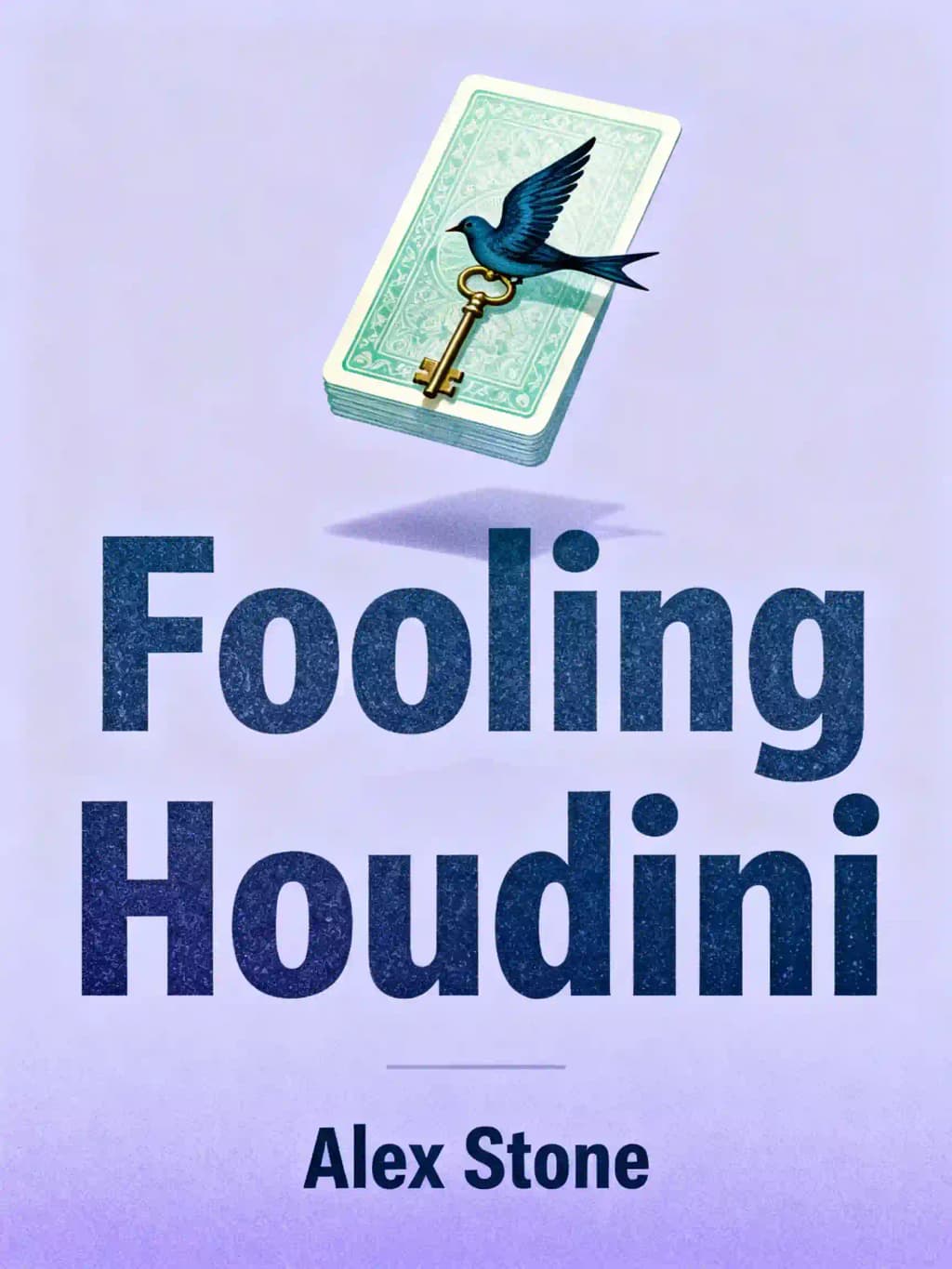
In a world increasingly dominated by technology and scientific rationalism, there's something uniquely captivating about magic-an art form that deliberately challenges our understanding of reality. Alex Stone's "Fooling Houdini" takes readers on an extraordinary journey through the underground world of magic, revealing its surprising connections to psychology, mathematics, and the human desire for wonder. This New York Times bestseller has garnered praise from magicians and scientists alike, with Penn Jillette calling it "a dazzling mix of memoir, reportage, and research." The book chronicles Stone's transformation from humiliated amateur to skilled performer, offering readers unprecedented access to secretive magic societies and the eccentric characters who populate them. What makes this exploration particularly fascinating is how it reveals magic not as mere entertainment but as a sophisticated art form with deep intellectual roots-one that continues to captivate audiences in our skeptical age.
第 2 章
The Magic Olympics: A Spectacular Failure
The World Championships of Magic in Stockholm, 2006: a gathering of the planet's most skilled illusionists competing in what insiders call "The Magic Olympics." The lobby of the convention center buzzes with activity-a Belgian woman transforms playing cards with impossible grace, mentalists huddle at tables sharing secrets, and performers from 66 countries showcase their finest deceptions. Among these 146 competitors stands Alex Stone, a relative newcomer whose presence feels almost miraculous given the prestigious nature of the event.
Stone's journey into magic began at age five when his father, a skeptical geneticist, gave him an FAO Schwarz magic kit. Despite an embarrassing debut performance at his sixth birthday party where hecklers reduced him to tears, his father's encouragement kept him going. Their Saturday trips to JCR Magic in San Antonio became a special ritual connecting father and son. Even meeting his idol David Copperfield as a child left him starstruck-so much so that when face-to-face with the famous illusionist, young Alex could only stammer, "Can I touch you?"
By high school, Stone was performing paid shows, ironically believing magic would make him less nerdy while actually spending most of his time with what he describes as "pasty male virgins." Magic provided an escape during his later years studying physics at Columbia and working in the corporate world-a refuge from both routine and rigid empiricism.
The magic community became Stone's island of misfit toys, a place where everyone was "special in the wrong way." Magic offered introverts a structured medium for social interaction without personal vulnerability-a way to seem extroverted while maintaining safe distance. The deeper Stone immersed himself in this world, the more the outside world of "clock watchers with their 401(k)s" seemed unbearably dull.
As Stone prepared to compete in Stockholm, he faced the hierarchy of the magic world: hobbyists content to fool laypeople, competitive magicians who live to fool other magicians, and the small number of eccentric geniuses sitting atop the pyramid. The thrill of victory and a shot at the title had brought him to Stockholm-he too wanted to be a "magician fooler," a misfit king.
But Stone's Olympic moment turned disastrous. Following Canadian wizard Shawn Farquhar's dazzling performance, Stone stepped into the spotlight with trembling hands and immediately dropped a coin with a loud "clink." His Renaissance-themed routine connecting magic and physics fell apart as he performed for nearly a thousand people including judges, television crews, and reporters. When he moved to card tricks, his hands dipped below the table twice-a cardinal sin-drawing snickers and heckles. Panicked and trembling, he dropped cards into his lap during a failed deck switch. The Spanish judge waved for him to stop, red-lighting him mid-performance-the only competitor to suffer this disgrace. Humiliated and devastated, Stone vowed never to do magic again.
第 3 章
Mystery School: The Path to Magical Rebirth
After his humiliating defeat at the Magic Olympics, Stone went underground. He stuffed his impressive collection of magic gear into his Championships tote bag and hid it in his closet, avoiding performances and experiencing what felt like PTSD symptoms. Nightmares of mockery haunted his sleep. His personal life crumbled too when his girlfriend left for Venezuela on a Pulitzer fellowship.
The following spring brought good news when Stone was accepted to Columbia's PhD program in physics-a field that had always fascinated him as a spiritual pursuit into nature's deepest mysteries. Despite warnings from friends that graduate school wouldn't quell his existential longings, he left his editor position at Discover magazine to enroll. Physics humbled him immediately; surrounded by geniuses, he felt intellectually inadequate for the first time in his life. Yet with plenty of leisure time between study sessions, the dormant magic virus began tingling at the base of his spine.
Eventually, Stone worked up the nerve to attend a Society of American Magicians meeting. To his surprise, nobody cared about his Olympic humiliation. Rather than facing scorn, his chutzpah in competing seemed to have earned respect from peers who had dreamed of competing but knew better. This reception encouraged him to ease back into magic, visiting Tannen's magic shop on West Thirty-fourth Street-a hub of the underground magic community. Watching teenagers manipulating cards with remarkable skill, he felt the old wonder returning: "Holy cow, I wish I could do that."
Stone began contemplating a comeback, realizing he needed formal training-a magic school like Hogwarts, but real and not British. His research revealed that magic schools function like art movements, with distinct values and belief systems radiating from great masters. Google led him to Jeff McBride's Magic and Mystery School in Las Vegas, run by one of the world's top professional magicians.
McBride's two-story home, dubbed the "McBride House of Mystery," sat in a suburb east of the Las Vegas airport. The home overflowed with scrolls, swords, New Age artifacts, and especially masks-Japanese, Venetian, Greek, Native American-creating a surreal mosaic of hollow stares. The first day lived up to McBride's billing of "Hogwarts for grownups" as students gathered around a flame atop an iron pedestal in a darkened room, where masks on the walls seemed to flicker alive in the shadows. Each student read aloud and signed the "Obligation of the Mage," a solemn vow of secrecy.
When Stone's turn came to perform one of his Magic Olympics tricks, McBride placed a hand on his shoulder afterward with a good-natured grin. "It's a great effect," he said, "but a bad method." He explained that Stone's sight lines were a mess and the handling convoluted. His performance was dreadful-he yammered onstage, tripping over his words, lacking stage presence and a coherent persona. In short, he was a hack compared to the other students who treated magic as a discipline.
Back in New York, Stone hung the Obligation of the Mage on his wall beneath Einstein's portrait. McBride had explained the four archetypes of magic: Trickster (the beginning stage), Sorcerer (disciplined and technically skilled), Oracle (explorer of perception and psychology), and Sage (who passes wisdom to the next generation). Stone realized he was clearly stuck as a middling Trickster, having never advanced since he began doing magic years ago. To progress to Sorcerer, McBride insisted, "you need a master." The question Stone needed to ask himself was: "Who's my Yoda?"
第 4 章
Miracles on Thirty-fourth Street: Finding a Master
Stone's search for a mentor led him to Wesley James, a whiskery sleight-of-hand master with fifty years' experience on the New York scene who held court at Cafe Rustico II, a grimy pizza parlor near Herald Square. James was one of the few surviving members of Dai Vernon's ultrasecretive underground community and an original member of the invitation-only FFFF Club. Some called him the greatest underground magician alive; others simply called him an asshole.
Grizzled and nearly seventy, Wes had a mangy doorknocker beard and a yard-long Manchu queue, but his hands moved with a concert pianist's elegance. Stone approached Wes as he demonstrated a poker cheating technique called "hand mucking," where he transformed the worst starting hand in Texas Hold 'Em into a pair of aces through sleight of hand. Trying to impress him, Stone performed a spread pass he thought he'd mastered. "You're flashing," Wes immediately critiqued, showing him how his protruding thumb was a dead giveaway.
It wasn't until Stone took out his physics textbook that Wes showed genuine interest. Their conversation about quantum mechanics, card counting, and mathematics finally established common ground. When Stone mentioned that his Ambitious Card routine incorporated quantum physics concepts in its presentation, Wes immediately corrected his technique, grabbing his hands and molding his fingers into a more forward grip to better cover the bottom half of the deck. After hours of practice, something finally clicked. "Yes," Wes said, his face brightening. "That's it! You've got it!"
One weekend turned into many as Saturdays at the pizzeria became Stone's newest ritual. Wes was always there-a constant presence who arrived at noon and left just after six, never missing a Saturday except for the annual FFFF convention. Originally from Florida, Wes moved to Brooklyn in 1945 at age nine. "I grew up in a very tough neighborhood," he told Stone proudly. "I may have a PhD, but I'm a street kid." His doctorate from NYU was in computer science, and after graduate school and an IT job, he became a professional magician working trade shows and nightclubs for two decades.
Like his mentor Dai Vernon, Wes enjoyed teaching, but with a tough-love approach. When Stone flaunted a fancy one-handed cut he'd learned, hoping to impress him, Wes scowled: "That'll get you killed." He explained that showing skill gives audiences reason not to believe in magic. "Magic is not about selling your prowess," he hollered. "It's about the effect you create-a profound violation of the natural laws of the universe. I don't want them to think I'm skillful. I'm a magician, not a juggler."
Stone's first assignment with Wes was learning to think and act like a cheat. Wes taught him dozens of false cuts and shuffles designed to preserve card order while appearing random. Stone practiced rigged shuffles, crooked deals (seconds, bottoms, and middles), glimpsing cards, and switching hands. The dense technical passages of Erdnase's mysterious book "The Expert at the Card Table" became Stone's subway reading, often mistaken for a Bible by fellow passengers. "Bless you," an old woman once said. "It's so nice to see a young boy reading the good book."
As Stone's skills improved, he began seeing his monthly poker game differently-each hand an opportunity for dishonest play. Following Wes's example, who had once practiced moves without actually gaining advantage, Stone decided to test his techniques during a friendly Texas Hold 'Em game. He dealt seconds to players without peeking at the cards, palmed cards, executed false shuffles, and performed the Zarrow-all without using these moves for gain. No one noticed his deceptions, but despite stealing nothing, he experienced both an adrenaline rush and moral discomfort. The next day he bragged about his exploits to Wes, who approved: "That's the thing to do when you're learning. You find out if your technique stands up. And you find out whether you got the cojones or not."
第 5 章
The Touch Analyst: Learning from the Blind Card Mechanic
After working with Wes, Stone sought out Richard Turner, widely regarded as the world's greatest card cheat. Turner had been singled out by Dai Vernon himself as the most gifted card mechanic he'd encountered in his eight-decade career. What made Turner extraordinary wasn't just his skill-it was that he performed his miracles while legally blind.
With his black Stetson hat, lizard-skin boots, and wide Doc Holliday moustache, Richard Turner looked like he stepped out of the Old West. His gold belt buckle displayed the dead man's hand-three aces and two eights. Turner was so skilled that mob families had once pursued him relentlessly, offering millions to work for them and threatening to kill him if he declined. What they wanted was his extraordinary sense of touch.
During his lecture for the Society of American Magicians, Turner demonstrated impossible feats. He challenged a volunteer to match his shuffling techniques, gradually increasing in complexity until his hands moved in a blur. After numerous shuffles that should have thoroughly mixed the cards, he spread the deck to reveal them in perfect numerical order. He performed simultaneous one-handed perfect shuffles with two decks, executed flawless crooked deals, and located selected cards after spectators had shuffled the deck-all without seeing a single card.
Turner's vision was six grades below the cutoff for blindness due to birdshot chorioretinopathy, a rare degenerative disease that began destroying his retinas at age nine. Rather than abandoning his childhood dream of becoming a card manipulator, Turner practiced obsessively, sleeping with cards in his hand-even clutching a deck during hernia surgery. "I have to do it all by touch," he explained. "Which is a real blessing." His tactile sensitivity was so acute that casinos and the United States Playing Card Company employed him as a "Touch Analyst."
The idea that blind people develop enhanced nonvisual abilities has deep historical roots, from blind Homer to musicians like Ray Charles. Recent scientific studies confirm that blind people outperform the sighted in virtually every measure of acoustic ability and possess extraordinary tactile sensitivity. Brain scans reveal the surprising mechanism: when blind people read Braille or perform tactile tasks, their visual cortex activates alongside their somatosensory cortex. They literally "see" with their fingers, challenging the long-held belief in fixed divisions between brain regions.
Turner demonstrated his legendary middle deal by having Stone select the nines as his four of a kind. After placing them on top of the deck, cutting the cards, and choosing a six-player Texas Hold 'Em scenario, he proceeded to deal the community cards. One by one, he produced all four nines in sequence, dealing them precisely from the middle of the deck.
Turner's relationship with the US Playing Card Company began in 1988 when he noticed quality deterioration in Bicycle cards. His extraordinary tactile sensitivity detected changes in paper stock and cutting techniques that even the company was unaware of. Impressed by his abilities, USPCC hired him as their "touch analyst" to evaluate card quality. Turner's fingers can detect paper thickness to within 1/1000 inch, count embossed ridges, and sense variations in moisture and coating chemistry.
Research shows that blind people develop extraordinary finger sensitivity through practice, not inherent ability. Turner's obsessive practice-135,000 hours with cards, performing his second deal over 5 million times publicly-explains his supernatural abilities. He shuffles constantly: at church with blank cards, at movies, while grocery shopping, even falling asleep with cards in hand. This relentless tactile engagement transformed his hands into his primary connection to the world. Inspired by Turner, Stone adopted Greg Irwin's Finger Fitness program and designed his own coin-palming workout. Through blindfolded practice sessions, he developed heightened tactile sensitivity, experiencing firsthand how touch can be a powerful sensory tool with remarkable precision.
第 6 章
The Hype: Exploring Magic's Dark Side
On a chilly March afternoon in New York, Stone ventured to Canal Street to investigate where magic meets crime. Following a tip from coin magician David Roth, he tracked down three-card monte operators who had relocated from Times Square during Giuliani's quality-of-life campaign. Despite warnings about the dangers-these weren't magicians but violent criminals who could make $10,000 in a single afternoon-Stone was determined to make contact with the monte mob as a fellow practitioner of sleight of hand.
Stone's fascination with three-card monte began at age eleven in Barcelona, where he lost his entire allowance to a con man on La Rambla. The monte has been around for centuries, arriving in Europe with gypsies in the 14th century before spreading across the continent. The scam truly flourished in America, first appearing in New Orleans in the 1830s before spreading up the Mississippi on riverboats. Monte mobs made fortunes during this golden age-one four-man team cleared the equivalent of $25 million in just three years.
After learning about the monte mob's techniques, Stone discovered how they "cool out the mark"-a friendly confederate consoles the victim, reminding them it was gambling and they can't tell police. Most victims walk away in a daze, rarely becoming violent. The entire scam takes under ten minutes, with multiple crews working a block, functioning as efficient small businesses.
Stone's exploration of scams continued at the School for Scoundrels in Los Angeles, where he learned the shell game-essentially the con man's version of the cups and balls trick. Dating back to Roman times and spread by gypsies across medieval Europe, the game evolved to use thimbles and peas for portability. Famous American grifters like Lucky Bill Thornton and Soapy Smith built criminal empires from shell game operations.
After visiting the Getty Villa, Stone walked along Malibu's shore, contemplating how he'd drifted from mainstream life-from office worker to grad student to now skipping Columbia classes to pursue magic. His physics world grew increasingly distant as he traveled deeper into this new realm, making him wonder if he'd ever return.
第 7 章
Breaking the Code: The Ethics of Exposure
Being a magician resembles working for the CIA-you possess secrets you can't reveal. The magic community enforces strict codes of secrecy, with organizations like The Magic Circle adopting the motto "Not Prone to Divulge Secrets." No one is immune-museums have closed exhibitions for revealing too much, and prominent magicians have been expelled for participating in exposure shows.
The most notorious exposer was the Masked Magician (Val Valentino), whose Fox specials drew record-breaking audiences. Magicians reacted apocalyptically-filing lawsuits, organizing boycotts, and issuing death threats. Valentino was permanently banned from magic venues and publicly humiliated by other performers.
But is this outrage justified? Magic secrets are unique intellectual property-unprotected by copyright or patent laws. Instead, the community enforces professional norms through collective action, blacklisting those who violate attribution standards or expose methods inappropriately.
Ironically, during magic's golden age, exposures were common as performers competed, which drove innovation rather than destroying the art. Today, magicians sell their secrets through books, DVDs and lectures while condemning exposure to non-magicians-a contradiction that seems hypocritical. Even after exposure, great magicians like Penn and Teller demonstrate that knowing secrets doesn't diminish the wonder of skillful performance.
Despite dire predictions after the Masked Magician specials, magic has thrived. The militant anti-exposure stance underestimates magic's depth-there are endless techniques constantly evolving, requiring years of expertise to master. Classic effects like the Ambitious Card continue fooling audiences and even other magicians despite being "exposed" countless times.
Magic, like physics, never stops evolving. Each new discovery opens vistas to further mysteries. The hysteria around exposure fails to credit audiences with intelligence-Penn and Teller challenge this by letting spectators choose whether to learn secrets or maintain mystery. When magicians claim exposure kills magic, it's reminiscent of Max Planck being told physics was "finished" before he helped discover quantum mechanics.
Stone's own experience with exposure came when he published an article that revealed some magical methods. Though he expected severe consequences, the Society of American Magicians ultimately backed away from formal action. The experience inspired him to start Columbia's first magic society-one without oaths or rituals, open to anyone interested. Beginning with just two students, it quickly grew into a thriving community.
第 8 章
How to Steal a Watch: The Psychology of Misdirection
Stone's journey led him to explore the psychological foundations of magic at Arien Mack's laboratory at the New School in New York's Greenwich Village. For twenty years, Mack had pioneered scientific study of attention and misdirection-fundamental elements of magic.
In her lab, Stone participated in an experiment demonstrating "inattentional blindness"-when focusing on comparing lines in a cross, he completely missed pictures that briefly flashed on screen despite looking directly at them. Mack and colleague Irvin Rock's research reveals that without attention, conscious perception essentially stops functioning-we become blind to objects directly in our visual field.
This phenomenon extends beyond vision to hearing and touch-"There is no conscious perception without attention," Mack explained. The most famous demonstration is Daniel Simons' "invisible gorilla" experiment, where viewers counting basketball passes miss a person in a gorilla suit walking through the scene. Despite looking directly at the gorilla for a full second, most participants never consciously perceive it.
Inattentional blindness has serious real-world implications-it's why using phones while driving is dangerous, regardless of hands-free devices. It may also explain motorcycle accidents, as drivers often fail to perceive motorcycles even when looking directly at them because they don't expect to see them.
Change blindness-our failure to notice alterations between consecutive scenes-is another perceptual phenomenon fundamental to magic. Movie continuity errors typically go unnoticed by viewers. Simons and Levin demonstrated the extremes of change blindness by creating films with glaring continuity errors-including completely switching actors mid-scene-that most viewers failed to notice.
These perceptual blind spots suggest our mental representations of reality are subjective constructions built from incomplete, sometimes distorted information. Philosophers call these subjective experiences "qualia," raising questions about how much of our perception is constructed versus objectively real. Daniel Dennett suggests consciousness itself may be an illusion, comparing it to the quantum realm where "memories pop in and out of our minds like subatomic particles" and perception is filled with Heisenberg-like uncertainties.
第 9 章
The Mentalists: Mind Reading and Belief
After successfully performing a cold reading on a woman with saffron hair, Stone continued experimenting with mentalism techniques. The results were astonishing-people broke into tears, accused him of spying on them, or claimed supernatural connections with him. One Russian exchange student insisted they'd known each other in a past life.
This power came with ethical discomfort. Stone realized there are two types of liars in magic: "honest liars" (professional magicians who don't claim supernatural powers) and "dishonest liars" (those who profit from people's grief or ignorance by claiming genuine psychic abilities).
Unlike conventional magic that alienates spectators by keeping secrets, mentalism engages them personally, creating an illusion of intimacy. As Jeff McBride says, "Whereas magic creates questions, mentalism is about answering them."
The practice of presenting magic tricks as miracles dates back to ancient religions. Temple priests used hidden mechanisms like steam turbines to make doors open "miraculously" and created hydraulic statues that appeared to weep. Evidence suggests Jesus himself may have been viewed as a magician during his lifetime. A two-thousand-year-old bowl discovered in Alexandria's harbor bears the inscription "Christ, the magician," and parallels exist between gospel miracles and rituals from the Egyptian Magical Papyri.
Modern mentalism emerged in the 19th century alongside spiritualism and new technologies like the telegraph. The term "telepathy" was coined in 1882, as wireless communication breakthroughs made thought transference seem plausible to many prominent thinkers.
The most disturbing aspect of mentalism is how it affects you even when you understand the techniques. Despite knowing better, Stone found himself dwelling on a psychic's predictions, experiencing confirmation bias that reinforced her hits while forgetting her misses. Research shows people find readings more convincing when attributed to mystical sources like astrology or palmistry.
第 10 章
The Perfect Shuffle: Where Magic Meets Mathematics
When mathematicians Persi Diaconis and Dave Bayer investigated shuffling, they discovered that conventional wisdom about card randomization was wrong. Through sophisticated probability analysis and computer simulations, they found it takes seven shuffles-not three or four as casinos believed-to truly randomize a deck. This randomization isn't gradual but undergoes a "phase transition" around the seventh shuffle, similar to water freezing or dough suddenly becoming smooth when kneaded.
This discovery revealed a security breach in casinos, where professional gamblers could exploit inadequate shuffling through "card sequencing." The research also provided a mathematical model for many other mixing phenomena, from bread dough to pharmaceutical compounds, showing how randomness often appears suddenly rather than incrementally.
Stone's exploration took him to the Conjuring Arts Research Center, which houses an extraordinary collection of magical artifacts and literature. Beyond the main collection's fifteen thousand books, the library contains gambling manuals, declassified CIA documents from when magician John Mulholland trained spies, and a rare book room housing treasures like a 300-year-old Belgian legal text on dice cheating.
For centuries, magic and science were parallel paths to wisdom rather than opposites. Newton secretly studied alchemy, Leibniz began as an alchemist, and Robert Boyle sought the philosopher's stone. The nineteenth century saw magician-inventors like Jean-Eugene Robert-Houdin experimenting with electromagnetism and creating mechanical marvels. This tradition of magician-scientists continued well into the 20th century, with magic shows billed as "scientific amusements" until the late 1930s.
第 11 章
Flight Time: The Final Performance
As the IBM competition approached, Stone intensified his search for the perfect trick, mastering the faro shuffle which requires precise interweaving of cards. After much practice, he developed his ultimate closer-a mind-blowing effect where a spectator secretly writes down someone's name and selects a card. Through a series of eight perfect faro shuffles, blue dots on the edges of the cards mysteriously rearrange themselves to reveal first the selected card, then the secret name the spectator wrote down.
With his girlfriend Kate's help, Stone scripted his act, improved his timing using a metronome, and filmed himself from different angles to perfect his technique. He even practiced first thing in the morning to ensure he could perform half-asleep.
Despite his mentor Wes's pessimism about his gimmicked sketchpad, Stone's performance at the Gershwin Hotel was a resounding success. The audience was captivated when the secret name materialized on the deck, and he felt relaxed and authentic on stage for the first time.
His final challenge was the IBM Gold Cups competition in San Diego-the most prestigious close-up competition in the world. Though he didn't win against prodigies like Shin Lim and Nathan Gibson, he performed confidently even when former IBM president Obie O'Brien (who had eliminated him at the World Championships) entered the room. In that moment of calm performance, Stone realized winning no longer mattered-he had accomplished his goal.
Flying home, Stone reflected on how great ideas in both magic and science often come from playfulness and curiosity. Richard Feynman's Nobel Prize-winning work began with observing a wobbling dinner plate, and mathematicians Bayer and Diaconis started their revolutionary work on card shuffling simply by "amusing themselves." Magic, like play, helps us recapture that childlike sense of astonishment that fades with age. Being fooled is fun because it offers a controlled experience of losing control-a cathartic feeling that even the legendary Dai Vernon, at the end of his life, still wished to experience one more time.