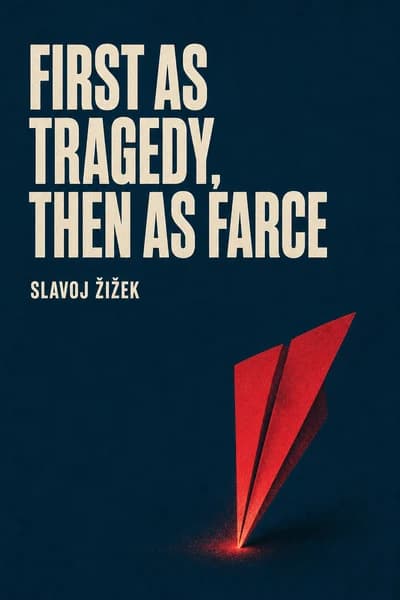
Zizek's provocative analysis dissects how 9/11 and the 2008 financial crisis exposed liberalism's fatal flaws. Hailed as "the most dangerous philosopher in the West," his spellbinding critique challenges capitalism's moral failures while offering a radical vision for the Left's reinvention.
Slavoj Žižek is a Slovenian Marxist philosopher and cultural theorist, known for his sharp critique of global capitalism and ideological systems, as exemplified in his work, First as Tragedy, Then as Farce. He stands as a leading figure in contemporary political philosophy.
Žižek masterfully blends Lacanian psychoanalysis, Hegelian dialectics, and Marxist theory to dissect modern crises. Born in Ljubljana in 1949, he pursued his philosophical studies at the University of Ljubljana and later studied psychoanalysis under Jacques-Alain Miller in Paris.
During the 1980s, Žižek emerged as a prominent voice in Slovenia’s democratic opposition. His extensive body of work, including notable titles like The Sublime Object of Ideology and Violence: Six Sideways Reflections, delves into themes of ideology, subjectivity, and societal contradictions, often analyzed through the lens of pop culture and political discourse.
As a visiting professor at numerous institutions worldwide, Žižek has gained recognition as a public intellectual through his provocative lectures and films, such as The Pervert’s Guide to the Cinema. With his books translated into over 20 languages, Žižek challenges readers to confront uncomfortable truths about power and desire within neoliberal societies.
First as Tragedy, Then as Farce analyzes modern crises through Slavoj Žižek’s Marxist-Hegelian lens, arguing that events like 9/11 (tragedy) and the 2008 financial crash (farce) expose capitalism’s failures. The book critiques systemic ideology, advocates for reinventing communism, and dissects how crises paradoxically strengthen oppressive systems. Split into political analysis and philosophical exploration, it blends pop culture references with dense theory.
This book suits readers interested in Marxist theory, Lacanian psychoanalysis, or critiques of global capitalism. Ideal for those comfortable with academic philosophy and Žižek’s signature style—mixing high theory with references to films like The Baader Meinhof Complex and Starbucks’ branding. Not recommended for casual readers seeking light commentary.
Yes, for its incisive critique of capitalism’s cyclical crises and bold advocacy for communist renewal. While Žižek’s writing is dense and digressive, his analysis of ideology’s hidden mechanisms—like how “rights” under capitalism mask systemic control—offers fresh perspectives. Critics note his lack of concrete solutions, but the book remains a provocative primer on modern leftist thought.
The title references Marx’s observation that history repeats—first as tragedy (9/11’s geopolitical shock), then as farce (2008’s absurd financial collapse). Žižek argues both events stem from capitalism’s contradictions, with the latter exposing the system’s inability to self-correct.
Žižek posits that capitalism thrives on crises: disasters like 2008 reinforce ideological control by framing austerity or bailouts as inevitable. He compares this to “fetishistic disavowal,” where society acknowledges systemic flaws yet perpetuates them.
Žižek’s “communist hypothesis” urges reimagining leftist politics beyond 20th-century failures. It emphasizes radical equality and collective action to dismantle capitalism’s structural violence, rejecting both liberal reformism and Stalinist authoritarianism.
Ideology, for Žižek, is an invisible framework shaping perceptions of freedom and crisis. He argues capitalist ideology normalizes inequality—e.g., framing unemployment as personal failure rather than systemic exploitation—to maintain power.
These lines underscore Žižek’s critique of capitalist realism and crisis exploitation.
He dissects films (The Baader Meinhof Complex), consumer trends (Starbucks’ “Ethos Water”), and political spectacles (Obama’s 2008 campaign) to illustrate abstract concepts like “symbolic efficiency” and ideological performativity.
Critics argue Žižek offers vague alternatives to capitalism and overrelies on philosophical jargon. Others note his analysis of 2008 lacks concrete economic solutions, leaning too heavily on theoretical provocation.
As of 2025, its critique of capitalism’s crisis-driven resilience remains urgent amid climate collapse, AI-driven labor shifts, and wealth inequality. Žižek’s call for ideological reinvention resonates with contemporary movements for economic justice.
Less technical than The Sublime Object of Ideology (1989) but more politically urgent, it distills his core ideas—ideology critique, Lacanian psychoanalysis—into a concise manifesto. Ideal for newcomers to his work.
通过作者的声音感受这本书
将知识转化为引人入胜、富含实例的见解
快速捕捉核心观点,高效学习
以有趣互动的方式享受这本书
This anti-ideological self-description is itself pure ideology.
Capitalism constantly enchants subjects with dreams of freedom.
Crises often reinforce existing power structures.
The danger is a narrative that lets us continue dreaming.
Our era proclaims itself post-ideological while being thoroughly embedded in ideology.
将《First As Tragedy, Then As Farce》的核心观点拆解为易于理解的要点,了解创新团队如何创造、协作和成长。
将《First As Tragedy, Then As Farce》提炼为快速记忆要点,突出坦诚、团队合作和创造力的关键原则。

通过生动的故事体验《First As Tragedy, Then As Farce》,将创新经验转化为令人难忘且可应用的精彩时刻。
随心提问,选择声音,共同创造真正与你产生共鸣的见解。

"Instead of endless scrolling, I just hit play on BeFreed. It saves me so much time."
"I never knew where to start with nonfiction—BeFreed’s book lists turned into podcasts gave me a clear path."
"Perfect balance between learning and entertainment. Finished ‘Thinking, Fast and Slow’ on my commute this week."
"Crazy how much I learned while walking the dog. BeFreed = small habits → big gains."
"Reading used to feel like a chore. Now it’s just part of my lifestyle."
"Feels effortless compared to reading. I’ve finished 6 books this month already."
"BeFreed turned my guilty doomscrolling into something that feels productive and inspiring."
"BeFreed turned my commute into learning time. 20-min podcasts are perfect for finishing books I never had time for."
"BeFreed replaced my podcast queue. Imagine Spotify for books — that’s it. 🙌"
"It is great for me to learn something from the book without reading it."
"The themed book list podcasts help me connect ideas across authors—like a guided audio journey."
"Makes me feel smarter every time before going to work"

免费获取《First As Tragedy, Then As Farce》摘要的 PDF 或 EPUB 版本。可打印或随时离线阅读。
Two catastrophes bookended the first decade of the 21st century: the Twin Towers fell in 2001, and global markets collapsed in 2008. What connects these seemingly unrelated events? Both revealed the same uncomfortable truth-our dominant economic and political system, despite its claims of invincibility, contains fatal contradictions. More striking still, the response to both crises followed an identical script: suspend the very values we claim to defend in order to save them. After 9/11, democratic freedoms were curtailed to protect democracy. After 2008, trillions in public money rescued the private financial system that had just proven its recklessness. History didn't just repeat itself-it became a dark comedy where the punchline was always the same: the system survives while its victims pay the price. This isn't a story about communism's failure, as the title might suggest. It's about capitalism's remarkable ability to survive its own self-destruction. When the Berlin Wall fell, we were told history had ended-liberal democracy and free markets had won forever. That dream lasted barely twenty years before new walls appeared: gated communities for the wealthy, militarized borders against migrants, and invisible barriers between the financial elite and everyone else. The question isn't whether capitalism works, but for whom it works and at what cost to the rest of us. Think about the last time someone told you "that's just how the world works" when discussing economic policy. That phrase-innocent as it sounds-contains capitalism's most powerful trick. Unlike previous systems that openly declared their values, capitalism presents itself as simply describing reality rather than imposing an ideology. When Alan Greenspan admitted after the 2008 crash that he'd found "a flaw in the model," he revealed something profound: what he thought was objective economic science was actually a belief system all along.