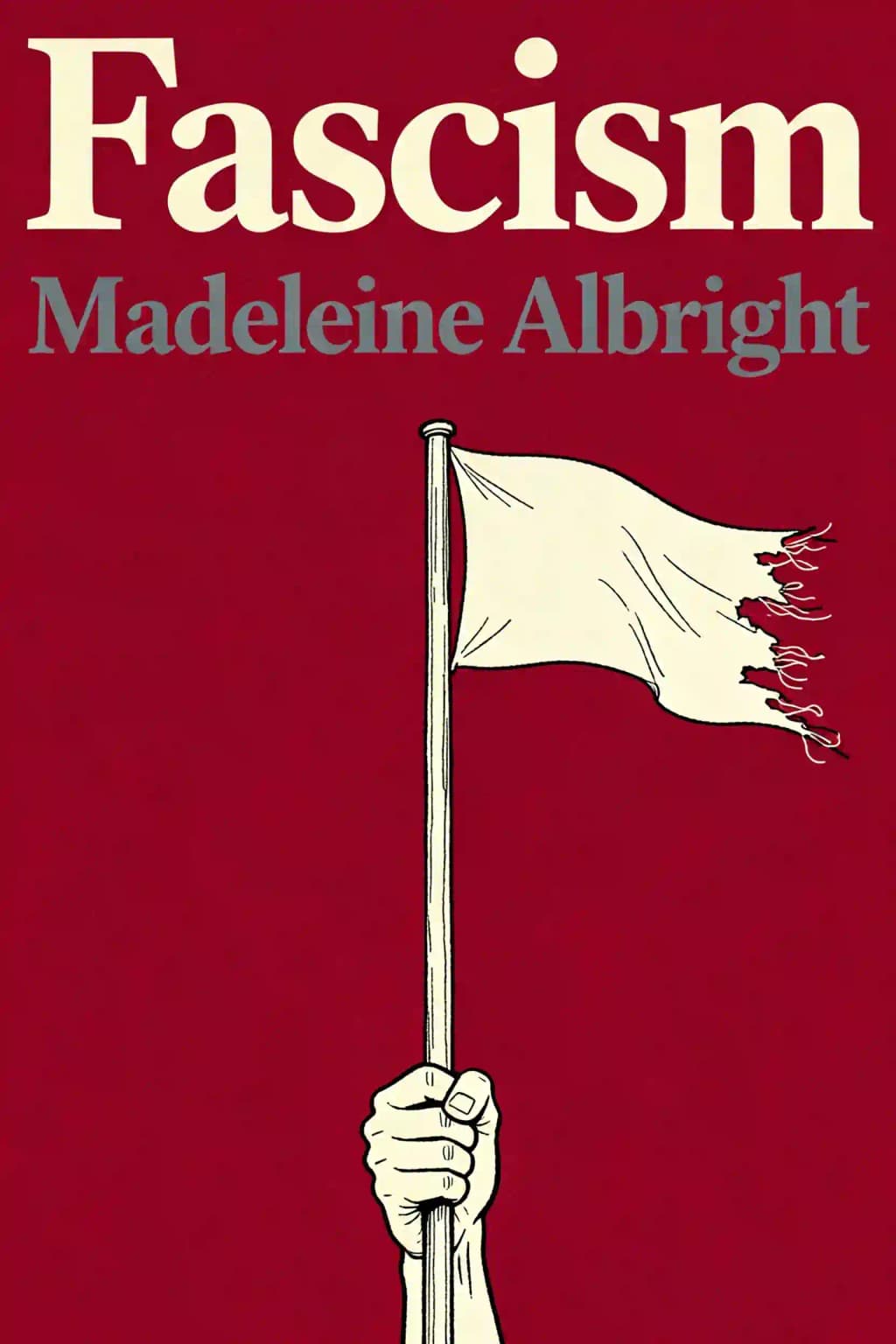
Former Secretary of State Albright's #1 NYT bestseller defines fascism not as ideology but as a process for seizing power. Can democracy survive when Trump is called "the first antidemocratic president in modern U.S. history"? "Priceless wisdom on every page" - Booklist.
Madeleine Jana Korbel Albright, author of Fascism: A Warning, was a groundbreaking diplomat, political scientist, and the first woman to serve as U.S. Secretary of State (1997–2001). Born in Prague to a Czechoslovakian diplomat family who fled Nazi and Soviet oppression, her lifelong commitment to democracy and human rights shaped this urgent examination of authoritarianism’s historical roots and modern resurgence. Blending memoir with geopolitical analysis, Albright draws on her experiences as a refugee, UN ambassador, and key architect of NATO’s Kosovo intervention to dissect fascism’s enduring threats.
A bestselling author and Presidential Medal of Freedom recipient (2012), Albright’s other works include Madam Secretary and Prague Winter, which explore her diplomatic career and family’s wartime history. As a Georgetown University professor and founder of global strategy firm Albright Stonebridge Group, she remained a sought-after commentator, featured on TED Talks and major news networks.
Fascism: A Warning reflects her signature blend of scholarly rigor and accessible prose, cementing her legacy as America’s foremost voice on foreign policy and democratic resilience. Translated into 25 languages, the book became a New York Times bestseller and remains essential reading in political science curricula worldwide.
Fascism: A Warning examines the historical roots of fascism in the 20th century and its resurgence in modern politics. Madeleine Albright analyzes authoritarian tactics like exploiting societal divisions, scapegoating minorities, and eroding democratic institutions, urging vigilance to protect freedom. The book blends personal reflections from Albright’s refugee childhood with diplomatic insights from her career as U.S. Secretary of State.
This book is essential for readers interested in political history, democratic governance, and current affairs. Policymakers, educators, and citizens concerned about rising authoritarianism will find actionable insights into recognizing and countering fascist tendencies. Albright’s accessible writing also appeals to general audiences seeking historical context for modern geopolitical challenges.
Albright identifies fascism as a process—not a fixed ideology—marked by divisive rhetoric, tribalistic loyalties, and violence to maintain power. Key elements include undermining press freedom, manipulating public fear, and blaming marginalized groups for societal problems. She emphasizes that while not all authoritarians are fascists, all fascists are dictators.
The book draws parallels between 20th-century dictators like Mussolini and Hitler and contemporary leaders who exploit polarization, misinformation, and nationalism. Albright critiques policies that isolate nations (e.g., “America First”) and warns against complacency in defending democratic institutions.
Albright reflects on her childhood fleeing Nazi-occupied Czechoslovakia and later Soviet oppression, shaping her understanding of tyranny. She also discusses her diplomatic career, including efforts to expand NATO and promote human rights, underscoring the importance of global cooperation against authoritarianism.
Some critics argue the book oversimplifies complex political movements by labeling modern leaders as “fascist.” Others note its focus on Western democracies overlooks authoritarianism in non-Western contexts. Nonetheless, Albright’s analysis is widely praised for its urgency and historical rigor.
She highlights how fascist leaders deflect blame onto vulnerable groups (e.g., immigrants, ethnic minorities) to consolidate power. Albright warns that this tactic distracts from systemic failures and deepens societal fractures, citing examples from Hitler’s Germany to modern populist movements.
Albright advocates for strengthening international alliances, investing in civic education, and protecting free media. She stresses individual responsibility to vote, fact-check misinformation, and resist normalization of authoritarian behavior.
Albright criticizes Trump’s “America First” policies as reminiscent of 1940s isolationism and his rhetoric for emboldening far-right movements. She argues his administration’s attacks on the press and democratic norms mirror early fascist strategies.
The book analyzes dictators like Mussolini, Hitler, and Stalin, as well as authoritarian-leaning modern leaders such as Vladimir Putin and Kim Jong-Un. Albright also highlights lesser-known enablers of fascism, including propagandists and compliant bureaucrats.
Yes—its exploration of disinformation, eroded trust in institutions, and nationalist movements remains critically relevant. Albright’s clear-eyed analysis provides a framework for understanding ongoing threats to global democracy.
Unlike purely historical accounts, Albright’s book combines memoir, diplomatic expertise, and urgent advocacy. It complements works like Timothy Snyder’s On Tyranny but stands out for its firsthand insights from a high-ranking U.S. official.
通过作者的声音感受这本书
将知识转化为引人入胜、富含实例的见解
快速捕捉核心观点,高效学习
以有趣互动的方式享受这本书
Albright doesn't just explain fascism-she shows us how easily it can happen again, even here.
We just need someone who can get things done.
Yes, we are barbarians. We want to be barbarians.
Hitler positioned himself as an angry man for an angry age.
Fascism rarely makes a dramatic entrance - instead, it creeps in gradually.
将《Fascism》的核心观点拆解为易于理解的要点,了解创新团队如何创造、协作和成长。
将《Fascism》提炼为快速记忆要点,突出坦诚、团队合作和创造力的关键原则。

通过生动的故事体验《Fascism》,将创新经验转化为令人难忘且可应用的精彩时刻。
随心提问,选择声音,共同创造真正与你产生共鸣的见解。

"Instead of endless scrolling, I just hit play on BeFreed. It saves me so much time."
"I never knew where to start with nonfiction—BeFreed’s book lists turned into podcasts gave me a clear path."
"Perfect balance between learning and entertainment. Finished ‘Thinking, Fast and Slow’ on my commute this week."
"Crazy how much I learned while walking the dog. BeFreed = small habits → big gains."
"Reading used to feel like a chore. Now it’s just part of my lifestyle."
"Feels effortless compared to reading. I’ve finished 6 books this month already."
"BeFreed turned my guilty doomscrolling into something that feels productive and inspiring."
"BeFreed turned my commute into learning time. 20-min podcasts are perfect for finishing books I never had time for."
"BeFreed replaced my podcast queue. Imagine Spotify for books — that’s it. 🙌"
"It is great for me to learn something from the book without reading it."
"The themed book list podcasts help me connect ideas across authors—like a guided audio journey."
"Makes me feel smarter every time before going to work"

免费获取《Fascism》摘要的 PDF 或 EPUB 版本。可打印或随时离线阅读。
What happens when a former Secretary of State who fled both Hitler and Stalin as a child sits down to write about fascism? The result is a warning that feels uncomfortably relevant. In 2018, Madeleine Albright's examination of how democracies crumble became an unexpected bestseller, recommended by everyone from historians to Oprah. The timing wasn't accidental. Around the world, democratic institutions were showing cracks, strongmen were rising, and the word "fascist" was being thrown around so carelessly it had lost all meaning. Albright cut through the noise with a simple observation: fascism doesn't announce itself with jackboots and swastikas. It arrives quietly, feather by feather, exploiting our worst fears and our desperate desire for someone-anyone-who promises to fix everything.