第 1 章
The Eternal Struggle of the Human Soul
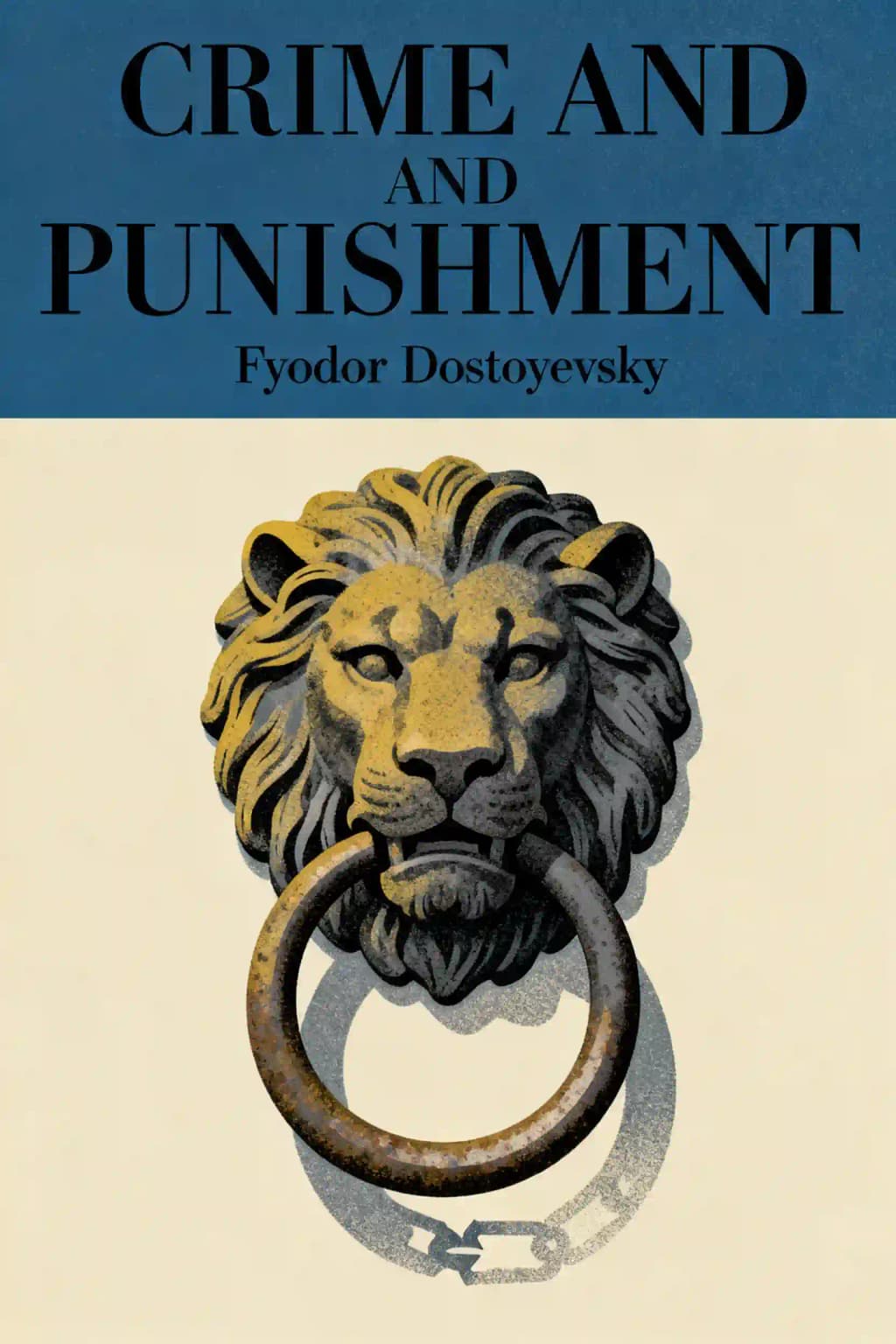
Have you ever wondered what drives a person to commit the unthinkable? Crime and Punishment isn't just a novel-it's a psychological odyssey that has captivated readers for over 150 years. This masterpiece by Fyodor Dostoyevsky continues to resonate deeply with modern audiences, exploring the darkest corners of human consciousness. Jordan Peterson has cited it as the book that most influenced his understanding of human psychology, while David Fincher acknowledged its influence on films like "Seven" and "Fight Club." When Alfred Hitchcock was asked about his inspirations, he famously replied, "Dostoyevsky taught me everything I know about suspense." The novel's cultural impact extends beyond literature-it's been adapted into over 25 films and inspired countless works across all artistic mediums, with its psychological depth making it as relevant today as when it first shocked 19th century Russia.
第 2 章
A Mind Divided Against Itself
At the heart of Crime and Punishment lies Raskolnikov, a former student living in abject poverty in St. Petersburg. His cramped garret room with peeling yellow wallpaper serves as both physical space and psychological metaphor-a coffin-like existence that mirrors his spiritual death. The room's location at the top of a building, just under the roof, symbolizes his isolation from society, while its slanting walls create a perpetual sense of confinement. From the novel's opening pages, we find him in a state of feverish determination, having convinced himself that murdering a "worthless" pawnbroker would benefit society while solving his financial problems. His internal monologues reveal a mind already fracturing under the weight of its own contradictions.
What makes Raskolnikov such a compelling character is the war raging within him. He's developed a theory that divides humanity into two categories: "ordinary" people who must obey laws, and "extraordinary" individuals (like Napoleon) who may transgress moral boundaries if their actions ultimately benefit mankind. He cites historical examples like Napoleon and Muhammad to support his theory, arguing that their "crimes" were forgiven by history because they led to greater achievements. This theory isn't merely intellectual posturing-it's his desperate attempt to elevate himself above the squalor of his existence, to prove he belongs among history's great men rather than the "trembling creatures" he despises. His contempt for ordinary humanity is particularly evident in his interactions with his landlady and local shopkeepers, whom he treats with barely concealed disdain.
The brilliance of Dostoyevsky's characterization lies in how he makes us understand Raskolnikov's twisted logic without endorsing it. We witness his mind working through elaborate justifications-the pawnbroker is "a louse," "useless," someone whose death would benefit others-while simultaneously showing us glimpses of his better nature through acts of spontaneous generosity, like giving money to the Marmeladov family or helping a young girl escape from a predatory man on the street. This duality creates a protagonist who is simultaneously repulsive and sympathetic, monstrous yet recognizably human. His philosophical arguments are undermined by his own actions, as he repeatedly demonstrates compassion that contradicts his supposed belief in the worthlessness of ordinary people.
When Raskolnikov finally commits the murder, the scene unfolds with horrifying precision. The carefully planned crime immediately goes awry when the pawnbroker's innocent sister Lizaveta unexpectedly appears, forcing him to kill her too. The axe, the blood, the stolen items hastily stuffed into pockets-these visceral details make us unwilling witnesses to an act that will haunt both Raskolnikov and readers throughout the novel. Dostoyevsky's masterful description captures both the physical horror and the psychological unraveling: the sound of the axe striking bone, Raskolnikov's trembling hands, his growing panic as events spiral beyond his control. What's most striking isn't the violence itself but how quickly Raskolnikov's grand philosophical justifications crumble in the face of brutal reality, revealing the vast gulf between abstract theory and the concrete consequences of human actions.
第 3 章
The Psychological Aftermath of Crime
The true brilliance of Crime and Punishment emerges after the murder, as we witness Raskolnikov's psychological disintegration. Rather than focusing on whether he'll be caught, Dostoyevsky explores something far more profound-how a crime punishes its perpetrator from within.
Immediately following the murders, Raskolnikov falls into a delirious fever that lasts for days. When he recovers, he finds himself in a strange psychological state-alternately paranoid and recklessly bold, confessing through hints and innuendos that only barely fall short of outright admission. He visits the scene of his crime, rings the same doorbell that announced his arrival on the fateful day, and seems almost desperate to be discovered.
The novel masterfully portrays how isolation becomes both Raskolnikov's defense mechanism and his torture chamber. He pushes away his devoted friend Razumikhin and treats his mother and sister with inexplicable cruelty when they arrive from the provinces. "Whether I sink or swim, I want to be alone," he tells them, even as his isolation intensifies his suffering. This self-imposed exile reflects Dostoyevsky's understanding that the most severe punishment isn't physical but spiritual-the separation from human connection.
Physical symptoms manifest his inner turmoil: fever, trembling, fainting spells. In one particularly revealing scene, Raskolnikov nearly confesses at the police station but faints instead, his body betraying what his conscious mind refuses to acknowledge. These physical manifestations demonstrate Dostoyevsky's remarkable insight into how psychological distress expresses itself somatically-an understanding that preceded Freud's theories by decades.
Most revealing are Raskolnikov's dreams, particularly the nightmare where he returns to the murder scene only to find the old woman laughing silently as he strikes her repeatedly with the axe. Another dream depicts a worldwide plague where people become infected with microbes that make them believe only in their own truth, leading to societal collapse as everyone kills over ideological differences-a disturbingly prophetic vision that resonates with our own polarized times.
第 4 章
The Detective and the Criminal: A Psychological Duel
The relationship between Raskolnikov and the investigating magistrate Porfiry Petrovich forms one of literature's most fascinating psychological duels. Unlike conventional detective stories where the investigator pieces together physical clues, Porfiry works primarily through psychological insight, playing an elaborate cat-and-mouse game designed to make Raskolnikov reveal himself.
Porfiry first appears when Raskolnikov visits him ostensibly to reclaim a pawned watch. Their initial conversation seems casual but quickly turns to Raskolnikov's published article about extraordinary men being above conventional morality. With subtle provocation, Porfiry asks whether such a man might consider himself justified in committing murder. This conversation establishes their relationship as an intellectual chess match where both men recognize the other's intelligence and the real stakes beneath their superficial exchanges.
Their second encounter escalates the tension dramatically. Porfiry deliberately creates an atmosphere of nervous uncertainty, pacing around his office "like a little ball rolling off in various directions," making small talk that seems pointless until he suddenly reveals knowledge of Raskolnikov's suspicious behavior at the murder apartment. He describes his investigative philosophy-sometimes it's better to give a suspect rope, let him roam free while under surveillance, until psychological pressure forces a confession. "Like a moth around a candle," he says, the criminal will eventually fly directly into the investigator's mouth.
The brilliance of these scenes lies in their ambiguity-we're never entirely certain how much Porfiry actually knows versus what he's bluffing. Does he have concrete evidence, or is he relying entirely on psychological manipulation? This uncertainty mirrors Raskolnikov's own confused state, drawing readers into the same paranoid mindset as the protagonist.
Their final confrontation brings this psychological warfare to its climax. Porfiry directly accuses Raskolnikov-"Why, you did, Rodion Romanych!"-but admits he lacks sufficient evidence for an arrest. Instead, he offers a reduced sentence if Raskolnikov confesses voluntarily. "God might just be saving you for something," he suggests, showing unexpected compassion beneath his calculating exterior. This scene reveals Porfiry as more than just a clever detective; he genuinely wants Raskolnikov's redemption, understanding that legal punishment is less important than spiritual renewal.
第 5 章
The Redemptive Power of Suffering
While Crime and Punishment explores the darkest aspects of human nature, it ultimately affirms the possibility of redemption through suffering. This theme emerges most powerfully through the character of Sonya Marmeladova, a young woman forced into prostitution to support her family.
When we first meet Sonya, she appears in her father's squalid apartment wearing the gaudy attire of her profession-a stark visual contrast to her meek demeanor. Despite her circumstances, she maintains a profound religious faith that baffles the intellectual Raskolnikov. In one of the novel's most moving scenes, he asks her to read the biblical story of Lazarus being raised from the dead. As she reads "loudly and rapturously," her voice gaining strength with each word, we witness the power of faith to transcend even the most degrading circumstances.
What makes Sonya extraordinary isn't just her faith but her capacity for compassion without judgment. When Raskolnikov confesses his crime to her, her response isn't horror or condemnation but overwhelming empathy: "No, no, nobody in the whole world is unhappier than you are now!" She embraces him, promising to follow him to Siberia-a promise she later fulfills. Through Sonya, Dostoyevsky presents suffering not as meaningless torment but as potentially transformative when accepted with humility and faith.
Raskolnikov's journey toward redemption culminates in the epilogue, set in a Siberian prison where he's serving his eight-year sentence. For most of this time, he remains unrepentant, clinging to his theory of extraordinary men while treating Sonya coldly despite her faithful visits. The turning point comes unexpectedly, as he gazes across the river at the distant steppe where nomads live in apparent freedom. Sonya appears beside him, and something finally breaks within him: "He fell at her feet. He wept, embracing her knees."
This moment represents not just romantic love but spiritual rebirth-Raskolnikov finally abandoning his pride and accepting human connection. The novel ends with the promise of "gradual renewal" and "crossing into a new reality" through love and suffering. This conclusion affirms Dostoyevsky's deeply held belief that redemption comes not through intellectual theories or social reforms, but through the humbling experience of acknowledged guilt and the acceptance of love freely given.
第 6 章
St. Petersburg: City as Character
St. Petersburg isn't merely a backdrop in Crime and Punishment-it's an active force shaping the characters' psychology and actions. Dostoyevsky portrays the city as a feverish, claustrophobic labyrinth of narrow streets, cramped apartments, and stifling taverns that mirror Raskolnikov's mental state. The city itself becomes a physical manifestation of the psychological torment experienced by its inhabitants, with its maze-like structure reflecting the twisted paths of their moral reasoning.
The oppressive summer heat that blankets the city throughout the novel creates a suffocating atmosphere where tensions simmer and reason falters. "It was terribly hot out, and moreover it was close, crowded," Dostoyevsky writes in the opening pages, establishing a setting where extreme actions become more plausible. The yellow-grey buildings, dirty canals, and drunken crowds create an environment of moral decay that seems to infect everyone within it. The heat wave serves as both literal and metaphorical fever, distorting judgment and pushing characters toward desperate acts. The stench of the canals, the press of unwashed bodies, and the perpetual dust combine to create an almost hallucinatory atmosphere.
Raskolnikov's wanderings through the city reveal its stark social contrasts. He moves between the relative affluence of Nevsky Prospect, with its fashionable shops and well-dressed crowds, and the squalor of the Haymarket district, witnessing scenes of degradation that fuel his resentment. He encounters a young girl staggering drunk, a suicide in the canal, children begging in the streets, and prostitutes lingering in doorways. These urban tableaux aren't incidental but integral to understanding his crime's social context. The city's geography becomes a map of class division, with each neighborhood representing different levels of moral and social decay.
The city's architecture reinforces themes of confinement and surveillance. Narrow staircases wind like serpents through buildings, cramped apartments with low ceilings press down on their inhabitants, and courtyards described as "wells" create a sense of being trapped. Raskolnikov's room is famously coffin-like, a "tiny closet" that physically embodies his psychological imprisonment, while the prevalent yellow walls suggest jaundice or disease spreading through the urban landscape. Even public spaces offer no freedom-someone is always watching, listening, following. The taverns are filled with eavesdroppers, the streets with suspicious police, and the buildings themselves seem to observe their inhabitants through countless windows. This constant visibility becomes psychological torture for Raskolnikov after his crime, transforming the city into an open-air prison.
Perhaps most significant is how the city fragments human connection while forcing people into uncomfortable proximity. Characters live pressed against each other in crowded tenements, yet remain profoundly isolated. Neighbors overhear each other's most intimate moments through thin walls but remain strangers, creating a paradoxical environment of forced intimacy without genuine connection. This urban alienation enables Raskolnikov's theory that some lives matter less than others-a distortion only possible in an environment where human bonds have already been severely weakened by the city's physical and social architecture. The layout of St. Petersburg itself becomes an accomplice to Raskolnikov's crime, its labyrinthine streets and anonymous crowds providing both opportunity and psychological justification for his actions.
第 7 章
The Critique of Rationalism
Throughout Crime and Punishment, Dostoyevsky mounts a powerful critique of rationalism and utilitarianism-philosophical positions gaining popularity in mid-19th century Russia. Raskolnikov's crime emerges directly from these intellectual currents, making the novel not just a psychological study but a philosophical challenge to modernity itself.
Raskolnikov's theory about extraordinary men draws from various Western philosophical ideas, particularly utilitarianism's notion that actions should be judged by their usefulness to society rather than adherence to moral absolutes. His justification for murder-that eliminating one "harmful" person could benefit many others-is essentially a perverse application of utilitarian calculus. Similarly, his division of humanity into ordinary and extraordinary individuals echoes aspects of Nietzsche's later concept of the Ubermensch, though Dostoyevsky's treatment is clearly critical rather than celebratory.
The novel systematically exposes the dangerous consequences of purely rational approaches to human problems. When Raskolnikov attempts to justify his crime through abstract reasoning, reality intrudes in ways his theory never accounted for-the unexpected presence of Lizaveta, his physical revulsion after the murder, his inability to use the stolen goods. These failures demonstrate how rational schemes collapse when confronted with the messy complexity of actual human experience.
Luzhin, Raskolnikov's sister's fiance, represents another version of rationalism through his embrace of economic self-interest. "Love yourself and your affairs will take care of themselves, and your coat will remain in one piece," he pompously declares, arguing that pursuing self-interest ultimately benefits society more than charity does. Dostoyevsky portrays him as morally bankrupt-willing to frame an innocent woman and exploit others for his advancement.
Against these rational systems, Dostoyevsky posits faith, compassion, and suffering as truer paths to understanding. Sonya's simple faith appears irrational by conventional standards-she continues to believe in divine goodness despite her terrible circumstances. Yet the novel suggests her "irrational" perspective grasps truths that Raskolnikov's clever theories miss entirely. When he asks what God has done for her, she replies with quiet certainty: "He does everything." This answer, incomprehensible to pure reason, contains a wisdom that ultimately proves more enduring than any theory.
第 8 章
Family Bonds and Social Responsibility
While Crime and Punishment focuses intensely on Raskolnikov's individual psychology, it also examines how family relationships shape moral choices and social responsibility. The novel presents several family units, each revealing different aspects of love, obligation, and sacrifice.
The Raskolnikov family exemplifies both the strength and strain of family bonds. Pulkheria Alexandrovna and Dunya show extraordinary devotion to Rodion, traveling to Petersburg and enduring hardship for his sake. Yet his response is ambivalence and even cruelty-he pushes them away while simultaneously feeling bound to protect them. This contradiction reveals how family ties can be both sustaining and suffocating. When he kisses his mother's feet before his confession, it's a gesture acknowledging both his love and his betrayal of familial duty.
The Marmeladov family presents a more tragic vision of family life. Semyon Marmeladov, an alcoholic civil servant, has driven his family to destitution while indulging his addiction. His wife Katerina Ivanovna, consumed by pride and consumption (tuberculosis), forces her children to beg in the streets. Most poignantly, Sonya sacrifices her virtue to support her stepmother and half-siblings, embodying the extreme cost of family obligation. When the dying Marmeladov cries "Forgive!" to Sonya after seeing her in her prostitute's attire for the first time, it's a moment of devastating recognition of how his failures have destroyed those he loves.
Beyond biological families, Dostoyevsky explores chosen bonds of responsibility. Razumikhin's devotion to Raskolnikov transcends friendship, eventually leading him to become a surrogate son to Pulkheria and brother to Dunya. His willingness to assume responsibility for others contrasts sharply with Raskolnikov's isolation and Svidrigailov's predatory self-interest.
Through these varied family portraits, the novel suggests that moral health depends on recognizing our interconnectedness. Raskolnikov's crime stems partly from his failure to see how his actions affect others-a failure the novel portrays as both moral and psychological. His eventual redemption begins when he acknowledges his responsibility not just to abstract humanity but to specific individuals who love him despite his flaws.
第 9 章
The Shadow Self: Doubles and Alter Egos
One of Crime and Punishment's most fascinating psychological techniques is its use of character doubles or doppelgangers-figures who reflect aspects of Raskolnikov's personality that he cannot fully acknowledge. Through these mirrors, Dostoyevsky explores the fragmentation of modern consciousness and the struggle to integrate opposing aspects of the self.
Svidrigailov serves as Raskolnikov's darkest double-a man who has fully embraced amorality and self-indulgence. Like Raskolnikov, he's intelligent and capable of generosity (as shown by his financial assistance to the Marmeladov children). Unlike Raskolnikov, he feels no guilt for his transgressions, viewing conscience as merely "indigestion" and morality as social convention. When he tells Raskolnikov, "We're two of a kind," it's a statement that terrifies precisely because it contains partial truth. Svidrigailov represents what Raskolnikov might become if he fully embraces his theory without moral restraint-a prospect so disturbing that Svidrigailov's suicide suggests the ultimate emptiness of such existence.
Razumikhin functions as Raskolnikov's positive double-sharing his intelligence but channeling it toward constructive ends. Where Raskolnikov isolates himself, Razumikhin builds connections; where Raskolnikov theorizes, Razumikhin acts practically. Their names even share the same root (razum, meaning "reason"), suggesting they represent different applications of the same human faculty. Razumikhin's eventual happiness with Dunya offers a glimpse of the life Raskolnikov might have had without his crime.
Even minor characters serve as mirrors. Mikolka, the workman who falsely confesses to the murders, reflects Raskolnikov's desire for punishment without requiring actual confession. Luzhin's calculated exploitation of others parallels aspects of Raskolnikov's utilitarian thinking. The consumptive Katerina Ivanovna shares his pride and refusal to accept charity despite desperate circumstances.
Most significant is Sonya, who represents both Raskolnikov's opposite and his potential salvation. Like him, she has transgressed social norms, yet where his transgression isolates him, hers is an act of self-sacrifice that maintains human connection. Her suffering without resentment offers an alternative path to his suffering with pride. When he finally falls at her feet in the epilogue, it represents not just romantic love but the integration of these opposing aspects of human experience-pride and humility, intellect and faith, isolation and connection.
第 10 章
The Enduring Relevance of Crime and Punishment
Over 150 years after its publication, Crime and Punishment remains startlingly relevant to contemporary concerns. Its psychological insights anticipate modern understandings of trauma, dissociation, and moral injury. Its philosophical questions about individual rights versus social responsibility continue to challenge readers in an age of increasing individualism and moral relativism.
The novel's exploration of radicalization feels particularly timely. Raskolnikov's progression from isolated theorizing to violent action parallels patterns observed in modern extremism, where individuals develop distorted worldviews that justify violence against dehumanized others. His belief that he belongs to a special category exempt from moral rules echoes contemporary concerns about narcissism and entitlement in digital culture.
Dostoyevsky's critique of utilitarian thinking raises questions that still trouble us: Can human life be reduced to cost-benefit calculations? What happens when we prioritize abstract principles over individual suffering? As algorithms increasingly make decisions affecting human lives, the novel's insistence on irreducible human worth provides a necessary counterbalance to purely quantitative approaches.
The novel's psychological realism continues to resonate because it captures universal aspects of human experience-guilt, isolation, the longing for connection, the possibility of redemption. Raskolnikov's struggle isn't just a 19th-century Russian phenomenon but a timeless portrayal of consciousness in conflict with itself. His journey from intellectual pride through suffering to the possibility of renewal speaks to anyone who has ever failed, suffered, or hoped for transformation.
Perhaps most powerfully, Crime and Punishment affirms that no one is beyond redemption. In an era often characterized by public shaming and permanent judgment, Dostoyevsky's vision of human potential for change offers a more compassionate alternative. The novel insists that even after the worst actions, the possibility remains for what the epilogue calls "gradual renewal" and "crossing into a new reality." This message of hope amidst darkness may explain why the novel continues to move readers across vast cultural and historical distances-it speaks to our deepest fears and our highest aspirations.