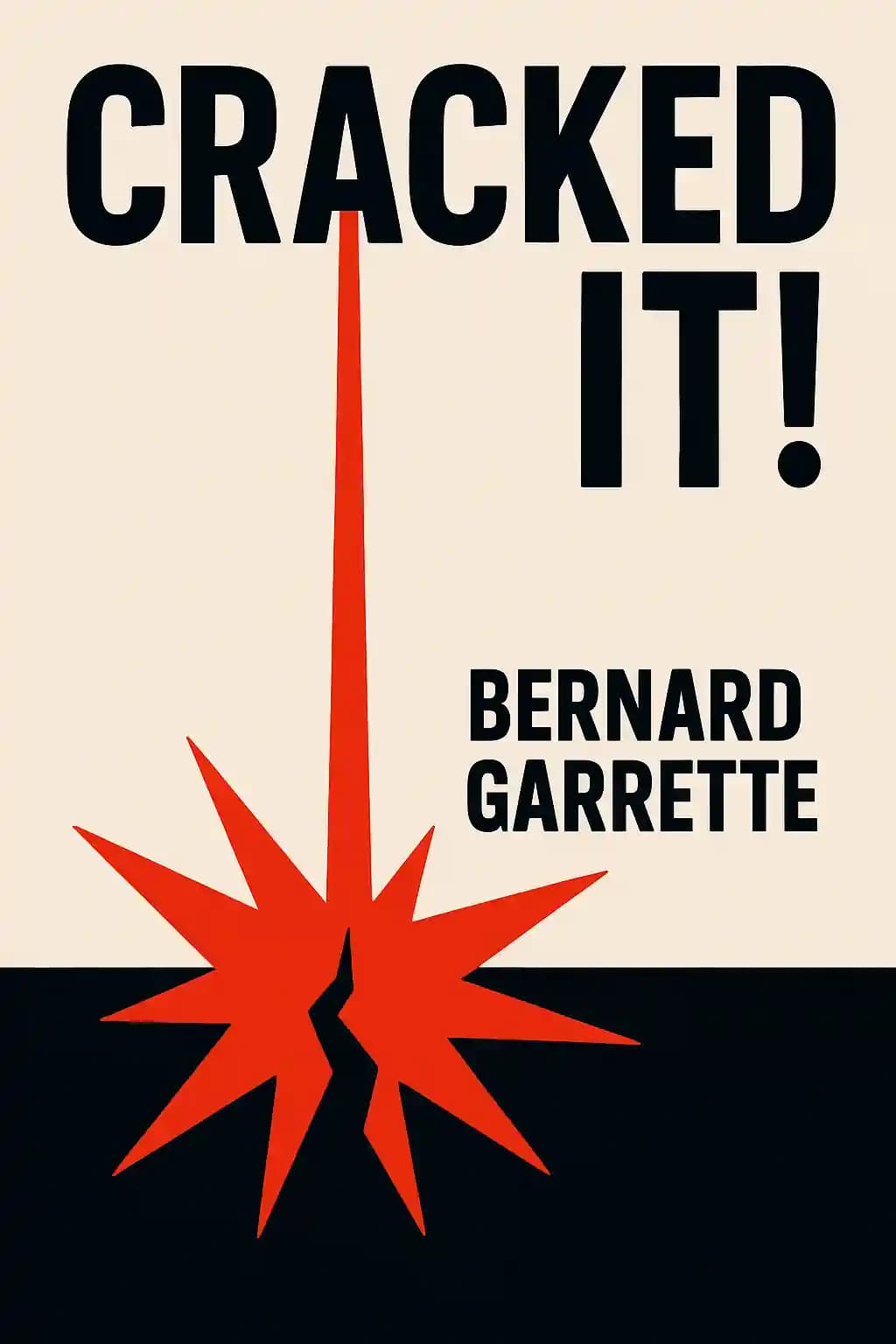
Crack the code of complex problem-solving with "Cracked It!" - the 4.27-rated strategic playbook trusted by elite consultants worldwide. Learn the revolutionary 4S method that transformed business strategy and turned JCPenney's failure into tomorrow's success blueprint. Your toughest challenges just met their match.
Bernard Garrette, author of Cracked It! How to Solve Big Problems and Sell Solutions Like Top Strategy Consultants, is a renowned strategy professor at HEC Paris and former McKinsey senior consultant. A leading expert in corporate problem-solving, Garrette combines academic rigor with practical consulting insights honed through decades of teaching and advising global organizations. His book merges cognitive psychology, design thinking, and proven consulting frameworks to address complex business challenges.
Garrette co-authored the influential Cooperative Strategy and the 8th edition of Strategor, France’s premier strategic management textbook. A recipient of BNP Paribas’ Pierre Vernimmen Teaching Award, he has served as visiting professor at IESE, London Business School, and Cambridge University. Beyond academia, he self-published Vous voulez de mes nouvelles?, a collection of illustrated short stories, showcasing his creative approach to communication.
Cracked It! reflects Garrette’s dual expertise in analytical frameworks and human-centered solutions, with methodologies adopted by top MBA programs and Fortune 500 leaders worldwide. The book’s four-step problem-solving process has become a benchmark in strategic education and professional training.
Cracked It! provides a four-step framework for solving complex business problems and selling solutions, blending strategies from top consultants, cognitive psychology, and design thinking. Authors Bernard Garrette, Corey Phelps, and Olivier Sibony emphasize problem structuring, hypothesis testing, and stakeholder communication, using real-world cases like retail CEO missteps and MRI scanner redesigns.
Professionals, managers, and consultants facing complex organizational challenges will benefit most. The book equips readers with tools to avoid confirmation bias, structure ambiguous problems, and persuasively present solutions—ideal for strategy teams, product developers, and leaders driving innovation.
Yes—it’s praised for merging academic rigor with actionable methods, offering rare insights into consulting techniques rarely shared publicly. Case studies illustrate both successful and failed problem-solving, making it valuable for avoiding common pitfalls like solution bias or poor stakeholder alignment.
The method includes:
The authors stress empathy-driven stakeholder analysis and hypothesis testing to counter confirmation bias. For example, they show how a CEO’s overreliance on past strategies led to failure, while redesigning MRI scanners through a child’s perspective succeeded.
Notable examples include:
It emphasizes tailoring communication to audiences, using storytelling to bridge knowledge gaps. For instance, the book contrasts dry scientific arguments with compelling narratives that simplify complex data.
The authors integrate design thinking to reframe problems empathetically. The MRI case study demonstrates how viewing a problem through end-users’ eyes (e.g., frightened children) led to transformative solutions.
Unlike generic self-help guides, it combines consultancy tactics with academic research, offering structured tools like hypothesis trees and stakeholder maps. This makes it more actionable than theoretical works.
Bernard Garrette, Corey Phelps, and Olivier Sibony—seasoned strategy professors and consultants with decades of combined experience at firms like McKinsey and HEC Paris. They’ve advised Fortune 500 companies and governments.
Key traps include:
Yes—the framework’s emphasis on empathy, systematic analysis, and storytelling suits personal decisions, nonprofit challenges, or policy design. The MRI case, for instance, highlights cross-industry applicability.
通过作者的声音感受这本书
将知识转化为引人入胜、富含实例的见解
快速捕捉核心观点,高效学习
以有趣互动的方式享受这本书
Expertise can become a liability.
Intelligence alone isn't enough either.
Being right isn't enough.
Avoid both Othello's hasty conclusions and Hamlet's analysis paralysis.
This narrow framing led them to fight unwinnable battles.
将《Cracked It!》的核心观点拆解为易于理解的要点,了解创新团队如何创造、协作和成长。
将《Cracked It!》提炼为快速记忆要点,突出坦诚、团队合作和创造力的关键原则。

通过生动的故事体验《Cracked It!》,将创新经验转化为令人难忘且可应用的精彩时刻。
随心提问,选择声音,共同创造真正与你产生共鸣的见解。

"Instead of endless scrolling, I just hit play on BeFreed. It saves me so much time."
"I never knew where to start with nonfiction—BeFreed’s book lists turned into podcasts gave me a clear path."
"Perfect balance between learning and entertainment. Finished ‘Thinking, Fast and Slow’ on my commute this week."
"Crazy how much I learned while walking the dog. BeFreed = small habits → big gains."
"Reading used to feel like a chore. Now it’s just part of my lifestyle."
"Feels effortless compared to reading. I’ve finished 6 books this month already."
"BeFreed turned my guilty doomscrolling into something that feels productive and inspiring."
"BeFreed turned my commute into learning time. 20-min podcasts are perfect for finishing books I never had time for."
"BeFreed replaced my podcast queue. Imagine Spotify for books — that’s it. 🙌"
"It is great for me to learn something from the book without reading it."
"The themed book list podcasts help me connect ideas across authors—like a guided audio journey."
"Makes me feel smarter every time before going to work"

免费获取《Cracked It!》摘要的 PDF 或 EPUB 版本。可打印或随时离线阅读。
Why do brilliant minds sometimes make catastrophic decisions? When Dell's performance plummeted in 2007, observers quickly blamed CEO Kevin Rollins-a classic case of jumping to conclusions without proper analysis. This tendency to create coherent narratives from incomplete information isn't just a business problem; it's fundamentally human. "Cracked It!" has become a cult favorite among consultants and strategists because it addresses this universal challenge with a systematic approach that bridges academic theory and practical application. The book reveals a fundamental tension in problem-solving: our brains operate in two modes. "System 1" thinking-fast, automatic, and unconscious-quickly constructs narratives through association. "System 2" thinking is slow, deliberate, and effortful, questioning assumptions and applying analytical frameworks. The challenge is avoiding both Othello's hasty conclusions and Hamlet's analysis paralysis. What makes this particularly tricky? Expertise can become a liability. Within their domains, experts recognize patterns effectively. But facing problems outside their expertise, they often perform worse than novices-their mental models become rigid, they grow overconfident, and develop poor solutions based on superficial analogies. This explains why brilliant engineers might struggle with marketing challenges or finance experts might mishandle organizational problems.