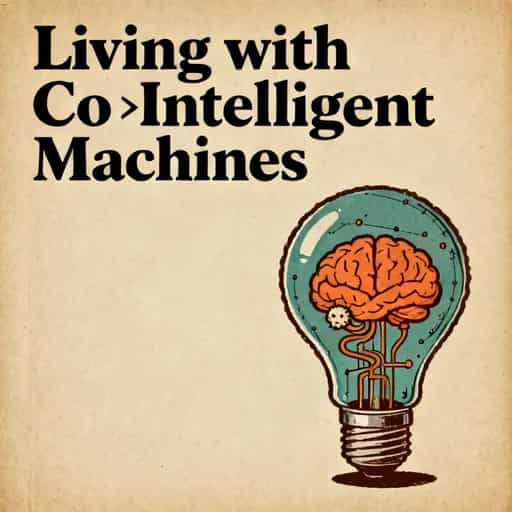
In "Cointelligence," Ethan Mollick reveals how AI is transforming knowledge work. Can machines truly augment human creativity? This groundbreaking exploration shows why understanding AI collaboration isn't optional - it's the new competitive advantage that's reshaping industries and careers worldwide.
Ethan Mollick, bestselling author of Co-Intelligence: Living and Working with AI and a leading expert on artificial intelligence’s impact on work and education, is an associate professor at the University of Pennsylvania’s Wharton School.
His book, blending technology and business strategy, explores how AI reshapes human creativity, productivity, and decision-making—themes rooted in his MIT and Harvard education, startup experience, and role as co-director of Wharton’s Generative AI Labs.
Mollick’s insights appear in The New York Times, TIME (which named him one of 2023’s Most Influential People in AI), and his widely read Substack, One Useful Thing, which reaches over 150,000 subscribers.
His earlier work, The Unicorn’s Shadow, critiques startup myths and has been cited in top management journals. Co-Intelligence became a New York Times bestseller and was featured in The Economist and Financial Times as a best book of the year, solidifying its status as essential reading for professionals navigating AI’s transformative era.
Co-Intelligence explores how individuals and organizations can thrive alongside AI by treating it as a collaborator in creativity, education, and work. Ethan Mollick provides actionable frameworks for leveraging AI’s strengths while mitigating risks, emphasizing strategies like human oversight and ethical alignment. The book balances optimism about AI’s potential with pragmatic advice for navigating its challenges.
Professionals, educators, and leaders seeking to understand AI’s transformative impact on workplaces and learning environments will benefit most. It’s also valuable for anyone curious about practical AI integration, offering tools for writers, entrepreneurs, and policymakers to harness AI responsibly.
Yes—it’s a New York Times bestseller praised by The Economist and Financial Times for its balanced insights. Mollick’s expertise as a Wharton professor and AI researcher provides credible, accessible guidance on navigating AI’s rapid evolution, making it essential for staying informed.
Mollick argues that adaptability trumps specialization, illustrated by the quote: “The world doesn’t care what you majored in.” He highlights how AI reshapes industries, urging readers to embrace lifelong learning and interdisciplinary skills to stay relevant.
While comprehensive, the book overlooks AI’s environmental costs, such as energy consumption and resource extraction. Some argue it could delve deeper into regulatory specifics, though it emphasizes societal collaboration for ethical AI development.
He advocates for AI as a co-teacher and coach, enhancing personalized learning through simulations and real-time feedback. His work at Wharton Interactive demonstrates how AI-driven tools can democratize access to high-quality education.
The 2017 Transformer architecture and attention mechanism enabled breakthroughs like GPT-3/4, allowing AI to contextualize information and generate humanlike text. Mollick explains how these advancements drive AI’s emergent, unpredictable capabilities.
Mollick stresses proactive human oversight, transparency in AI decision-making, and ethical guardrails. He encourages users to audit AI outputs rigorously and prioritize systems that align with human values.
He frames AI as a “mirror” reflecting human ingenuity and flaws, urging readers to shape its development thoughtfully. This metaphor underscores the book’s theme: AI’s trajectory depends on our choices today.
It uniquely blends academic rigor with practical advice, avoiding either dystopian or overly utopian narratives. Mollick’s focus on actionable co-working strategies sets it apart from theoretical or technical guides.
As AI becomes ubiquitous, Mollick’s frameworks for collaboration address emerging challenges like workplace automation, AI-driven creativity, and ethical dilemmas. His insights help readers stay ahead in fast-evolving environments.
通过作者的声音感受这本书
将知识转化为引人入胜、富含实例的见解
快速捕捉核心观点,高效学习
以有趣互动的方式享受这本书
AI isn't merely complementing human intelligence-it's beginning to replace aspects of it.
We're collaborating with entities that demonstrate aspects of intelligence we once considered uniquely human.
The impact was immediate and profound.
Attention Is All You Need.
The scale is staggering.
将《Co-Intelligence》的核心观点拆解为易于理解的要点,了解创新团队如何创造、协作和成长。
将《Co-Intelligence》提炼为快速记忆要点,突出坦诚、团队合作和创造力的关键原则。

通过生动的故事体验《Co-Intelligence》,将创新经验转化为令人难忘且可应用的精彩时刻。
随心提问,选择声音,共同创造真正与你产生共鸣的见解。

"Instead of endless scrolling, I just hit play on BeFreed. It saves me so much time."
"I never knew where to start with nonfiction—BeFreed’s book lists turned into podcasts gave me a clear path."
"Perfect balance between learning and entertainment. Finished ‘Thinking, Fast and Slow’ on my commute this week."
"Crazy how much I learned while walking the dog. BeFreed = small habits → big gains."
"Reading used to feel like a chore. Now it’s just part of my lifestyle."
"Feels effortless compared to reading. I’ve finished 6 books this month already."
"BeFreed turned my guilty doomscrolling into something that feels productive and inspiring."
"BeFreed turned my commute into learning time. 20-min podcasts are perfect for finishing books I never had time for."
"BeFreed replaced my podcast queue. Imagine Spotify for books — that’s it. 🙌"
"It is great for me to learn something from the book without reading it."
"The themed book list podcasts help me connect ideas across authors—like a guided audio journey."
"Makes me feel smarter every time before going to work"

免费获取《Co-Intelligence》摘要的 PDF 或 EPUB 版本。可打印或随时离线阅读。
Three sleepless nights. That's how long it took to realize we were living through a revolution. Not the kind announced with fanfare, but the quiet kind that rewrites the rules while most of us sleep. Sitting alone with ChatGPT in those dark hours, something became clear: this wasn't just another tech upgrade. This was a conversation with something that felt disturbingly, thrillingly close to human. It helped with homework. Drafted business plans. Wrote poetry. And it did all this with an ease that should have been impossible. We've reached a peculiar moment in history. The machines we built to serve us have learned to think-or at least, to do something eerily similar. This isn't science fiction anymore. It's Tuesday afternoon, and you're asking an AI to explain quantum physics or write a breakup letter. The question isn't whether this technology will reshape our world. It's already happening. The real question is: how do we live and work alongside an intelligence that mirrors our own yet remains fundamentally alien?