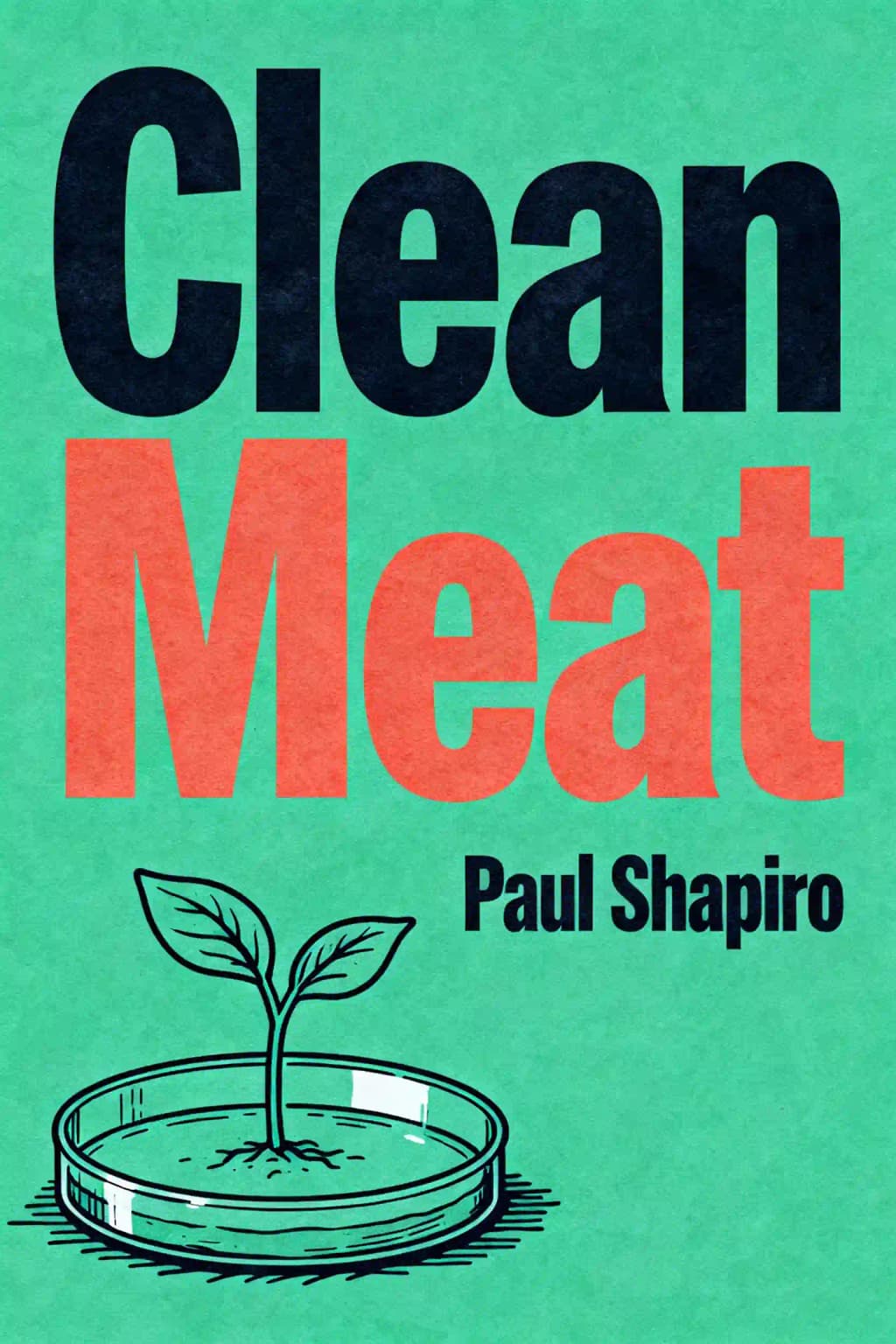
Paul Shapiro's "Clean Meat" unveils how lab-grown protein could revolutionize dinner without animals. Endorsed by Google's Eric Schmidt and Whole Foods' John Mackey, this book sparked industry debates and inspired Shapiro to launch his own alternative protein company. Could your next burger be slaughter-free?
Paul Shapiro is the national bestselling author of Clean Meat: How Growing Meat Without Animals Will Revolutionize Dinner and the World, a pioneering exploration of food technology and sustainable agriculture.
As CEO of The Better Meat Co., Shapiro leverages microbial fermentation to produce animal-free meat alternatives, aligning with the book’s themes of ethical consumption and environmental innovation.
A five-time TEDx speaker and host of the Business for Good Podcast, he combines decades of advocacy—including founding Compassion Over Killing and leading farm animal protection at the Humane Society—with rigorous science communication. His insights have been featured in the Washington Post, Scientific American, and on CNN and Neil deGrasse Tyson’s StarTalk Radio.
Shapiro’s work has earned recognition as a 2023 Sacramento Business Journal Most Admired CEO, and Clean Meat has been translated into seven languages, solidifying its status as a seminal text in the future-of-food movement.
Clean Meat explores the groundbreaking field of lab-grown meat, detailing how scientists and entrepreneurs are developing real animal products without slaughtering livestock. Paul Shapiro examines the technology’s potential to address environmental degradation, animal suffering, and public health crises, offering a vision of a sustainable food future. The book combines scientific innovation narratives with discussions on ethics and global food security.
This book is ideal for environmentally conscious readers, food-tech enthusiasts, and anyone interested in ethical consumption. It also appeals to policymakers and entrepreneurs exploring sustainable alternatives to industrial agriculture. Shapiro’s accessible writing makes complex biotechnology concepts understandable for general audiences.
Yes. Shapiro’s thorough research and engaging storytelling provide a compelling case for cellular agriculture’s role in solving global food challenges. The book balances optimism with realistic discussions of hurdles like cost and public acceptance, making it valuable for both supporters and skeptics of clean meat.
Clean meat is cultivated by isolating animal cells and nurturing them in bioreactors with nutrients, allowing them to grow into muscle tissue. This process bypasses traditional livestock farming, requiring fewer resources and no slaughter. Some products use microbial fermentation to create animal proteins directly from yeast or bacteria.
Lab-grown meat could reduce greenhouse gas emissions by up to 96%, cut water use by 82–96%, and require 99% less land compared to conventional meat. It also minimizes pollution from animal waste and lowers the risk of deforestation linked to livestock grazing.
By eliminating the need for animal slaughter, clean meat could drastically reduce livestock suffering and end factory farming practices. Shapiro argues this technology aligns ethical consumption with dietary habits, offering a guilt-free way to enjoy meat.
High production costs, scaling difficulties, and regulatory hurdles remain obstacles. Consumer skepticism about “lab-grown” products and competition from plant-based alternatives also pose challenges. Shapiro highlights ongoing efforts to improve taste, texture, and affordability.
Shapiro emphasizes that clean meat targets mainstream meat-eaters, not just vegetarians. He showcases startups focused on replicating the taste and texture of conventional meat, arguing that familiarity and affordability will drive adoption. The book also debunks myths about genetic modification.
Companies like Memphis Meats, Mosa Meat, and Eat Just are pioneers, securing investments from firms such as Cargill and Tyson Foods. These startups aim to refine production techniques, lower costs, and secure regulatory approvals to bring products to market.
Critics argue lab-grown meat may face opposition from natural-food advocates and face technical barriers to replicating complex cuts like steaks. Shapiro acknowledges these concerns but stresses the urgency of finding sustainable protein sources for a growing population.
With the global population projected to reach 11 billion by 2100, clean meat offers a scalable protein source without the resource constraints of traditional agriculture. It could stabilize food supplies in regions vulnerable to climate change and livestock diseases.
Shapiro envisions clean meat dominating markets by 2050, with cultured products surpassing plant-based alternatives in popularity. He predicts partnerships between biotech firms and major food corporations, alongside regulatory frameworks ensuring safety and transparency.
通过作者的声音感受这本书
将知识转化为引人入胜、富含实例的见解
快速捕捉核心观点,高效学习
以有趣互动的方式享受这本书
Clean meat isn't science fiction - it's already here.
We're "domesticating cells themselves" rather than whole animals.
The math simply doesn't work for our growing population.
Each chicken requires over 1,000 gallons of water.
The implications are staggering.
将《Clean meat》的核心观点拆解为易于理解的要点,了解创新团队如何创造、协作和成长。
将《Clean meat》提炼为快速记忆要点,突出坦诚、团队合作和创造力的关键原则。

通过生动的故事体验《Clean meat》,将创新经验转化为令人难忘且可应用的精彩时刻。
随心提问,选择声音,共同创造真正与你产生共鸣的见解。

"Instead of endless scrolling, I just hit play on BeFreed. It saves me so much time."
"I never knew where to start with nonfiction—BeFreed’s book lists turned into podcasts gave me a clear path."
"Perfect balance between learning and entertainment. Finished ‘Thinking, Fast and Slow’ on my commute this week."
"Crazy how much I learned while walking the dog. BeFreed = small habits → big gains."
"Reading used to feel like a chore. Now it’s just part of my lifestyle."
"Feels effortless compared to reading. I’ve finished 6 books this month already."
"BeFreed turned my guilty doomscrolling into something that feels productive and inspiring."
"BeFreed turned my commute into learning time. 20-min podcasts are perfect for finishing books I never had time for."
"BeFreed replaced my podcast queue. Imagine Spotify for books — that’s it. 🙌"
"It is great for me to learn something from the book without reading it."
"The themed book list podcasts help me connect ideas across authors—like a guided audio journey."
"Makes me feel smarter every time before going to work"

免费获取《Clean meat》摘要的 PDF 或 EPUB 版本。可打印或随时离线阅读。
Imagine holding a piece of beef that required no animal to die, no forest to be cleared, and no antibiotics to be administered. In 2014, at Brooklyn Army Terminal, this future became tangible as lab-grown meat made its debut. The significance wasn't just in its barbecue flavor, but in what it represented: a potential solution to one of humanity's greatest challenges-feeding billions without destroying our planet. This technological breakthrough has attracted investment from visionaries like Bill Gates, Richard Branson, and Sergey Brin, who recognize its potential to reduce greenhouse gas emissions by up to 96%, eliminate industrial animal suffering, and prevent pandemics originating in factory farms. Winston Churchill's 1931 prediction is finally materializing: "We shall escape the absurdity of growing a whole chicken in order to eat the breast or wing, by growing these parts separately under a suitable medium."