第 1 章
The Journey of a Brown Girl Dreaming
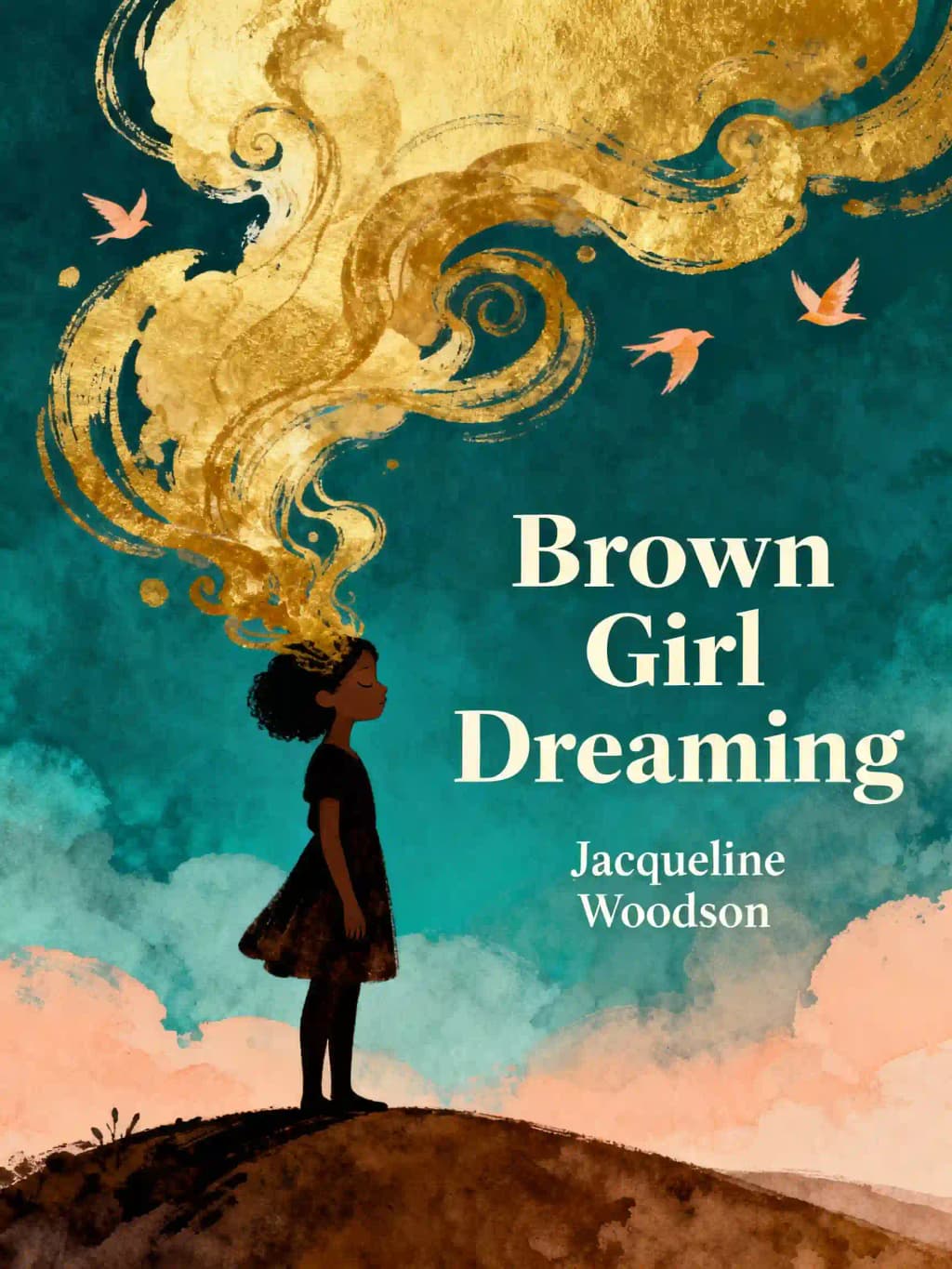
In 1963, a remarkable story began in Columbus, Ohio-the birth of Jacqueline Woodson, who would grow to become one of America's most celebrated authors. Her memoir "Brown Girl Dreaming" has captivated millions of readers, including former First Lady Michelle Obama, who named it one of her favorite books. This National Book Award winner chronicles Jacqueline's journey through childhood during the Civil Rights Movement, navigating between two worlds: the North and the South. Through poetic verse that flows like memory itself, Woodson captures the essence of growing up Black in America during a pivotal time of social change, showing how a young girl discovered her voice and her power through words.
第 2 章
Between Two Worlds: The North and South Divide
Born in Ohio but with deep roots in South Carolina, Jacqueline Woodson's early life was defined by the stark contrast between these two worlds. Her father, Jack Woodson, wanted a strong name for his daughter-originally suggesting she simply be named "Jack"-but her mother insisted on "Jacqueline," providing room for her daughter to define herself. The Woodsons of Ohio traced their lineage to Thomas Woodson, rumored to be the first son of Thomas Jefferson and Sally Hemings, giving them what they called "a head start" in life. This northern heritage, with its relative freedoms and opportunities, stood in marked contrast to the southern world Jacqueline would soon know intimately. The family took pride in their connection to American history, even as it highlighted the complex relationship between race and privilege in their lineage.
When her parents' marriage dissolved after her first birthday, Jacqueline's mother took her three children-Hope, Odella (Dell), and baby Jacqueline-to Greenville, South Carolina, to live with her parents. The journey south became a powerful lesson in the realities of racial division. On the bus to Greenville, Jacqueline's mother moved her children to the back, explaining, "This isn't Ohio." Yet even as she complied with these unjust rules, she whispered to her wide-eyed son, "We're as good as anybody." The children learned early that geography could determine not just where they sat, but how they were treated and what opportunities were available to them. Each mile southward brought new revelations about the different America that existed below the Mason-Dixon line.
The South revealed itself through contradictions-the warmth of family and community in Nicholtown, the sweet smell of honeysuckle and pine, but also the persistent reminders of segregation. In downtown Greenville, WHITE ONLY signs had been painted over but remained visible like ghosts, a physical reminder of recent history that refused to fade. Jacqueline's grandmother would avoid certain stores where Black customers were followed, developing intricate maps of safe spaces and forbidden zones that she passed down to her grandchildren. Restaurants always seated them near the kitchen, a subtle but clear message about their perceived place in society. At the Woolworth's lunch counter, they could shop but not eat, forced to take their food to go while white customers dined in comfort. These experiences taught young Jacqueline about the world's inequities while simultaneously showing her the strength of those who fought against them, particularly the quiet dignity of her family members who found ways to maintain their self-respect in a system designed to deny it.
The contrast between her two worlds shaped Jacqueline's understanding of race, family, and identity. In Ohio, the family could shop freely and attend integrated schools, while in South Carolina, every interaction was colored by racial codes both written and unwritten. Yet the South also offered deep connections to family history, cultural traditions, and a sense of belonging within the tight-knit Black community of Nicholtown, where neighbors looked out for one another and shared what they had, creating a fortress of support against external prejudices.
第 3 章
The Sanctuary of Nicholtown
In Nicholtown, the predominantly Black neighborhood in Greenville where Jacqueline's grandparents lived, she found a sanctuary of belonging. Their small red stone house on Hall Street became home, with its immense yard, front porch swing, blooming azaleas, and pine trees. Here, Jacqueline was embraced by her grandparents' love-her grandmother Georgiana, a part-time teacher who also did "daywork" cleaning white people's homes, and her grandfather Gunnar, who worked at a printing press.
Gunnar's garden was a source of pride and sustenance, yielding sweet peas, collards, peppers, lettuce, berries, and peaches. "God gives you what you need," her grandmother would say, to which her grandfather would respond with a simple "Hmph" as he pulled from the land all they needed and more. Each evening, he would walk home from work, his silver lunch box bouncing against his leg as he sang old songs and greeted neighbors. The children called him "Daddy," just as their mother did, and he seemed taller and more handsome than anyone in Greenville.
Nicholtown evenings were filled with rituals-fireflies flickering as darkness fell, crickets and frogs competing to be heard, and neighbors gathering on porches to share stories. On warm autumn nights, women would bring quilts to the porch-Aunt Lucinda, Miss Bell, and other neighbors-to sit and talk while the children listened silently from the stairs. These stories became part of Jacqueline's consciousness, shaping her understanding of community and belonging.
The candy lady's house was another Nicholtown treasure, where on Fridays their grandfather would take them despite their grandmother's concerns about their teeth. The small living room filled with shelves of chocolate bars, gumdrops, Good & Plenty, and Moon Pies offered a sweet respite from the world's complexities. The walk home afterward was quiet except for the sound of melting ice cream being slurped up before it could slide past their wrists.
第 4 章
Witnesses to History: The Civil Rights Movement
Against the backdrop of Jacqueline's childhood, the Civil Rights Movement unfolded with undeniable urgency. Her grandfather explained why people were marching all over the South: "Because we have a right. First they brought us here. Then we worked for free. Then it was 1863, and we were supposed to be free but we weren't." Even as a child, Jacqueline couldn't turn on the radio without hearing about the marching, couldn't go downtown without seeing teenagers sitting where brown people weren't allowed.
Her mother's cousin Dorothy spoke of the trainings needed to join the sit-ins, which happened in church basements and back rooms. These sessions taught people how to change the South without violence-how to walk slowly but deliberately, how to sit at counters while being cursed at without cursing back. Even teenagers learned to sit tall, not cry, and swallow fear. "But Lord," Cousin Dorothy would say, "everybody has a line. When I'm walking to that lunch counter, I pray nobody spits on me. I can be Sweet Dorothy as long as nobody crosses that line."
Their neighbor Miss Bell, who worked for a white lady who threatened to fire her if seen marching, found her own way to contribute to the movement. When marchers gathered at her house, she would pull her blinds closed, fill plates with food and glasses with sweet tea, providing a safe place for them to gather and plan. In the morning, before pulling her uniform from the closet, she would pray, "God, please give me and those people marching another day. Amen."
These experiences taught Jacqueline that there were many ways to fight for justice-some visible and some hidden, but all necessary. When her grandmother took her to downtown Greenville, she witnessed firsthand the persistence of segregation despite legal changes. Even though the laws had changed, her grandmother still took them to the back of the bus when they went downtown in the rain. "It's easier," she would say, "than having white folks look at me like I'm dirt." But young Jacqueline knew they weren't dirt-they were people paying the same fare as others. Looking around, she saw those who walked straight to the back and those who took seats up front, "daring anyone to make them move." In that moment, she knew which she wanted to be: "Not scared like that. Brave like that."
第 5 章
Faith and Family: The Jehovah's Witness Influence
Religion played a central role in Jacqueline's upbringing, particularly after her mother left the children with their grandparents for a time to establish a new life in New York. Her grandmother pulled them deeper into her Jehovah's Witness faith, insisting, "In my house, you will do as I do." Each day of the week had its rhythm-Monday was Bible study with Kingdom Hall visitors, Tuesday was Bible study at the Kingdom Hall, Thursday was Ministry School where they learned to preach God's word, and Saturday they were up early with Watchtower and Awake! magazines, walking through Nicholtown as "Sister Jacqueline" spreading the good news.
This religious upbringing created both structure and conflict. As Witnesses, they couldn't celebrate Halloween, Christmas, or birthdays. When classmates had birthday parties, they had to leave the room just as cupcakes arrived, pretending not to see the chocolate frosting or colorful sprinkles they longed to taste. Their faith also meant they couldn't pledge allegiance to the flag, setting them apart from their peers. Each morning at school, Jacqueline would walk out with Gina and Alina, the two other Witnesses in her class, while the rest of the students recited the pledge.
A tension existed between her grandfather's more relaxed approach to faith and her grandmother's strict adherence to Witness teachings. Her grandfather didn't believe in a God that restricted simple pleasures like cigarettes or beer, telling them, "Your God is not my God." When they prayed for him despite his nonbelief, he insisted he needed no prayers: "I work hard. I treat people like I want to be treated. God sees this. God knows." This duality taught Jacqueline that faith could take many forms and that goodness might be expressed in different ways.
After moving to Brooklyn, her mother found a Kingdom Hall on Bushwick Avenue so they could continue their Witness ways. Every Sunday, they would put on their Kingdom Hall clothes, pull out their Kingdom Hall satchels filled with their Kingdom Hall books, and walk the seven blocks to the Kingdom Hall. But unlike in Greenville, their mother would drop them off at the door, watch them walk down the aisle to where Brothers and Sisters were waiting, then leave. "Sunday," she would say, "is my day of rest."
第 6 章
The Power of Words: Finding Her Voice
From an early age, Jacqueline was drawn to words and stories, though reading didn't come easily to her. Unlike her brilliant sister Odella, who could read quickly and effortlessly, Jacqueline struggled: "When I read, the words twist twirl across the page. When they settle, it is too late. The class has already moved on." Yet this challenge didn't diminish her love for language-it intensified it. "I want to catch words one day," she thought. "I want to hold them then blow gently, watch them float right out of my hands."
Her first composition notebook arrived "long before I could really write," but she treasured it immediately-the smell of the paper, the feel of the pages, the sound they made when fanned. "Nothing in the world is like this," she thought, "a bright white page with pale blue lines. The smell of a newly sharpened pencil, the soft hush of it moving finally one day into letters." When she wrote her full name-Jacqueline Amanda Woodson-without help for the first time, she realized, "if I wanted to I could write anything."
A pivotal moment came when she discovered the book "Stevie" at the library-a story with a brown boy on the cover. "If someone had been fussing with me to read like my sister," she reflected, "I might have missed the picture book filled with brown people, more brown people than I'd ever seen in a book before." This representation showed her that "someone who looked like me could be in the pages of the book, that someone who looked like me had a story."
As she grew, her writing became more confident. She memorized Oscar Wilde's "The Selfish Giant" and recited it perfectly to her amazed classmates. When they asked how she memorized all those words, she couldn't explain "that stories are like air to me-I breathe them in and out." Her fifth-grade teacher, Ms. Vivo, recognized her talent, telling her, "You're a writer," words that validated what Jacqueline already knew in her heart.
第 7 章
Between Worlds: New York City and the Urban Experience
When Jacqueline's mother finally established herself in New York City, she returned to Greenville to bring her children north. The transition was jarring-from the red dirt and pine trees of South Carolina to the gray rock and treeless landscape of New York. "Who could love this place," Jacqueline wondered, "where no pine trees grow, no porch swing moves with the weight of your grandmother." Initially, she refused to call it home.
Their first apartment in Brownsville, Brooklyn, didn't last long-"the dim bulb that hung from a chain swung back and forth when our upstairs neighbors walked across their floor, casting shadows that made my brother cry." When the bathroom ceiling fell into the bathtub, her mother declared, "I am not Henny Penny and that is not the sky!" They moved to Herzl Street, where her Aunt Kay and boyfriend Bernie lived upstairs, and Peaches from Greenville lived below. On Saturday nights, more people from Greenville would visit, talking like their grandparents and eating familiar foods-they were "red dirt and pine trees, they were fireflies in jelly jars and lemon-chiffon ice cream cones."
Brooklyn presented new experiences-johnny pumps (fire hydrants) that sprayed cool water on hot summer days, graffiti tags marking territory, and the freedom of playing games like steal the bacon, coco levio, and double Dutch on the streets. She found friendship with Maria, a Puerto Rican girl who lived two doors down. Every morning, they would call to each other, "Come outside," and spend their days together. They traded dinners-Jacqueline bringing her mother's baked chicken with Kraft mac and cheese to Maria's house in exchange for arroz con habichuelas y tostones.
Yet even in this new urban environment, the South remained a touchstone. Each summer, the children would return to Greenville, where time seemed to slow down and the familiar rhythms of Nicholtown welcomed them back. "And it's not even strange that it feels the way it's always felt," Jacqueline observed, "like the place we belong to. Like home." These annual pilgrimages kept their connection to their southern roots alive, even as they became more firmly established as New Yorkers.
第 8 章
Family Bonds and Losses
Throughout her childhood, Jacqueline experienced significant losses that shaped her understanding of family and belonging. Her uncle Odell died in a car accident six months before her sister's birth, leaving a hole in her mother's heart that could never be filled. Years later, her beloved Aunt Kay died in a fall down the stairs, leaving another void. After Kay's death, they moved again because "the hallway smelled like Kay's perfume whenever it rained."
Her grandfather's declining health became increasingly apparent during their summer visits to Greenville. His once-robust body grew thin, his garden tending slowed, and his cough worsened. During one visit, Jacqueline spent hours by his bedside, "fluffing pillows and telling stories that come to me again and again." When he asked her to sing, she did, and unlike others who criticized her voice as being "just left of the key" or "right of the tune," he told her she sang beautifully. On their final visit, they found him "sitting at the window, a blanket covering his thin shoulders," promising, "Soon, I'll get back to that garden." But they all knew his gardening days were over. He died shortly after, and at his burial, the children wore white, leading a silent parade through Nicholtown as others joined to show their sadness.
Her uncle Robert's imprisonment was another family challenge. After a midnight phone call from Rikers Island, her mother explained, "Robert walked the wide road, and now he's paying for it." The family visited him at Dannemora prison upstate, where Jacqueline was shocked by his transformation-his afro gone, "shaved to a black shadow on his perfect skull," his eyebrows "dipping down in a newer, sadder way." Even his smile seemed trapped "inside a newer, sadder uncle." After his release, Robert converted to Islam, wearing a small black kufi and sharing stories about Muhammad, Mecca, and "the strength of all Black people."
Through these losses and changes, Jacqueline learned about resilience and the enduring nature of family bonds. Despite physical separations, moves, and absences, the connections remained, sometimes transformed but never broken.
第 9 章
Finding Her Place: Identity and Belonging
As Jacqueline grew, she grappled with questions of identity-who she was and where she belonged. She existed between worlds: North and South, Witness and nonbeliever, writer and listener, Jackie and Jacqueline. Her brother Hope struggled with similar questions, finding comfort in comic books and later science, "mixing chemicals that stink up the house, causing sparks to fly." Her sister Dell found her identity in books, often disappearing under the kitchen table with "a book in her hand, a glass of milk and a small bowl of peanuts beside her." Each child was searching for something-"Something way past Brooklyn. Something out there."
In Brooklyn, Jacqueline became aware of broader social movements that shaped her understanding of identity. She watched Angela Davis on television "telling us there's a revolution going on and that it's time for Black people to defend themselves." With Maria, she would walk through the streets with fists raised "Angela Davis style," declaring they were "not afraid to die for what we believe in." Though she didn't fully understand the revolution, she absorbed its energy and promise.
Her uncle Robert, after his release from prison, encouraged this awareness: "Don't wait for your school to teach you about the revolution. It's happening in the streets." For young Jacqueline, "the revolution is like a merry-go-round, history always being made somewhere. And maybe for a short time, we're a part of that history. And then the ride stops and our turn is over."
As she approached adolescence, Jacqueline developed a syncretic worldview that embraced multiple perspectives: "I believe in God and evolution. I believe in the Bible and the Qur'an. I believe in Christmas and the New World. I believe that there is good in each of us no matter who we are or what we believe in." This capacity to hold seemingly contradictory truths allowed her to navigate her complex identity with grace and openness.
By the memoir's end, Jacqueline has come to understand that identity isn't fixed but fluid: "When there are many worlds, you can choose the one you walk into each day." All the worlds she inhabited-"Ohio and Greenville, Woodson and Irby, Gunnar's child and Jack's daughter, Jehovah's Witness and nonbeliever, listener and writer, Jackie and Jacqueline"-gathered into "one world called You where You decide what each world and each story and each ending will finally be."
第 10 章
The Birth of a Writer: Dreaming in Words
Throughout her childhood, Jacqueline's dream of becoming a writer remained constant despite discouragement. When she told her family about her ambition, they smiled and said, "We see you in the backyard with your writing" and "We hear you making up all those stories," but suggested alternative careers: "But maybe you should be a teacher, a lawyer, do hair..." Her mother accused her of lying when she made up stories: "If you lie, one day you'll steal." But her uncle encouraged her: "Keep making up stories."
Her early writing attempts were challenging-"It's easier to make up stories than it is to write them down. When I speak, the words come pouring out of me." But on paper, she struggled, "Trying again and again until there is nothing but pink bits of eraser and a hole now where a story should be." Yet she persisted, memorizing song lyrics, copying words from TV commercials, and reading books repeatedly until the language became part of her.
Her first completed book was a collection of butterfly poems, cut into small squares and stapled together. "The butterfly book, complete now," she declared proudly, though no one believed she was actually writing a book. When she wrote her first words-"Wings of a butterfly whisper..."-her brother scoffed that butterflies "don't even live that long." But Jacqueline knew better: "On paper, things live forever. On paper, a butterfly never dies."
As she developed as a writer, Jacqueline began to understand the power of words to preserve memory and create new worlds. Watching "The Big Blue Marble" on Saturday mornings, seeing children from around the world telling their stories, she realized the vastness of possibility: "This big blue marble of world and words and people and places inside my head and somewhere out there, too. All of it, mine now if I just listen and write it down."
By the memoir's conclusion, Jacqueline's identity as a writer is firmly established. When her teacher Ms. Vivo tells her, "You're a writer," it confirms what she already knows in her heart. Every wish blown on a dandelion, every fallen eyelash, every heads-up penny found leads to the same dream: "I want to be a writer." And with each story read and poem remembered, she comes "closer and closer to the dream."
In the final pages, Jacqueline declares herself ready: "My name is Jacqueline Woodson and I am ready for the ride." Ready to tell her story, ready to capture the memories of her childhood, ready to transform her experiences into art that will touch countless readers for generations to come. The brown girl is no longer just dreaming-she is becoming.